Samizdat

Publishing the Forbidden. All Rights Reserved. © Samizdat 2014-2025.

Category: Adapa and the South Wind. Language Has the Power of Life and Death

Dalley: Apkallu-4, IDD 2011

Iconography of Deities and Demons (IDD). 

Apkallu (continued).

Type 2 Fish-cloaked Apkallu, Phenotypes.

“The fish-cloak Apkallu (12*, 33*–35, 40–66), a human figure wearing a fish-cloak suspended from the top of his head and with the head of a fish on top of his human head, corresponds to Berossos’ description of the first sage, Oannes.
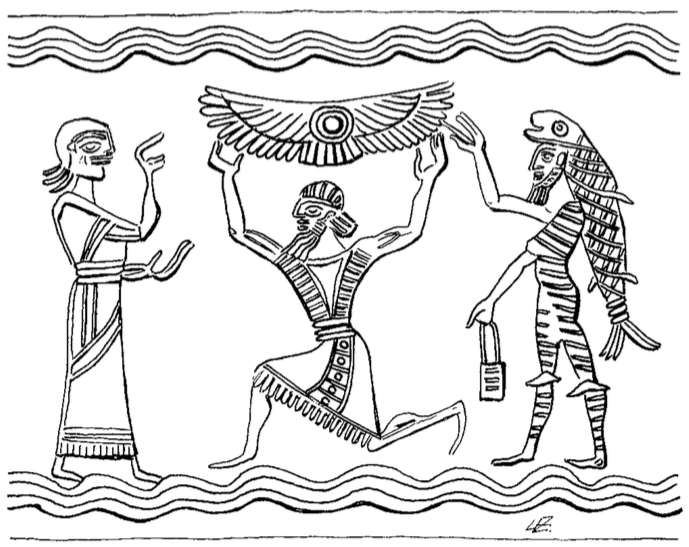
Apkallu type 2, illustration 34, Stephanie Dalley, IDD. As noted by Stephanie Dalley, the fish-cloak of the puradu-fish variant of the apkallu is worn over the naked figure or a full-length flounced robe. In this depiction the apkallu cloak, as Dalley describes it, ends just below the waist. Fishtails are apparent at the knees, and the banduddu bucket appears in its usual place, the left hand.

Apkallu type 2, illustration 34, Stephanie Dalley, IDD.
As noted by Stephanie Dalley, the fish-cloak of the puradu-fish variant of the apkallu is worn over the naked figure or a full-length flounced robe.
In this depiction the apkallu cloak, as Dalley describes it, ends just below the waist. Fishtails are apparent at the knees, and the banduddu bucket appears in its usual place, the left hand.

He is always bearded and never has wings. The fish-cloak is either worn over the naked body (33*–34*, 42*, 47–48), the typical garb of the Apkallus (40, 44*), or a full-length flounced robe (52*, 55*).
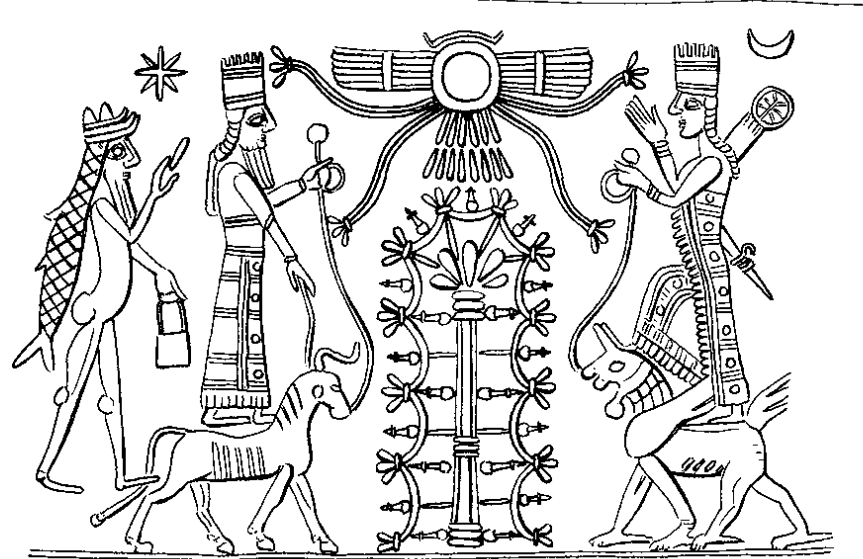
Apkallu type 2, illustration 42, Stephanie Dalley, IDD.<br />  In this depiction the type 2 apkallu is the puradu-fish variant, naked, with banduddu bucket in the left hand and an indistinct object in the right.<br />  The apkallu's horned headdress has three horns, and he appears beneath the eight-pointed star typically associated with Ištar.<br />  Portrayed in an obviously supporting role, the apkallu stands behind a deity standing upon a bull, facing another divinity, probably Ištar owing to her weaponry and stance atop what appears to be a winged lion. Atypically, the inverted crescent of the Moon god Sin appears above Ištar.<br />  Both deities hold rings in their hands and appear to hold leashes controlling their mounts.<br />  They face a central sacred tree, in a typical stylization, beneath a winged conveyance.

Apkallu type 2, illustration 42, Stephanie Dalley, IDD.
In this depiction the type 2 apkallu is the puradu-fish variant, naked, with banduddu bucket in the left hand and an indistinct object in the right.
The apkallu’s horned headdress has three horns, and he appears beneath the eight-pointed star typically associated with Ištar.
Portrayed in an obviously supporting role, the apkallu stands behind a deity standing upon a bull, facing another divinity, probably Ištar owing to her weaponry and stance atop what appears to be a winged lion. Atypically, the inverted crescent of the Moon god Sin appears above Ištar.
Both deities hold rings in their hands and appear to hold leashes controlling their mounts.
They face a central sacred tree, in a typical stylization, beneath a winged conveyance.
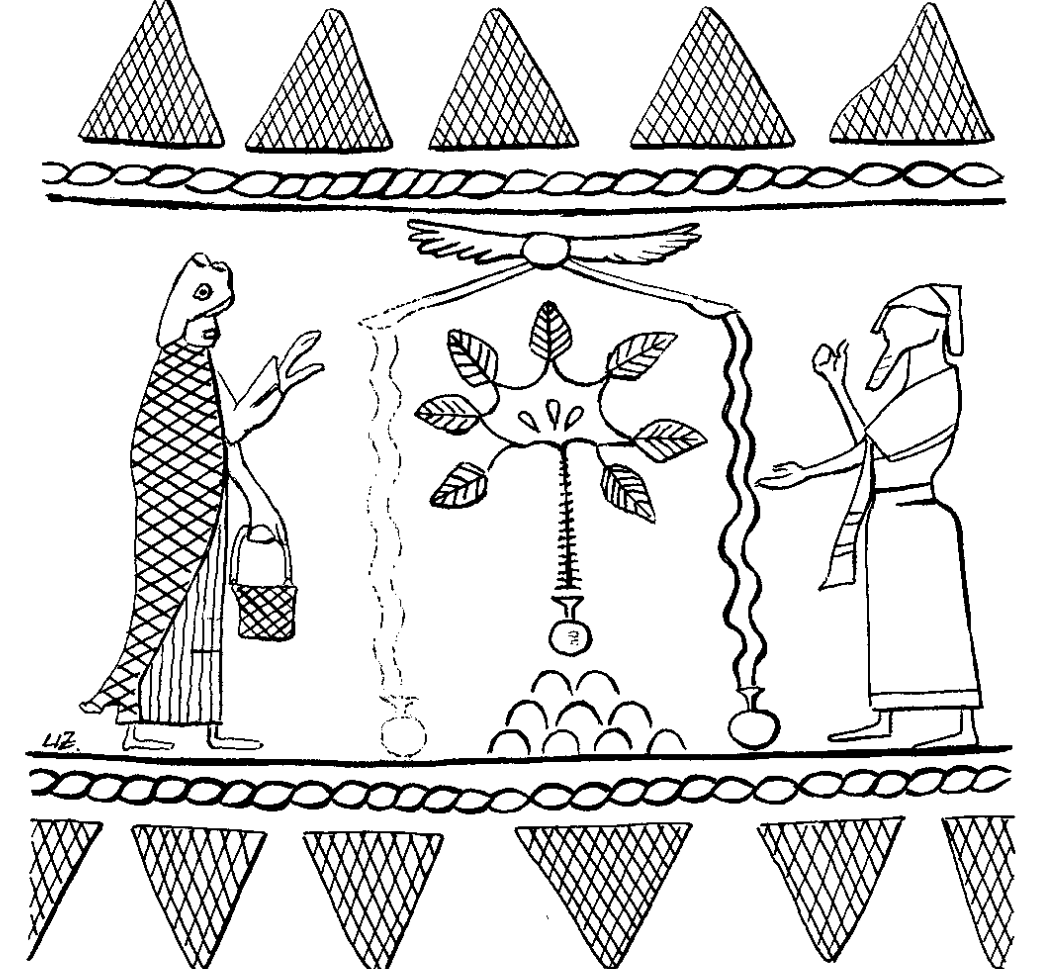
Apkallu type 2, illustration 52, Stephanie Dalley, IDD.<br />  The puradu-fish variant apkallu in this illustration wears a full-length fish cloak. This apkallu appears to be beardless, despite Dalley's assertion that type 2 apkallu are never portrayed without beards, and he raises his right hand in the classic gesture of exorcism, though no cone is apparent. The banduddu bucket is in his left hand.<br />  An indistinct but bearded figure faces the apkallu from the right, with an irregular depiction of the sacred tree in the center.<br />  While the water flowing down into jugs from the winged conveyance at the top is seen in other examples, the sacred tree in this illustration is perhaps unique in design, depicting leaves.<br />  It is possible that this plant is not a sacred tree at all. Or it could be a sacred tree, but portrayed differently.

Apkallu type 2, illustration 52, Stephanie Dalley, IDD.
The puradu-fish variant apkallu in this illustration wears a full-length fish cloak. This apkallu appears to be beardless, despite Dalley’s assertion that type 2 apkallu are never portrayed without beards, and he raises his right hand in the classic gesture of exorcism, though no cone is apparent. The banduddu bucket is in his left hand.
An indistinct but bearded figure faces the apkallu from the right, with an irregular depiction of the sacred tree in the center.
While the water flowing down into jugs from the winged conveyance at the top is seen in other examples, the sacred tree in this illustration is perhaps unique in design, depicting leaves.
It is possible that this plant is not a sacred tree at all. Or it could be a sacred tree, but portrayed differently.

On some Late Bronze Age items the fish-cloak is full-length (52*) or ends just below the waist (34* ). The latter type is also attested on some 9th/8th cent. depictions (48, 55*; but not 64), and reaches almost to the ground on representations of the 8th/7th cent. (35, 38, 45–46, 49–51, 53–54, 58–62*).

Apkallu type 2, illustration 62, Stephanie Dalley, IDD.<br />  Dalley notes the forked beard on this paradu-fish apkallu.<br />  In all other respects, this apkallu is representative of the clay figurines which were buried in foundation boxes for apotropaic purposes.<br />  Indeed, it has to be wondered whether Dalley is astray when she describes the fish details as a cloak. Depictions like this one are clearly of a composite figure.<br />  The apkallu does not appear to be wearing a garment, as it is often portrayed elsewhere. <br />  Finally, Dalley cites this illustration as an example which includes horns, or a horned headdress. I see no horns in this case.

Apkallu type 2, illustration 62, Stephanie Dalley, IDD.
Dalley notes the forked beard on this paradu-fish apkallu.
In all other respects, this apkallu is representative of the clay figurines which were buried in foundation boxes for apotropaic purposes.
Indeed, it has to be wondered whether Dalley is astray when she describes the fish details as a cloak. Depictions like this one are clearly of a composite figure.
The apkallu does not appear to be wearing a garment, as it is often portrayed elsewhere.
Finally, Dalley cites this illustration as an example which includes horns, or a horned headdress. I see no horns in this case.

The beard is normally of the typical Assyrian shape, but is forked on 57 – 58, and 62*. The fish-cloak Apkallu rarely has two daggers tucked in at his waist (55* ).

A fish-apkallu drawn by A.H. Layard from a stone relief, one of a pair flanking a doorway in the Temple of Ninurta at Kalhu. This example is identical to illustration 55 in Dalley's article on the apkallu, which she cites for the dual daggers in his waistband. British Museum. 

Reproduced in Schlomo Izre'el, Adapa and the South Wind: Language Has the Power of Life and Death, Eisenbrauns, 2001.

 https://books.google.co.th/books?id=MbwwROVGl7UC&pg=PA3&source=gbs_selected_pages&cad=3#v=onepage&q&f=false

A fish-apkallu drawn by A.H. Layard from a stone relief, one of a pair flanking a doorway in the Temple of Ninurta at Kalhu.
This example is identical to illustration 55 in Dalley’s article on the apkallu, which she cites for the dual daggers in his waistband.
British Museum. 

Reproduced in Schlomo Izre’el, Adapa and the South Wind: Language Has the Power of Life and Death, Eisenbrauns, 2001.


https://books.google.co.th/books?id=MbwwROVGl7UC&pg=PA3&source=gbs_selected_pages&cad=3#v=onepage&q&f=false

Occasionally the fish-cloak Apkallu wears a horned crown with a single pair of horns, shown between his brow and the fish-head, indicating the status of a minor divinity (56, 59, 62*).

Associations.

The fish-cloak Apkallu is associated with water (33*, 40, 63) and with mermen whose upper body is human, the lower half a fish; this is the kulullû who fights in Tiamat’s army in the Epic of Creation (44*, 51, 63).
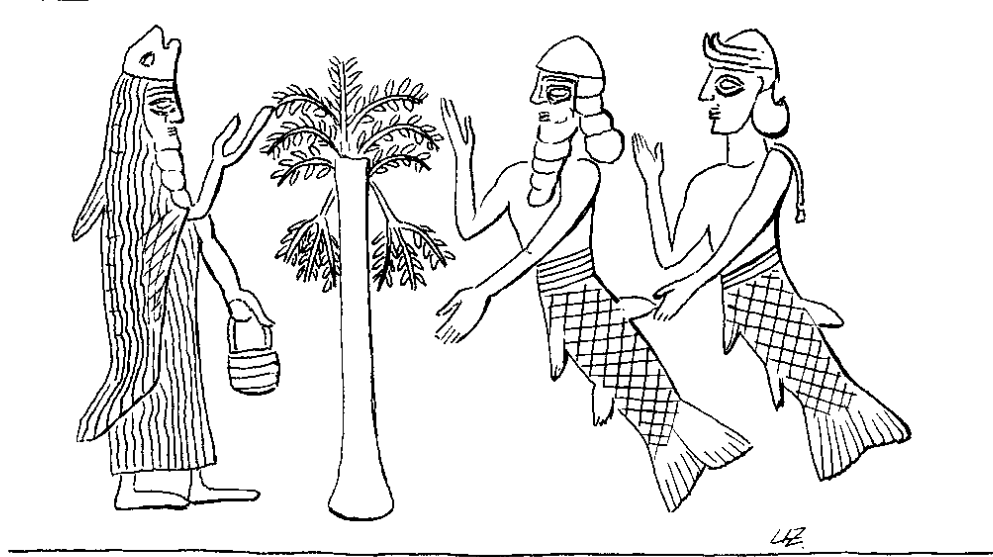
Apkallu type 44.<br />  Stephanie Dalley, IDD.<br />  A puradu-fish apkallu appears to the left of the sacred tree, with two fish-men, apparently a merman and a mermaid, on the right.<br />  Wiggermann identified these composite mermen and mermaids as kullulu from textual sources.

Apkallu type 44.
Stephanie Dalley, IDD.
A puradu-fish apkallu appears to the left of the sacred tree, with two fish-men, apparently a merman and a mermaid, on the right.
Wiggermann identified these composite mermen and mermaids as kullulu from textual sources.

The fish-cloak Apkallu is found with the goat-fish, symbol of Ea (47–48, 50*); appears together with deities (40, 42*, 45–46, 48); next to a sacred tree (44* ), which is often surmounted by a winged disc (38, 42*–43, 49, 52*); with a winged disc alone supported by a kneeling figure (33*–34*); or with a priest (63 ).

Apkallu type 2, illustration 41, Stephanie Dalley, IDD.<br />  Stephanie Dalley observes that the apkallu in this illustration "may function as a filling motif in a scene with an offerings table and divine symbols."<br />  Indeed the apkallu is not the focus of this illustration at all, which appears to portray a king (or a divinity?) receiving the blessings of a beardless priest with what appears to be a whisk in his raised left hand.<br />  The king, or divinity, wears a horned cap with three tusks at the apex.<br />  This illustration is significant for its repetitive eight-rayed stars, evocative of Ištar. The seven heavenly entities of Mesopotamian cosmogony are portrayed as small circles. The god in the winged conveyance is generally considered a reference to Aššur or Marduk, though he displays the sun disc of Shamash. The inverted crescent of the Moon god Sin, and the wedge mounted upon a stand, which I believe represents Nabu, complete the upper register.<br />  On this wedge symbol, Wiggermann, The Mesopotamian Pandemonium, 2011, is mute.

Apkallu type 2, illustration 41, Stephanie Dalley, IDD.
Stephanie Dalley observes that the apkallu in this illustration “may function as a filling motif in a scene with an offerings table and divine symbols.”
Indeed the apkallu is not the focus of this illustration at all, which appears to portray a king (or a divinity?) receiving the blessings of a beardless priest with what appears to be a whisk in his raised left hand.
The king, or divinity, wears a horned cap with three tusks at the apex.
This illustration is significant for its repetitive eight-rayed stars, evocative of Ištar. The seven heavenly entities of Mesopotamian cosmogony are portrayed as small circles. The god in the winged conveyance is generally considered a reference to Aššur or Marduk, though he displays the sun disc of Shamash. The inverted crescent of the Moon god Sin, and the wedge mounted upon a stand, which I believe represents Nabu, complete the upper register.
On this wedge symbol, Wiggermann, The Mesopotamian Pandemonium, 2011, is mute.

He may function as a filling motif (sic) in a scene with an offerings table and divine symbols (41*), and in a contest scene in which a hero dominates winged scorpion men, a composite being which fights in Tiamat’s army in the Epic of Creation (50*).
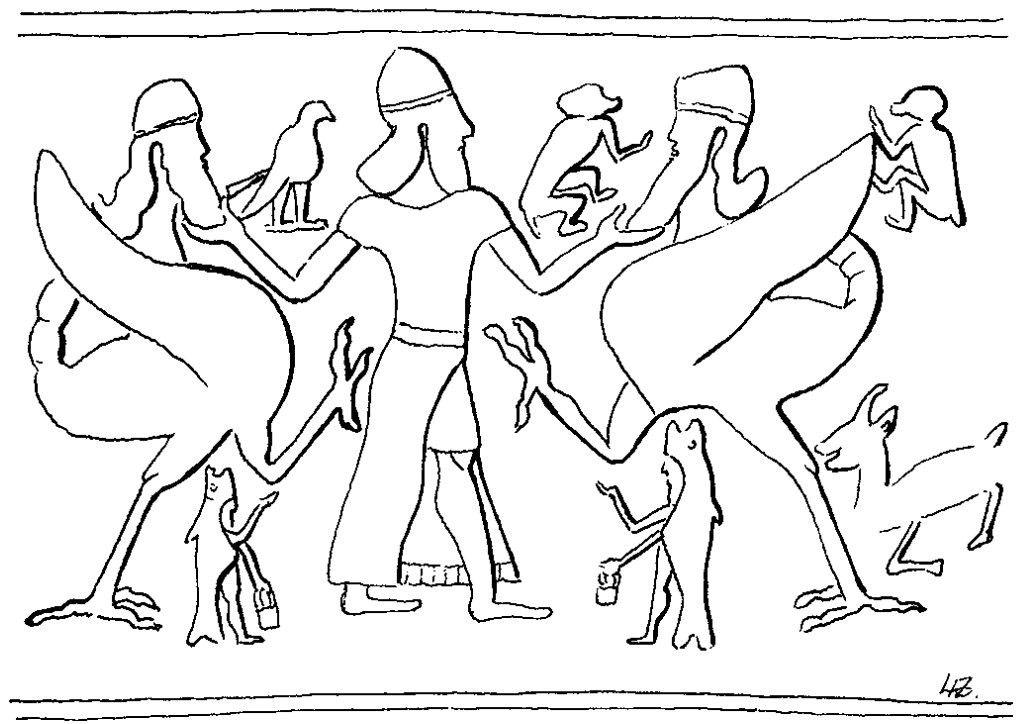
Apkallu type 2, illustration 50, Stephanie Dalley, IDD. Another example of puradu-fish apkallu as a filling motif in Dalley's reference to a

Apkallu type 2, illustration 50, Stephanie Dalley, IDD.
Another example of puradu-fish apkallu as a filling motif in Dalley’s reference to a “contest scene in which a hero dominates winged scorpion men,” composite beings which fought “in Tiamat’s army in the Epic of Creation.”
Scorpion men are actually attested often in Mesopotamian art.
Wiggermann and Green call this composite being “Scorpion-tailed bird-man.” He has a human upper torso, an avian body, and a scorpion tail.
In this drawing from Dalley’s article on the Apkallu, puradu-fish apkallu can be seen beneath them.
Anthony Green, “Mischwesen. B,” Reallexikon der Assyriologie, 1994, pp. 254-5. figure 15.

Three exceptional pieces are described here in more detail. The fish-cloak Apkallu is depicted on Lamashtu-amulets as a mirror-image pair standing at a sick man’s bed (35).

A depiction of the underworld, or alternatively, a portrayal of an exorcism. Wiggermann identifies Pazuzu appearing at the top, leering over a top register which contains the eight-pointed star of Ishtar, the inverted half-moon crescent of the Moon God Sin, and the lamp of Nusku. The seven celestial objects of Babylonian cosmogony are at far right, above Nusku's lamp. Earlier analysts identified the leering monster as Nergal. In the second register, seven exemplars of the Mesopotamian pandemonium appear to support the heavens. These composite creatures include ugallu, lion headed monsters with an apotropaic function, among others. The middle register could portray burial rites for new arrivals in the underworld, presided over by two fish-apkallū, or the scene could be a typical exorcism for apkallu, who played a role in banishing demons from the ill. In this register Wiggermann identifies the lion headed monsters as ugallu and the human-appearing entity as Lulal, a “minor apotropaic god.” The lower register may depict the goddess Allat, or Ereshkigal, sister of Ishtar, who reigns in the underworld. She kneels upon a horse or a donkey, which appears to be oppressed by her burden, in a boat which floats upon the waters of life. Note the lion pups suckling at her breast. Wiggermann prefers Lamaštu, and considers this 1st millennium amulet a portrayal of a Lamaštu exorcism. Drawn by Faucher-Gudin, from a bronze plaque of which an engraving was published by Clermont-Ganneau. The original, which belonged to M. Péretié, is now in the collection of M. de Clercq. http://www.gutenberg.org/files/17323/17323-h/17323-h.htm#linkBimage-0039

A depiction of the underworld, or alternatively, a portrayal of an exorcism.
Wiggermann identifies Pazuzu appearing at the top, leering over a top register which contains the eight-pointed star of Ishtar, the inverted half-moon crescent of the Moon God Sin, and the lamp of Nusku. The seven celestial objects of Babylonian cosmogony are at far right, above Nusku’s lamp. Earlier analysts identified the leering monster as Nergal.
In the second register, seven exemplars of the Mesopotamian pandemonium appear to support the heavens. These composite creatures include ugallu, lion headed monsters with an apotropaic function, among others.
The middle register could portray burial rites for new arrivals in the underworld, presided over by two fish-apkallū, or the scene could be a typical exorcism for apkallu, who played a role in banishing demons from the ill.
In this register Wiggermann identifies the lion headed monsters as ugallu and the human-appearing entity as Lulal, a “minor apotropaic god.”
The lower register may depict the goddess Allat, or Ereshkigal, sister of Ishtar, who reigns in the underworld. She kneels upon a horse or a donkey, which appears to be oppressed by her burden, in a boat which floats upon the waters of life.
Note the lion pups suckling at her breast. Wiggermann prefers Lamaštu, and considers this 1st millennium amulet a portrayal of a Lamaštu exorcism.
Drawn by Faucher-Gudin, from a bronze plaque of which an engraving was published by Clermont-Ganneau.
The original, which belonged to M. Péretié, is now in the collection of M. de Clercq.
http://www.gutenberg.org/files/17323/17323-h/17323-h.htm#linkBimage-0039
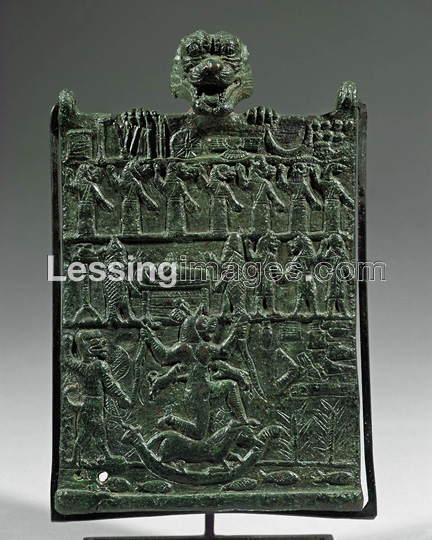
This is the actual bronze frieze of the illustration above, held in the collection of the Louvre as AO 22205.

This is the actual bronze frieze of the illustration above, held in the collection of the Louvre as AO 22205.

The unpublished Assyrian or Babylonian amulet-seal 63 shows a god in a winged disc above a sacred tree, which is flanked by mermen.

Approaching from the left is a priest in a tall headdress followed by the fish-cloak Apkallu, approaching a mushhushshu-dragon that bears on its back symbols of Marduk and Nabu.
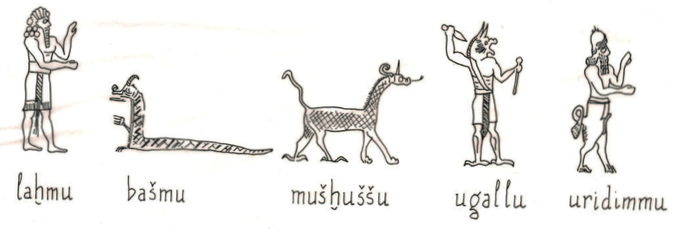
Five monsters from The Mesopotamian Pandemonium (SMSR 77, 2 / 2011) courtesy of F.A.M. Wiggermann. The Akkadian mušhuššu derives from the Sumerian muš-huš,

Five monsters from The Mesopotamian Pandemonium (SMSR 77, 2 / 2011) courtesy of F.A.M. Wiggermann.
The Akkadian mušhuššu derives from the Sumerian muš-huš, “fearsome serpent,” or “snake-dragon,” an apotropaic “companion of certain gods and their ally against evil.”
F.A.M. Wiggermann, Mušhuššu, Reallexikon der Assyriologie (RLA), 1989, p. 456.

A stone tank for water, found at Assur and inscribed by Sennacherib (704-681 BCE) (40), represents the Apsu and shows repeated fish-cloak Apkallus holding cone and bucket pointing the cone toward a figure holding an overflowing vase, sculptured around the sides.

This water basin carved from a solid block of basalt was found in Nineveh near the temple of Ishtar. It is decorated with reliefs of apkallu – puradu-fish antediluvian sages. (Pergamon Museum, Berlin)

 http://www.arcalog.com/image-library/museums/assyria/sennacherib/

This water basin carved from a solid block of basalt was found in Nineveh near the temple of Ishtar. It is decorated with reliefs of apkallu – puradu-fish antediluvian sages.
(Pergamon Museum, Berlin)


http://www.arcalog.com/image-library/museums/assyria/sennacherib/

This example possibly represents the sages as priests of Ea in Eridu in the Babylonian tradition. These contexts related to water are not found on Assyrian palace sculpture or ivory carving, and may belong to a Babylonian rather than an Assyrian tradition.

No Akkadian word for this type has been identified. In BARNETT 1998: pls. 360- 361 it is misleadingly described as being the god Dagon.”

Stephanie Dalley, “Apkallu,” Iconography of Deities and Demons in the Ancient Near East (IDD), Swiss National Science Foundation, University of Zurich, 2011 (text updated 2011 and illustrations updated 2007), p. 3/7.
Kvanvig: Bīt Mēseri and the Adapa Myth

“The exact form and meaning of the name of the first apkallu is not easy to decide. There are several reasons for this. On the one hand there seems to be a connection in the cuneiform sources between Uan as the name is given in the Uruk tablet and Bīt Mēseri, and the Adapa known from the myth.

Second, there is a connection between the name as attested in cuneiform sources and the Greek name Oannes in Berossos.

Third, there is a combined name that first seems to appear in the Catalogue of Texts and Authors I, 6, “ūma-an-na a-da-pà, which seems to play on both Uan and adapa (sic) in some mysterious way.

Fourth, there is a connection in the meaning of the name and the fate, related to the seventh apkallu, Utuabzu, and the first apkallu, Uan.

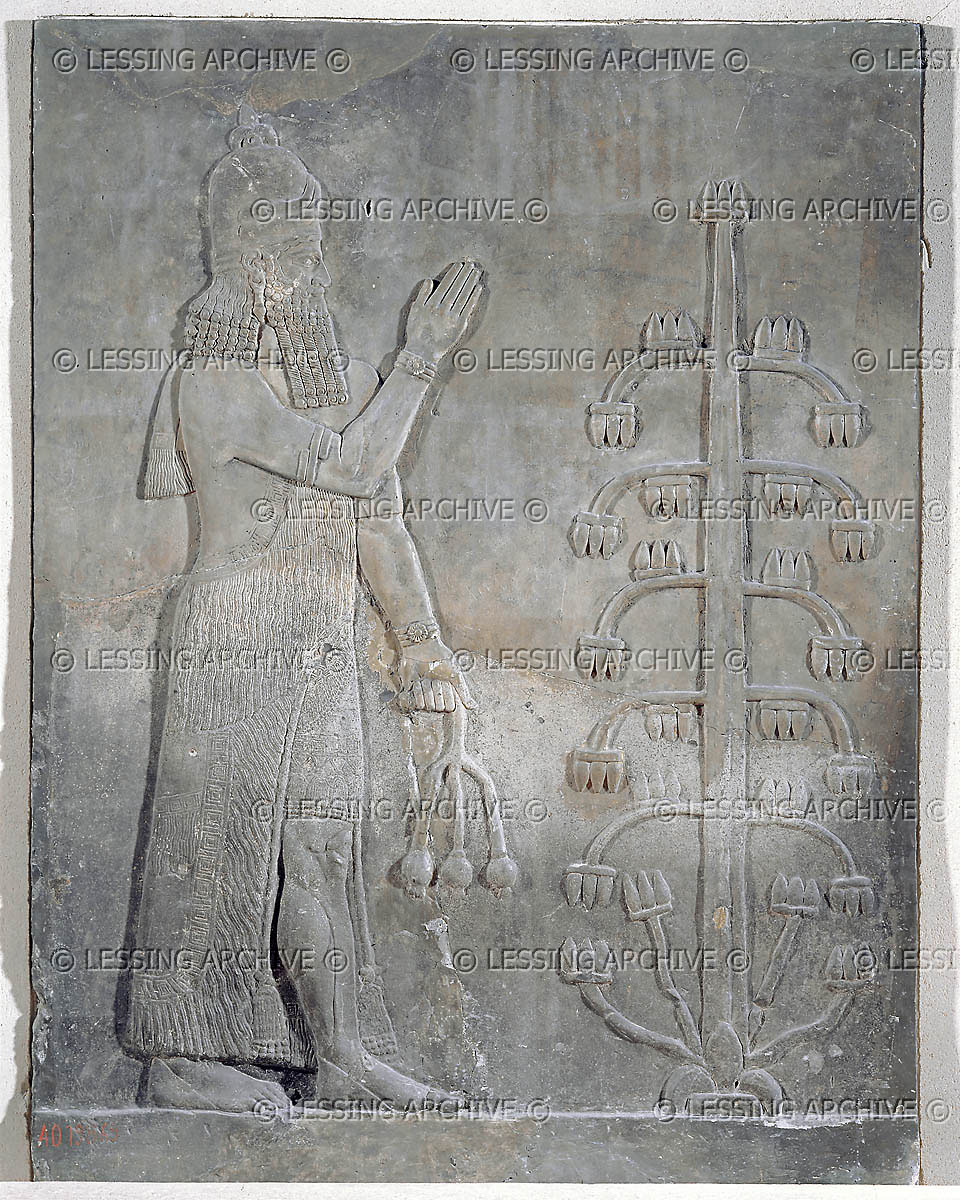
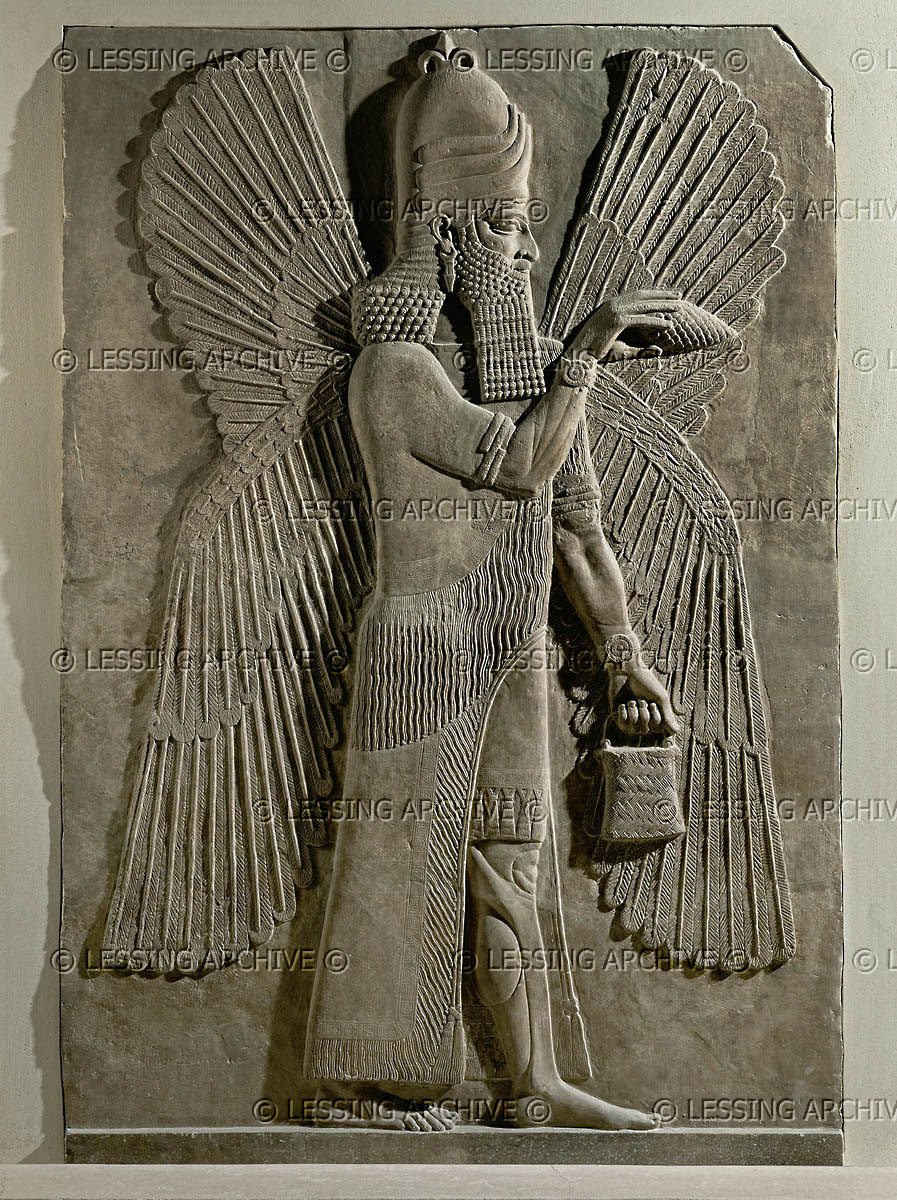
Now compare this Nimrud bas relief from the Louvre: an ummânū sprinkles water with a mullilu cone in his right hand, holding his banduddu bucket in his left. This ummânū wears bracelets with a concentric circular design, and rosettes are not apparent. This ummânū also wears the common horned headdress of Anu, but with three stacked layers of horns. As noted elsewhere, this headdress is surmounted by an object that resembles a partial fleur de lis. From Nimrud, capital of king Ashurnarzipal.  Louvre, AO 19845

Now compare this Nimrud bas relief from the Louvre: an ummânū sprinkles water with a mullilu cone in his right hand, holding his banduddu bucket in his left.
This ummânū wears bracelets with a concentric circular design, and rosettes are not apparent.
This ummânū also wears the common horned headdress of Anu, but with three stacked layers of horns.
As noted elsewhere, this headdress is surmounted by an object that resembles a partial fleur de lis.
From Nimrud, capital of king Ashurnarzipal.
Louvre, AO 19845

To the first issue, R. Borger, supported by F. Wiggermann, has claimed that Adapa from the myth and Uan from the lists were originally two separate figures. If this is the case, we first have to explain the meaning of the short form of the name, i.e. Uan, then the combination with adapu.

The short name form, Uan, in the two cuneiform lists is most easy (sic) explained as a Sumerian genitive, simply meaning “Light of An.” Since An is written with the Sumerian determinative for “god,” An is here the god of heaven.

Given the general and somewhat vague resemblances between the cuneiform and Greek names, we think Uan alone very well could form the background for Oannes in Berossos. Lambert has called attention to the fact that in a list of adjectives for “wise” the Sumerian ù.tu.a.an.ba, “born in the water,” is equated with a-da-pu.

The same Akkadian word is used in a royal prayer in which the king speaks of himself as “your wise (a-da-pà) slave.”  This could point in the direction that Uan is the proper name and adapu is an epithet designating Uan as “wise.” It is, however, difficult to equate myths with lexical texts and draw certain conclusions.

Reading the Adapa Myth from the Old Babylonian period clearly evokes the impression that Adapa was a proper name, and this proper name of the foremost wise among humans (sic) could very well have caused the use of the name as an epithet.

Finally compare this representation. Wings are missing. The horned headdress has two levels of horns, and is again surmounted with what appears to be a fleur-de-lis.  Like other examples, this figure holds what appear to be poppy bulbs, and raises his right hand in the greeting gesture.  Bracelets with rosettes are present, as are armlets on the upper arms.  The sacred tree before the figure varies from other depictions, as well.  It is not certain that this figure depicts an ummânū at all. It could portray a king. The lack of wings is clearly deliberate.  Bas-relief, Louvre, AO 19869

Finally compare this representation. Wings are missing. The horned headdress has two levels of horns, and is again surmounted with what appears to be a fleur-de-lis.
Like other examples, this figure holds what appear to be poppy bulbs, and raises his right hand in the greeting gesture.
Bracelets with rosettes are present, as are armlets on the upper arms.
The sacred tree before the figure varies from other depictions, as well.
It is not certain that this figure depicts an ummânū at all. It could portray a king. The lack of wings is clearly deliberate.
Bas-relief, Louvre, AO 19869

(Cf. the discussion in S. Izre’el, Adapa and the South Wind. Language Has the Power of Life and Death, ed. J.S. Cooper, vol. 10, Mciv. Winona Lake 2001, 1-2.)

The combined name “‘ūma-an-na a-da-pà (sic) is a riddle. Adapa at the end can be part of the name, or it can be an epithet, “the wise one;” if so the real name is ūmanna. This name does not tell us anything, except that it could be an odd spelling of ummānu, “craftsman or scholar.” But why should the foremost sage, designated apkallu, bear a name similar to an expert of lower rank?

This points in the direction that both words belong together in the name. We see that the only element in the first name that separates from the name of the first sage in the Akkadian lists is the nasalization of u in um, umanna instead of uanna.

Why this is done is hard to figure out. It could have been to create a pun between the primeval Uan, “the light of heaven,” patron of the scholars, and these succeeding scholars, designated as ummānū.

In any case the proper name of the primary sage in the Catalogue would be Uanadapa, a combination of the first apkallu Uan from the lists and Adapa from the myth.”

Helge Kvanvig, Primeval History: Babylonian, Biblical, and Enochic: An Intertextual Reading, Brill, 2011, pp. 117-9.