
Samizdat

Publishing the Forbidden. All Rights Reserved. © Samizdat 2014-2025.

Category: 700 BCE

Gane: Composite Beings in Neo-Babylonian Art

“An examination of all the extant, provenanced depictions of composite beings, Mischwesen, in Neo-Babylonian (NB) iconography sheds important new light on the worldview of the last great Mesopotamian civilization.

Wall relief depicting a winged and eagle-headed Apkallu (Sage). This protective spirit holds a cone and a bucket for religious ceremonial purposes. From the North-West Palace of Ashurnasirpal II at Nimrud (Biblical Calah; ancient Kalhu), modern day Ninawa Governorate, Iraq (Mesopotamia). Neo-Assyrian period, 865-850 BCE. The British Museum, London. Photo by Osama Shukir Muhammed Amin. This file is licensed under the Creative Commons Attribution-Share Alike 4.0 International license. https://commons.wikimedia.org/wiki/File:Wall_relief_depicting_an_eagle-headed_and_winged_man,_Apkallu,_from_Nimrud..JPG

Wall relief depicting a winged and eagle-headed Apkallu (Sage). This protective spirit holds a cone and a bucket for religious ceremonial purposes.
From the North-West Palace of Ashurnasirpal II at Nimrud (Biblical Calah; ancient Kalhu), modern day Ninawa Governorate, Iraq (Mesopotamia). Neo-Assyrian period, 865-850 BCE.
The British Museum, London.
Photo by Osama Shukir Muhammed Amin.
This file is licensed under the Creative Commons Attribution-Share Alike 4.0 International license.
https://commons.wikimedia.org/wiki/File:Wall_relief_depicting_an_eagle-headed_and_winged_man,_Apkallu,_from_Nimrud..JPG

The types of hybrids that are portrayed include such disparate forms as the apkallu and the genius in human form, as well as creatures based on bulls, lions, canines, winged quadrupeds, fish, birds, scorpions, and snakes.

Demons, monsters, and minor apotropaic deities, from Jeremy Black and Anthony Green, Demons & Symbols of Ancient Mesopotamia, 1992, p. 64. https://books.google.co.th/books?id=pr8-i1iFnIQC&redir_esc=y

Demons, monsters, and minor apotropaic deities, from Jeremy Black and Anthony Green, Demons & Symbols of Ancient Mesopotamia, 1992, p. 64.
https://books.google.co.th/books?id=pr8-i1iFnIQC&redir_esc=y

Each composite being is analyzed in terms of its physical components, its context within scenes, its historical development, and its interpretation in NB texts.

Within the hierarchical cosmic community, some lower deities and sub-divine beings appear in composite form. These play a key role in the cosmos by interacting with gods, with each other, with humans, and with natural animals.

Their behavior parallels dynamics found in natural life, such as in competition, conflict, predation, protection, and in the service of others who are more powerful.

In hybrids the capabilities of natural animals and humans are heightened by the selective addition of features derived from other species. There is no consistent correlation, however, between the strength of a natural creature and the relative power of the superhuman being that it symbolizes, or between its physical complexity and its placement in the cosmic hierarchy.

Pazuzu: a demon-god of the underworld, sometimes invoked for beneficial ends. The inscription covering the back of his wings states: "I am Pazuzu, son of Hanpa, king of the evil spirits of the air which issue violently from mountains, causing much havoc.” <br />  Pazuzu was particularly associated with the west wind which brought the plague. Under certain circumstances Pazuzu was a protective spirit, particularly to drive his wife Lamashtu back to the underworld. Lamashtu was a demoness who infected men with various diseases.<br />  Pazuzu first appeared in the 1st millennium BC with the body of a man and the head of a scowling dragon-snake, with two pairs of wings and talons of a bird of prey. He has a scorpion's tail and his body is covered in scales.<br />  http://wayback.archive.org/web/20090628125910/<br />  http://www.louvre.fr/llv/oeuvres/detail_notice.jsp?CONTENT%3C%3Ecnt_id=10134198673225951&amp;CURRENT_LLV_NOTICE%3C%3Ecnt_id=10134198673225951&amp;FOLDER%3C%3Efolder_id=9852723696500800&amp;baseIndex=56&amp;bmLocale=en<br />  Bronze statuette of Pazuzu, circa 800 BC –- circa 700 BC, Louvre Museum.

Pazuzu: a demon-god of the underworld, sometimes invoked for beneficial ends. The inscription covering the back of his wings states: “I am Pazuzu, son of Hanpa, king of the evil spirits of the air which issue violently from mountains, causing much havoc.”
Pazuzu was particularly associated with the west wind which brought the plague. Under certain circumstances Pazuzu was a protective spirit, particularly to drive his wife Lamashtu back to the underworld. Lamashtu was a demoness who infected men with various diseases.
Pazuzu first appeared in the 1st millennium BC with the body of a man and the head of a scowling dragon-snake, with two pairs of wings and talons of a bird of prey. He has a scorpion’s tail and his body is covered in scales.
http://wayback.archive.org/web/20090628125910/
http://www.louvre.fr/llv/oeuvres/detail_notice.jsp?CONTENT%3C%3Ecnt_id=10134198673225951&CURRENT_LLV_NOTICE%3C%3Ecnt_id=10134198673225951&FOLDER%3C%3Efolder_id=9852723696500800&baseIndex=56&bmLocale=en
Bronze statuette of Pazuzu, circa 800 BC –- circa 700 BC, Louvre Museum.

In fact, the transcendence of high gods is often emphasized by their simple representation through attribute animals in natural form.

Ishtar receives the worship of an Amazon. Ishtar stands on a lion, holding a bow with arrows at her back. Her eight-pointed star is atop her head. Lusty antelopes rear on the right side, perhaps signifying the god Ea. The portrayal of the tree is somewhat problematic, as it differs from the iconic depictions of the sacred tree common in Neo-Assyrian art.

Ishtar receives the worship of an Amazon. Ishtar stands on a lion, holding a bow with arrows at her back. Her eight-pointed star is atop her head.
Lusty antelopes rear on the right side, perhaps signifying the god Ea.
The portrayal of the tree is somewhat problematic, as it differs from the iconic depictions of the sacred tree common in Neo-Assyrian art. Drawing © 2008 S. Beaulieu, after Leick, 1998: Plate 38. Used by kind permission.


Portrayals of composite beings often express the need for protection from malevolent powers by beneficent beings, some of whom can be accessed only through human mediators, such as ritual functionaries.
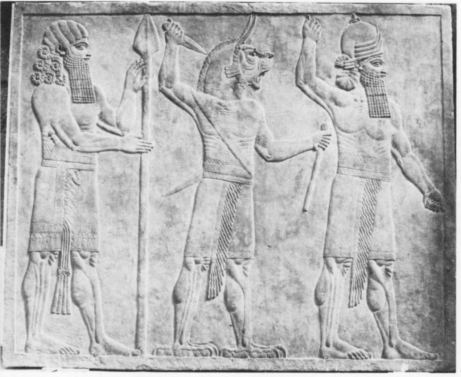
BM 118918, courtesy of the British Museum, plate XId. Green identifies the ugallu at the center, the

BM 118918, courtesy of the British Museum, plate XId.
Green identifies the ugallu at the center, the “lion-man,” and lahmu at left. He speculates that the “House god” appears at far right.
Limestone relief, one of a pair flanking a doorway in the N. Palace at Nineveh.
Previously published: H.R. Hall, Babylonian and Assyrian Sculptures in the British Museum, Pls. VI-IX; Cf. also Gadd, The Stones of Assyria, 191.

Special relationships between supernatural beings and elite humans, especially the king, make such humans indispensable and therefore support their roles in the existing social order.

It appears that the choice of a particular being portrayed on a given object could be influenced by factors such as its owner’s profession, religious and/or political affiliations, and especially by the apotropaic function(s) of specific composite beings.”

Constance Ellen Gane, Composite Beings in Neo-Babylonian Art, Doctoral Dissertation, University of California at Berkeley, 2012, p. 1.

Lenzi: A Fault Line Where Legend and History Collides

“If this were the only instance of apkallū in a ritual context, this difference in genre would be of little consequence. But, in fact, it is not.

The seven apkallū are mentioned, for example, in anti-witchcraft incantations in Maqlû II 124,36 V 110,37 VII 49,38 VIII 38 (though without names). (Note that the next line…has “the wisdom, the ingenuity of Ea they spoke.”)

They also occur in a medical incantation in LKA 146 that gives a mythological account of Ea communicating poultices to humans.

(W. G. Lambert, “The Twenty-one ‘Poultices,’” Anatolian Studies 30 (1980), 77-83. See also, e.g., Bīt rimki (Rykle Borger, “Das Dritte ‘Haus’ der Serie Bīt Rimki [VR 50-51, Schollmeyer HGS Nr.1],” Journal of Cuneiform Studies 21 [1967], 11:25 + a); the rituals treated by Wiggermann, Mesopotamian Protective Spirits; and the (overlapping) attestations noted by J. J. A. van Dijk, La Sagesse Sumero-Accadienne, Commentationes Orientales 1 (Leiden: Brill, 1953), 20, n.56.)

In this bas relief from Nimrud, human apkallū, the ummánū, kneel and tend to a sacred tree.<br />  Both ummânū wear horned tiaras and display rosette bracelets on their wrists. Bracelets are also apparent on their upper arms.<br />  In the lower register, bird-apkallū raise mulillu cones to sprinkle water in a gesture of exorcism and liberation of sin.<br />  As is typical, the banduddu buckets are in their left hands.<br />  Interestingly in this case, the bracelets are atypical, and only one rosette insignia can potentially be discerned. This sort of specificity must be deliberate. What it portends, however, remains speculative.

In this bas relief from Nimrud, human apkallū, the ummánū, kneel and tend to a sacred tree.
Both ummânū wear horned tiaras and display rosette bracelets on their wrists. Bracelets are also apparent on their upper arms.
In the lower register, bird-apkallū raise mulillu cones to sprinkle water in a gesture of exorcism and liberation of sin.
As is typical, the banduddu buckets are in their left hands.
Interestingly in this case, the bracelets are atypical, and only one rosette insignia can potentially be discerned. This sort of specificity must be deliberate. What it portends, however, remains speculative.

From such evidence Sanders has argued that the seven apkallū are restricted to myths (they are found in Erra I 162 and Gilgamesh I 21 and XI 326 (called muntalkū)) and rituals during the Neo-Assyrian period (and earlier), and this fact, in his opinion, speaks against their use in a scholarly genealogy before the Seleucid era.

(He writes, “[t]he human sages, ummânu, appear for the first time in Neo-Assyrian king lists, and in the bīt mēseri fragments of the Neo-Assyrian period the superhuman apkallū are for the first time listed by name and correlated with legendary and historical kings.

While Mesopotamian kings remain on the throne, the apkallū remain confined to myth and ritual. In the Seleucid period, after the loss of native kingship, the apkallū enter history. . . .

Evidence of a historically developing identification between the Mesopotamian ritual practitioner and the apkallū in general and Adapa in particular finally emerges in Seleucid Uruk” (Sanders, “Writing, Ritual, and Apocalypse,” 144-45).

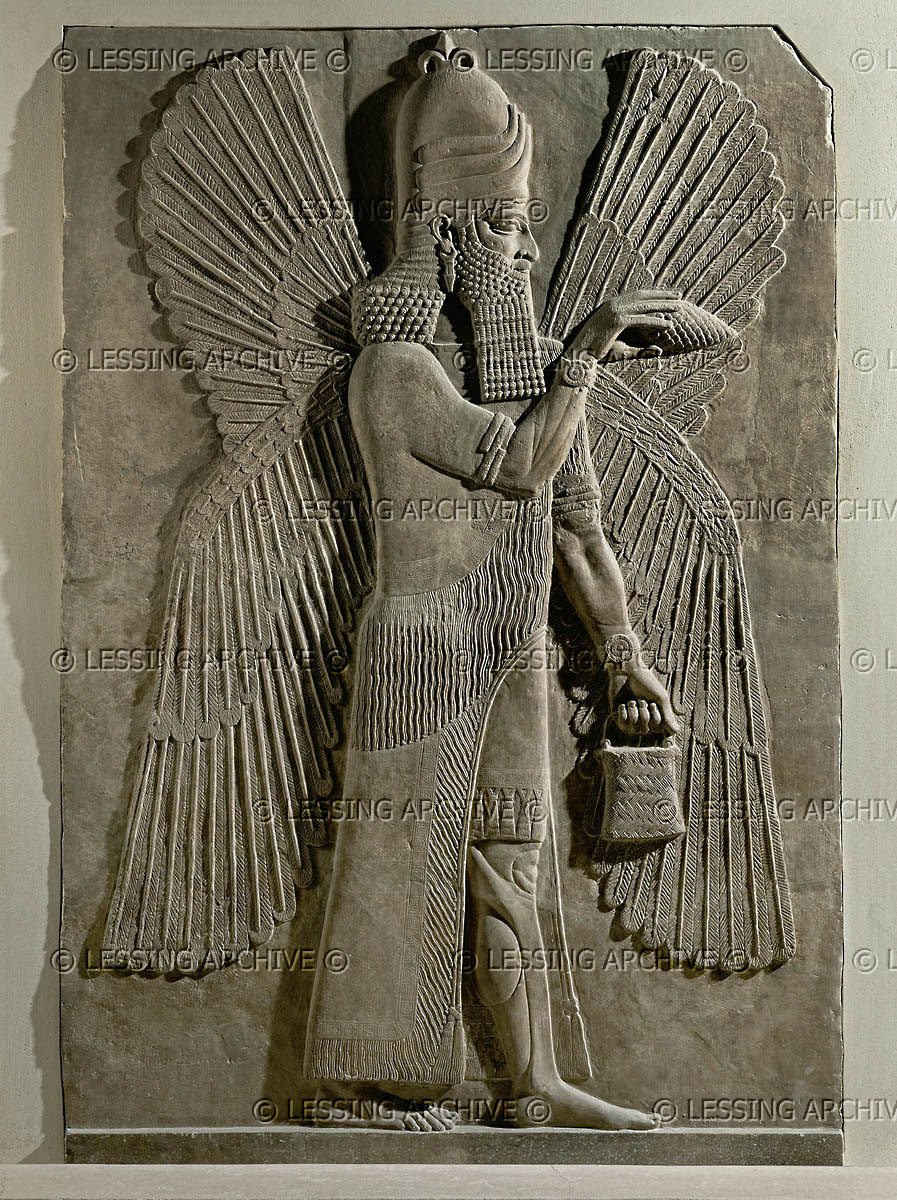
In this Nimrud bas relief from the Louvre an ummânū sprinkles water with a mullilu cone, holding his banduddu bucket in his other hand. This ummânū wears bracelets with a different design, as rosettes are not apparent. In this case, the design appears to consist of concentric circles.  This ummânū also wears the common horned headdress, but in this case the headdress is surmounted by an object that resembles a partial fleur de lis. The detail on this bas relief is unusually good, revealing details about the earrings that are blurry in most other examples.  Bracelets are also apparent on the upper arms, and the banduddu bucket reveals cross-hatching detail which rarely appears on other depictions.  The realistic portrayal of fine detail on the fingernails, the toenails, and the tassels are singular. In no other example does the embroidery on the garment stand out as well.  The fine detail on the wings and the braided hair is exceptional, and this ummânū appears to be wearing a medallion or other object at his sternum, a detail not noted elsewhere.  From Nimrud, capital of king Ashurnarzipal.  Louvre, AO 19845

In this Nimrud bas relief from the Louvre an ummânū sprinkles water with a mullilu cone, holding his banduddu bucket in his other hand.
This ummânū wears bracelets with a different design, as rosettes are not apparent. In this case, the design appears to consist of concentric circles.
This ummânū also wears the common horned headdress, but in this case the headdress is surmounted by an object that resembles a partial fleur de lis.
The detail on this bas relief is unusually good, revealing details about the earrings that are blurry in most other examples.
Bracelets are also apparent on the upper arms, and the banduddu bucket reveals cross-hatching detail which rarely appears in other depictions.
The realistic portrayal of fine detail on the fingernails, the toenails, and the tassels is singular. In no other example does the embroidery on the garment stand out so well.
The fine detail on the wings and the braided hair is exceptional, and this ummânū appears to be wearing a medallion or other object at his sternum, a detail not noted elsewhere.
From Nimrud, capital of king Ashurnarzipal.
Louvre, AO 19845

Sanders’ objection reminds us of the need for sensitivity to genre in adducing evidence, something few others have taken seriously when discussing the issue of scholarly genealogy.

There is, however, other non-ritual evidence that both alleviates the problem he raises and provides more support for the earlier apkallūummânū association suggested by the Bīt mēseri material.

A textual variant between the only two manuscripts of the Akkadian literary composition “Advice to a Prince,” which is clearly a non-ritual text, supports the close association of the apkallū and ummânū in the early first millennium. A comparison of the two tablets at lines 4 and 5 reveals our variant of interest.

(In the standard edition of the text, Lambert expresses the opinion that the text is from Babylon and should be dated to roughly 1000 to 700 BCE. He also notes, “(t)he text is written on a tablet from the libraries of Assurbanipal [i.e., DT 1], and no duplicate has yet been found” (W. G. Lambert, Babylonian Wisdom Literature [Oxford: Oxford University Press, 1960; reprinted, Winona Lake: Eisenbrauns, 1996], 110, 111).

Steven Cole has recently published a duplicate to DT 1 (Nippur IV. The Early Neo-Babylonian Governor’s Archive from Nippur, Oriental Institute Publications 114 [Chicago: The Oriental Institute of the University of Chicago, 1996], no. 128 [= OIP 114 128]); the tablet was found among a cache from Nippur.)

(If) he does not listen to his sage, his days will be short.

(If ) he does not listen to (his) scholar, his land will rebel against him.

In the standard edition based on DT 1 (the Ninevite version), Lambert took the ME in NUN.ME-šú as a plural marker and read the word as rubû, “princes, nobles.” (Babylonian Wisdom Literature, 112-13.)

This is understandable in light of line 10 which sets NUN.ME alongside DI.KUD.ME (dayyānū, “judges”).

In the orthography of the latter term ME must indicate plurality. But Reiner has noted that DT 1 typically uses MES to express the plural (line 10’s DI.KUD.ME being the one indisputable exception); thus, it seemed likely to her that NUN.ME in both lines 4 and 10 should be read apkallū (singular.) (See Erica Reiner, “The Etiological Myth of the ‘Seven Sages,’” Orientalia 30 (1961), 9 and n.1.)”

Alan Lenzi, The Uruk List of Kings and Sages and Late Mesopotamian ScholarshipJANER 8.2, Brill, Leiden, 2008. pp. 146-8.