Samizdat

Publishing the Forbidden. All Rights Reserved. © Samizdat 2014-2025.

Category: 1926

Izre’el: The Tale of the Adapa Myth

“Moreover, there is further textual evidence for the identification of the two figures in the combined name u-an(-na) adapa or u-ma-a-num a-da-pa (Lambert 1962: 73-4; van Dijk 1962: 44-8; Hallo 1963: 176; Bottéro 1969-70: 106; Borger 1974: 186; Picchioni 1981: 97-101; Kvanvig 1988: 202-4; Denning-Bolle 1992: 44-5; cf. Albright 1926).

The mythological figure Adapa has, thus, two variants: one is called Uan; another is called Adapa. The myth of the seven primordial sages shares with the Berossus tradition the mytheme of emergence from water. The etymological equation between Adapa and ù.tu.a.ab.ba is related to a similar tradition, while his having ascended to heaven is perhaps recalled by the name Uan, which includes a direct reference to heaven (An).

Purādu-fish apkallū were antediluvian sages, the famous Seven Sages of Sumeria were purādu-fish. The genotype is also attested in Berossus, as the form of the mentor of mankind, Oannes.

Purādu-fish apkallū were antediluvian sages, the famous Seven Sages of Sumeria were purādu-fish.
The genotype is also attested in Berossus, as the form of the mentor of mankind, Oannes.

Thus it was Oannes-Adapa who instructed people about the ordinance of the earth. It is with this theme that the myth of Adapa and the South Wind opens.

The Story

The myth as we know it opens with a description of the background to the main narrative. This background has reached us through what is now called Fragment A, of which the very first line or lines are missing (for the find and the extant fragments, see below).

The first legible lines refer to the power of divine speech, and it is said that Ea—known to us as the Mesopotamian god of fresh water and wisdom—perfected Adapa “with great intelligence, to give instruction about the ordinance of the earth. To him he gave wisdom, he did not give him eternal life” (lines 3’-4’).

Adapa was a servant of Ea. Respected and adored by his community, he performed the chores necessary to the daily rituals, which included, among others, supplying fish from the nearby sea.

One day Adapa’s journey to the wide sea ended unexpectedly in a sudden burst of the South Wind. Adapa was plunged into the sea. Here begins the narrative as we know it from Fragment B. This fragment has some close, albeit broken, parallels in Fragment C and at the beginning of Fragment D.

Adapa, who for the first time in his life had met with some difficulty, could do nothing other than to threaten the blowing wind that he would break its wing. As soon as he uttered this threat, the wing of the South Wind broke.
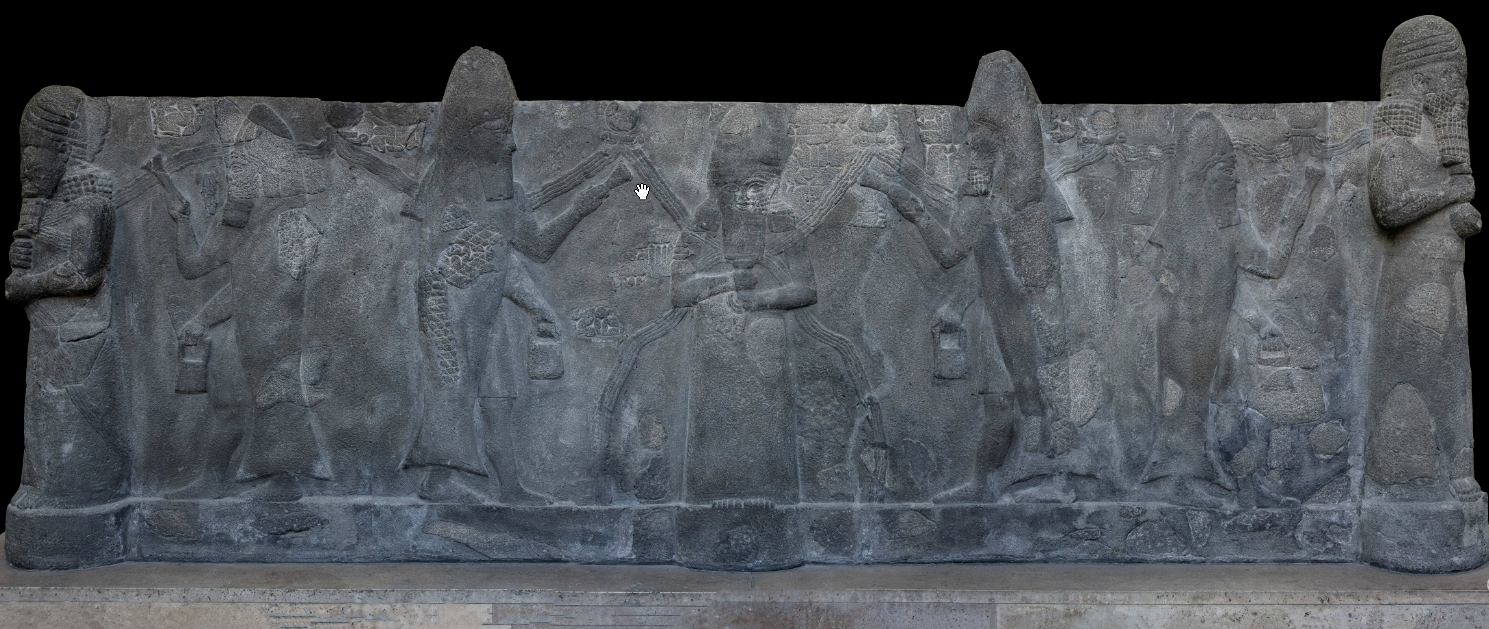
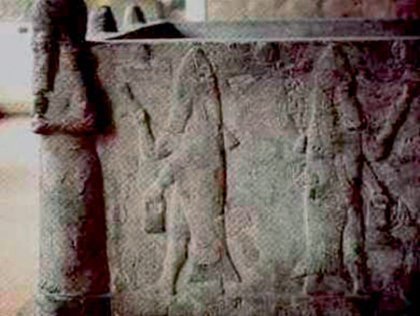
Click to zoom.<br /> A solid basalt tub recovered from outside the Temple of Ishtar at Nineveh, now in the collection of the Pergamon Museum.<br />  Ea is readily identified at the center with water flowing from his shoulders. Ea is surrounded by apkallu, puradu-fish apkallu.<br />  The puradu-fish apkallu have a fish head and fish skin flowing down their backs. They raise rectangular objects of unknown etiology in their right hands, in their traditional acts of purification and blessing. The banduddu buckets are, as usual, in their lowered left hands.<br />  This tub probably portrays the Seven Sages of antediluvian Sumeria.

Click to zoom.
A solid basalt tub recovered from outside the Temple of Ishtar at Nineveh, now in the collection of the Pergamon Museum.
Ea is readily identified at the center with water flowing from his shoulders. Ea is surrounded by apkallu, puradu-fish apkallu.
The puradu-fish apkallu have a fish head and fish skin flowing down their backs. They raise rectangular objects of unknown etiology in their right hands, in their traditional acts of purification and blessing. The banduddu buckets are, as usual, in their lowered left hands.
This tub probably portrays the Seven Sages of antediluvian Sumeria.

Nothing could be done against Adapa’s spell, and Anu, the sky god and the head of the Mesopotamian pantheon, called Adapa to task. The situation was indeed unpleasant for the disciple of Ea. Yet, a god such as Ea would not risk a meeting between his loyal servant and Anu without proper preparation.

As might be appropriate for the god of wisdom, Ea, well known also for his artful character, supplied Adapa with minute instructions that were intended to save his life. Among these were strict orders to avoid any food or drink offered to him in heaven, any of which Ea said would bring death on Adapa.

However the situation turned out to be rather different from what Adapa anticipated. While in heaven, Anu’s anger was appeased by two deities, Dumuzi and Gizzida, who were standing at the gate of heaven. Following Ea’s instructions, Adapa had paid a tribute of flattering words to them. Instead of being offered deadly food and water, he was offered the food and water of life.

Adapa refused it, and thus—at least according to one recension, recorded in Fragment B—lost a unique and irreversible chance for eternal life.

However, according to another version of the story, recorded in Fragment D, Anu seems to have shown Adapa the awesomeness of heaven and to have installed Adapa in his own rather than in Ea’s service. This fragment also adds to the myth a healing incantation that is based on the very fact that Adapa, “a seed of humankind,” succeeded in breaking the wing of the South Wind.”

Schlomo Izre’el, Adapa and the South Wind: Language Has the Power of Life and Death, Eisenbrauns, 2001, pp. 2-5.
Carolyn Nakamura on the Figurines

Mastering Matters: Magical Sense and Apoptropaic Figurine Worlds of Neo-Assyria

Introduction: Magical Figures from the Past

“When contemplating certain deposits unearthed during the excavations at Nimrud in the 1950s, Max Mallowan remarked, “this magical practice had an immensely long survival, as witness the nursery rhyme:

Four corners to my bed,
Four angels round my head,
One to watch and one to pray,
And two to bear my soul away.” (1966:226)

Mallowan’s commentary, rather typical of his time, concerned the discovery of numerous brick boxes encasing figurines made of sun-dried clay, found buried underneath the corners, thresholds, and central spaces of room floors, possibly where a bed once stood.

Excavations during the late 1800s to mid 1900s located such deposits in residences, palaces, and temples at important political and religious capitals of the Neo-Assyrian Empire, including Nimrud, Assur, Nineveh, Khorsabad and at Ur in Babylonia under Assyrian rule; they first appeared during the reign of Shalmaneser III and generally persisted up through the reign of Sin-shar-ishkun (ca. 858–612 B.C.).

One can imagine an excavator’s delight in finding such deposits, and there was apparently considerable competition and excitement surrounding their discovery and unveiling (Oates and Oates 2001:253–254).

But, locating such boxes did not always promise the discovery of figurines. Numerous “empty” brick boxes contained nothing more than a thick layer of sandy material, possibly remnants of decomposed organic matter such as wood or food.

Deposits from Ur contained offerings of animal bones, remnants of grain and a pottery sherd along with the clay figures (Woolley 1926:692). And at Assur, some of the buried boxes entombed miniature bronze weapons (Rittig 1977).

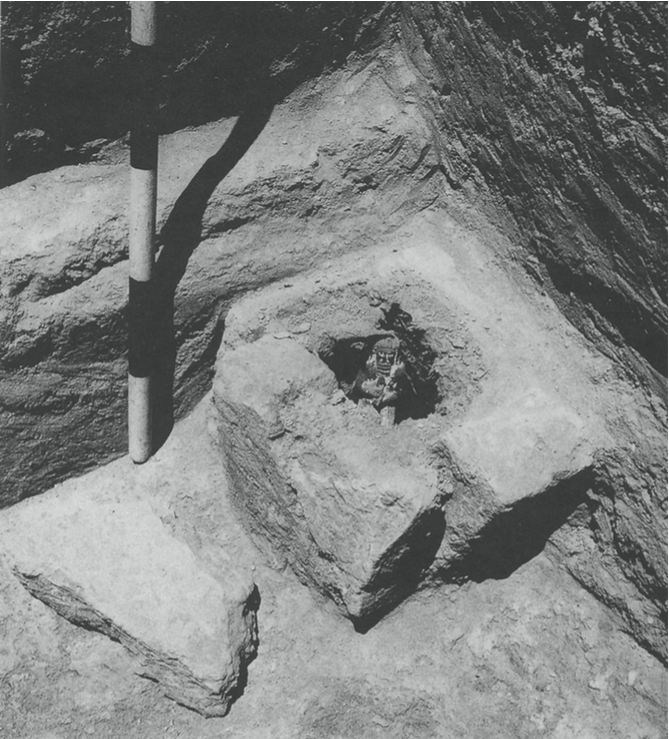
But perhaps the most curious finds were the figurines of “warrior” men, mythological fish- and bird-apkallū sages, human-beast hybrids, horned snakes, and other fantastical beings (Figure 2.1).

Apotropaic figurine deposit found in room S57 of Fort Shalmaneser at Nimrud. Adapted from Curtis and Read (1995:112).

Apotropaic figurine deposit found in room S57 of Fort Shalmaneser at Nimrud. Adapted from Curtis and Read (1995:112).

Generally, such deposits comprised one, two, or seven figurines standing “at attention” in boxes facing in toward the center of the room.

These deposits, not simply buried but concealed and contained, amounted to the discovery within a discovery, the revelation of an ancient secret or desire that had remained hidden for thousands of years.

Other archaeological findings, however, had already anticipated these discoveries: ancient texts preserved instructions for an apotropaic ritual involving the burial of clay and wood figurines under room floors quite in the manner described above (Gurney 1935; Smith 1926; Wiggermann 1992).

The name of one text explicitly pronounced its purpose: šēp lemutti ina bīt amēli parāsu, “to block the entry of the enemy in someone’s house” (Wiggermann 1992:1); and the first twenty lines named the “enemy” to be almost any evil imaginable, from spirits, gods, and ancestors to disease, misfortune, Fate, and Death.

The text guided a priest-exorcist through a choreography of very specific and often protracted ceremonies involving various objects, gestures, substances, and locations, leading up to the final installation of the magically protective figures entombed underground.

Notably, another related text fragment, KAR 298, specifically detailed the making, function, character, number, and placement of the figurines (Smith 1926). The archaeological evidence proved to be remarkably consistent with these texts in terms of form and details of surface treatment, and to some extent, position and grouping of the figures.

So the Neo-Assyrians themselves revealed the secret of the figurine deposits: they were magically powerful deposits that protected the individual and his house from sickness and evil. The protective figures served to “watch,” “pray,” and “bear souls away,” as it were.”

Carolyn Nakamura, “Mastering matters: magical sense and apotropaic figurine worlds of Neo-Assyria,” Archaeologies of materiality (2005): 18-19.

On the Fish-Apkallu

Fish Apkallu

“Lamaštu amulets:

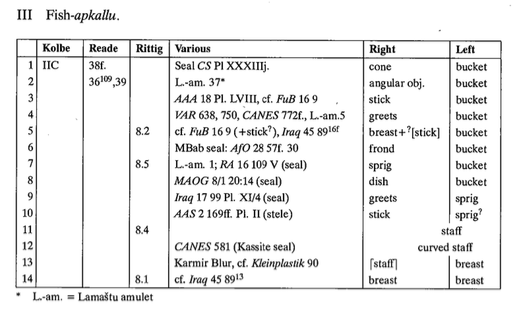
The fish-apkallū on Lamaštu amulet 2 (and 4?), exactly like the ūmu-apkallū on Lamaštu amulets 3 and 61, has his left hand on the bed of the sick man. The right hand is slightly damaged, but probably greeting.

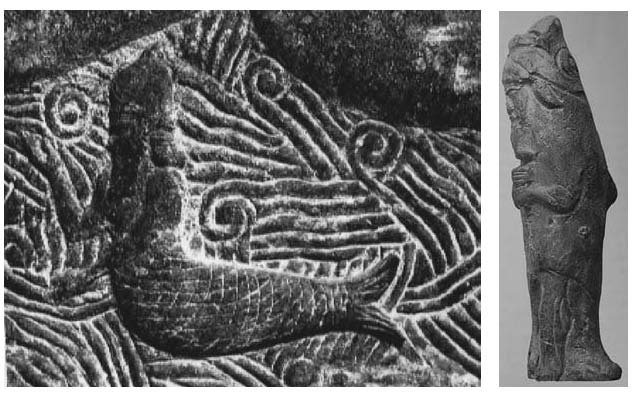
Fish-Apkallu statuettes of the type that were buried in the foundations of buildings.

Fish-Apkallu statuettes of the type that were buried in the foundations of buildings. It is difficult to tell whether they hold their hands in a prayerful position or hold something indistinct. 

Wrong hand:

Occasionally apkallū are attested holding the bucket in their right hand: AfO 28 57f. 30 (above IIiI/6), Lamaštu amulet 5 (?), Calmeyer Reliefbronzen 66 H:8 (bird-apkallū).

Unidentified object:

One of the apkallū on CANES 773 holds in his right hand an unidentified feather-like object.

Identification:

The identification of the fish-apkallū of ritual I/IiI with the “fish-garbed” man goes back to Smith JRAS 1926 709 (based on comparison with the Kleinplastik from Ur); identification of one of them with Oannes has been proposed since the early days of Assyriology (Kolbe Reliefprogramme 26, Zimmern KAT 535ff., ZA 35 151ff.) but was proved only after the names of the sages in Berossos’ Babyloniaka were recognized in cuneiform (van Dijk UVB 18 46ff.).

Occasionally the apkallū is mistakenly identified with the fish-man / kulullû (see below, VII.C.9), a completely different figure. U4 – a n (Oannes) and Adapa, a human sage living approximately at the same time, are probably two different figures (Borger JNES 33186, Picchioni Adapa 97ff.).

A "fish-man" / kulullû is depicted at left, and a fish-apkallū at right.  Wiggermann distinguishes these two entities.

A “fish-man” / kulullû is depicted at left, and a fish-apkallū at right.
Wiggermann distinguishes these two entities.

The texts clearly indicate that the fish-apkallū are not fish-garbed priests, but mythological figures, man and fish; they are bīnūt apsî, “creatures of apsû“, in ritual I/IIi, purād tāmtiša ina nāri ibbanú, “carp of the sea…who were grown in the river” in text IIiI.B.8 (cf. also Cagni Erra, I 162), and Berossos clearly describes them as a mixture of fish and man (cf. S. Mayer Burstein SANE I/5 13, 19).

Their names lack the determinative DINGIR, they are no gods, and the horns on the head of the fish (on palace reliefs, not on seals, cf. Kleinplastik 89, FuB 10 35) probably developed from its gills.

Berossos calls them “hemidaimones” (Jacoby FGrH 400).

Fish-Apkallū depicted on a cistern. The fish iconography is unmistakable, as are the banduddu buckets in their left hands. Objects in their right hands are indistinct, but the traditional gestures of warding or blessing seem clear.

Fish-Apkallū depicted on a cistern. The fish iconography is unmistakable, as are the banduddu buckets in their left hands. Objects in their right hands are indistinct, but the traditional gestures of warding or blessing seem clear. The objects in their right hands may be the “angular objects” mentioned in the table by Wiggermann at the top of the page. 

History.

In the third millennium a b g al is the name of a profession: see MSL 12 10:15, ZA 72 174 11 v 3, Bauer AWL 125 i 4 (NUN.ME.KA X ME/GANA2f, cf. also Barton MBI 2 iv 2), Ukg. 6 ii 30′, iii 4 (NUN.ME.KA X ME/GANA2f.) UET 8 33:15 and for the same profession in the divine world: TCL 15 10:98 (dA b g a l) cf. 85.

In OB sum. incantations a b g a l apparently refers to a mythological sage at the court of Enki: VAS 17 13:5 (together with Enkum, Ninkum, and the seven children of Apsû), 16:11, 32:21, HSAO 262:56, PBS I/2 123:9 IIIISET 1 217 Ni 4176:12, OrNS 44 68, cf. ASKT 12 Obv. 11ff.

The “seven apkallū of Eridu“, at least in AnSt 30 78 (SB) identified with the seven antediluvian sages (Anenlilda is among them), are rooted in the third millenium (TCS 3 25:139, cf. Benito “Enki and Ninmah” and “Enki and the World Order” 91:105, and for later attestations JCS 21 11 25+a, Maqlû II 124, V 110 = AfO 21 77, VII 49, VIII 38).

The names of the seven antediluvian sages are certainly not as old as the names of the antediluvian kings: they seem to be derived partly from the titles of literary works (Hallo JAOS 83 175f.), and partly from the names of the antediluvian kings.

The element en-me-(e n) (and a m – m e, a m – i etc.) = e m e n (me —en) (cf. Finkelstein JCS 17 42, Wilcke Lugalbanda 41), “lord”, in the names of the kings has been reinterpreted as “the lord (e n) who makes good (d u 10 – g a)/ perfects (g a l a m) / refines (b ùl u g -g á) the regulations (m e)”.

Although the resulting names are good Sumerian (Lambert JCS 16 74), the consistent difference is telling. The Sumerian of the linguistically rather simple bilingual incantation to the fish-apkallū in bīt mēseri (III.B.8) could well be of MB date, and the Kassite seals with representations of the fish-apkallū prove that at this time the later views existed at least partially.

These undatable later views connect the named carp apkallū with canonized literature (Lambert JCS 16 59ff., Hallo JAOS 83 175f., van Dijk-Mayer BaMB 2 no 90) and have possibly been developed concomittantly.

Literature on the apkallū types :

Below text III.B.8, 9, 10, 11; Borger JNES 33 183ff., Foster OrNS 43 344ff., Komoróczy ActAntHung 21 135ff., 142ff., S. Mayer Burstein SANE 1/5 13ff., Kawami Iran 10 146ff., van Dijk UVB 18 43ff., all with many references to previous literature.”

F.A.M. Wiggermann, Mesopotamian Protective Spirits: The Ritual Texts, STYX&PP Publications, Groningen, 1992, p. 76-7.

Footnote 55 on the Use of the Name Iao

“On the use of the name Iao in the magic of the age of syncretism there is an abundance of material. Most of the older examples have been collected by W. von Baudissin, Studien zur Semitischen Religionsgeschichte, vol. 1 (Leipzig, 1876), 179-254. The passage from Yesirah is not referred to by Baudissin, nor did R. Reitzenstein make use of it in his treatment of the Book Yesirah, for which he assumes an ultimately Hellenistic origin reaching back to the second century; his arguments are based on a comparative study of letter-mysticism in late antiquity; see Reitzenstein, Poimandres (Leipzig, 1904), 291.

As an historian with a broad perspective, Reitzenstein perhaps had a clearer view than many other Jewish scholars, who often regarded the Book Yesirah as if it were suspended in a vacuum in the midst of the history of religions. It should also be noted, in this connection, that in the Coptic Pistis Sophia, chap. 136, Iao appears in a similar context: Jesus calls out his name as he turns toward the four corners of the world.

The sealing of the six directions of space by means of the permutations of Iao corresponds to the idea that this name is the master of the four directions of the world, that is, the master of the cosmos. Cf. the material assembled by Erik Peterson, Heis Theos (Göttingen, 1926), 306-307. Peterson’s interpretation of the magical name Arbathiao as “the four Iao” is, however, utterly unconvincing. The magical name is nothing other than a syncretistic transcription of the Tetragrammaton as “the tetrad [of the four letters of the name YHWH upon which is based the name] of Iao.”

This is proven by the corresponding form Tetrasya, which we find in the Hebrew writings of the Hekhaloth and which was still unknown to Peterson; cf. my Major Trends, 56, 363. The terminology employed in the Yesirah for these three directions of space is also very ancient: the phrase “above and below, in front and behind, right and left” is used in exactly the same manner in Akkadian, and is evidently also behind the wording of the Mishnah Hagigah 2:1 (first century), where “in front” and “behind” are to be understood spatially.

This usage was no longer understood by the amoraim, and was in any case transferred from the spatial to the temporal, as S. E. Löwenstamm, “On an Alleged Gnostic Element in Mishnah Hagiga II, 1″ (in Hebrew) in M. Haram (ed.), Yehezkel Kaufmann Jubilee Volume (Jerusalem, 1960), 112-121, has shown, drawing upon Akkadian material. His explanations furnished additional linguistic evidence in support of the antiquity of the Book Yesirah, although precisely the passage under consideration here escaped his attention.”

–Gershom Scholem, Origins of the Kabbalah, 1987, pp. 33-4