Samizdat

Publishing the Forbidden. All Rights Reserved. © Samizdat 2014-2026.

Vignettes From the Papyrus of Ani

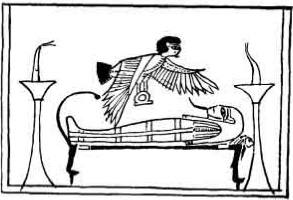
soul_of_ani_visiting_his_body_in_the_bier

The soul of the scribe Ani visiting his mummified body 
as it lies on its bier in the tomb. 
(From the Papyrus of Ani, plate 17.)

“Many of the pictures or vignettes carry their own interpretations with them, e.g., the picture of the soul hovering over the dead body which lies beneath it on the bier at once suggests the reunion of the soul with the body; the picture of the deceased walking away from a “block of slaughter” and a knife dripping with blood suggests escape from a cruel death; the picture of a soul and spirit standing before an open door suggests that the soul has freedom to wander about at will; and the picture of the soul and the shadow in the act of passing out through the door of the tomb indicates clearly that these parts of man’s economy are not shut up in the tomb for all eternity.

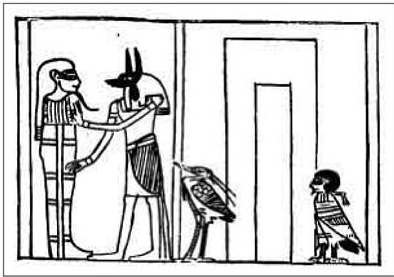
Anubis with Ani

Anubis holding the mummy of the scribe Ani.

Anubis holding the mummy of the scribe Ani; 
by the door of the tomb stand the soul and spirit of the deceased 
in the form of a human-headed hawk and bennu bird respectively. 
(From the Papyrus of Ani, plate 16.)

But the ideas which prompted the painting of other vignettes are not so clear, e.g., those which accompany Chapters CLXII-CLXV in the late or Säite Recension of the Book of the Dead, although, fortunately, the rubrics to these chapters make their object clear.

Thus the picture which stands above Chapter CLXII. is that of a cow having upon her head horns, a disk, and two plumes, and from the rubric we learn that a figure of it was to be made in gold and fastened to the neck of the deceased, and that another, drawn upon new papyrus, was to be placed under his head.

If this be done “then shall abundant warmth be in him throughout, even like that which was in him when he was upon earth. And he shall become like a god in the underworld, and he shall never be turned back at any of the gates thereof.”

Ani Leaving the Tomb

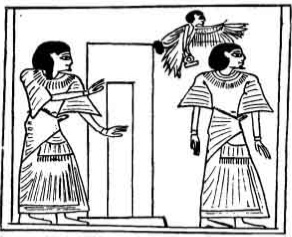
Ani Passing Through the Door of His Tomb

The scribe Ani passing through the door of the tomb. 
Outside are his shadow and his soul in the form of a human-headed bird. 
(From the Papyrus of Ani, plate 18.)

The words of the chapter have great protective power (i.e., are a charm of the greatest importance) we are told, “for it was made by the cow for her son Râ when he was setting, and when his habitation was surrounded by a company of beings of fire.”

E.A. Wallis Budge, Egyptian Magic, London, 1901. Pp. 113-6.

Men Attaining the Form of the Radiance of Ra

“Elsewhere it is ordered that the boat of Râ be painted “in a pure place,” and in the bows is to be painted a figure of the deceased; but Râ was supposed to travel in one boat (called “Âtet “) until noon, and another (called “Sektet”) until sunset, and provision had to be made for the deceased in both boats.

How was this to be done? On one side of the picture of the boat a figure of the morning boat of Râ was to be drawn, and on the other a figure of the afternoon boat; thus the one picture was capable of becoming two boats. And, provided the proper offerings were made for the deceased on the birthday of Osiris, his soul would live for ever, and be would not die a second time. (Ibid., p. 212).

According to the rubric to the chapter (i.e., CXXX) in which these directions are given, the text of it is as old, at least, as the time of Hesepti, the fifth king of the Ist dynasty, who reigned about B.C. 4350, and the custom of painting the boat upon papyrus is probably contemporaneous.

The two following rubrics from Chapters CXXXIII. and CXXXIV., respectively, will explain still further the importance of such pictures:–

1. “This chapter shall be recited over a boat four cubits in length, and made of green porcelain [on which have been painted] the divine sovereign chiefs of the cities; and a figure of heaven with its stars shall be made also, and this thou shalt have made ceremonially pure by means of natron and incense.

And behold, thou shalt make an image of Râ in yellow colour upon a new plaque and set it at the bows of the boat. And behold, thou shalt make an image of the spirit which thou dost wish to make perfect [and place it] in this boat, and thou shalt make it to travel about in the boat [which shall be made in the form of the boat] of Râ; and he shall see the form of the god Râ himself therein.

Let not the eye of any man whatsoever look upon it, with the exception of thine own self, or thy father, or thy son, and guard [this] with great care. Then shall the spirit be perfect in the heart of Râ, and it shall give unto him power with the company of the gods; and the gods shall look upon him as a divine being like unto themselves; and mankind and the dead shall fall down upon their faces, and he shall be seen in the underworld in the form of the radiance of Râ.”

E.A. Wallis Budge, Egyptian Magic, London, 1901. Pp. 111-2.

Secrets of the Winds in the Tuat, Sailing in the Boat of Millions of Years

“But yet another “exceeding great mystery” had to be performed if the deceased was to be enabled to enter into heaven by its four doors at will, and to enjoy the air which came through each.

The north wind belonged to Osiris, the south wind to Râ, the west wind to Isis, and the east wind to Nephthys; and for the deceased to obtain power over each and all of these it was necessary for him to be master of the doors through which they blew.

This power could only be obtained by causing pictures of the four doors to be painted on the coffin with a figure of Thoth opening each. Some special importance was attached to these, for the rubric says, “Let none who is outside know this chapter, for it is a great mystery, and those who dwell in the swamps (i.e., the ignorant) know it not.”

“Thou shalt not do this in the presence of any person except thy father, or thy son, or thyself alone; for it is indeed an exceedingly great mystery which no man whatever knoweth.” (Ibid., p. 212).

One of the delights coveted by the deceased was to sail over heaven in the boat of Râ, in company with the gods of the funeral cycle of Osiris; this happiness could be secured for him by painting certain pictures, and by saying over them certain words of power.

On a piece of clean papyrus a boat is to be drawn with ink made of green âbut mixed with ânti water, and in it are to be figures of Isis, Thoth, Shu, and Khepera, and the deceased; when this has been done the papyrus must be fastened to the breast of the deceased, care being taken that it does not actually touch his body.

Then shall his spirit enter into the boat of Râ each day, and the god Thoth shall take heed to him, and he shall sail about with Râ into any place that he wisheth. (See Chapters of Coming Forth by Day, p. 162).

E.A. Wallis Budge, Egyptian Magic, London, 1901. Pp. 110-1.

Egyptian Picture Magic

“Here, then, we have an excellent example of the far-reaching effects of a picture accompanied by the proper words of power, and every picture in the Book of the Dead was equally efficacious in producing a certain result, that result being always connected with the welfare of the dead.

According to several passages and chapters the deceased was terrified lest he should lack both air and water, as well as food, in the underworld, and, to do away with all risk of such a calamity happening, pictures, in which he is represented holding a sail (the symbol of air and wind and breath) in his hands, and standing up to his ankles in water, (see the vignettes to Chapters LIV.-LX. of the Book of the Dead) were painted on his papyrus, and texts similar to the following were written below them.

“My mouth and my nostrils are opened in Tattu (Busiris), and I have my place of peace in Annu (Heliopolis) which is my house; it was built for me by the goddess Sesheta, and the god Khnemu set it upon its walls for me. . . .”

“Hail, thou god Tem, grant thou unto me the sweet breath which dwelleth in thy nostrils! I embrace the great throne which is in Khemennu (Hermopolis), and I keep watch over the Egg of the Great Cackler; I germinate as it germinateth; I live as it liveth; and my breath is its breath.” (See Chapters of Coming Forth by Day, p. 106).

E.A. Wallis Budge, Egyptian Magic, London, 1901. Pp. 109-10.

Fear of Oblivion

“On the insides of the wooden coffins of the XIIth dynasty, about B.C. 2500, are painted whole series of objects which, in still earlier times, were actually placed in the tombs with the mummy; but little by little men ceased to provide the numerous articles connected with the sepulture of the dead which the old ritual prescribed, and they trusted to the texts and formulæ which they painted on the coffin to turn pictures into substances, and besides the pillow they placed little else in the tomb.

About a thousand years later, when the religious texts which formed the Book of the Dead were written upon papyri instead of coffins, a large number of illustrations or vignettes were added to them; to many of these special importance was attached, and the following are worthy of note.

It will be remembered that the CXXVth Chapter of the Book of the Dead contains the so-called “Negative Confession” which is recited in the Hall of Maâti, and a number of names of gods and beings, the knowledge of which is most important for the welfare of the deceased.

At the end of the Chapter we find the following statement:—

“This chapter shall be said by the deceased after he hath been cleansed and purified, and when he is arrayed in apparel, and is shod with white leather sandals, and his eyes have been painted with antimony, and his body hath been anointed with ânti unguent, and when he hath made offerings of oxen, and birds, and incense, and cakes, and ale, and garden herbs.

And behold, thou shalt paint a picture of what shall happen in the Hall of Maâti upon a new tile moulded from earth, upon which neither a pig nor any other animal hath trodden. And if thou writest upon it this chapter the deceased shall flourish; and his children shall flourish; and his name shall never fall into oblivion; and bread, and cakes, and sweetmeats, and wine, and meat shall be given unto him at the altar of the great god; and he shall not be turned back at any door in the underworld; and he shall be brought in along with the Kings of the North and South; and he shall be in the following of Osiris always and for ever.”

E.A. Wallis Budge, Egyptian Magic, London, 1901. Pp. 108-9.

Budgeting for the Afterlife

“And in the CLXXXIXth Chapter he prays that he may not be obliged to drink filthy water or be defiled in any way by it. The rich man, even, was not certain that the appointed offerings of meat and drink could or would be made in his tomb in perpetuity: what then was the poor man to do to save his ka from the ignominy of eating filth and drinking dirty water?

To get out of this difficulty the model of an altar in stone was made, and models of cakes, vases of water, fruit, meat, etc., were placed upon it; in cases where this was not possible figures of the offerings were sculptured upon the stone itself; in others, where even the expense of an altar could not be borne by the relatives of the dead, an altar with offerings painted upon it was placed in the tomb, and as long as it existed through the prayers recited, the ka did not lack food.

Sometimes neither altar, nor model nor picture of an altar was placed in the tomb, and the prayer that sepulchral meals might be given to the deceased by the gods, which was inscribed upon some article of funeral furniture, was the only provision made for the wants of the ka; but every time any one who passed by the tomb recited that prayer, and coupled with it the name of the man who was buried in it, his ka was provided with a fresh supply of meat and drink offerings, for the models or pictures of them in the inscription straightway became veritable substances.”

E.A. Wallis Budge, Egyptian Magic, London, 1901. Pp. 106-7.

MAGICAL PICTURES AND FORMULÆ, SPELLS, ETC.

“FROM what has been said above it is clear that the Egyptian believed it possible to vivify by means of formulæ and words of power any figure made in the form of a man or animal, and to make it work either on behalf of or against his fellow man.

Besides this, he believed greatly in the efficacy of representations or pictures of the gods, and of divine beings and things, provided that words of power properly recited by properly appointed people were recited over them. If this fact be borne in mind a great many difficulties in understanding religious texts disappear, and many apparently childish facts are seen to have an important meaning.

If we look into the tombs of the early period we see painted on the walls numbers of scenes in which the deceased is represented making offerings to the gods and performing religious ceremonies, as well as numbers of others in which he is directing the work of his estate and ruling his household.

It was not altogether the result of pride that such pictures were painted on the walls of tombs, for at the bottom of his heart the Egyptian hoped and believed that they were in reality representations of what he would do in the next world, and he trusted that the words of his prayers would turn pictures into realities, and drawings into substances.

The wealthy Egyptian left behind him the means for making the offerings which his ka, or double, needed, and was able to provide for the maintenance of his tomb and of the ka chapel and of the priest or priests who ministered to it.

It was an article of faith among all classes that unless the ka was properly fed it would be driven to wander about and pick up filth and anything else of that nature which it found in its path, as we may see from the LIInd Chapter of the Book of the Dead, in which the deceased says, “That which is an abomination unto me, that which is an abomination unto me let me not eat. That which is an abomination unto me, that which is an abomination unto me is filth; let me not eat of it instead of the cakes [which are offered unto] the Doubles (kau). Let it not light upon my body; let me not be obliged to take it into my hands; and let me not be obliged to walk thereon in my sandals.”

E.A. Wallis Budge, Egyptian Magic, London, 1901. Pp. 104-6.

More on Wax Figurines in Magic

The art of making such figures King James I. attributes to the “Divell,” and says in describing the things which witches are able to “effectuate by the power of their master (the following words are put into the mouth of Epistemon in Dæmonologie, in Forme of one Dialogue, London, 1603, Second Booke, Chap. V. pp. 44, 45)”:—

“To some others at these times hee teacheth, how to make pictures of waxe or clay: That by the roasting thereof, the persons that they beare the name of, may be continually melted or dried away by continuall sicknesse. . . .

They can bewitch and take the life of men or women, by roasting of the pictures, as I spake of before, which likewise is verie possible to their Maister to performe, for although (as I said before) that instrument of waxe have no vertue in that turne doing, yet may hee not very well, even by the same measure that his conjured slaves, melts that waxe at the fire, may hee not, I say at these same times, subtily, as a sprite, so weaken and scatter the spirites of life of the patient, as may make him on the one part, for faintnesse, so sweate it out the humour of his bodie: And on the other parte, for the not concurrence of these spirites, which causes his digestion, so debilitate his stomacke, that this humour radicall continually sweating out on the one part, and no new good sucke being put in the place thereof, for lacke of digestion on the other, he at last shall vanish away, even as his picture will die at the fire?

And that knavish and cunning workeman, by troubling him, onely at sometimes, makes a proportion, so neere betwixt the working of the one and the other, that both shall end as it were at one time.”

Thus we have seen that the belief in the efficacy of wax figures is at least six thousand years old, and judging from passages in the works of modern writers its existence is not unknown in our own country at the present time.

E.A. Wallis Budge, Egyptian Magic, London, 1901. Pp. 100-2.

On the Black Arts

“From Egypt, by way of Greece and Rome, the use of wax figures passed into Western Europe and England, and in the Middle Ages it found great favour with those who interested themselves in the working of the “black art,” or who wished to do their neighbour or enemy an injury.

Many stories are current of how in Italy and England ignorant or wicked minded people made models of their enemies in wax and hung them up in the chimney, not too close to the fire, so that they might melt away slowly, and of how the people that were represented by such figures gradually lost the power over their limbs, and could not sleep, and slowly sickened and died.

If pins and needles were stuck into the wax figures at stated times the sufferings of the living were made more agonizing, and their death much more painful.

Sharpe relates (see C. K. Sharpe, Witchcraft in Scotland, London, 1884, p. 21) that about the end of the VIIth century king Duffus was so unpopular that “a company of hags roasted his image made of wax upon a wooden spit, reciting certain words of enchantment, and basting the figure with a poisonous liquor.

These women when apprehended declared that as the wax melted, the body of the king should decay, and the words of enchantment prevented him from the refreshment of sleep.”

The two following extracts from Thomas Middleton’s The Witch (London, 1778) illustrate the views held about wax figures in England in the time of this writer. (Born about 1570, died about 1626).

I.
Heccat. Is the heart of wax
Stuck full of magique needles?”
Stadlin. ‘Tis done Heccat.

Heccat. And is the Farmer’s picture, and his wives, Lay’d downe to th’ fire yet?
Stadlin. They are a roasting both too.
Heccat. Good:
Then their marrowes are a melting subtelly
And three monethes sicknes sucks up life in ’em.”
(Act i., scene 2.)

II.
Heccat. What death is’t you desire for Almachildes?
Duchesse. A sodaine and a subtle.
Heccat. Then I have fitted you.
Here lye the guifts of both; sodaine and subtle:
His picture made in wax, and gently molten
By a blew fire kindled with dead mens’ eyes
Will waste him by degrees.”
(Act v., scene 2)

Mr. Elworthy in his very interesting book The Evil Eye (London, 1895, pp. 53, 56) relates some striking examples of the burning of hearts stuck full of pins for magical purposes in recent years.

Thus an old woman at Mendip had a pig that fell ill, and she at once made up her mind that the animal had been “overlooked”; in her trouble she consulted a “white witch,” i.e. a “wise” man, and by his orders she acted thus.

She obtained a sheep’s heart, and having stuck it full of pins (in the Worth Riding of Yorkshire evil influences were averted by means of a living black cock which “was pierced with pins and roasted alive at dead of night, with every door, window, and cranny and crevice stuffed up” (see Blakeborough, Wit, Character, Folk-lore and Customs of the North Riding of Yorkshire, London, 1898, p. 205)) set it to roast before a fire, whilst her friends and neighbours sang:–

“It is not this heart I mean to burn.
But the person’s heart I wish to turn,
Wishing them neither rest nor peace
Till they are dead and gone.”

At intervals her son George sprinkled salt on the fire which added greatly to the weirdness of the scene, and at length, when the roasting had been continued until far into the night, a black cat jumped out from somewhere and was, of course, instantly declared to be the demon which had been exorcised.

Again, in October, 1882, a heart stuck full of pins was found in a recess of a chimney in an old house in the village of Ashbrittle; and in 1890 another was found nailed up inside the “clavel” in the chimney of an old house at Staplegrove.”

E.A. Wallis Budge, Egyptian Magic, London, 1901. Pp. 97-100.

On Nectanebus, the Last Native King of Egypt, BC 318

“But of all the Egyptians who were skilled in working magic, Nectanebus, the last native king of Egypt, about B.C. 318, was the chief, if we may believe Greek tradition.

According to Pseudo-Callisthenes, and the versions of his works which were translated into Pehlevi, Arabic, Syriac, and a score of other languages and dialects, this king was famous as a magician and a sage, and he was deeply learned in all the wisdom of the Egyptians.

He knew what was in the depths of the Nile and of heaven, he was skilled in reading the stars, in interpreting omens, in casting nativities, in telling fortunes, and in predicting the future of the unborn child, and in working magic of every kind, as we shall see; he was said to be the lord of the earth, and to rule all kings by means of his magical powers.

Whenever he was threatened with invasion by sea or by land he succeeded in destroying the power of his enemies, and in driving them from his coasts or frontiers; and this he did by the following means.

If the enemy came against him by sea, instead of sending out his sailors to fight them, he retired into a certain chamber, and having brought forth a bowl which he kept for the purpose, he filled it with water, and then, having made wax figures of the ships and men of the enemy, and also of his own men and ships, he set them upon the water in the bowl, his men on one side, and those of the enemy on the other.

He then came out, and having put on the cloak of an Egyptian prophet and taken an ebony rod in his hand, he returned into the chamber, and uttering words of power he invoked the gods who help men to work magic, and the winds, and the subterranean demons, which straightway came to his aid.

By their means the figures of the men in wax sprang into life and began to fight, and the ships of wax began to move about likewise; but the figures which represented his own men vanquished those which represented the enemy, and as the figures of the ships and men of the hostile fleet sank through the water to the bottom of the bowl, even so did the real ships and men sink through the waters to the bottom of the sea.”

E.A. Wallis Budge, Egyptian Magic, London, 1901. Pp. 91-2.

Egyptian Magic 101: Step-by-Step Instructions

“In another part of the work, after a series of curses which are ordered to be said over Âpep, the rubric directs that they shall be recited by a person who hath washed himself and is ceremonially clean, and when this has been done he is to write in green colour upon a piece of new papyrus the names of all the fiends who are in the train of Âpep, as well as those of their fathers, and mothers, and children.

He must then make figures of all these fiends in wax, and having inscribed their names upon them, must tie them up with black hair, and then cast them on the ground and kick them with the left foot, and pierce them with a stone spear; this done they are to be thrown into the fire.

More than once is it said, “It is good for a man to recite this book before the august god regularly,” for the doing of it was believed to give great power “to him, both upon earth and in the underworld.”

Finally, after the names of Âpep are enumerated, he who would benefit by the knowledge of them is bidden to “make the figure of a serpent with his tail in his mouth, and having stuck a knife in his back, cast him down upon the ground and say, “‘Âpep, Fiend, Betet.’”

Then, in order to destroy the fiends who are in the train of Âpep, other images or figures of them must be made with their hands tied behind them; these are to be called “Children of inactivity.”

The papyrus then continues, “Make another serpent with the face of a cat, and with a knife stuck in his back, and call it ‘Hemhem‘ (Roarer).

Make another with the face of a crocodile, and with a knife stuck in his back, and call it ‘Hauna-aru-her-hra.’

Make another with the face of a duck, and with a knife stuck in his back, and call it ‘Aluti.’

Make another with the face of a white cat, and with a knife stuck in his back, and tie it up and bind it tightly, and call it ‘Âpep the Enemy.’”

Such are the means which the Egyptians adopted when they wanted to keep away rain and storm, thunder and lightning, and mist and cloud, and to ensure a bright clear sky wherein the sun might run his course.”

E.A. Wallis Budge, Egyptian Magic, London, 1901. Pp. 82-4.

Magical Weather Control

“If thou wouldst destroy Âpep, thou shalt say this chapter over a figure of Âpep which hath been drawn in green colour upon a sheet of new papyrus, and over a wax figure (Theocritus has preserved for us a proof that the Greeks made use of wax figures at an early date. Thus in Pharmakeutria (1. 27 ff.) the lady spinning her wheel and addressing the Lynx says, “Even as I melt this wax, with the god to aid, so speedily may he by love be molten!” (Lang’s Translation, p. 12)) of Âpep upon which his name hath been cut and inlaid with green colour; and thou shalt lay them upon the fire so that it may consume the enemy of Râ.

And thou shalt put such a figure on the fire at dawn, and another at noon, and another at eventide when Râ setteth in the land of life, and another at midnight, and another at the eighth hour of the day, and another towards evening; [and if necessary] thou mayest do thus every hour during the day and the night, and on the days of the festivals and every day.

By means of this Âpep, the enemy of Râ, shall be overthrown in the shower, for Râ shall shine and Âpep shall indeed be overthrown.”

And the papyrus and the figure “having been burnt in a fire made of khesau grass, the remains thereof shall be mixed with excrement and thrown upon a fire; thou shalt do this at the sixth hour of the night, and at dawn on the fifteenth day [of the month].

And when the figure of Âpep is placed in the fire thou shalt spit upon him several times each hour during the day, until the shadow turneth round. Thou shalt do these things when tempests rage in the east of the sky as Râ setteth, in order to prevent the coming onward of the storms. Thou shalt do this and so prevent the coming of a shower or a rain-storm, and “thereby shall the sun be made to shine.”

E.A. Wallis Budge, Egyptian Magic, London, 1901. Pp. 80-2.

Vanquishing the Serpent Fiend Apep

“It will be remembered that the XXXIXth Chapter of the Book of the Dead is a composition which was written with the object of defeating a certain serpent, to which many names are given, and of delivering the deceased from his attacks.

In it we have a description of how the monster is vanquished, and the deceased says to him, “Râ maketh thee to turn back, O thou that art hateful to him; he looketh upon thee, get thee back.

He pierceth thy head, he cutteth through thy face, he divideth thy head at the two sides of the ways, and it is crushed in his land; thy bones are smashed in pieces, thy members are hacked from off thee, and the god Aker hath condemned thee, O Âpep, thou enemy of Râ.

Get thee back, Fiend, before the darts of his beams! Râ hath overthrown thy words, the gods have turned thy face backwards, the Lynx hath torn open thy breast, the Scorpion hath cast fetters upon thee, and Maât hath sent forth thy destruction.

The gods of the south, and of the north, of the west, and of the east, have fastened chains upon him, and they have fettered him with fetters; the god Rekes hath overthrown him, and the god Hertit hath put him in chains.” (See Chapters of Coming Forth by Day, p. 89).

The age of this composition is unknown, but it is found, with variants, in many of the copies of the Book of the Dead which were made in the XVIIIth dynasty. Later, however, the ideas in it were developed, the work itself was greatly enlarged, and at the time of the Ptolemies it had become a book called “The Book of Overthrowing Âpep,” which contained twelve chapters.

At the same time another work bearing the same title also existed; it was not divided into chapters, but it contained two versions of the history of the Creation, and a list of the evil names of Âpep, and a hymn to Râ. (I have given a hieroglyphic transcript of both works, with translations, in Archæologia, Vol. LII).

E.A. Wallis Budge, Egyptian Magic, London, 1901. Pp. 78-80.

Violent Love

“One of the earliest instances of the use of a magical figure is related in the Westcar Papyrus, (Ed. Erman, pp. 7 and 8) where we read that Prince Khâf-Râ told Khufu (Cheops) a story of an event which had happened in the time of Neb-ka or Neb-kau-Ed, a king of the IIIrd dynasty, who reigned about B.C. 3830.

It seems that this king once paid a visit to one of his high officials called Âba-aner, whose wife fell violently in love with one of the soldiers in the royal train.

This lady sent her tirewoman to him with the gift of a chest of clothes, and apparently she made known to him her mistress’s desire, for he returned with her to Âba-aner’s house. There he saw the wife and made an appointment to meet her in a little house which was situated on her husband’s estate, and she gave instructions to one of the stewards of Âba-aner to prepare it for the arrival of herself and her lover.

When all had been made ready she went to the house and stayed there the whole day drinking and making love with the man until sunset; and when the evening had come he rose up and went down to the river and the tirewoman bathed him in the water thereof.

But the steward, who had made ready the house, declared that he must make the matter known unto his master, and on the following morning as soon as it was light, he went to Âba-aner and related to him everything which had happened. The official made no answer to his servant’s report, but ordered him to bring him certain materials and his box made of ebony and precious metal.

Out of the box he took a quantity of wax, which was, no doubt, kept there for purposes similar to that to which a portion of it was now to be put, and made a model of a crocodile seven spans long, and then reciting certain magical words over it, he said, “When the man cometh down to bathe in my waters seize thou him.”

Then, turning to the steward, he gave the wax crocodile to him and said, “When the man, according to his daily wont, cometh down to wash in the water thou shalt cast the crocodile in after him”; and the steward having taken the wax crocodile from his master went his way.

And again the wife of Âba-aner ordered the steward who had charge of the estate to make ready the house which was in the garden, “for,” she said, “behold, I am coming to pass some time therein.”

So the house was made ready and provided with all good things, and she came with the man and passed some time with him there. Now when the evening was come the man went down to the water to wash according to his daily wont, and the steward went down after him and threw into the water the wax crocodile, which straightway turned into a living crocodile seven cubits (i.e., about twelve feet) in length, and seized upon the man and dragged him down in the water.

Meanwhile Âba-aner tarried with his king Neb-kau-Râ for seven days, and the man remained in the depths of the water and had no air to breathe. And on the seventh day Âba-aner the kher heb (i.e., the priestly official who performed the most important of the funeral ceremonies; he was always a man of great learning, and generally of high rank) went out with the king for a walk, and invited His Majesty to come and see for himself a wonderful thing which had happened to a man in his own days; so the king went with him.

When they had come to the water Âba-aner adjured the crocodile, saying, “Bring hither the man,” and the crocodile came out of the water bringing the man with him. And when the king remarked that the crocodile was a horrid looking monster, Âba-aner stooped down and took it up into his hand, when it straightway became a waxen crocodile as it was before.

After these things Âba-aner related to the king what had happened between his wife and the man whom the crocodile had brought up out of the water, whereupon the king said to the crocodile, “Take that which is thine and begone”; and immediately the crocodile seized the man and sprang into the water with him, and disappeared in its depths.

And by the royal command Âba-aner’s wife was seized, and having been led to the north side of the palace was burnt, and her ashes were cast into the stream. Here then we have already in the IIIrd dynasty the existence of a belief that a wax crocodile, over which certain words had been said, could change itself into a living reptile at pleasure, and that a man could be made by the same means to live at the bottom of a stream for seven days without air.

We may also notice that the great priestly official, the kher heb, was so much in the habit of performing such acts of magic that he kept in a room a box of materials and instruments always ready for the purpose; and, apparently, neither himself, nor his king, nor his servant, thought the working of magic inconsistent with his high religious office.

But at the time when Âba-aner was working magic by means of wax figures, probably to the harm and injury of his enemies, the priests were making provision for the happiness and well-being of the dead also by means of figures made of various substances.”

E.A. Wallis Budge, Egyptian Magic, London, 1901. Pp. 67-71.

On Magical Figures in Ancient Egyptian Magic

“IT has been said above that the name or the emblem or the picture of a god or demon could become an amulet with power to protect him that wore it, and that such power lasted as long as the substance of which it was made lasted, if the name, or emblem, or picture was not erased from it.

But the Egyptians went a step further than this, and they believed that it was possible to transmit to the figure of any man, or woman, or animal, or living creature, the soul of the being which it represented, and its qualities and attributes.

The statue of a god in a temple contained the spirit of the god which it represented, and from time immemorial the people of Egypt believed that every statue and every figure possessed an indwelling spirit.

When the Christianized Egyptians made their attacks on the “idols of the heathen” they proved that they possessed this belief, for they always endeavoured to throw down the statues of the gods of the Greeks and Romans, knowing that if they were once shattered the spirits which dwelt in them would have no place wherein to dwell, and would thereby be rendered homeless and powerless.

It will be remembered that it is stated in the Apocryphal Gospels that when the Virgin Mary and her Son arrived in Egypt there “was a movement and quaking throughout all the land, and all the idols fell down from their pedestals and were broken in pieces.”

Then all the priests and nobles went to a certain priest with whom “a devil used to speak from out of the idol,” and they asked him the meaning of these things; and when he had explained to them that the footstep of the son of the “secret and hidden god” had fallen upon the land of Egypt, they accepted his counsel and made a figure of this god.

The Egyptians acknowledged that the new god was greater than all their gods together, and they were quite prepared to set up a statue of him because they believed that in so doing they would compel at least a portion of the spirit of the “secret and hidden god” to come and dwell in it.

In the following pages we shall endeavour to describe the principal uses which the Egyptians made of the figures of gods, and men, and beasts, to which magical powers had been imparted by means of the performance of certain symbolic ceremonies and the recital of certain words of power; and how they could be employed to do both good and evil.”

E.A. Wallis Budge, Egyptian Magic, London, 1901. Pp. 65-7.

Thoth, Isis, and Words of Power

“On the amulet of the Buckle we have inscribed the words, “May the blood of Isis, and the powers of Isis, and the words of power of Isis be mighty to protect this mighty one,” etc., and in the address which Thoth makes to Osiris he says, “I am Thoth, the favoured one of Râ, the lord of might, who bringeth to a prosperous end that which he doeth, the mighty one of words of power, who is in the boat of millions of years, the lord of laws, the subduer of the two lands,” etc. (See Chapters of Coming forth by Day, p. 340 f).

From the above passages we not only learn how great was the confidence which the deceased placed in his words of power, but also that the sources from which they sprang were the gods Thoth and Isis.

It will be remembered that Thoth is called the “scribe of the gods,” the “lord of writing,” the “master of papyrus,” the maker of the palette and the ink-jar,” the “lord of divine words,” i.e., the holy writings or scriptures, and as he was the lord of books and master of the power of speech, he was considered to be the possessor of all knowledge both human and divine.

At the creation of the world it was he who reduced to words the will of the unseen and unknown creative Power, and who uttered them in such wise that the universe came into being, and it was he who proved himself by the exercise of his knowledge to be the protector and friend of Osiris, and of Isis, and of their son Horus.

From the evidence of the texts we know that it was not by physical might that Thoth helped these three gods, but by giving them words of power and instructing them how to use them.

We know that Osiris vanquished his foes, and that he reconstituted his body, and became the king of the underworld and god of the dead, but he was only able to do these things by means of the words of power which Thoth had given to him, and which he had taught him to pronounce properly and in a proper tone of voice.

It is this belief which makes the deceased cry out, “Hail, Thoth, who madest Osiris victorious over his enemies, make thou Ani to be victorious over his enemies in the presence of the great and sovereign princes who are in Tattu,” or in any other place.

Without the words of power given to him by Thoth, Osiris would have been powerless under the attacks of his foes, and similarly the dead man, who was always identified with Osiris, would have passed out of existence at his death but for the words of power provided by the writings that were buried with him.

In the Judgment Scene it is Thoth who reports to the gods the result of the weighing of the heart in the balance, and who has supplied its owner with the words which he has uttered in his supplications, and whatever can be said in favour of the deceased he says to the gods, and whatever can be done for him he does.”

E.A. Wallis Budge, Egyptian Magic, London, 1901. Pp. 127-9.

Egyptian Magic

A STUDY of the remains of the native religious literature of ancient Egypt which have come down to us has revealed the fact that the belief in magic, that is to say, in the power of magical names, and spells, and enchantments, and formulæ, and pictures, and figures, and amulets, and in the performance of ceremonies accompanied by the utterance of words of power, to produce supernatural results, formed a large and important part of the Egyptian religion.

[ … ]

The belief in magic, the word being used in its best sense, is older in Egypt than the belief in God, and it is certain that a very large number of the Egyptian religious ceremonies, which were performed in later times as an integral part of a highly spiritual worship, had their origin in superstitious customs which date from a period when God, under any name or in any form, was unconceived in the minds of the Egyptians.

[ … ]

From the religious books of ancient Egypt we learn that the power possessed by a priest or man who was skilled in the knowledge and working of magic was believed to be almost boundless. By pronouncing certain words or names of power in the proper manner and in the proper tone of voice he could heal the sick, and cast out the evil spirits which caused pain and suffering in those who were diseased, and restore the dead to life, and bestow upon the dead man the power to transform the corruptible into an incorruptible body, wherein the soul might live to all eternity.

His words enabled human beings to assume divers forms at will, and to project their souls into animals and other creatures; and in obedience to his commands, inanimate figures and pictures became living beings and things which hastened to perform his behests. The powers of nature acknowledged his might, and wind and rain, storm and tempest, river and sea, and disease and death worked evil and ruin upon his foes, and upon the enemies of those who were provided with the knowledge of the words which he had wrested from the gods of heaven, and earth, and the underworld.

Inanimate nature likewise obeyed such words of power, and even the world itself came into existence through the utterance of a word by Thoth; by their means the earth could be rent asunder, and the waters forsaking their nature could be piled up in a heap, and even the sun’s course in the heavens could be stayed by a word.

No god, or spirit, or devil, or fiend, could resist words of power, and the Egyptians invoked their aid in the smallest as well as in the greatest events of their lives. To him that was versed in the lore contained in the books of the “double house of life” the future was as well known as the past, and neither time nor distance could limit the operations of his power; the mysteries of life and death were laid bare before him, and he could draw aside the veil which hid the secrets of fate and destiny from the knowledge of ordinary mortals.

[ … ]

In the “white” and “black” magic of the Egyptians most of the magic known in the other countries of the world may be found; it is impossible yet to say exactly how much the beliefs and religious systems of other nations were influenced by them, but there is no doubt that certain views and religious ideas of many heathen and Christian sects may be traced directly to them.

[ … ]

But the fact remains that they did believe in One God Who was almighty, and eternal, and invisible, Who created the heavens, and the earth, and all beings and things therein; and in the resurrection of the body in a changed and glorified form, which would live to all eternity in the company of the spirits and souls of the righteous in a kingdom ruled by a being who was of divine origin, but who had lived upon the earth, and had suffered a cruel death at the hands of his enemies, and had risen from the dead, and had become the God and king of the world which is beyond the grave; and that, although they believed all these things and proclaimed their belief with almost passionate earnestness, they seem never to have freed themselves from a hankering after amulets and talismans, and magical names, and words of power, and seem to have trusted in these to save their souls and bodies, both living and dead, with something of the same confidence which they placed in the death and resurrection of Osiris.

E.A. Wallis Budge, Egyptian Magic, London, 1901. Pp. vii. – xiv.

Budge’s Version of the Legend of Ra and Isis

At this time Isis lived in the form of a woman who possessed the knowledge of spells and incantations, that is to say, she was regarded much in the same way as modern African peoples regard their “medicine-women,” or “witch-women.”

She had used her spells on men, and was tired of exercising her powers on them, and she craved the opportunity of making herself mistress of gods and spirits as well as of men. She meditated how she could make herself mistress both of heaven and earth, and finally she decided that she could only obtain the power she wanted if she possessed the knowledge of the secret name of Ra, in which his very existence was bound up.

Ra guarded this name most jealously, for he knew that if he revealed it to any being he would henceforth be at that being’s mercy. Isis saw that it was impossible to make Ra declare his name to her by ordinary methods, and she therefore thought out the following plan.

It was well known in Egypt and the Sudan at a very early period that if a magician obtained some portion of a person’s body, e.g., a hair, a paring of a nail, a fragment of skin, or a portion of some efflux from the body, spells could be used upon them which would have the effect of causing grievous harm to that person.

Isis noted that Ra had become old and feeble, and that as he went about he dribbled at the mouth, and that his saliva fell upon the ground. Watching her opportunity she caught some of the saliva and mixing it with dust, she moulded it into the form of a large serpent, with poison-fangs, and having uttered her spells over it, she left the serpent lying on the path, by which Ra travelled day by day as he went about inspecting Egypt, so that it might strike at him as he passed along.

[ … ]

Soon after Isis had placed the serpent on the Path, Ra passed by, and the reptile bit him, thus injecting poison into his body. Its effect was terrible, and Ra cried out in agony. His jaws chattered, his lips trembled, and he became speechless for a time; never before had he suffered such pain. The gods hearing his cry rushed to him, and when he could speak he told them that he had been bitten by a deadly serpent. In spite of all the words of power which were known to him, and his secret name which had been hidden in his body at his birth, a serpent had bitten him, and he was being consumed with a fiery pain.

He then commanded that all the gods who had any knowledge of magical spells should come to him, and when they came, Isis, the great lady of spells, the destroyer of diseases, and the revivifier of the dead, came with them. Turning to Ra she said, “What hath happened, O divine Father?” and in answer the god told her that a serpent had bitten him, that he was hotter than fire and colder than water, that his limbs quaked, and that he was losing the power of sight.

Then Isis said to him with guile, “Divine Father, tell me thy name, for he who uttereth his own name shall live.” Thereupon Ra proceeded to enumerate the various things that he had done, and to describe his creative acts, and ended his speech to Isis by saying, that he was Khepera in the morning, Ra at noon, and Temu in the evening.

Apparently he thought that the naming of these three great names would satisfy Isis, and that she would immediately pronounce a word of power and stop the pain in his body, which, during his speech, had become more acute.

Isis, however, was not deceived, and she knew well that Ra had not declared to her his hidden name; this she told him, and she begged him once again to tell her his name. For a time the god refused to utter the name, but as the pain in his body became more violent, and the poison passed through his veins like fire, he said, “Isis shall search in me, and my name shall pass from my body into hers.”

At that moment Ra removed himself from the sight of the gods in his Boat, and the Throne in the Boat of Millions of Years had no occupant. The great name of Ra was, it seems, hidden in his heart, and Isis, having some doubt as to whether Ra would keep his word or not, agreed with Horus that Ra must be made to take an oath to part with his two Eyes, that is, the Sun and the Moon.

At length Ra allowed his heart to be taken from his body, and his great and secret name, whereby he lived, passed into the possession of Isis. Ra thus became to all intents and purposes a dead god.

Then Isis, strong in the power of her spells, said: “Flow, poison, come out of Ra. Eye of Horus, come out of Ra, and shine outside his mouth. It is I, Isis, who work, and I have made the poison to fall on the ground. Verily the name of the great god is taken from him, Ra shall live and the poison shall die; if the poison live Ra shall die.”

This was the infallible spell which was to be used in cases of poisoning, for it rendered the bite or sting of every venomous reptile harmless. It drove the poison out of Ra, and since it was composed by Isis after she obtained the knowledge of his secret name it was irresistible.

E.A. Wallis Budge, Legends of the Gods: The Egyptian Texts, edited with Translations, London, 1912. (No page numbers are given in my edition).

Thoth, Scribe of Truth

Ra next sent for the god Thoth, and when he came into the presence of Ra, he invited him to go with him to a distance, to a place called “Tuat,” i.e., hell, or the Other World, in which region he had determined to make his light to shine.

When they arrived there he told Thoth, the Scribe of Truth, to write down on his tablets the names of all who were therein, and to punish those among them who had sinned against him, and he deputed to Thoth the power to deal absolutely as he pleased with all the beings in the Tuat.

Ra loathed the wicked, and wished them to be kept at a distance from him. Thoth was to be his vicar, to fill his place, and “Place of Ra,” was to be his name. He gave him power to send out a messenger (hab), so the Ibis (habi) came into being.

All that Thoth would do would be good (khen), therefore the Tekni bird of Thoth came into being. He gave Thoth power to embrace (anh) the heavens, therefore the Moon-god (Aah) came into being.

He gave Thoth power to turn back (anan) the Northern peoples, therefore the dog-headed ape of Thoth came into being. Finally Ra told Thoth that he would take his place in the sight of all those who were wont to worship Ra, and that all should praise him as God. Thus the abdication of Ra was complete.

In the fragmentary texts which follow we are told how a man may benefit by the recital of this legend. He must proclaim that the soul which animated Ra was the soul of the Aged One, and that of Shu, Khnemu (?), Heh, &c., and then he must proclaim that he is Ra himself, and his word of power Heka.

If he recites the Chapter correctly he shall have life in the Other World, and he will be held in greater fear there than here. A rubric adds that he must be dressed in new linen garments, and be well washed with Nile water; he must wear white sandals, and his body must be anointed with holy oil.

He must burn incense in a censer, and a figure of Maat (Truth) must be painted on his tongue with green paint. These regulations applied to the laity as well as to the clergy.

E.A. Wallis Budge, Legends of the Gods: The Egyptian Texts, edited with Translations, London, 1912. (No page numbers are given in my edition).
Magicians and Snake-Charmers

When Ra had made a heaven for himself, and had arranged for a continuance of life on the earth, and the welfare of human beings, he remembered that at one time when reigning on earth he had been bitten by a serpent, and had nearly lost his life through the bite. Fearing that the same calamity might befall his successor, he determined to take steps to destroy the power of all noxious reptiles that dwelt on the earth.

With this object in view he told Thoth to summon Keb, the Earth-god, to his presence, and this god having arrived, Ra told him that war must be made against the serpents that dwelt in his dominions. He further commanded him to go to the god Nu, and to tell him to set a watch over all the reptiles that were in the earth and in water, and to draw up a writing for every place in which serpents are known to be, containing strict orders that they are to bite no one.

Though these serpents knew that Ra was retiring from the earth, they were never to forget that his rays would fall upon them. In his place their father Keb was to keep watch over them, and he was their father for ever.

As a further protection against them Ra promised to impart to magicians and snake-charmers the particular word of power, hekau, with which he guarded himself against the attacks of serpents, and also to transmit it to his son Osiris.

Thus those who are ready to listen to the formulae of the snake-charmers shall always be immune from the bites of serpents, and their children also. From this we may gather that the profession of the snake-charmer is very ancient, and that this class of magicians were supposed to owe the foundation of their craft to a decree of Ra himself.

E.A. Wallis Budge, Legends of the Gods: The Egyptian Texts, edited with Translations, London, 1912. (No page numbers are given in my edition).
Creation of the Stars

Meanwhile darkness covered the land. When day broke the men who had repented of their blasphemies appeared with their bows, and slew the enemies of Ra. At this result Ra was pleased, and he forgave those who had repented because of their righteous slaughter of his enemies. From this time onwards human sacrifices were offered up at the festivals of Ra celebrated in this place, and at Heliopolis and in other parts of Egypt.

After these things Ra declared to Nut that he intended to leave this world, and to ascend into heaven, and that all those who would see his face must follow him thither. Then he went up into heaven and prepared a place to which all might come. Then he said, “Hetep sekhet aa,” i.e., “Let a great field be produced,” and straightway “Sekhet-hetep,” or the “Field of peace,” came into being.

He next said, “Let there be reeds (aaru) in it,” and straightway “Sekhet Aaru,” or the “Field of Reeds,” came into being. Sekhet-hetep was the Elysian Fields of the Egyptians, and the Field of Reeds was a well-known section of it.

Another command of the god Ra resulted in the creation of the stars, which the legend compares to flowers. Then the goddess Nut trembled in all her body, and Ra, fearing that she might fall, caused to come into being the Four Pillars on which the heavens are supported.

Turning to Shu, Ra entreated him to protect these supports, and to place himself under Nut, and to hold her up in position with his hands. Thus Shu became the new Sun-god in the place of Ra, and the heavens in which Ra lived were supported and placed beyond the risk of falling, and mankind would live and rejoice in the light of the new sun.

At this place in the legend a text is inserted called the “Chapter of the Cow.” It describes how the Cow of Heaven and the two Boats of the Sun shall be painted, and gives the positions of the gods who stand by the legs of the Cow, and a number of short magical names, or formulae, which are inexplicable.

The general meaning of the picture of the Cow is quite clear. The Cow represents the sky in which the Boats of Ra, sail, and her four legs are the four cardinal points which cannot be changed. The region above her back is the heaven in which Ra reigns over the beings who pass thereto from this earth when they die, and here was situated the home of the gods and the celestial spirits who govern this world.

E.A. Wallis Budge, Legends of the Gods: The Egyptian Texts, edited with Translations, London, 1912. (No page numbers are given in my edition).

Beer of Human Blood and Mandrakes

The legend now goes on to describe an act of Ra, the significance of which it is difficult to explain. The god ordered messengers to be brought to him, and when they arrived, he commanded them to run like the wind to Abu, or the city of Elephantine, and to bring him large quantities of the fruit called tataat.

What kind of fruit this was is not clear, but Brugsch thought they were “mandrakes,” the so-called “love-apples,” and this translation of tataat may be used provisionally. The mandrakes were given to Sekti, a goddess of Heliopolis, to crush and grind up, and when this was done they were mixed with human blood, and put in a large brewing of beer which the women slaves had made from wheat.

In all they made 7,000 vessels of beer. When Ra saw the beer he approved of it, and ordered it to be carried up the river to where the goddess Hathor was still, it seems, engaged in slaughtering men. During the night he caused this beer to be poured out into the meadows of the Four Heavens, and when Hathor came she saw the beer with human blood and mandrakes in it, and drank of it and became drunk, and paid no further attention to men and women.

In welcoming the goddess, Ra, called her “Amit,” i.e., “beautiful one,” and from this time onward “beautiful women were found in the city of Amit,” which was situated in the Western Delta, near Lake Mareotis. [It was also called the “City of Apis,” (Brugsch, Dict. Geog., p. 491), and is the Apis city of classical writers. It is, perhaps, represented by the modern Kom al-Hisn.]

Ra also ordered that in future at every one of his festivals vessels of “sleep-producing beer” should be made, and that their number should be the same as the number of the handmaidens of Ra. Those who took part in these festivals of Hathor and Ra drank beer in very large quantities, and under the influence of the “beautiful women,” i.e., the priestesses, who were supposed to resemble Hathor in their physical attractions, the festal celebrations degenerated into drunken and licentious orgies.

Soon after this Ra complained that he was smitten with pain, and that he was weary of the children of men. He thought them a worthless remnant, and wished that more of them had been slain. The gods about him begged him to endure, and reminded him that his power was in proportion to his will. Ra was, however, unconsoled, and he complained that his limbs were weak for the first time in his life.

Thereupon the god Nu told Shu to help Ra, and he ordered Nut to take the great god Ra on her back. Nut changed herself into a cow, and with the help of Shu Ra got on her back. As soon as men saw that Ra was on the back of the Cow of Heaven, and was about to leave them, they became filled with fear and repentance, and cried out to Ra to remain with them and to slay all those who had blasphemed against him.

But the Cow moved on her way, and carried Ra to Het-Ahet, a town of the nome of Mareotis, where in later days the right leg of Osiris was said to be preserved.

Meanwhile darkness covered the land. When day broke the men who had repented of their blasphemies appeared with their bows, and slew the enemies of Ra. At this result Ra was pleased, and he forgave those who had repented because of their righteous slaughter of his enemies. From this time onwards human sacrifices were offered up at the festivals of Ra celebrated in this place, and at Heliopolis and in other parts of Egypt.

E.A. Wallis Budge, Legends of the Gods: The Egyptian Texts, edited with Translations, London, 1912. (No page numbers are given in my edition).

Legend of the Destruction of Mankind

THE LEGEND OF THE DESTRUCTION OF MANKIND.
The text containing the Legend of the Destruction of Mankind is written in hieroglyphs, and is found on the four walls of a small chamber which is entered from the “hall of columns” in the tomb of Seti I., which is situated on the west bank of the Nile at Thebes.

On the wall facing the door of this chamber is painted in red the figure of the large “Cow of Heaven.” The lower part of her belly is decorated with a series of thirteen stars, and immediately beneath it are the two Boats of Ra, called Semketet and Mantchet, or Sektet and Matet.

Each of her four legs is held in position by two gods, and the god Shu, with outstretched uplifted arms, supports her body. The Cow was published by Champollion, [Monuments, tom., iii., p. 245] without the text.

[ … ]

The legend takes us back to the time when the gods of Egypt went about in the country, and mingled with men and were thoroughly acquainted with their desires and needs. The king who reigned over Egypt was Ra, the Sun-god, who was not, however, the first of the Dynasty of Gods who ruled the land.

His predecessor on the throne was Hephaistos, who, according to Manetho, reigned 9000 years, whilst Ra reigned only 992 years; Panodorus makes his reign to have lasted less than 100 years.

Be this as it may, it seems that the “self-created and self-begotten” god Ra had been ruling over mankind for a very long time, for his subjects were murmuring against him, and they were complaining that he was old, that his bones were like silver, his body like gold, and his hair like lapis-lazuli.

When Ra heard these murmurings he ordered his bodyguard to summon all the gods who had been with him in the primeval World-ocean, and to bid them privately to assemble in the Great House, which can be no other than the famous temple of Heliopolis. This statement is interesting, for it proves that the legend is of Heliopolitan origin, like the cult of Ra itself, and that it does not belong, at least in so far as it applies to Ra, to the Predynastic Period.

When Ra entered the Great Temple, the gods made obeisance to him, and took up their positions on each side of him, and informed him that they awaited his words. Addressing Nu, the personification of the World-ocean, Ra bade them to take notice of the fact that the men and women whom his Eye had created were murmuring against him. He then asked them to consider the matter and to devise a plan of action for him, for he was unwilling to slay the rebels without hearing what his gods had to say.

In reply the gods advised Ra to send forth his Eye to destroy the blasphemers, for there was no eye on earth that could resist it, especially when it took the form of the goddess Hathor. Ra accepted their advice and sent forth his Eye in the form of Hathor to destroy them, and, though the rebels had fled to the mountains in fear, the Eye pursued them and overtook them and destroyed them.

Hathor rejoiced in her work of destruction, and on her return was praised by Ra, for what she had done. The slaughter of men began at Suten-henen (Herakleopolis), and during the night Hathor waded about in the blood of men. Ra asserted his intention of being master of the rebels, and this is probably referred to in the Book of the Dead, Chapter XVII., in which it is said that Ra rose as king for the first time in Suten-henen.

Osiris also was crowned at Suten-henen, and in this city lived the great Bennu bird, or Phoenix, and the “Crusher of Bones” mentioned in the Negative Confession.

E.A. Wallis Budge, Legends of the Gods: The Egyptian Texts, edited with Translations, London, 1912. (No page numbers are given in my edition).

Tears of the God in Egyptian Creation Myths

The embraces of Keb caused Nut to bring forth five gods at a birth, namely, Osiris, Horus, Set, Isis, and Nephthys. Osiris and Isis married before their birth, and Isis brought forth a son called Horus; Set and Nephthys also married before their birth, and Nephthys brought forth a son named Anpu (Anubis), though he is not mentioned in the legend.

Of these gods Osiris is singled out for special mention in the legend, in which Khepera, speaking as Neb-er-tcher, says that his name is Ausares, who is the essence of the primeval matter of which he himself is formed. Thus Osiris was of the same substance as the Great God who created the world according to the Egyptians, and was a reincarnation of his great-grandfather. This portion of the legend helps to explain the views held about Osiris as the great ancestral spirit, who when on earth was a benefactor of mankind, and who when in heaven was the saviour of souls.

The legend speaks of the sun as the Eye of Khepera, or Neb-er-tcher, and refers to some calamity which befell it and extinguished its light. This calamity may have been simply the coming of night, or eclipses, or storms; but in any case the god made a second Eye, i.e., the Moon, to which he gave some of the splendour of the other Eye, i.e., the Sun, and he gave it a place in his Face, and henceforth it ruled throughout the earth, and had special powers in respect of the production of trees, plants, vegetables, herbs, etc.

Thus from the earliest times the moon was associated with the fertility of the earth, especially in connection with the production of abundant crops and successful harvests.

According to the legend, men and women sprang not from the earth, but directly from the body of the god Khepera, or Neb-er-tcher, who placed his members together and then wept tears upon them, and men and women, came into being from the tears which had fallen from his eyes.

E.A. Wallis Budge, Legends of the Gods: The Egyptian Texts, edited with Translations, London, 1912. (No page numbers are given in my edition).

Fire Vomiting Goddesses

“The leaders of this remarkable procession are four forms of the goddess NEITH of Saïs, who spring into life so soon as the sound of the voice of AFU-RA is heard; these are Neith the Child, Neith of the White Crown, Neith of the Red Crown, and Neith of the phallus. These goddesses “guard the holy gate of the city of Saïs, which is unknown, and can neither be seen nor looked at.”

On the right of the path of AFU-RA we see the two-headed god APER-HRA-NEB-TCHETTA, with the Crown of the South on one head, and the Crown of the North on the other.

Next come the god TEMU, his body, and his soul, the former in the shape of a serpent with two pairs of human legs and a pair of wings, and the latter in that of a man, with a disk on his head, and his hands stretched out to the wings (vol. i., p. 242).

In front of these are the body and soul of the Star-god SHETU, who follows AFU-RA and casts the living ones to him every day. All the other deities here represented assist the god in his passage, and help him to arrive on the Horizon of the East.

The region to the left of the Boat is one of fire, and representations of it which we have in the BOOK AM-TUAT and the BOOK OF GATES may well have suggested the beliefs in a fiery hell that have come down through the centuries to our own time.

Quite near the Boat stands Horus, holding in the left hand the snake-headed boomerang, with which he performs deeds of magic; in front of him is the serpent SET-HEH, i.e., the Everlasting Set, his familiar and messenger (vol. i., p. 249).

Horus is watching and directing the destruction of the bodies, souls, shadows, and heads of the enemies of RA, and of the damned who are in this DIVISION, which is taking place in five pits of fire.

A lioness-headed goddess stands by the side of the first pit which contains the enemies of RA; the fire with which they are consumed is supplied by the goddess, who vomits it into one corner of the pit.

The next four pits contain the bodies, souls, shades, and heads respectively, of the damned, the fire being supplied by the goddesses in charge. In the pit following are four beings who are immersed, head downwards, in the depths of its fires (vol. i., pp. 249-253). The texts which refer to the pits of fire show that the beings who were unfortunate enough to be cast into them were hacked in pieces by the goddesses who were over them, and then burned in the fierce fire provided by SET-HEH and the goddesses until they were consumed.

The pits of fire were, of course, suggested by the red, fiery clouds which, with lurid splendour, often herald the sunrise in Egypt. As the sun rose, dispersing as he did so the darkness of night, and the mist and haze which appeared to cling to him, it was natural for the primitive peoples of Egypt to declare that his foes were being burned in his pits or lakes of fire.

The redder and brighter the fiery glare, the more effective would the burning up of the foes be thought to be, and it is not difficult to conceive the horror which would rise in the minds of superstitious folk when they saw the day open with a dull or cloudy sky, with no evidence in it that the Sun had defeated the powers of darkness, and had suffered no injury during the night.

The presence of the pits of fire in this DIVISION suggests that we have now practically arrived at the end of the Tuat, and, according to the views of those who compiled the original description of AKERT, this is indeed the case.”

E.A. Wallis Budge, The Egyptian Heaven and Hell, 1905, pp. 177-9.

Doom of the Profane

“On the right of the path of AFU-RA is HORUS THE AGED, leaning on a staff, and addressing a company of twelve of the enemies of Osiris (vol. ii., pp. 232-234), who stand with their arms tied together behind their backs in very painful attitudes. Before these is a huge serpent called KHETI, belching fire into the faces of the enemies of Osiris; in each of the seven undulations of the serpent stands a god, who is adjured by Horus to aid in the work of destruction.

From the text we learn that the chief offences with which these enemies are charged is the “putting of secret things behind them, the dragging forth of the sacred object sekem from the secret place, or sanctuary, and the profanation of certain of the hidden things of the Tuat”; because of these things they are doomed to have their bodies first hacked in pieces, and then burned, and their souls utterly annihilated.”

E.A. Wallis Budge, The Egyptian Heaven and Hell, 1905, pp. 170-1.

Killing Doomed Souls with Fire in the Egyptian Tuat

“The region now entered by Afu-Ra is called NET-NEB-UA-KHEPER-AUT, and it is 309 (or 480) atru or leagues in length, and 120 in width; it is, in fact, a continuation of the domains of Osiris, and in it is the House of Tet wherein the great god of the dead himself dwells.

The Boat of AFU-RA is preceded by three boats (vol. i., pp. 45-47) of a mystical character, containing hawk-gods, and mummied forms of gods who are akin to Osiris. Facing the boats are four forms of Osiris, with their arms and hands covered. Having arrived in this Division, AFU-RA cries out to its god, Osiris, who straightway creates these secret boats and sends them to bring AFU-RA to the place where he is.

The abode of Osiris is situated on the NET-ASAR i.e., the “Stream of Osiris,” a name given to the river of the Tuat in the THIRD DIVISION, and it is at the head of this river that the throne of Osiris rests according to some copies of the Theban Recension of the Book of the Dead. The inhabitants who are seen on both banks of the stream are called PERTIU, and they live on lands which have been allotted to them by Afu-Ra; in return for these they serve Osiris and defend him from the attacks of all his enemies.

As the boat in which AFU-RA stands and the three other boats move on, the gods on the banks move with them and guard them, and when they have escorted the great god to the end of their territory, they return to their old places and await his coming on the following night.

On the right of AFU-RA are twenty-six gods, and of these eight are forms of Osiris, four of Osiris of the North, and four of Osiris of the South; all are under the rule of KHETRA, who is the “Warder of this Field” (vol. i., p. 60), but it is only when they hear the words of AFU-RA that they come to life.

The work which they do in this region is to hew and hack souls in pieces, to imprison the shadows of the dead, and to carry out the sentence of death on those who are doomed to destruction in a place of fire; they cause fires to come into being, and flames to burst forth on the wicked.

Now in this case also the beings who are doomed to be burned in a place specially set apart for this purpose cannot be of the number of the gods who protect Osiris, for they were created by Ra to serve this god in this Division of the Tuat, and to attend upon himself as he made his journey through it each day.

They must, then, be the dead of olden time who have reached this Division, but who through want of friends and relatives upon earth to make proper and sufficient offerings daily, or through some other cause, have failed to find nourishment and have perished in consequence.

The realm of Osiris had to be cleared of such beings, and the gods whose duty it was to protect him destroyed them with fire. We may note, too, that in this Division the shadows and souls of the dead were supposed to wander about, and though we do not know how they arrived there, or exactly why they failed to please Osiris, it is quite certain that they were regarded as a danger to the god, and destroyed in consequence.”

E.A. Wallis Budge, The Egyptian Heaven and Hell, 1905, pp. 121-4.

Words of Power in the Egyptian Tuat

The ultimate fate of the souls of human beings who had departed to the Tuat must always have been a matter of speculation to the Egyptians, and at the best they could only hope that they had traversed the long, dark, and dangerous valley in safety.

The same may be said of numbers of the gods, who in very early times were believed to possess a nature which closely resembled that of men and women, and to be in danger of extermination in the Tuat. Of the gods the only one about whose successful passage of the Tuat there was no doubt was Ra, or according to the priests of Amen, Amen-Ra, for he rose each morning in the East, and it was manifest to all that he had overcome whatsoever dangers had threatened him in the Tuat during the past night.

This being so, it became the object of every man to obtain permission to travel in the boat of Ra through the Tuat, for those who were followers of Osiris could disembark when it arrived at his kingdom, and those who wished to remain with Ra for ever could remain in it with him. To each class of believer a guide to the Tuat was necessary, for up to a certain place in that region both the followers of Osiris and the followers of Ra required information about the divisions of the Tuat, and knowledge of the names of the Halls and Gates, and of the beings who guarded them and who were all-powerful in the land of darkness.

For the worshippers of Amen, or Amen-Ra, the BOOK AM-TUAT was prepared, whilst the followers of Osiris pinned their faith to the BOOK OF GATES. From each of these Books we find that the Sun-god was not able to pass through the Tuat by virtue of the powers which he possessed as the great god of the world, but only through his knowledge of the proper words of power, and of magical names and formulae, before the utterance of which every denizen of the Tuat was powerless.

Osiris had, of course, passed through the Tuat, and seated himself on his throne in the “House of Osiris,” but even he would have been unable to perform his journey in safety through the Tuat without the help of the words of power which Horus, the son of Isis, the son of Osiris, had uttered, and the magical ceremonies which he had performed.

Words and ceremonies alike he learned from Isis, who, according to a later tradition, obtained the knowledge of them from Thoth, the Divine Intelligence. Now if Osiris and Ra had need of such magical assistance in their passage through the Tuat, how much greater must have been the need of man!

E.A. Wallis Budge, The Egyptian Heaven and Hell, 1905, pp. 91-3.

Weighing the Heart in the Balance

“From the extract from the Chapter of Sekhet-Aaru and Sekhet-hetepet given above, it is quite clear that the followers of Osiris hoped and expected to do in the next world exactly what they had done in this, and that they believed they would obtain and continue to live their life in the world to come by means of a word of power; and that they prayed to the god Hetep for dominion over it, so that they might keep it firmly in their memories, and not forget it.

This is another proof that in the earliest times men relied in their hope of a future life more on the learning and remembering of a potent name or formula than on the merits of their moral and religious excellences. From first to last throughout the chapter there is no mention of the god Osiris, unless he be the “Great God” whose birthplace is said to be in the region Unen-em-hetep, and nowhere in it is there any suggestion that the permission or favour of Osiris is necessary for those who would enter either Sekhet-Aaru or Sekhet-hetep.

This seems to indicate that the conceptions about the Other World, at least so far as the “realms of the blest” were concerned, were evolved in the minds of Egyptian theologians before Osiris attained to the high position which he occupied in the Dynastic Period. On the other hand, the evidence on this point which is to be deduced from the Papyrus of Ani must be taken into account.

At the beginning of this Papyrus we have first of all Hymns to Ra and Osiris, and the famous Judgment Scene which is familiar to all. We see the heart of Ani being weighed in the Balance against the symbol of righteousness in the presence of the Great Company of the Gods, and the weighing takes place at one end of the house of Osiris, whilst Osiris sits in his shrine at the other.

The “guardian of the Balance” is Anubis, and the registrar is Thoth, the scribe of the gods, who is seen noting the result of the weighing. In the picture the beam of the Balance is quite level, which shows that the heart of Ani exactly counterbalances the symbol of righteousness.

This result Thoth announces to the gods in the following words, “In very truth the heart of Osiris hath been weighed, and his soul hath stood as a witness for him; its case is right (i.e., it hath been found true by trial) in the Great Balance. No wickedness hath been found in him, he hath not purloined the offerings in the temples, (Ani was the receiver of the ecclesiastical revenues of the gods of Thebes and Abydos, and the meaning here is that he did not divert, to his own use any portion of the goods he received) and he hath done no evil by deed or word whilst he was upon earth.”

The gods in their reply accept Thoth’s report, and declare that, so far as they are concerned, Ani has committed neither sin nor evil. Further, they go on to say that he shall not be delivered over to the monster Amemet, and they order that he shall have offerings, that he shall have the power to go into the presence of Osiris, and that he shall have a homestead, or allotment, in Sekhet-hetepet for ever.

We next see Ani being led into the presence of Osiris by Horus, the son of Isis, who reports that the heart of Ani hath sinned against no god or goddess; as it hath also been found just and righteous according to the written laws of the gods, he asks that Ani may have cakes and ale given to him, and the power to appear before Osiris, and that he may take his place among the “Followers of Horus,” and be like them for ever.

Now from this evidence it is clear that Ani was considered to have merited his reward in Sekhet-hetepet by the righteousness and integrity of his life upon earth as regards his fellow-man, and by the reverence and worship which he paid to every god and every goddess; in other words, it is made to appear that he had earned his reward, or had justified himself by his works. Because his heart had emerged triumphantly from its trial the gods decreed for him the right to appear in the presence of the god Osiris, and ordered him to be provided with a homestead in Sekhet-hetep.

There is no mention of any repentance on Ani’s part for wrong done; indeed, he says definitely, “There is no sin in my body. I have not uttered wittingly that which is untrue, and I have committed no act having a double motive [in my mind].” As he was troubled by no remembrance of sin, his conscience was clear, and he expected to receive his reward, not as an act of mercy on the part of the gods, but as an act of justice.

Thus it would seem that repentance played no part in the religion of the primitive inhabitants of Egypt, and that a man atoned for his misdeeds by the giving of offerings, by sacrifice, and by worship. On the other hand, Nebseni is made to say to the god of Sekhet-hetep, “Let me be rewarded with thy fields, O Hetep; but do thou according to thy will, O lord of the winds.”

This petition reveals a frame of mind which recognizes submissively the omnipotence of the god’s will, and the words “do thou according to thy will” are no doubt the equivalent of those which men of all nations and in every age have prayed–“Thy will be done.”

E.A. Wallis Budge, The Egyptian Heaven and Hell, 1905, pp. 49-52.

Getting Laid in the Afterlife

“The texts inscribed on them contain extracts from the Heliopolitan Recension of the Book of the Dead, of which we know so much from the selections given in the Pyramids of Unas, Teta, and other kings, but side by side with these are copies of chapters belonging to Books of the Dead, which seem to have been originally composed at some anterior period, and which were intended to reflect the more popular and more materialistic religious views and beliefs.

Among such books must be mentioned the “Book of Two Ways,” or the “Two Ways of the Blessed Dead,” of which a version inscribed on a coffin in the Berlin Museum has been recently published. (Schack-Schackenburg, Das Buch von den Zwei Wegen des Seligen Toten, Leipzig, 1903).

The rubrical directions of this work show that it was compiled when implicit belief existed in the minds of the Egyptians as to the efficacy of certain “words of power” (hekau ) and of pictures of the gods, and it is clear that many portions of it are purely magical, and were intended to produce very material results. Thus concerning one passage a rubric says, “Whosoever knoweth this Chapter may have union with women by night or by day, and the heart (or, desire) of the woman shall come to him whensoever he would enjoy her.”

This rubric follows a text in which the deceased is made to pray for power of generation similar to that possessed by the god Beba, and for the will and opportunity of overcoming women, and it was to be written on a bandlet which was to be attached to the right arm. Moreover, the soul which had knowledge of certain sections of the work would “live among the living ones,” and would “see Osiris every day,” and would have “air in his nostrils, and death would never draw nigh unto him.”

The illustrations which accompany the texts on the coffins from Al-Barsha make it evident that under the XIth Dynasty the Egyptian theologian had not only divided the Under-world in his mind into sections, with doors, &c., but that he was prepared to describe that portion of it which belonged to the blessed dead, and to supply a plan of it!”

E.A. Wallis Budge, The Egyptian Heaven and Hell, 1905, pp. 12-4.

The Hidden Gate of Isis and Nephthys

Chapter XIV.

The Gate of Sebi and Reri.

The Twelfth Division of the Tuat.

HAVING passed through the Eleventh Division of the Tuat, the boat of the sun arrives at the gateway TESERT-BAIU, which is the last that he will have to pass through before emerging in heaven in the light of a new day.

“This great god cometh forth to this gate, this great god entereth through it, and the gods who are therein acclaim the great god.”

The gateway is like that through which the god passed into the previous Division; at the entrance to the gate proper stands a bearded mummied form called PAI, and at its exit stands a similar form called AKHEKHI.

The corridor is swept by flames of fire, which proceed from the mouths of uraei, as before. In the space which is usually guarded by a number of gods stand two staves, each of which is surmounted by a bearded head; on one head is the disk of TEM, and on the other a beetle, the symbol of Khepera.

The text which refers to these reads:

“They stand up on their heads, and they come into being on their staves by the gate; the heads stand up by the gate.”

The monster serpent which stands on its tail and guards the one door is called SEBI, and the two lines of text which refer to his admission of Ra read, “He who is over this door openeth to Ra. SA saith unto Sebi, ‘Open thy gate to Ra, unfold thy portal to Khuti, so that he may come forth from the hidden place, and may take up his position in the body of NUT.’

Behold, there is wailing among the souls who dwell in Ament after this door hath closed,” &c.

The monster serpent which stands on its tail and guards the other door is called RERI, and the two lines of text which refer to his admission of Ra read,

“He who is over this door openeth to Ra. SA saith unto RERI, ‘Open thy gate to Ra, unfold thy portal to KHUTI, so that he may come forth from the hidden place, and may take up his position in the body of Nut.’

Behold, there is wailing among the souls who dwell in Ament after this door hath closed.”

The text, being similar to that which refers to SEBI, is not repeated here.

On each side of the door is a uraeus, the one representing Isis and the other NEPHTHYS, and of them it is said, “They it is who guard this hidden gate of Ament, and they pass onwards in the following of this god.”

Here we see that the end of the Tuat is reached, and the boat of the sun has reached that portion of it through which he is about to emerge in the waters of Nu, and thence in the form of a disk in the sky of this world.

Having passed on to the water the boat is supported by the two arms of Nu himself, or, as the text says, “These two arms come forth from the waters, and they bear up this god.”

The god appears in the boat in the form of a beetle, which is rolling along a disk; on the left of the beetle is Isis, and on the right Nephthys. The three beings in the front of the boat are probably the personifications of doors, and the gods to the left are SEB, SHU, HEK, HU, and SA, In the hieroglyphics at the top of the open space above the boat is written, “This god taketh up his place in the MATETET Boat [with] the gods who are in it.”

Away in the waters above, or beyond the boat, is a kind of island, formed by the body of a god, which is bent round in such a way that the tips of his toes touch the back of his head. On his head stands the goddess Nut, with her arms and hands raised and stretched out to receive the disk of the sun, which the Beetle is rolling towards her; the text says, “Nut receiveth Ra.”

The island formed by the body of the god is said to be Osiris, whose circuit is the Tuat.”

END OF VOL. II.

—E.A. Wallis Budge, The Short Form of the Book of Am-Tuat, The Summary of the Book of What Is In the Underworld, from The Book of Gates, 1905, pp. 302-306.

Horus Avenges Osiris

“[This scene representeth] what Horus doeth for his father Osiris. The enemies c (sic) who are in this scene have their calamities ordered for them by Horus, who saith unto them:—

“Let there be fetters on your arms, O enemies of my father, let your arms be tied up towards your heads, O ye who have no [power], ye shall be fettered [with your arms] behind you, O ye who are hostile to Ra. Ye shall be backed in pieces, ye shall nevermore have your being, your souls shall be destroyed, and none [of you] shall live because of what ye have done to my father Osiris; ye have put [his] mysteries behind your backs, and ye have dragged out the statue [of the god] from the secret place.

“The word of my father Osiris is maat against you, and my word is maat against you, O ye who have desecrated (literally, laid bare) the hidden things which concern the rest (or, resting-place) of the Great One who begot me in the Tuat. O ye shall cease to exist, ye shall come to an end.”‘

“Horus saith:–‘[O] my serpent KHET, thou Mighty Fire, from whose mouth cometh forth this flame which is in my Eye, whose undulations are guarded by [my] children, open thy mouth, distend thy jaws, and belch forth thy fires against the enemies of my father, burn thou up their bodies, consume their souls by the fire which issueth from thy mouth, and by the flames which are in thy body.

“My divine children are against them, they destroy [their] spirits, and those who have come forth from me are against them, and they shall never more exist. The fire which is in this serpent shall come forth, and shall blaze against these enemies whensoever Horus decreeth that it shall do so.’

Whosoever knoweth how to use words of power [against] this serpent shall be as one who doth not enter upon his fiery path.”

The end of this text on the sarcophagus of Seti I. is defective, but from the tomb of Rameses VI. we see that it should end thus:—

“Offerings shall be made to these gods who are upon this great serpent. Their food is of bread, their drink is of tesher beer, and the waters of their libations are cool.”

—E.A. Wallis Budge, The Short Form of the Book of Am-Tuat, The Summary of the Book of What Is In the Underworld, from The Book of Gates, 1905, pp. 219-236.

The Original Content of the Kabbalah

” … Traditions differ in matters of detail. According to some, it was Rabbi David, the father of Rabbi Abraham ben David (known in Hebrew literature by the acronym Rabad) and not Abraham ben Isaac, his father- in-law, who was the first to receive this Kabbalah. Albeck assumed Isaac the Blind was the son and not the grandson of Abraham ben Isaac, but the analysis of the oldest sources does not confirm this assumption. Around these scholars, but especially around Isaac the Blind, there crystallized the oldest groups of Provençal kabbalists that we are still able to identify.

The pupils of Rabad and his son, coming from Spain to study in the talmudic academies of Provence, were the principal agents of the Kabbalah’s transplantation to Spain and its propagation in that country. Nothing permits us to suppose that the Kabbalah, in the precise sense of the term, became known in Spain other than through this channel or by way of a parallel path that would point to Provence.

Here, to be sure, we must ask what the exact significance of the word Kabbalah was at this time in the circle of the kabbalists themselves. Kabbalah is a fairly common word in rabbinic Hebrew: it simply means “tradition.” In the Talmud, it served to designate the non-Pentateuchal parts of the Hebrew Bible. Later, every tradition was called by this name, without its entailing any specifically mystical nuance.

That it was already employed by the philosopher Solomon ibn Gabirol in the sense it would acquire among the kabbalists is a widespread but completely false assumption. It has just a little to do with the Aramaic word qibhla, “amulet.” The Spanish kabbalists still knew very well several generations later what original notion their predecessors had in mind when they employed the term Kabbalah. As late as the year 1330, Meir ben Solomon ibn Sahula, a pupil of Solomon ibn Adreth, expressed himself clearly and directly on the origin and meaning of this new discipline.

“It is incumbent upon us,” he writes in the preface to his commentary on the Book Yesirah, “to explore all of these things according to the measure of our understanding, and to follow, in what concerns them, the path taken by those who, in our generation and in the preceding generations, for two hundred years, are called kabbalists, mequbbalim, and they call the science of the ten sefiroth and some of the reasons for the [biblical] commandments by the name Kabbalah.”

It follows, then, that in the eyes of these kabbalists the new theosophic conception of God, based upon the doctrine of the ten sefiroth of the Book Yesirah as well as upon the mystical reasons founded on this doctrine for certain ritual precepts of the Torah, constitute the original content of the Kabbalah.

In the author’s own opinion, this teaching is by no means ancient; it does not go back many centuries. Rather, it is about two hundred years old, which brings us back, for its initial stage, to the period of the first revelations of the prophet Elijah —that is, in Provence, toward the middle of the thirteenth century. The chain of kabbalistic traditions that contains the names mentioned previously accords perfectly with this information. It should be noted, also, that the clear awareness on the part of this later kabbalist of the relative youth of the Kabbalah in no way prevents him from considering it a path to knowledge that is ”incumbent upon us” to follow.”

–Gershom Scholem, Origins of the Kabbalah, 1987, pp. 37-9.

The Revelations of the Prophet Elijah and the Celestial Academy

” … Their accounts emphasize the mystical inspiration, namely, the “appearance of the Holy Spirit,” in one of the most distinguished families representing the rabbinic culture of Provençal Jewry. These sources name several historical personalities to whom the prophet Elijah is said to have revealed himself (gilluy Eliyahu)-, that is, they were the recipients of celestial mysteries of which earlier tradition knew nothing until then, and which came to them as revelations from above.

These revelations may have been of a purely visionary character, or they may have been experiences of illumination sustained while in a state of contemplation. I have expressed my opinion elsewhere on the meaning of this category of gilluy Eliyahu, which is of considerable importance for an understanding of the relationship between religious authority and mysticism in Judaism.

The prophet Elijah is for rabbinic Judaism the guardian of the sacred tradition. In the end, with the arrival of the Messiah, he will bring the divergent opinions of the teachers of the Torah into harmony. To the pious, he now reveals himself on diverse occasions in the marketplace, on the road, and at home. Important religious traditions of the Talmud and even an entire midrashic work are attributed to his instruction. He is present every time a child is admitted into the Covenant of Abraham—that is, at the establishment of the sacral connection between the generations by means of circumcision. It is by no means the mystics alone who encounter him; he may just as well reveal himself to the simple Jew in distress as to one perfect in saintliness and learning.

As the zealot of God in the Bible, he is the guarantor of the tradition. He is, as I have written, “not the kind of figure of whom it could be supposed that he would communicate or reveal anything whatsoever which stood in fundamental contradiction to such a tradition.” A tradition that was acknowledged to have come from the prophet Elijah therefore became part, in the consciousness of the faithful, of the main body of Jewish tradition, even if it brought something new; and it stood above any possible suspicion of foreign influence or heretical attitude.

It is no wonder, then, that at important turning points in the history of Jewish mysticism—precisely at those times when something new appeared—constant reference was made to revelations of the prophet Elijah. Understood in this sense, “tradition” included not only that which was transmitted on earth and in history, but also that which was received from the “celestial academy” above.”

–Gershom Scholem, Origins of the Kabbalah, 1987, pp. 35-6.

Autoeroticism and Tears in Egyptian Funerary Texts

CHAPTER VI.

The Gate of Teka-Hra.

The Fifth Division of the Tuat.

“THE boat of the sun having passed through the Fourth Division of the Tuat arrives at the gateway which leads to the FIFTH DIVISION. This gateway is similar to that which guards the Fourth Division, and is guarded by nine gods, who are described as the “Fourth company;” at the entrance to the corridor and at its exit stands a jackal-headed god, the former being called AAU, and the latter TEKMI, each is said to “extend his arms and hands to Ra.”

The corridor is swept by flames of fire, as before. The gateway is called ARIT, and the text says, “This great god cometh to this gateway, and entereth in through it, and the gods who are therein acclaim him.” The nine gods say to Ra, “RA-HERU-KHUTI unfoldeth our doors, and openeth our gateways. Hail, Ra, come thou to us, O great god, lord of hidden nature.”

[ … ]

This door is shut after the great god hath passed through it, and there is lamentation to those who are in this gateway when they hear this door close upon them.”

[ … ]

[Ra saith:—]

‘Draw ye me along, O ye gods of the Tuat, and sing praises unto me, O ye who are at the head of the stars; let your cords be strong (or, vigorous), and draw ye me along by means of them, and let your hands and arms be steady, let there be speed in your legs, let there be strong intent in your souls, and let your hearts be glad. Open ye a prosperous way into the chambers (qerti) of hidden things.”’

[ … ]

Horus saith unto the creatures of Ra who dwell in the Black Land (Qemt, i.e., Egypt) and in the Red Land (i.e., the deserts which lie on each side of the Black Land formed of the mud of the Nile):—

“Magical protection be unto you, O ye creatures of Ra, who have come into being from the Great One who is at the head of heaven! Let there be breath to your nostrils, and let your linen swathings be unloosed! Ye are the tears (or the weeping) of the eye of my splendour in your name of RETH (i.e., men). Mighty of issue (AA-MU) ye have come into being in your name of AAMU; Sekhet hath created them, and it is she who delivereth (or, avengeth) their souls. I masturbated [to produce you], and I was content with the hundreds of thousands [of beings] who came forth from me in your name of NEHESU (i.e., Negroes); Horus made them to come into being, and it is he who avengeth their souls. I sought out mine Eye, and ye came into being in your name of THEMEHU; Sekhet hath created them, and she avengeth their souls.”

The passage which refers to the gods who make stable the period of life (KHERU-AHAU-EM-AMENT) reads:—

Those who make firm (or, permanent) the duration of life stablish the days of the souls [in] Amenti and possess the word (or, command) of the place of destruction. Ra saith unto them:—

“Inasmuch as ye are the gods who dwell in the Tuat, and who have possession of [the serpent] METERUI, by means of whom ye mete out the duration of life of the souls who are in Amenti who are condemned to destruction, destroy ye the souls of the enemies according to the place of destruction which ye are commanded to appoint, and let them not see the hidden place.”

[ … ]

“[Here are] the divine sovereign chiefs who shall destroy the enemies. They shall have their offerings by means of the word [which becometh] Maat; they shall have their oblations upon earth by means of the word [which becometh] Maat, and it is they who destroy and who pass the edict concerning (literally, write) the duration of the life of the souls who dwell in Amenti.

The destruction which is yours shall be [directed] against the enemies, and the power to write which ye possess shall be for the place of destruction. I have come, even I the great one Horus, that I may make a reckoning with my body, and that I may shoot forth evils against my enemies.

Their food is bread, and their drink is the tchesert wine, and they have cool water wherewith to refresh (or, bathe) themselves. [Offerings are made to them upon earth. One doth not enter into the place of destruction.]”

—E.A. Wallis Budge, The Short Form of the Book of Am-Tuat, The Summary of the Book of What Is In the Underworld, from The Book of Gates, 1905, pp. 139-57.

The Seventh Hour, in Which “Stinking-Face” Makes His Appearance

“The Seventh Hour:

The majesty of this great god taketh up his position in the secret place of Osiris, and the majesty of this great god sendeth forth words into this to the gods who dwell therein. This god maketh to himself other forms for this hidden place in order to drive out of his path the serpent fiend APEP by means of the words of power of Isis, and the words of power of SEMSU (?).

RUTI-ASAR is the name of the gate of this City through which this god passeth.

TEPHET-SHETA is the name of this City.

This great god maketh his way over the road of Amentet in the holy boat, and he passeth in it over this road which is without water, without being towed along. He maketh his way by means of the words of power of Isis, and by means of the words of power of SEMSU (?), and the utterances of this great god himself [act as] magical protectors, and perform the slaughters of Apep in the Tuat, in this Circle, in his windings in the sky.

Whosoever shall make [a copy of] these [pictures] according to the similitudes which are in writing at the northern side of the Hidden Palace in the Tuat, they shall act as magical protectors for him that maketh them in heaven and in earth.

And whosoever knoweth them shall be a soul of souls with Ra.

And whosoever shall make (i.e., recite) the words of power of Isis and the words of power of SEMSU, shall make to be driven back the Apep of Ra in Amentet.

Whosoever shall do [this] in the Hidden Palace of the Tuat, and whosoever shall do [this] upon earth, [the result is] the same.

Whosoever knoweth this shall be in the Boat of Ra, both in heaven and upon earth; but he that hath no knowledge of this representation shall not know how to drive back NEHA-HRA (i.e., Stinking-Face).

Now the ridge of earth of NEHA-HRA in the Tuat is four hundred and fifty cubits in length, and he filleth it with the undulations of his body.

The regions which belong to him are made (i.e., kept) for him, and the great god doth not make his way over him when he maketh him to turn aside out of the way for him, from the secret place of Osiris, when this god maketh his way through this city in the form of the serpent MEHEN.

Whosoever shall know this upon earth, the serpent NEHA-HRA shall not drink his water, and the soul of him that knoweth it shall not be evilly entreated by the gods who are in this Circle; and whosoever knoweth it the crocodile AB-SHAU shall not devour his soul.

KHESEF-HAI-HESEQ-NEHA-HRA is the name of the hour of the night which guideth this great god through this Circle.”

—E.A. Wallis Budge, The Short Form of the Book of Am-Tuat, The Summary of the Book of What Is In the Underworld, from The Book of Gates, 1905, pp. 25-7.

Footnote 55 on the Use of the Name Iao

“On the use of the name Iao in the magic of the age of syncretism there is an abundance of material. Most of the older examples have been collected by W. von Baudissin, Studien zur Semitischen Religionsgeschichte, vol. 1 (Leipzig, 1876), 179-254. The passage from Yesirah is not referred to by Baudissin, nor did R. Reitzenstein make use of it in his treatment of the Book Yesirah, for which he assumes an ultimately Hellenistic origin reaching back to the second century; his arguments are based on a comparative study of letter-mysticism in late antiquity; see Reitzenstein, Poimandres (Leipzig, 1904), 291.

As an historian with a broad perspective, Reitzenstein perhaps had a clearer view than many other Jewish scholars, who often regarded the Book Yesirah as if it were suspended in a vacuum in the midst of the history of religions. It should also be noted, in this connection, that in the Coptic Pistis Sophia, chap. 136, Iao appears in a similar context: Jesus calls out his name as he turns toward the four corners of the world.

The sealing of the six directions of space by means of the permutations of Iao corresponds to the idea that this name is the master of the four directions of the world, that is, the master of the cosmos. Cf. the material assembled by Erik Peterson, Heis Theos (Göttingen, 1926), 306-307. Peterson’s interpretation of the magical name Arbathiao as “the four Iao” is, however, utterly unconvincing. The magical name is nothing other than a syncretistic transcription of the Tetragrammaton as “the tetrad [of the four letters of the name YHWH upon which is based the name] of Iao.”

This is proven by the corresponding form Tetrasya, which we find in the Hebrew writings of the Hekhaloth and which was still unknown to Peterson; cf. my Major Trends, 56, 363. The terminology employed in the Yesirah for these three directions of space is also very ancient: the phrase “above and below, in front and behind, right and left” is used in exactly the same manner in Akkadian, and is evidently also behind the wording of the Mishnah Hagigah 2:1 (first century), where “in front” and “behind” are to be understood spatially.

This usage was no longer understood by the amoraim, and was in any case transferred from the spatial to the temporal, as S. E. Löwenstamm, “On an Alleged Gnostic Element in Mishnah Hagiga II, 1″ (in Hebrew) in M. Haram (ed.), Yehezkel Kaufmann Jubilee Volume (Jerusalem, 1960), 112-121, has shown, drawing upon Akkadian material. His explanations furnished additional linguistic evidence in support of the antiquity of the Book Yesirah, although precisely the passage under consideration here escaped his attention.”

–Gershom Scholem, Origins of the Kabbalah, 1987, pp. 33-4

Footnote 48, An Amulet

“Through 231 gates everything goes forth. It is found therefore, that every creature and every speech [language] goes forth out of one name” (2:5). Does this mean that the alphabet, in its sequence, constitutes a mystical name? Of such a conception of the alphabet, Franz Dornseiff (Das Alphabet in Mystik und Magie, 2d ed. [Leipzig, 1925], 69-80) collected abundant testimonies from the Greek and Latin sources; cf. also A. Dieterich, ABC—Denkmäler, Rheinisches Museum für Philologie 56 (1900): 77-105.

In the Wiener Jahres hefte 32 (1940): 79-84, Joseph Keil published an important Hebrew-Greek amulet that contains, with an obviously magical intention, the Hebrew alphabet in Greek transcription in the so-called at-bash order. In this order the alphabet is written in two rows boustrophedon and two letters are vertically connected in pairs.

The amulet should be dated between the second and fourth centuries, but certainly no later. (I was able to identify clearly, though with some effort, the Hebrew text of Deuteronomy 28:58, which was in one of the three lines that neither Keil nor Ludwig Blau—to whom he showed the amulet in 1926—was able to decipher.

It is only natural that the view that the alphabet constitutes “One name, to wit the name of 22 letters” should have passed into the early Kabbalah, as is attested by the Commentary on the Prayer Book, composed about 1260, by the (anonymous?) commentator Sefer ha-Manhig on the Pirqe Rabbi Eliezer, Ms. British Museum, Mar-goliouth 743, fol. 96b.”

–Gershom Scholem, Origins of the Kabbalah, 1987, pp. 24-35.

Kabbalistic Foundations of Magic

I have briefly developed here some of the fundamental concepts of the Book Yesirah because they are of essential importance for the understanding of what follows and because this book was later read and interpreted by the kabbalists as a vade mecum for the Kabbalah. In contrast to later interpretations, the special charm of this text consists in the frequently felicitous and in any event ever-vivid imagery and fullness of meaning it lends to most of the concepts newly created in order to express abstractions. The author finds concrete and appropriate designations for notions that, until then, Hebrew did not know how to render in adequate terms.

That he failed on certain points and that his images sometimes remain obscure for us—which only encouraged their subsequent reinterpretation—is a clear sign of the difficulty of his efforts and of the energy with which he undertook them. The book’s solemn and enigmatic manner of speaking made it possible for the Jewish philosophers as well as the kabbalists of the Middle Ages to appeal to its authority.

Saadya, in the earliest extant (although certainly not the oldest) commentary interpreted it around 933 in accordance with his philosophic conception of the doctrine of Creation and his Jewish theology in general. Since then, a complete series of more or less detailed Hebrew and Arabic commentaries continued to be written down to the thirteenth and fourteenth centuries.

Everyone found in the book more or less what he was looking for, and the fact that Yehudah Halevi devoted extensive attention to it, almost a complete commentary, in the fourth tractate of his principal work of philosophy and theology, Sefer ha-Kuzari (around 1130), may serve as an indication of the great authority the book enjoyed.

But at the same time, this text also remained influential in entirely different circles, those who saw in its theory of language some sort of a foundation of magic, or those for whom the doctrine of the book included authentic elements of the Merkabah gnosis and of cosmogony.

The Book Yesirah was studied in the schools of the sages of Narbonne as well as among the French rabbis of the school of the tosafists and among the German Hasidim of the same period, and many commentaries have come down to us from these circles, which were generally averse to philosophic speculation.

It offers remarkable parallels, to say the least, to the turn which the Kabbalists gave to the doctrine of the sefiroth. It is no longer possible to say with certainty to what extent the study of the Book Yesirah was regarded in these circles as an esoteric discipline in the strict sense of the term. Perhaps one could view the text as situated at the limits of esotericism, partly within it, but partly already beyond it.

–Gershom Scholem, Origins of the Kabbalah, 1987, pp. 33-5.

The Great Name of God

“Also related to the magic of language mysticism is the author’s view that the six dimensions of heaven are “sealed” (1:13) by the six permutations of “His great name Yaho” (Hebrew YHW). These three consonants, utilized in Hebrew as matres lectionis for the vowels ia, and o, which are not written, make up the divine name Yaho, which contains the three consonants of the four-letter name of God, YHWH, as well as the form Yao, which penetrated into the documents of Hellenistic syncretism where its permutations likewise play a role. The signs that were subsequently developed to designate vowels were still unknown to the author.

This idea concerning the function of the name Yaho or Yao suggests important parallels. In the system of the Gnostic Valentinus, Iao is the secret name with which the Horos (literally: the limit, the limitation!) frightens away from the world of the pleroma the Sophia-Akhamoth who is in pursuit of Christ.

Does not the cosmos (as distinct from the pleroma), sealed by means of the six permutations of Yao in the Book Yesirah, constitute a sort of monotheistic parallel, perhaps even inspired by polemical intentions, to this Valentinian myth? In another text of a manifestly Jewish-syncretistic character, we similarly find the name Iao, as an invocation that consolidates the world in its limits, a perfect analogy to the sealing in Yesirah: in the cosmogony of the Leiden magical papyrus the earth writhed when the Pythian serpent appeared “and reared up powerfully. But the pole of heaven remained firm, even though it risked being struck by her. Then the god spoke: Iao! And everything was established and a great god appeared, the greatest, who arranged that which was formerly in the world and that which will be, and nothing in the realm of the Height was without order any more.”

The name Iao appears again among the secret names of this greatest god himself. It is difficult not to suspect a relation here between Jewish conceptions and those of Gnosticism and syncretism. This “sealing” of the Creation by means of the divine name belongs to the old stock of ideas of the Merkabah gnosis; it is attested in chapter 9 of the “Greater Hekhaloth.” What is said in the “Book of Creation” of the “six directions” of space is here said of the “orders of the Creation,” therefore, of the cosmos in general, whose preservation within its established arrangements, sidre bereshith, is due to its “sealing” by the great name of God.”

–Gershom Scholem, Origins of the Kabbalah, 1987, pp. 31-3.

Gershom Scholem on Correspondences

“All reality is constituted in the three levels of the cosmos—the world, time, and the human body, which are the fundamental realm of all being—and comes into existence through the combination of the twenty-two consonants, and especially by way of the “231 gates,” that is, the combinations of the letters into groups of two (the author apparently held the view that the roots of Hebrew words were based not on three but on two consonants).

Among the three realms there exist precise correlations, which no doubt also expresses relations of sympathy. The twenty-two consonants are divided into three groups, in accordance with the author’s peculiar phonetic system. The first contains the three “matrices,” ‘alef, mem, and shin. These in turn correspond to the three elements deduced in the first chapter in connection with the sefiroth—ether, water, fire—and from these all the rest came into being. These three letters also have their parallel in the three seasons of the year (again an ancient Greek division!) and the three parts of the body: the head, the torso, and the stomach.

The second group consists of the seven “double consonants” that in the Hebrew phonology of the author have two different sounds. They correspond, above all, to the seven planets, the seven heavens, the seven days of the week, and the seven orifices of the body. At the same time, they also represent the seven fundamental opposites in man’s life: life and death, peace and disaster, wisdom and folly, wealth and poverty, charm and ugliness, sowing and devastation, domination and servitude. To these correspond, in addition, the six directions of heaven and the Temple in the center of the world, which supports all of them (4:1-4).

The twelve remaining “simple” consonants correspond to man’s twelve principal activities, the signs of the zodiac, the twelve months, and the twelve chief limbs of the human body (the “leaders”). The combinations of all of these elements contain the root of all things, and good and evil, “pleasure and sorrow” (‘oneg and nega‘, which have the same consonants) have their origin in the same process, only according to a different arrangement of the elements (2:4).

This cosmogony and cosmology, based on language-mysticism, betray their relationship with astrological ideas. From them, direct paths lead to the magical conception of the creative and miraculous power of letters and words. It is by no means absurd to imagine that our text not only pursued theoretical aims, but was intended for thaumaturgical use as well. That is how the tradition of the early Middle Ages understood it, at least in part, and it would not have been wrong, in this case, to establish a connection between our text (or its prototype) and the story of the two masters of the Talmud, Rabbi Hanina and Rabbi Oshayah, who every Friday studied the “halakhoth concerning Creation” and by means of it created a calf that they then proceeded to eat.”

–Gershom Scholem, Origins of the Kabbalah, 1987, pp. 29-31.

Letters by Means of Which Heaven and Earth Were Created

The last six sefiroth are defined in an entirely different way; they represent the six dimensions of space, though it is not expressly stated that they emanated from the earlier elements. Nevertheless, it is said of the totality of these sefiroth that their beginning and their end were connected with each other and merged one into the other.

The primal decade thus constitutes a unity—although its nature is not sufficiently defined—but is by no means identical with the deity. The author, no doubt intentionally, employs expressions borrowed from the description of the hayyoth, the animals bearing the Throne in Ezekiel’s vision of the Merkabah. Hayyoth means literally “living beings,” and it can be said of the sefiroth that they are the “living numerical beings,” but nonetheless creatures:

“Their appearance is like that of a flash of lightning and their goal is without end. His word is in them when they come forth [from Him] and when they return. At His bidding do they speed swiftly as a whirlwind, and before His throne they prostrate themselves” (1:6).

They are the “depths” of all things:

“The depth of the beginning and the depth of the end, the depth of good and the depth of evil, the depth of above and the depth of below—and a single Master, God, the faithful king, rules over all of them from His holy abode” (1:5).

The fact that the theory of the significance of the twenty-two consonants as the fundamental elements of all creatures in the second chapter partly conflicts with the first chapter has caused some scholars (for example, Louis Ginzberg) to attribute to the author the conception of a kind of double creation: the one ideal and pure brought about by means of the sefiroth, which are conceived in a wholly ideal and abstract manner; the other one effected by the interconnection of the elements of speech. According to some views, the obscure word belimah, which always accompanies the word sefiroth, is simply a composite of beli mah—without anything, without actuality, ideal.

However, judging from the literal meaning, it would seem that it should be understood as signifying “closed,” that is, closed within itself. I am inclined to believe that here, too, an as yet unidentified Greek term underlies the expression.

The text offers no more detailed statement of the relationship between the sefiroth and the letters, and the sefiroth are not referred to again. While the numerical-mystical speculation on the sefiroth probably has its origin in neo-Pythagorean sources—Nikomachos of Gerasa, the celebrated author of a mystical arithmology who lived around 140 C.E., came from Palestine east of the Jordan—the idea of “letters by means of which heaven and earth were created” may well come from within Judaism itself.

In the first half of the third century it is encountered in a statement of the Babylonian amora, Rab, originally of Palestine. It is perfectly conceivable that two originally different theories were fused or juxtaposed in the author’s doctrine concerning the thirty-two paths. This range of ideas would fit well in the second or third century in Palestine or its immediate environs.”

–Gershom Scholem, Origins of the Kabbalah, 1987, pp. 27-9.

Scholem on the Kabbalistic Elements

“The ten primordial numbers are called sefiroth—a Hebrew noun, newly formed here, that bears no relation to the Greek word sphaira, but is derived from a Hebrew verb meaning “to count.”

Steinschneider’s contention (Mathematik bei den Juden [Hildesheim, 1965], p. 148) that the original term acquired its specific kabbalistic meaning as a result of the similarity to the Greek word is not borne out by an analysis of the oldest kabbalistic texts. By introducing a new term, sefirah, in place of the usual mispar, the author seems to indicate that it is not simply a question of ordinary numbers, but of metaphysical principles of the universe or stages in the creation of the world.

The possibility that the term refers to emanations from God himself can be excluded in view of both the wording and the context; it could only be read into the text by later reinterpretation. Each of these primordial numbers is associated with a particular category of creation, the first four sefiroth undoubtedly emanating from each other.

The first one is the pneuma of the living God, ruah ‘elohim hayyim (the book continues to use the word ruah in its triple meaning of breath, air, and spirit). From the ruah comes forth, by way of condensation, as it were, the “breath of breath,” that is, the primordial element of the air, identified in later chapters with the ether, which is divided into material and immaterial either (SIC, should probably be ether).

The idea of an “immaterial ether,” ‘awir she’eno nithpas, like the other Hebrew neologisms in the book, seems to correspond to Greek conceptions. From the primordial air come forth the water and the fire, the third and the fourth sefiroth. Out of the primordial air God created the twenty-two letters; out of the primordial fire, the Throne of Glory and the hosts of angels.

The nature of this secondary creation is not sufficiently clear, for the precise terminological meaning that the author gave to the verbs haqaq and hasab, which belong to the vocabulary of architecture, can be interpreted in different ways. He does not utilize the Hebrew word for “create,” but words that mean “engrave” (is this to designate the contours or the form?) and “hew,” as one hews a stone out of the rock. The Aristotelian element of the earth is not known to the author as a primordial element.”

–Gershom Scholem, Origins of the Kabbalah, 1987, pp. 26-7.

The 32 Paths of the Sophia

“Besides these literary monuments of the Merkabah gnosis, there was another, extremely curious text which circulated widely during the Middle Ages, excercising a great influence in many lands and in diverse circles: the “Book of Creation,” Sefer Yesirah. Concerning the origin and spiritual home of this work, which numbers only a few pages, divergent opinions have been voiced, although to date it has been impossible to come to any reliable and definitive conclusions.

This uncertainty is also reflected in the various estimates of the date of its composition, which fluctuate between the second and the sixth centuries. This slender work is also designated in the oldest manuscripts as a collection of “halakhoth on the Creation,” and it is not at all impossible that it is referred to by this name in the Talmud. In the two different versions that have come down to us, it is divided into chapters whose individual paragraphs were likewise regarded by medieval tradition as mishnaic.

[ … ]

The book’s strong link with Jewish speculations concerning divine wisdom, hokhmah or Sophia, is evident from the first sentence:

“In thirty-two wondrous paths of wisdom God . . . [there follows a series of biblical epithets for God] engraved and created His world.”

These thirty-two paths of the Sophia are the ten primordial numbers, which are discussed in the first chapter, and the twenty-two consonants of the Hebrew alphabet, which are described in a general way in chapter 2 and more particularly in the following chapters as elements and building blocks of the cosmos.

The “paths of the Sophia” are thus fundamental forces that emanate from her or in which she manifests herself. They are, as in the old conception of the Sophia herself, the instruments of creation. In her or through her—the Hebrew preposition permits both translations—God, the master of the Sophia, “engraved” Creation. The symbolism of the number thirty-two reappears also in some Christian gnostic documents, but it is in this text that it seems to be established for the first time and in the most natural manner.

Mention should, however, be made of Agrippa von Nettesheim, who informs us (De occulta philosophia 2:15) that thirty-two was considered by the Pythagoreans as the number of righteousness because of its well-nigh unlimited divisibility. More recently Nicholas Sed has discussed in a remarkable essay the relationship of the symbolism of the Book Yesirah with the Samaritan Memar of Marqah.

–Gershom Scholem, Origins of the Kabbalah, 1987, pp. 24-6.


Halakhoth Concerning the Hekhaloth

” … We have no reason to believe that this gnostic theosophy still possessed any creative impulses of a decisive character after the third century. The productive development of these ideas evidently occurred on Palestinian soil, as the analysis of the Hekhaloth texts proves. At a later date in Palestine as well as in Babylonia, we still encounter literary elaborations of this old material, some of which underwent metamorphosis into edifying tracts. But we no longer find any new ideas.

The practical realization of these heavenly voyages of the soul and the “vision of the merkabah,” sefiyyath merkabah, maintained itself also in the post-talmudic period, and some scattered reports concerning practices of this kind, which are by no means to be regarded as mere legends, have come down to us from as late as the twelfth and the thirteenth centuries from France and Germany.

These old texts, augmented by all kinds of later additions, were known to the Middle Ages in the form given to them in the late talmudic and early post-talmudic periods as “Greater Hekhaloth,” “Lesser Hekhaloth,” Shi’ur Qomah, Book of the Merkabah and under other titles as well as in different versions. These texts were considered to be ancient, esoteric paragraphs of the Mishnah, and in the superscriptions of the oldest manuscripts they are here and there designated as “halakhoth concerning the Hekhaloth.”

They enjoyed great authority and were in no way suspected of heresy. Manuscripts of these texts and the related theurgical literature were known in the Orient, as is proven by many fragments in the Cairo Grenizah, but also in Italy, in Spain, in France, and in Germany. In the twelfth century, texts of this kind circulated precisely in learned circles, where they were considered authentic documents of the old esoteric doctrines. It was therefore only to be expected that the earliest kabbalists would seek to establish a relationship with the traditions that enjoyed such high esteem.”

–Gershom Scholem, Origins of the Kabbalah, 1987, pp. 23-4.

Merkabah Gnosticism and Syncretistic Magical Papyri

” … But this representation of the demiurge proceeds from a thoroughly monotheistic conception and completely lacks the heretical and antinomian character it assumed when the Creator God had been opposed to the true God.

Here the throne of God is, in Jewish terminology, the home of the soul; it is there that the ascent of the ecstatic is completed. The world of the Merkabah into which he “descends” is closely related to the world of the pleroma of the Greek gnostic texts. However, in place of abstract concepts personified as aeons, we find the entities of the throne-world as they have entered into this tradition from the book of Ezekiel.

At the same time, there are direct contacts between these texts of Merkabah Gnosticism and the syncretistic world of the magical papyri. We possess Hebrew Merkabah texts that read as if they belonged to the literature of magical papyri. The boundaries, at least regarding Judaism, were not as well defined as those drawn by many recent authors writing on Gnosticism who were bent on differentiating between Christian Gnosticism and the syncretistic magic under discussion.”

–Gershom Scholem, Origins of the Kabbalah, 1987, pp. 22-3.

Passing the Gates of the Seven Celestial Palaces

“… precisely these ideas were affirmed in the heart of an esoteric discipline within the Jewish tradition, and not only among Jewish heretics, even though the role of the pagan planet-angels is here assumed by other archons.

These archons threaten the ecstatic visionary at the gates of the seven celestial palaces, and—entirely in keeping with the doctrines of various gnostic writings of the same period—can only be overcome and compelled to permit him to pass by the display of a magic “seal,” through the recitation of hymns, prayers, etc.

One can still discern plainly the relation to late Jewish apocalyptic writings, whose ideas evidently form a plausible transition to both Jewish monotheistic Gnosticism and the heretical Gnosticism that tended toward dualism.”

–Gershom Scholem, Origins of the Kabbalah, 1987, p. 22.

Revelation and Mystical Illumination

“The historian of religion is entitled to consider the mysticism of the Merkabah to be one of the Jewish branches of Gnosticism. However rare the references in the extant texts to gnostic myths, or abstract speculations on the aeons and their mutual relations, certain fundamental characteristics of Gnosticism are nevertheless fully congruent with the kind of mysticism we find in the Merkabah writings: the possession of a knowledge that cannot be acquired by ordinary intellectual means but only by way of a revelation and mystical illumination; the possession of a secret doctrine concerning the order of the celestial worlds and the liturgical and magical-theurgical means that provide access to it.”

–Gershom Scholem, Origins of the Kabbalah, 1987, pp. 21-2.

Editorial Note 1

Two hundred and fifteen posts into a strange experiment, you may be wondering what is happening here.

These are excerpts from my Writer’s Notebook. I post them to share with likeminded readers, so that you can read over my shoulder as I adventure through the history of great ideas.

The more scholarly among you may be annoyed by my selections. I seek wisdom wherever it may be mined, and I do not respect consensus. Heretics burned at the stake for offending the authorities of their day. Good ideas endure. I am not shy about mining ideas from controversial sources.

Some of you may detect themes emerging from my selections. The beauty of creating a database of excerpts is that they may be tagged, facilitating thematic associations spanning centuries and cultures. I presently read widely on Kabbalah, and I am wading through the staggering corpus left by E.A. Wallis Budge. I Include other excerpts if I find them beautiful. I find forbidden subjects much more satisfying than mainstream scholarship.

I cite sources so that you can locate originals and delve deeper. Most sources that I cite are available free. You just need to search for them. Should you perform such searches, please post the links in the comments. I will integrate them into the posts with gratitude. Likewise with corrections.

One liberty that I take with the excerpts that I post is that I break up long paragraphs to improve readability, or to showcase ideas which may otherwise not stand out.

Without further ado:

“Let us go then, you and I,
When the evening is spread out against the sky
Like a patient etherized upon a table;
Let us go, through certain half-deserted streets,
The muttering retreats
Of restless nights in one-night cheap hotels
And sawdust restaurants with oyster-shells:
Streets that follow like a tedious argument
Of insidious intent
To lead you to an overwhelming question …
Oh, do not ask, “What is it?”
Let us go and make our visit.”

–T.S. Eliot, “The Love Song of J. Alfred Prufrock,” Prufrock and Other Observations, 1998: Gutenberg Etext #1459.