Samizdat

Publishing the Forbidden. All Rights Reserved. © Samizdat 2014-2026.

Gilgamesh and Eabani Kill the Bull of Heaven

“To resume the tale: In her wrath and humiliation Ishtar appealed to her father and mother, Anu and Anatu, and begged the former to create a mighty bull and send it against Gilgamesh.

Anu at first demurred, declaring that if he did so it would result in seven years’ sterility on the earth; but finally he consented, and a great bull, Alu, was sent to do battle with Gilgamesh.

The portion of the text which deals with the combat is much mutilated, but it appears that the conflict was hot and sustained, the celestial animal finally succumbing to a sword-thrust from Gilgamesh. Ishtar looks on in impotent anger.

“Then Ishtar went up on to the wall of strong-walled Erech; she mounted to the top and she uttered a curse, (saying),

‘Cursed be Gilgamesh, who has provoked me to anger, and has slain the bull from heaven.’”

Then Eabani incurs the anger of the deity —“

When Eabani heard these words of Ishtar, he tore out the entrails of the bull, and he cast them before her, saying,

‘As for thee, I will conquer thee, and I will do to thee even as I have done to him.’”

Ishtar was beside herself with rage. Gilgamesh and his companion dedicated the great horns of the bull to the sun-god, and having washed their hands in the river Euphrates, returned once more to Erech. As the triumphal procession passed through the city the people came out of their houses to do honour to the heroes.

The remainder of the tablet is concerned with a great banquet given by Gilgamesh to celebrate his victory over the bull Alu, and with further visions of Eabani.

The Vllth and VlIIth tablets are extremely fragmentary, and so much of the text as is preserved is open to various readings. It is possible that to the Vllth tablet belongs a description of the underworld given to Eabani in a dream by the temple-maiden Ukhut, whom he had cursed in a previous tablet, and who had since died.

The description answers to that given in another ancient text—the myth of Ishtar’s descent into Hades—and evidently embodies the popular belief concerning the underworld.

“Come, descend with me to the house of darkness, the abode of Irkalla, to the house whence the enterer goes not forth, to the path whose way has no return, to the house whose dwellers are deprived of light, where dust is their nourishment and earth their food. They are clothed, like the birds, in a garment of feathers; they see not the light, they dwell in darkness.”

Lewis Spence, Myths and Legends of Babylonia and Assyria, 1917, pp. 168-70.
Prostitution is Not the Oldest Profession

“Two other classes of female temple servants can be briefly noted. One was the group of secretu, mentioned in the Codex Hammurabi in connection with inheritance laws. They were women of high rank, who probably lived cloistered.

Finally, there was a class of harimtu, who were prostitutes attached to the temple. These may have been daughters of slave women, and they were under the supervision of a minor temple official. It is unclear whether such women were considered to belong to the temple harem.

Given that the Sippar texts list only eleven such women, it seems likely that they were slave women owned by priests or priestesses. These slaves’ commercial earnings, like those of other slave workers, were turned over to their owners, who may then have given these sums to the temple.

[ … ]

Some linguistic evidence sheds light on the actual development of prostitution. The Sumerian word for female prostitute, kar.kid, occurs in the earliest lists of professions dating back to ca. 2400 B.C. Since it appears right after nam.lukur, which means “naditu-ship,” one can assume its connection with temple service.

It is of interest that the term kur-garru, a male prostitute or transvestite entertainer, appears on the same list but together with entertainers. This linkage results from a practice connected with the cult of Ishtar, in which transvestites performed acts using knives.

On the same list we find the following female occupations: lady doctor, scribe, barber, cook. Obviously, prostitution, while it is a very old profession, is not the oldest. Prostitutes continue to appear on several later lists of professions in the Middle Babylonian period.

On a seventh-century B.C. list there appear a variety of female entertainers, as well as transvestites, along with a midwife, nurse, sorceress, wet nurse, and “a gray-haired old lady.”

Prostitutes are listed again as kar.kid and by the Akkadian term harimtu. It is very interesting that among the twenty-five scribes on this list, there is no female scribe and that the doctors include no female doctors.

The earliest references on clay tablet texts connect harimtu with taverns. There is a sentence that reads, “When I sit in the entrance of the tavern, I, Ishtar, am a loving harimtu.” These and other references have led to the association of Ishtar with taverns and with both ritual and commercial prostitution.”

Gerda Lerner, “The Origin of Prostitution in Ancient Mesopotamia,” Signs, 1986, pp. 244-5.

The God Assur

“The transference of the centre of power from Assur to Nineveh made the anthropomorphic side of Assur’s nature still more prominent. He represented now the whole nation and the central power which governed the nation. He was thus the representative at once of the people and of the king in whose hands the government of the people was centred.

Assyria became “the land of the god Assur,” belonging to him in much the same way as the city of Babylon belonged to Bel-Merodach. But whereas Bel-Merodach was the Baal of a particular city only, Assur was, like the Yahveh of Israel, the national god of a race.

There was yet another respect in which Assur resembled the Yahveh of Israel. There was no goddess Assurritu by the side of Assur, as there was an Anatu by the side of Anu, a Beltis by the side of Bel. If, in imitation of Babylonian usage, Bilat or Beltis is sometimes addressed as the consort of Assur, it is simply a literary affectation; Assur was not a Bel or Baal, like Merodach.

Bilat is a Babylonian goddess; she is properly the wife of the older Bel, in later times identified with Zarpanit. There is no indication that Assur had a “face” or reflection; he stands by himself, and the inspiration received from him by the Assyrian kings is received from him alone. When a female divinity is invoked along with him, it is the equally independent goddess Istar or Ashtoreth.

We possess a list of the deities whose images stood in the temples of Assur at Assur and Nineveh.

At the head of each list the name of Assur is thrice invoked, and once his name is followed by that of Istar. There was, in fact, a special form of Istar, under which she was worshipped as “the Istar of Nineveh;” but the form was purely local, not national, arising from the existence there of a great temple dedicated to her. There was no national goddess to place by the side of the national god.

Assur consequently differs from the Babylonian gods, not only in the less narrowly local character that belongs to him, but also in his solitary nature. He is “king of all gods” in a sense in which none of the deities of Babylonia were.

He is like the king of Assyria himself, brooking no rival, allowing neither wife nor son to share in the honours which he claims for himself alone. He is essentially a jealous god, and as such sends forth his Assyrian adorers to destroy his unbelieving foes. Wife-less, childless, he is mightier than the Babylonian Baalim; less kindly, perhaps, less near to his worshippers than they were, but more awe-inspiring and more powerful.

We can, in fact, trace in him all the lineaments upon which, under other conditions, there might have been built up as pure a faith as that of the God of Israel.”

A.H. Sayce, Lectures on the Origin and Growth of Religion as Illustrated by the Religion of the Ancient Babylonians, 5th ed., London, 1898, pp. 126-9.

Lewis Spence’s Version of Ishtar and Gilgamesh

“In the Vlth tablet, which relates the story of Ishtar’s love for Gilgamesh, and the slaying of the sacred bull, victory again waits on the arms of the heroes, but here nevertheless we have the key to the misfortunes which later befall them.

On his return to Erech after the destruction of Khumbaba, Gilgamesh was loudly acclaimed. Doffing the soiled and bloodstained garments he had worn during the battle, he robed himself as befitted a monarch and a conqueror.

Ishtar beheld the King in his regal splendour, the flowers of victory still fresh on his brow, and her heart went out to him in love. In moving and seductive terms she besought him to be her bridegroom, promising that if he would enter her house “in the gloom of the cedar” all manner of good gifts should be his—his flocks and herds would increase, his horses and oxen would be without rival, the river Euphrates would kiss his feet, and kings and princes would bring tribute to him.

But Gilgamesh, knowing something of the past history of this capricious goddess, rejected her advances with scorn, and began to revile her. He taunted her, too, with her treatment of former lovers—of Tammuz, the bridegroom of her youth, to whom she clung weepingly year after year; of Alalu the eagle; of a Hon perfect in might and a horse glorious in battle; of the shepherd Tabulu and of Isullanu, the gardener of her father.

All these she had mocked and ill-treated in cruel fashion, and Gilgamesh perceived that like treatment would be meted out to him should he accept the proffered love of the goddess.

The deity was greatly enraged at the repulse, and mounted up to heaven :

“Moreover Ishtar went before Anu (her father), before Anu she went and she (said) : ‘ 0 my father, Gilgamesh has kept watch on me; Gilgamesh has counted my garlands, my garlands and my girdles.’”

Underlying the story of Ishtar’s love for Gilgamesh there is evidently a nature-myth of some sort, perhaps a spring-tide myth; Gilgamesh, the sun-god, or a hero who has taken over his attributes, is wooed by Ishtar, the goddess of fertility, the great mother-goddess who presides over spring vegetation.

In the recital of her former love-affairs we find mention of the Tammuz myth, in which Ishtar slew her consort Tammuz, and other mythological fragments. It is possible also that there is an astrological significance in this part of the narrative.”

Lewis Spence, Myths and Legends of Babylonia and Assyria, 1917, pp. 167-8.

Herodotus and Strabo on Babylonian Temple Prostitution

“There are two other “historic” accounts of sexual activities in and around the Babylonian temples, both of which have unduly influenced modern historians. One was written by the Greek historian Herodotus in the fifth century B.C. and purports to describe religious prostitution in the temple of the Goddess Mylitta; the other was written by the Roman traveler Strabo some four hundred years later, confirming Herodotus. Here is Herodotus’s account:

“Every woman born in the country must once in her life go and sit down in the precinct of Venus [Mylitta], and there consort with a stranger…. A woman who has once taken her seat is not allowed to return home till one of the strangers throws a silver coin into her lap, and takes her with him beyond the holy ground…. The silver coin maybe of any size….

The woman goes with the first man who throws her money, and rejects no one. When she has gone with him, and so satisfied the goddess, she returns home, and from that time forth no gift however great will prevail with her. Such of the women. . . who are ugly have to stay a long time before they can fulfil the law. Some have waited three or four years in the precinct.”

There is no confirmation besides Strabo’s for this story and there are no known “laws” regulating or even referring to this practice. Herodotus may have mistaken the activities of prostitutes around the temple for a rite involving every Assyrian virgin.

Another of Herodotus’s stories, told to him by Babylonian priests, seems to have more historic foundation. It described a high tower in the temple of Marduk, at the top of which the high priestess dwelt in a room with a couch, in which she was nightly visited by the god.

The story somewhat parallels a historic account, dating from the first millennium B.C., which describes how the Neo-Babylonian King Nabu-naid dedicated his daughter as high priestess of the Moon god Sin. He surrounded the building in which she lived with a high wall and furnished it with ornaments and fine furniture.

This description would be consistent with what we know of the living conditions of some of the royal high priestesses and with the belief that the god visited them nightly, just as he nightly ate the meals prepared for him.

Herodotus cites this as an example of “temple prostitution,” and modern historians of prostitution repeat the tale after him, treating his accounts as facts. I interpret the function of the priestess as a significant example of sacral sexual service, which may have been actually carried out or may have been symbolically reenacted.

From the conflicting interpretations of the evidence we have about the activities of women in temple service, it is difficult to arrive at an understanding of these women’s social role. What earlier was a purely religious cultic function may have become corrupted at a time when commercial prostitution already flourished in the temple precincts.

Sexual intercourse performed for strangers in the temple to honor the fertility and sexual power of the goddess may customarily have been rewarded by a donation to the temple. Worshipers regularly brought offerings of food, oil, wine, and precious goods to the temple to honor the deities and in the hope of thus advancing their own cause.

It is conceivable that this practice corrupted some of the temple servants, tempting them to keep all or some of these gifts for their own profit. Priests may also have encouraged or permitted the use of slave women and the lower class of temple servants as commercial prostitutes in order to enrich the temple.”

Gerda Lerner, “The Origin of Prostitution in Ancient Mesopotamia,” Signs, 1986, pp. 243-4.

Assur, National Deity of Assyria

“Supreme over the old Babylonian pantheon rises the figure of a new god, the national deity of Assyria, its impersonation Assur. Assur is not merely primus inter pares, merely the president of the divine assembly, like Merodach; he is their lord and master in another and more autocratic sense.

Like the Yahveh of Israel, he claims to be “king above all gods,” that “among all gods” there is none like unto himself. In his name and through his help the Assyrian kings go forth to conquer; the towns they bum, the men they slay, the captives they take, are all his gifts.

It is to destroy “the enemies of Assur,” and to lay their yoke upon those who disbelieve in his name, that they load their armies into other lands; it is his decrees, his law, that they write upon the monuments they erect in conquered countries.

The gods of Babylonia are invoked, it is true; their old Babylonian titles are accorded to them; they are called upon to curse the sacrilegious in the stereotyped phrases of the ancient literature; but it is Assur, and Assur alone, to whom the Assyrian monarch turns in moments of distress; it is Assur, and Assur alone, in whose name he subdues the infidel. Only the goddess Istar finds a place by the side of Assur.

It is not difficult to account for all this. In passing from their native homes to Assyria, the Babylonian deities lost that local character which was the very breath of their existence. How far they owe their presence in Assyrian literature to the literary class, how far they had been brought from Babylonia in early days by the people themselves, I am not prepared to say.

One fact, however, is clear; in becoming Assyrian the Babylonian gods have lost both their definiteness and their rank. The invocations addressed to them lack their old genuine ring, their titles are borrowed from the literature of the southern kingdom, and their functions are usurped by the new god Assur.

It is almost pitiable to find Bel-Merodach invoked, in phrases that once denoted his power above other deities, by the very kings who boast of their conquests over his people, or who even razed his city to the ground.

The Assyrian, in fact, occupied much the same position as an Israelite who, while recognizing the supremacy of his national God, thought it prudent or cultivated to offer at the same time a sort of inferior homage to the Baalim of Canaan.”

A.H. Sayce, Lectures on the Origin and Growth of Religion as Illustrated by the Religion of the Ancient Babylonians, 5th ed., London, 1898, pp. 122-3.

Epic of Gilgamesh, Tablets IV and V, Slaying of Khumbaba

“The IVth tablet is concerned with a description of the monster with whom the heroes are about to do battle.

Khumbaba, whom Bel had appointed to guard the cedar (i.e., one particular cedar which appears to be of greater height and sanctity than the others), is a creature of most terrifying aspect, the very presence of whom in the forest makes those who enter it grow weak and impotent.

As the heroes draw near Eabani complains that his hands are feeble and his arms without strength, but Gilgamesh speaks words of encouragement to him. It may be noted, in passing, that the word Khumbaba is of Elamite origin, a fact which has led certain authorities to identify the monster with an Elamite dynasty which anciently dominated Erech, and which came to grief about 2250 BCE.

It is difficult, if not impossible, to establish the connexion between the mythical encounter and a definite historical event; but it may at least be presumed that the bestowal of an Elamite designation on the monster argues a certain enmity between Elam and Babylon.

The next fragments bring us into the Vth tablet.

The heroes, having reached “a verdant mountain,” paused to survey the Forest of Cedars. When they entered the forest the death of Khumbaba was foretold to one or other, or both of them, in a dream, and they hastened forward to the combat.

Unfortunately the text of the actual encounter has not been preserved, but we learn from the context that the heroes were successful in slaying Khumbaba.

Lewis Spence, Myths and Legends of Babylonia and Assyria, 1917, pp. 166-7.

Neo-Babylonian Categories of Priestesses

“While most of the information about en priestesses comes from the Old Babylonian period, there are many references to nin-dingir priestesses in the Neo-Babylonian period in Ur and Girsu.

In the age of Hammurabi (1792-1750 B.C.) such priestesses could live outside the cloister, but their reputations were carefully guarded.

Next in rank to the en and nin-dingir came the naditum priestesses.

The word naditum means “left fallow,” which is consistent with the evidence that they were forbidden childbearing. We know a good deal about the naditum priestesses of the God Shamash and the God Marduk during the first dynasty of Babylon. They came from the upper levels of society; a few were king’s daughters, most were daughters of high bureaucrats, scribes, doctors, or priests. Naditum of the God Shamash entered a cloister at a young age and stayed unmarried.

The cloister in which they lived with their servants consisted of a large complex of individual buildings within the temple. The cloister in the temple of the town of Sippar has been shown by excavation to have also contained a library and school and a graveyard. The cloister housed up to two hundred priestesses at a time, but the number of naditum gradually declined after the age of Hammurabi.

Naditum brought rich dowries to the temple at the time of their dedication to the god. On their death, these dowries reverted to their families of birth. They could use these dowries as capital for business transactions and for loaning out money at interest, and they could leave the cloister in order to take care of their various business concerns.

Naditum sold land, slaves, and houses; made loans and gifts; and managed herds and fields. We know the names of 185 female scribes who served in the temple of Sippar. From the proceeds of their business transactions the naditum regularly made offerings to the gods on festival days.

Since they could not have children, naditum often adopted children to care for them in old age. Unlike other women of their time, they could will their property to female heirs, who, most likely, were family members also serving as priestesses.

Naditum of the God Marduk were uncloistered and could marry but were not allowed to have children. It is this group of women which is particularly the subject of regulation in the Codex Hammurabi (hereafter referred to as CH). A naditum could provide children for her husband by giving him a slave woman or a low-ranking temple servant called sugitum as a concubine or second wife.

Hammurabic law elaborately provides for the inheritance rights of such children, which may indicate the importance of the naditum in the social order.  It could also indicate that their social position had become somewhat precarious during Hammurabi’s reign or that it was undergoing some kind of change.

The latter fact may explain the inclusion of CH 110, which metes out the death penalty for an uncloistered naditum who enters an ale house or runs such an establishment. If the “ale house” implies, as the commentator seems to think, a brothel or an inn frequented by prostitutes, the obvious meaning of the law is that a naditum is forbidden all association with such a place.

She must not only live respectably but must also guard her reputation so as to be above reproach. The need for recording such a law may indicate a looseness of morals among the cultic servants. It also indicates, as we will discuss below, an increased desire on the part of the lawmakers (or of the compilers of laws) to draw clear lines of distinction between respectable and nonrespectable women.

Kulmashitum and qadishtum were lower-ranking temple servants, usually mentioned together in the texts. The distinction between them is not well understood. Their inheritance rights are specified in CH 181, according to which they are entitled to one-third of their inheritance out of the paternal estate if they were not given a dowry upon entering temple service.

But they only hold use rights in their portion of the inheritance as long as they live. Their inheritance belonged to their brothers. Driver and Miles interpret the fact that the inheritance of these temple servants reverts to their brothers as indicating that they were not expected to produce children.

This supposition seems contradicted by the evidence from a number of sources that qadishtum not infrequently served as paid wet nurses and must, therefore, themselves have had children. They may have lived outside the cloister and married after they had spent a certain period of time in temple service. Or they may have been prostitutes while in the temple service.

If so, their employment by wealthy people as wet nurses would indicate that their social role was not held in contempt. To make matters even more confusing, there are texts in which the Goddess Ishtar is herself called a qadishtu.”

Gerda Lerner, “The Origin of Prostitution in Ancient Mesopotamia,” Signs, 1986, pp. 240-3.

Nebo, God of Prophecy

“A knowledge of Babylonian letters and learning was accompanied by a knowledge of the Babylonian god of letters and learning.

In Assyria, Nebo was honoured as much as he was in Babylonia itself. The Assyrian kings and scribes might be silent about the name of Merodach, but the name of Nebo was continually in their mouths.

His name and worship passed even to the distant Semitic tribes of the west. The names of places in Palestine in which his name occurs, proves that the god of prophecy was adored by Canaanites and Moabites alike. Moses, the leader and prophet of Israel, died on the peak of Mount Nebo, and cities bearing the name stood within the borders of the tribes of Reuben and Judah.

When the Israelites entered upon their literary era, the old name of roch, or “seer,” was exchanged for the more literary one of Nēbi, or “prophet.”

The Semites of Babylonia provided Nebo with a wife, Tasmitu, “the hearer.” She helped to open and enlarge the ears which received the divine mysteries her husband’s inspiration enabled his devout servants to write down.

The revolution which transferred the learning of the Babylonians from the Accadians to the Semites, transferred the patronage of the literary class from the old god Ea to his younger rivals Nebo and Tasmit.

[ … ]

The Semites of Babylonia thus closely resembled their brother Semites of Canaan in their fundamental conception of religion. As the Canaanite or Phoenician had “lords many,” the multitudinous Baalim who represented the particular forms of the Sun-god worshipped in each locality, so too the gods of Semitic Babylonia were equally multitudinous and local–Merodach, for example, being merely the Bel or Baal of Babylon, just as Mel-karth (Melech-kiryath) was the Baal of Tyre.

But the parallelism extends yet further. We have seen that the rise of the prophet-god in Babylonia marks the growing importance of literature and a literary class, just as the beginning of a literary age in Israel is coeval with the change of the seer into the prophet.

Now the literary age of Israel was long preceded by a literary age among their Phoenician neighbours, and its growth is contemporaneous with the closer relations that grew up between the monarchs of Israel and Hiram of Tyre.

What Israel was in this respect to the Phoenicians, Assyria was to Babylonia. The Assyrians were a nation of warriors and traders rather than of students; their literature was for the most part an exotic, a mere imitation of Babylonian cuiture.

In Babylonia, education was widely diffused; in Assyria, it was confined to the learned class. We must remember, therefore, that in dealing with Assyrian documents we are dealing either with a foreign importation or with the thoughts and beliefs of a small and special class.”

A.H. Sayce, Lectures on the Origin and Growth of Religion as Illustrated by the Religion of the Ancient Babylonians, 5th ed., London, 1898, pp. 119-122.

Eabani Laments the Loss of His Animal Nature

“The feast of Ishtar was in progress when they reached Erech. Eabani had conceived the idea that he must do battle with Gilgamesh before he could claim that hero as a friend, but being warned (whether in a dream, or by Ukhut, is not clear) that Gilgamesh was stronger than he, and withal a favourite of the gods, he wisely refrained from combat.

Meanwhile Gilgamesh also had dreamed a dream, which, interpreted by his mother, Rimat-belit, foretold the coming of Eabani. That part of the poem which deals with the meeting of Gilgamesh and Eabani is unfortunately no longer extant, but from the fragments which take up the broken narrative we gather that they met and became friends.

The portions of the epic next in order appear to belong to the Ilnd tablet. In these we find Eabani lamenting the loss of his former freedom and showering maledictions on the temple-maiden who has lured him thither. However, Shamash, the sun-god, intervenes (perhaps in another dream or vision; these play a prominent part in the narrative), and showing him the benefits he has derived from his sojourn in the haunts of civilization, endeavours with various promises and inducements to make him stay in Erech—

“Now Gilgamesh, thy friend and brother, shall give thee a great couch to sleep on, shall give thee a couch carefully prepared, shall give thee a seat at his left hand, and the kings of the earth shall kiss thy feet.”

With this, apparently, Eabani is satisfied. He ceases to bewail his position at Erech and accepts his destiny with calmness. In the remaining fragments of the tablet we find him concerned about another dream or vision; and before this portion of the epic closes the heroes have planned an expedition against the monster Khumbaba, guardian of the abode of the goddess Irnina (a form of Ishtar), in the Forest of Cedars.

In the very mutilated Illrd tablet the two heroes go to consult the priestess Rimat-belit, the mother of Gilgamesh, and through her they ask protection from Shamash in the forthcoming expedition. The old priestess advises her son and his friend how to proceed, and after they have gone we see her alone in the temple, her hands raised to the sun-god, invoking his blessing on Gilgamesh :

“Why hast thou troubled the heart of my son Gilgamesh? Thou hast laid thy hand upon him, and he goeth away, on a far journey to the dwelling of Khumbaba; he entereth into a combat (whose issue) he knoweth not; he followeth a road unknown to him.

Till he arrive and till he return, till he reach the Forest of Cedars, till he hath slain the terrible Khumbaba and rid the land of all the evil that thou hatest, till the day of his return—let Aya, thy betrothed, thy splendour, recall him to thee.”

With this dignified and beautiful appeal the tablet comes to an end.”

Lewis Spence, Myths and Legends of Babylonia and Assyria, 1917, pp. 164-6.

Origins of the Sacred Marriage Rite

“In the Old Babylonian period, the daughters of kings and rulers were appointed as high priestesses of the Moon-God or of the Goddess Ishtar.

The en or entu priestesses were the counterparts of male high priests. They wore distinctive clothing, a cap with raised rim, a folded garment, jewelry, and a staff, the same insignia and garments worn by the ruler.

They lived inside the sacred shrine, had charge of temple management and affairs, performed ritual and ceremonial functions, and were usually unmarried. The nin-dingir priestess in ancient Sumer had a similar role.

Assyriologists believe that it is this class of women who annually participated in the Sacred Marriage, impersonating or representing the goddess. The basis for the ritual of the Sacred Marriage was the belief that fertility of the land and of people depended on the celebration of the sexual power of the fertility goddess.

It is likely that this rite originated in the Sumerian city of Uruk, which was dedicated to the Goddess Inanna, earlier than 3000 B.C.

The Sacred Marriage was that of the Goddess Inanna and either the high priest, representing the god, or the king, identified with the God Dumuzi. In one typical poem, the encounter is initiated by the goddess, who expresses her eagerness for union with her lover. After their union, the land blossoms forth:

“Plants rose high by his side,

Grains rose high by his side… .”

The goddess, happy and satisfied, promises to bless the house of her husband, the shepherd / king:

“My husband, the goodly store house, the holy stall,

I Inanna, will preserve you for,

I will watch over your house of life.”

The annual symbolic reenactment of this mythical union was a public celebration considered essential to the well-being of the community. It was the occasion of a joyous celebration, which may have involved sexual activity on the part of the worshipers in and around the temple grounds.

It is important for us to understand that contemporaries regarded this occasion as sacred, as mythically significant for the well-being of the community, and that they regarded the king and the priestess with reverence and honored them for performing this “sacred” service.

The Sacred Marriage was performed in the temples of various fertility goddesses for nearly two thousand years. The young God-lover or son of the goddess was known as Tammuz, Attis, Adonis, Baal, and Osiris in various languages.

In some of these rituals, the sacred union was preceded by the death of the young god, symbolizing a season of drought or infertility which ended only by his resurrection through his union with the goddess. It was she who could make him alive, who could make him king, and who could empower him to make the land fertile.

Rich sexual imagery with its joyous worship of sexuality and fertility permeated poetry and myth and found expression in statuary and sculpture. Rites similar to the Sacred Marriage also flourished in classical Greece and pre-Christian Rome.”

Gerda Lerner, “The Origin of Prostitution in Ancient Mesopotamia,” Signs, 1986, pp. 239-40.

More Epithets of Nebo

“We have only to glance over the titles which were given to Nebo to see how thoroughly the conception of “the prophet” was associated with that of ‘”the writer.”

He is not only “the wise,” “the intelligent,” “the creator of peace,” “the author of the oracle;” he is also “the creator of the written tablet,” “the maker of writing,” “the opener” and “enlarger of the ear.”

Assur-bani-pal is never weary of telling us, at the end of the documents his scribes had copied from their Babylonian originals, that “Nebo and Tasmit had given him broad ears (and) endowed (him) with seeing eyes,” so that he had “written, bound together and published the store of tablets, a work which none of the kings who had gone before had undertaken, even the secrets of Nebo, the list of characters as many as exist.”

In the literary dialect of the Semitic epoch, Nebo went by the Accadian name of dim-sar, “the scribe,” and the ideograph by which he is sometimes denoted was regarded by the Semitic literati as signifying “the maker of intelligence” and “the creator of writing.”

These, however, were not the only titles that Nebo bore. He was also “the bond of the universe,” and “the overseer of the angel-hosts of heaven and earth.” The latter office might be explained as derived from his duties as scribe of the gods; but it is hard to discover what connection there could be between the first title and his association with literature.

Light is thrown upon it, however, by the fact that the ziggurrat or tower of his temple at Borsippa had the name of “the house of the seven bonds of heaven and earth.” The seven “bonds” seem to represent the seven planets, or rather their stations; the tower was in seven stages, and each stage was painted so as to symbolise the colours symbolical of the several planets.

Nebo must, therefore, have once been an elemental god, or at all events a god connected with the chief of the heavenly bodies.

We know that Babylonian astronomy made him the presiding deity of the planet Mercury, just as it made Merodach the presiding deity of Jupiter; but it cannot have been in reference to this that the tower of his temple was dedicated to the seven heavenly spheres.

Nebo cannot well have been one of the seven himself in the conception of its builders; he must rather have been the universe in which the seven spheres were set.”

A.H. Sayce, Lectures on the Origin and Growth of Religion as Illustrated by the Religion of the Ancient Babylonians, 5th ed., London, 1898, pp. 114-6.

Ukhut, “Sacred Woman of the Temple of Ishtar”

“The poem goes on to introduce a new character, Tsaidu, the hunter, apparently designed by the gods to bring about the meeting of Gilgamesh and Eabani. How he first encounters Eabani is not quite clear from the mutilated text.

One reading has it that the King of Erech, learning the plan of the gods for his overthrow, sent Tsaidu into the mountains in search of Eabani, with instructions to entrap him by whatever means and bring him to Erech.

Another reading describes the encounter as purely accidental. However this may be, Tsaidu returned to Erech and related to Gilgamesh the story of his encounter, telling him of the strength and fleetness of the wild man, and his exceeding shyness at the sight of a human being.

By this time it is evident that Gilgamesh knows or conjectures the purpose for which Eabani is designed, and intends to frustrate the divine plans by anticipating the meeting between himself and the wild man.

Accordingly he bids Tsaidu return to the mountains, taking with him Ukhut, one of the sacred women of the temple of Ishtar. His plan is that Ukhut with her wiles shall persuade Eabani to return with her to Erech.

Thus the hunter and the girl set out.

“They took the straight road, and on the third day they reached the usual drinking-place of Eabani. Then Tsaidu and the woman placed themselves in hiding. For one day, for two days, they lurked by the drinking-place. With the beasts (Eabani) slaked his thirst, with the creatures of the waters his heart rejoiced. Then Eabani (approached) …”

The scene which follows is described at some length. Ukhut had no difficulty in enthralling Eabani with the snares of her beauty. For six days and seven nights he remembered nothing because of his love for her.

When at length he bethought him of his gazelles, his flocks and herds, he found that they would no longer follow him as before. So he sat at the feet of Ukhut while she told him of Erech and its king.

“Thou art handsome, O Eabani, thou art like a god. Why dost thou traverse the plain with the beasts? Come, I will take thee to strong-walled Erech, to the bright palace, the dwelling of Anu and Ishtar, to the palace of Gilgamesh, the perfect in strength, who, like a mountain-bull, wieldeth power over man.”

Eabani found the prospect delightful. He longed for the friendship of Gilgamesh, and declared himself willing to follow the woman to the city of Erech. And so Ukhut, Eabani, and Tsaidu set out on their journey.”

Lewis Spence, Myths and Legends of Babylonia and Assyria, 1917, pp. 163-4.

Ist and IInd Tablet, Creation of Eabani (Enkidu)

“Now we come to the real commencement of the poem, inscribed on a fragment which some authorities assign to the beginning of the Ilnd tablet, but which more probably forms a part of the Ist.

In this portion we find Gilgamesh filling the double role of ruler and oppressor of Erech—the latter evidently not inconsistent with the character of a hero. There is no mention here of a siege, nor is there any record of the coming of Gilgamesh, though, as has been indicated, he probably came as a conqueror. His intolerable tyranny towards the people of Erech lends colour to this view.

He presses the young men into his service in the building of a great wall, and carries off the fairest maidens to his court; he

“hath not left the son to his father, nor the maid to the hero, nor the wife to her husband.”

Finally his harshness constrained the people to appeal to the gods, and they prayed the goddess Aruru to create a mighty hero who would champion their cause, and through fear of whom Gilgamesh should be forced to temper his severity.

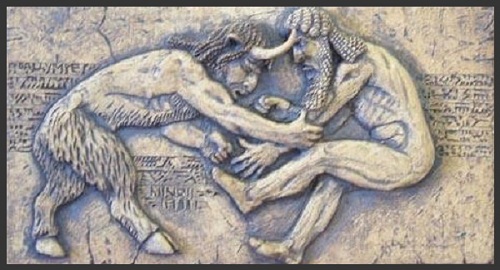
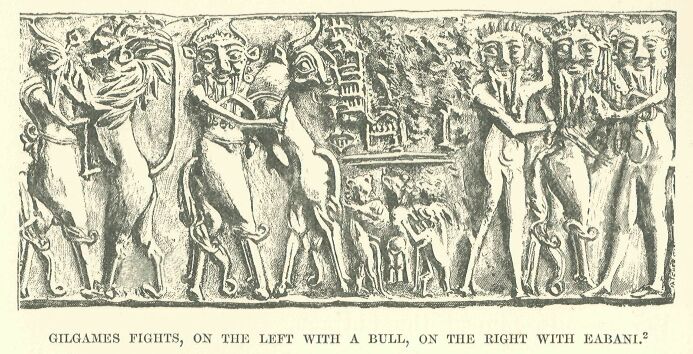
Gilgamesh, left and Eabani (Enkidu) on the right.  http://www.gutenberg.org/files/17323/17323-h/images/060.jpg

Gilgamesh, left and Eabani (Enkidu) on the right.
http://www.gutenberg.org/files/17323/17323-h/images/060.jpg

The gods themselves added their prayers to those of the oppressed people, and Aruru at length agreed to create a champion against Gilgamesh.

“Upon hearing these words (so runs the narrative), Aruru conceived a man (in the image) of Anu in her mind. Aruru washed her hands, she broke off a piece of clay, she cast it on the ground. Thus she created Eabani, the hero.”

When the creation of this champion was finished his appearance was that of a wild man of the mountains.

“The whole of his body was (covered) with hair, he was clothed with long hair like a woman. His hair was luxuriant, like that of the corn-god. He knew (not) the land and the inhabitants thereof, he was clothed with garments as the god of the field. With the gazelles he ate herbs, with the beasts he slaked his thirst, with the creatures of the water his heart rejoiced.”

In pictorial representations on cylinder-seals and elsewhere Eabani is depicted as a sort of satyr, with the head, arms, and body of a man, and the horns, ears, and legs of a beast. As we have seen, he is a type of beast-man, a sort of Caliban, ranging with the beasts of the field, utterly ignorant of the things of civilization.”

Lewis Spence, Myths and Legends of Babylonia and Assyria, 1917, pp. 160-3.

Nebo, God of Wisdom, God of Writing

In Semitic days, Zarpanit, the inheritor of all these old traditions and worships, fell from her high estate. She ceased to be the goddess of wisdom, the voice of the deep revealing the secrets of heaven to the diviner and priest; she became merely the female shadow and companion of Merodach, to whom a shrine was erected at the entrance to his temple.

Her distinctive attributes all belong to the pre-Semitic epoch; with the introduction of a language which recognized gender, she was lost in the colourless throng of Ashtaroth or Baalat, the goddesses who were called into existence by the masculine Baalim.

Zarpanit, however, had something to do with the prominence given to Nebo in the Babylonian cult. Nebo, the son of Merodach and Zarpanitu, had, as we have seen, a chapel called E-Zida within the precincts of the great temple of his father.

E-Zida, “the constituted house,” derived its name from the great temple of Borsippa, the suburb of Babylon, the ruins of which are now known to travelers as the Birs-i-Nimrúd. Borsippa, it would seem, had once been an independent town, and Nebo, or the prototype of Nebo, had been its protecting deity.

In the middle of the city rose E-Zida, the temple of Nebo and Nana Tasmit, with its holy of holies, “the supreme house of life,” and its lofty tower termed “the house of the seven spheres of heaven and earth.” It had been founded, though never finished, according to Nebuchadnezzar, by an ancient king.

For long centuries it had remained a heap of ruin, until restored by Nebuchadnezzar, and legends had grown up thickly around it. It was known as the tul ellu, “the pure” or “holy mound,” and one of the titles of Nebo accordingly was “god of the holy mound.”

The word Nebo is the Semitic Babylonian Nabiu or Nabû. It means the proclaimer,” “the prophet,” and thus indicates the character of the god to whom it was applied. Nebo was essentially the proclaimer of the mind and wishes of Merodach.

He stood to Merodach in the same relation that an older mythology regarded Merodach as standing to Ea. While Merodach was rather the god of healing, in accordance with his primitively solar nature, Nebo was emphatically the god of science and literature.

The communication of the gifts of wisdom, therefore, which originally emanated from Ea, was thus shared between Merodach and his son. At Babylon, the culture-god of other countries was divided into two personalities, the one conveying to man the wisdom that ameliorates his condition, the other the knowledge which finds its expression in the art of writing.”

A.H. Sayce, Lectures on the Origin and Growth of Religion as Illustrated by the Religion of the Ancient Babylonians, 5th ed., London, 1898, pp. 112-3.

Triads and Feminine Reflections in Babylonian Religion

“Even at Babylon, however, Merodach did not stand alone. He shared his divine honours, as we have seen, with his wife Zarpanitu and his son Nebo.

The old Accadian cult seems to have had a fancy for trinities or triads, originating perhaps in the primary astronomical triad of the Sun-god, the Moon-god and the Evening Star.

The Accadian triad usually consisted of male deities. The Semites, however, as I hope to point out in the next Lecture, introduced a new idea, that of sex, into the theology of the country. Every god was provided with his female reflection, who stood to him in the relation of the wife to the husband.

Baal, accordingly, had his female reflex, his “face,” as it was termed, Bilat or Beltis. By the side of the Baal of Babylon, therefore, stood Beltis, “the lady” by the side of her “lord.”

Her local name mas Zarpanitu, which a punning etymology subsequently turned into Zir-banitu, “creatress of seed,” sometimes written Zir-panitu, with an obvious  play on the word panu, or “face.”

Zarpanitu was of purely Semitic origin. But she was identified with an older Accadian divinity, Gasmu, “the wise one,” the fitting consort of a deity whose office it was to convey the wishes of the god of wisdom to suffering humanity.

The Accadian goddess, however, must originally have stood rather in the relation of mother than of wife to the primitive Merodach. She was entitled “the lady of the deep,” “the mistress of the abode of the fish,” and “the voice of the deep.”

Hence she must have ranked by the side of Ea, the fish-god and “lord of the deep;” and in the title “voice” or “incantation of the deep,” we may see a reference to the ideas which caused Ea to become the god of wisdom, and brought the fish-god Oannes out of the Persian Gulf to carry culture and knowledge to the inhabitants of Chaldea.

In the roar of the sea-waves, the early dwellers on the shores of the Gulf must have heard the voice of heaven, and their prophets and diviners must have discovered in it a revelation of the will of the gods.

It is not surprising, therefore, if Zarpanit was specially identified with the goddess Lakhamun, who was worshipped in the sacred island of Dilmun, or with the goddess Elagu, whose name was revered in the mountains of Elam.”

A.H. Sayce, Lectures on the Origin and Growth of Religion as Illustrated by the Religion of the Ancient Babylonians, 5th ed., London, 1898, pp. 110-1.

Plato on Time

“When the father creator saw the creature which he had made moving and living, the created image of the eternal gods, he rejoiced, and in his joy determined to make the copy still more like the original; and as this was eternal, he sought to make the universe eternal, so far as might be.

Now the nature of the ideal being was everlasting, but to bestow this attribute in its fulness upon a creature was impossible.

Wherefore he resolved to have a moving image of eternity, and when he set in order the heaven, he made this image eternal but moving according to number, while eternity itself rests in unity; and this image we call time.

For there were no days and nights and months and years before the heaven was created, but when he constructed the heaven he created them also.

They are all parts of time, and the past and future are created species of time, which we unconsciously but wrongly transfer to the eternal essence; for we say that he “was,” he “is,” he “will be,” but the truth is that “is” alone is properly attributed to him, and that “was” and “will be” only to be spoken of becoming in time, for they are motions, but that which is immovably the same cannot become older or younger by time, nor ever did or has become, or hereafter will be, older or younger, nor is subject at all to any of those states which affect moving and sensible things and of which generation is the cause.

These are the forms of time, which imitates eternity and revolves according to a law of number. Moreover, when we say that what has become is become and what becomes is becoming, and that what will become is about to become and that the non-existent is non-existent–all these are inaccurate modes of expression. But perhaps this whole subject will be more suitably discussed on some other occasion. 

Time, then, and the heaven came into being at the same instant in order that, having been created together, if ever there was to be a dissolution of them, they might be dissolved together.

It was framed after the pattern of the eternal nature, that it might resemble this as far as was possible; for the pattern exists from eternity, and the created heaven has been, and is, and will be, in all time. Such was the mind and thought of God in the creation of time.

The sun and moon and five other stars, which are called the planets, were created by him in order to distinguish and preserve the numbers of time; and when he had made their several bodies, he placed them in the orbits in which the circle of the other was revolving–in seven orbits seven stars.

First, there was the moon in the orbit nearest the earth, and next the sun, in the second orbit above the earth; then came the morning star and the star sacred to Hermes, moving in orbits which have an equal swiftness with the sun, but in an opposite direction; and this is the reason why the sun and Hermes and Lucifer overtake and are overtaken by each other.

To enumerate the places which he assigned to the other stars, and to give all the reasons why he assigned them, although a secondary matter, would give more trouble than the primary. These things at some future time, when we are at leisure, may have the consideration which they deserve, but not at present.”

Plato, Timaeus, 360 BCE. Translated by Benjamin Jowett.

The Puzzle of Marduk

“Was Merodach himself an Accadian or a Semitic deity? The names of the kings belonging to the first dynasty of Babylon are mostly Semitic; it might therefore be supposed that the deity they worshipped was Semitic also.

And so undoubtedly was the Merodach of the historical age, the great Bel or Baal of Babylon. But we must remember that the foundation of Babylon went back into the dim night of the past far beyond the era of its first dynasty of Semitic kings, and that its very name was but a translation of the older Ka-dimira, “gate of the god.”

The temple of Merodach, moreover, bore, up to the last, not a Semitic, but an Accadian designation. As we shall see, along with the older culture the Semitic settlers in Babylonia borrowed a good deal of the theology of the Accadian people, modifying it in accordance with their own beliefs, and identifying its gods and demons with their own Baalim.

Marduk.

Marduk.

It would not be surprising, then, if we found that Merodach also had once been an Accadian divinity, though his attributes, and perhaps also his name, differed very considerably from those of the Semitic Bel.

Even after the Romans had identified their Saturn with the Kronos of the Greeks, the essential characteristics of the two deities remained altogether different.”

A.H. Sayce, Lectures on the Origin and Growth of Religion as Illustrated by the Religion of the Ancient Babylonians, 5th ed., London, 1898, p. 105.

Elder and Younger Bel

The Bel of this legend, who has settled the places of the Sun and the Moon in the sky, is not the Babylonian Bel, but the older Bel of Nipur, from whom Merodach, the Bel of Babylon, had afterwards to be distinguished.

The Accadian original of the poem belongs to a very early epoch, before the rise of Babylon, when the supreme Bel of the Semitic inhabitants of Babylonia was still the god whom the Accadians called Mul-lilla, “the lord of the lower world.”

This Bel or Mul-lilla fades into the background as the Semitic element in Babylonian religion became stronger and the influence of Babylon greater, though the part that he played in astronomical and cosmological lore, as well as his local cult at Nipur, kept his memory alive; while the dreaded visitants of night, the demoniac lilu and lilat or lilith, from the lower world, preserved a faint memory of the spirits of which he had once been the chief.

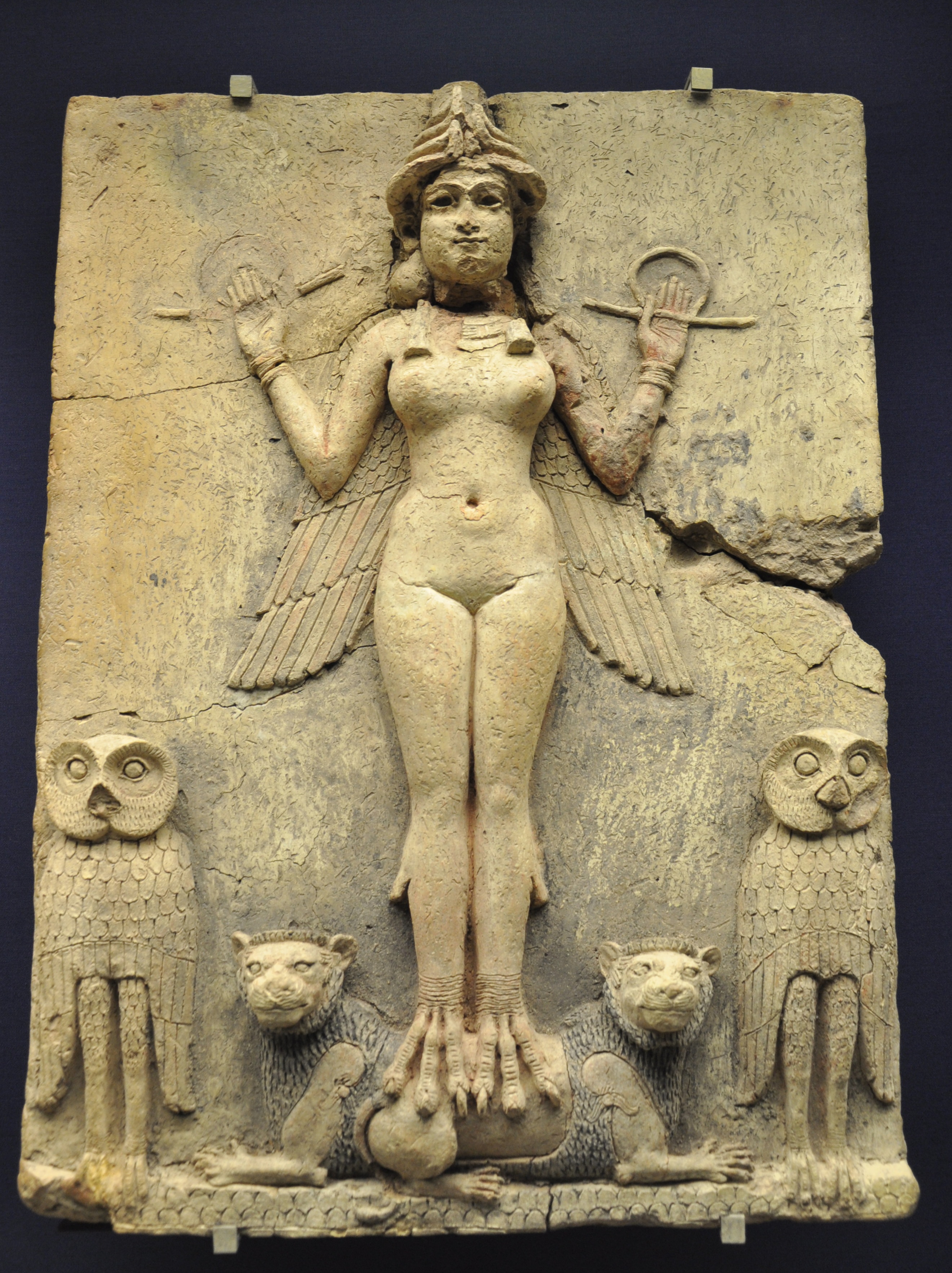
Burney Relief, Babylon (1800-1750 BCE). The figure in the relief was sometimes identified with Lilith, based on a misreading of an outdated translation of the Epic of Gilgamesh. Modern research has identified the figure as either Ishtar or Ereshkigal. https://upload.wikimedia.org/wikipedia/commons/1/19/Burney_Relief_Babylon_-1800-1750.JPG

Burney Relief, Babylon (1800-1750 BCE). The figure in the relief was sometimes identified with Lilith, based on a misreading of an outdated translation of the Epic of Gilgamesh. Modern research has identified the figure as either Ishtar or Ereshkigal.
https://upload.wikimedia.org/wikipedia/commons/1/19/Burney_Relief_Babylon_-1800-1750.JPG

 One by one, however, the attributes that had formerly attached to the older Bel were absorbed by the younger Bel of Babylon.

It was almost as it was in Greece, where the older gods were dethroned by their own offspring; in the Babylonia of Nebuchadnezzar and Nabonidos, it was the younger gods–Merodach, Sin and Samas–to whom vows were the most often made and prayer the most often ascended.

Such was the latest result of the local character of Babylonian worship: the younger gods were the gods of the younger Babylonian cities, and the god of Babylon, though he might be termed “the first-born of the gods,” was in one sense the youngest of them all.

The title, however, “first-born of the gods” was of the same nature as the other title, “prince of the world,” bestowed upon him by his grateful worshippers. It meant little else than that Babylon stood at the head of the world, and that its god must therefore be the first-born, not of one primeval deity, but of all the primeval deities acknowledged in Chaldea.

According to the earlier faith, he was the first-born of Ea only. Ea was god of the deep, both of the atmospheric deep upon which the world floats, and of that watery deep, the Okeanos of Homer, which surrounds the earth like a coiled serpent.

All streams and rivers were subject to his sway, for they flowed into that Persian Gulf which the ignorance of the primitive Chaldean imagined to be the ocean-stream itself. It was from the Persian Gulf that tradition conceived the culture and civilisation of Babylonia to have come, and Ea was therefore lord of wisdom as well as lord of the deep.

His son Merodach was the minister of his counsels, by whom the commands of wisdom were carried into practice. Merodach was thus the active side of his father Ea; to use the language of Gnosticism, he was the practical activity that emanates from wisdom.”

A.H. Sayce, Lectures on the Origin and Growth of Religion as Illustrated by the Religion of the Ancient Babylonians, 5th ed., London, 1898, p. 103-4.

Marduk vs. Tiamat

Merodach advances to the fight armed with a club and bow which Anu had placed in his hand and which subsequently became a constellation, as well as with his own peculiar weapon which hung behind his back. It was shaped like a sickle, and is the αρπη or khereb with which Greek mythology armed the Asiatic hero Perseus.

The struggle was long and terrible. Tiamat opened her month to swallow the god, but he thrust a storm-wind down her throat, and the monster was burst asunder, while her allies fled in terror before the victorious deity.

The combat is represented in stone in one of the Assyrian bas-reliefs now in the British Museum. There we can see the demon as she appeared to the Assyrians, with claws and wings, a short tail, and horns upon the head.

Battle between Marduk (Bel) and Tiamat. Drawn from a bas-relief from the Palace of Ashur-nasir-pal, King of Assyria, 885-860 B.C., at Nimrûd. British Museum, Nimrûd Gallery, Nos. 28 and 29. http://bharatkalyan97.blogspot.com/2013/06/tablet-of-destinies.html

Battle between Marduk (Bel) and Tiamat. Drawn from a bas-relief from the Palace of Ashurbanipal, King of Assyria, 885-860 B.C., at Nimrûd.
British Museum, Nimrûd Gallery, Nos. 28 and 29.
http://bharatkalyan97.blogspot.com/2013/06/tablet-of-destinies.html

When we remember the close parallelism that exists between this conflict of Merodach with Tiamat, and the war recorded in the Apocalypse between Michael and “the great dragon,” it is difficult not to trace in the lineaments of Tiamat the earliest portraiture of the mediaeval devil.”

A.H. Sayce, Lectures on the Origin and Growth of Religion as Illustrated by the Religion of the Ancient Babylonians, 5th ed., London, 1898, p. 102.

The Gilgamesh Epic

“The most important of the various mythological strata underlying the Gilgamesh myth is probably that concerning Eabani, who, as has been said, is a type of primitive man, living among the beasts of the field as one of themselves.

The "animal man" Enkidu (aka Eabani) defeating the King of Erech, Gilgamesh, during their first encounter.

The “animal man” Enkidu (aka Eabani) defeating the King of Erech, Gilgamesh, during their first encounter.

But he is also, according to certain authorities, a form of the sun-god, even as Gilgamesh himself. Like the hero of Erech, he rises to the zenith of his powers in a triumphal progress, then descends into the underworld.

He is not lost sight of, however, but lives in the memory of his friend Gilgamesh; and in the XIIth tablet he is temporarily brought forth from the underworld (that is, his ghost, or utukkii), which in a dim and shadowy fashion may typify the daily restoration of the sun.

Another important stratum of myth is that which concerns Ut-Napishtim, the Babylonian Noah; but whereas the myths of Eabani and Gilgamesh, though still distinguishable, have become thoroughly fused, the deluge story of which Ut-Napishtim is the hero has been inserted bodily into the XIth tablet of the epic, being related to Gilgamesh by Ut-Napishtim himself.

When he first appears in the narrative he has the attributes and powers of a god, having received these for his fidelity to the gods during the flood, from whose waters he alone of all mankind escaped.

The object of his narrative in the Gilgamesh epic seems to be to point out to the hero that only the most exceptional circumstances—unique circumstances, indeed—can save man from his doom.

Other distinct portions of the epic are the battle with the monster Khumbaba, the episode of Ishtar’s love for Gilgamesh, the fight with the sacred bull of Anu, and the search for the plant of life. These, whatever their origin, have become naturally incorporated with the story of Gilgamesh.

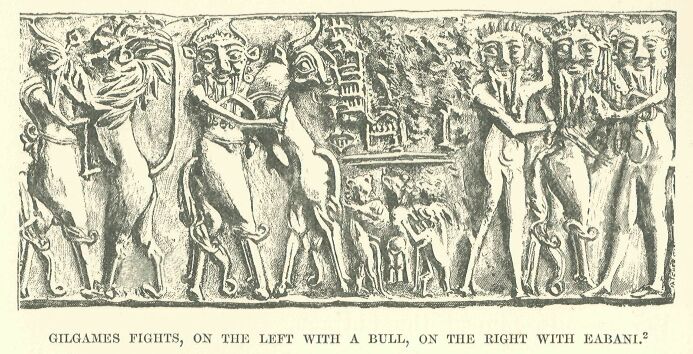
Gilgamesh defeating the Bull of Heaven.

Gilgamesh defeating the Bull of Heaven.

But besides the various historical and mythical elements herein presented, there is also a certain amount of Babylonian religious doctrine, evident to some extent in the XIth tablet (which points the moral that all men must die), but doubly so in the XIIth tablet, wherein the shade of Eabani appears to Gilgamesh, relates the misfortunes of the unburied dead or of those uncared for after death, and inculcates care for the deceased as the only means whereby they may evade the grievous woes which threaten them in the underworld.

Let us examine in detail the Gilgamesh epic as we have it in the broken fragments which remain to us. The Ist and Ilnd tablets are much mutilated. A number of fragments are extant which belong to one or other of these two, but it is not easy to say where the Ist ends and the Ilnd begins.

One fragment would seem to contain the very beginning of the Ist tablet—a sort of general preface to the epic, comprising a list of the advantages to be derived from reading it. After this comes a fragment whose title to inclusion in the epic is doubtful. It describes a siege of the city of Erech, but makes no mention of Gilgamesh.

The woeful condition of Erech under the siege is thus picturesquely detailed :

“She asses (tread down) their young, cows (turn upon) their calves. Men cry aloud like beasts, and maidens mourn like doves. The gods of strong-walled Erech are changed to flies, and buzz about the streets.

The spirits of strong-walled Erech are changed to serpents, and glide into holes. For three years the enemy besieged Erech, and the doors were barred, and the bolts were shot, and Ishtar did not raise her head against the foe.”

If this fragment be indeed a portion of the Gilgamesh epic, we have no means of ascertaining whether Gilgamesh was the besieger, or the raiser of the siege, or whether he was concerned in the affair at all.”

Lewis Spence, Myths and Legends of Babylonia and Assyria, 1917, pp. 159-61.

E-Sagila: Temple of the Sun

“May we not conclude, then, that originally Merodach also was a solar deity, the particular Sun-god, in fact, whose worship was carried on at Babylon?

The conclusion is verified by the express testimony of the ritual belonging to Merodach’s temple E-Sagila. Here we read that

“In the month Nison, on the second day, two hours after nightfall, the priest must come and take of the waters of the river, must enter into the presence of Bel; and putting on a stole in the presence of Bel, must say this prayer:

“0 Bel, who in his strength has no equal! O Bel, blessed sovereign, lord of the world, seeking after the favour of the great gods, the lord who in his glance has destroyed the strong, lord of kings, light of mankind, establisher of faith!

0 Bel, thy sceptre is Babylon, thy crown is Borsippa, the wide heaven is the dwelling-place of thy liver. …0 lord of the world, light of the spirits of heaven, utterer of blessings, who is there whose mouth murmurs not of thy righteousness, or speaks not of thy glory, and celebrates not thy dominion?

0 lord of the world, who dwellest in the temple of the Sun, reject not the hands that are raised to thee; be merciful to thy city Babylon, to E-Sagila thy temple incline thy face; grant the prayers of thy people the sons of Babylon.”

Nothing can be more explicit than the statement that E-Sagila, the temple of Merodach, was also the temple of the Sun. We thus come to understand the attributes that are ascribed to Merodach and the language that is used of him.

He is “the light of the spirits of heaven,” even as the Son-god, … is “the illuminator of darkness” whose face is beheld by the spirits of the earth. The wide heaven is naturally his dwelling-place, and he raises the dead to life as the sun of spring revivifies the dead vegetation of winter.

The part that he plays in the old mythological poems, in the poems, that is, which embody the ancient myths and legends of Babylonia, is now fully explained. One of the most famous of these was the story of the combat between Merodach and Tiamat, the dragon of darkness and chaos.”

A.H. Sayce, Lectures on the Origin and Growth of Religion as Illustrated by the Religion of the Ancient Babylonians, 5th ed., London, 1898, pp. 100-102.

Marduk as Sun God of Babylon

Here Merodach, it will be observed, though “lord of all that exists,” is nevertheless only the first-born of the gods.

There were gods older than he, just as there were cities older than Babylon. He could not therefore be absolute lord of the world; it was only within Babylon itself that this was the case; elsewhere his rule was shared with others.

Hence it was that while Nebuchadnezzar as a native of Babylon was the work of his hands, outside Babylon there were other creators and other lords. This fact is accentuated in an inscription of Nabonidos, belonging to the earlier part of his reign, in which Merodach is coupled with the Moon-god of Ur and placed on an equal footing with him.

One of the epithets applied by Nebuchadnezzar to Merodach is that of riminu, or “merciful.” It is indeed a standing epithet of the god. Merodach was the intercessor between the gods and men, and the interpreter of the will of Ea, the god of wisdom.

In an old bilingual hymn he is thus addressed: “Thou art Merodach, the merciful lord who loves to raise the dead to life.” The expression is a remarkable one, and indicates that the Babylonians were already acquainted with a doctrine of the resurrection at an early period.

Merodach’s attribute of mercy is coupled with his power to raise the dead. The same expression occurs in another of these bilingual hymns, which I intend to discuss in a future Lecture…

“(Thou art) the king of the land, the lord of the world!

0 firstborn of Ea, omnipotent over heaven and earth.

0 mighty lord of mankind, king of (all) lands,

(Thou art) the god of gods,

(The prince) of heaven and earth who hath no rival,

The companion of Anu and Bel (Mul-lil),

The merciful one among the gods,

The merciful one who loves to raise the dead to life,

Merodach, king of heaven and earth,

King of Babylon, lord of E-Sagila,

King of E-Zida, king of E-makh-tilla (the supreme house of life),

Heaven and earth are thine!

The circuit of heaven and earth is thine,

The incantation that gives life is thine,

The breath that gives life is thine,

The holy writing of the mouth of the deep is thine:

Mankind, even the black-headed race (of Accad),

All living souls that have received a name, that exist in the world,

The four quarters of the earth wheresoever they are,

All the angel-hosts of heaven and earth

(Regard) thee and (lend to thee) an ear.”

[ … ]

A.H. Sayce, Lectures on the Origin and Growth of Religion as Illustrated by the Religion of the Ancient Babylonians, 5th ed., London, 1898, pp. 98-102.

Temple of Bel, Temple of Marduk, Temple of Babylon, E-Sagila

“He says of it:

Ka-khilibu, the gate of glory, as well as the gate of E-Zida within E-Sagila, I made as brilliant as the sun. The holy seats, the place of the gods who determine destiny, which is the place of the assembly (of the gods), the holy of holies of the gods of destiny, wherein on the great festival (Zagmuku) at the beginning of the year, on the eighth and the eleventh days (of the month), the divine king (Merodach), the god of heaven and earth, the lord of heaven, descends, while the gods in heaven and earth, listening to him with reverential awe and standing humbly before him, determine therein a destiny of long-ending days, even the destiny of my life; this holy of holies, this sanctuary of the kingdom, this sanctuary of the lordship of the first-born of the gods, the prince, Merodach, which a former king had adorned with silver, I overlaid with glittering gold and rich ornament.”

Just within the gate was the “seat” or shrine of the goddess Zarpanit, the wife of Merodach, perhaps to be identified with that Succoth-benoth whose image, we are told in the Old Testament, was made by the men of Babylon.

E-Zida, “the firmly-established temple,” was the chapel dedicated to Nebo, and derived its name from the great temple built in honour of that deity at Borsippa. As Nebo was the son of Merodach, it was only fitting that his shrine should stand within the precincts of his father’s temple, by the side of the shrine sacred to his mother Zarpanit.

It was within the shrine of Nebo, the god of prophecy, that the parakku, or holy of holies, was situated, where Merodach descended at the time of the great festival at the beginning of the year, and the divine oracles were announced to the attendant priests.

The special papakha or sanctuary of Merodach himself was separate from that of his son. It went by the name of E-Kua, “the house of the oracle,” and probably contained the golden statue of Bel mentioned by Herodotus.

Nebuchadnezzar tells us that he enriched its walls with ”glittering gold.” Beyond it rose the stately ziggurat, or tower of eight stages, called E-Temen-gurum, “the house of the foundation-stone of heaven and earth.” As was the case with the other towers of Babylonia and Assyria, its topmost chamber was used as an observatory.

This illustration depicts the dual ziggurats of E-temen-anki and the Temple of Bel, conflating them as E-Sagila, the Temple of Marduk.  http://www.dalamatiacity.com/urantia-clues23.htm

This illustration depicts the dual ziggurats of E-temen-anki and the Temple of Bel, conflating them as E-Sagila, the Temple of Marduk.
http://www.dalamatiacity.com/urantia-clues23.htm

No temple was complete without such a tower; it was to the Babylonian what the high-places were to the inhabitants of a mountainous country like Canaan. It takes us back to an age when the gods were believed to dwell in the visible sky, and when therefore man did his best to rear his altars as near to them as possible. “Let us build us a city and a tower,” said the settlers in Babel, “whose top may reach unto heaven.”

 The Babylonian Bel, accordingly, was Merodach, who watched over the fortunes of Babylon and the great temple there which had been erected in his honour. He was not the national god of Babylonia, except in so far as the city of Babylon claimed to represent the whole of Babylonia; he was simply the god of the single city of Babylon and its inhabitants.

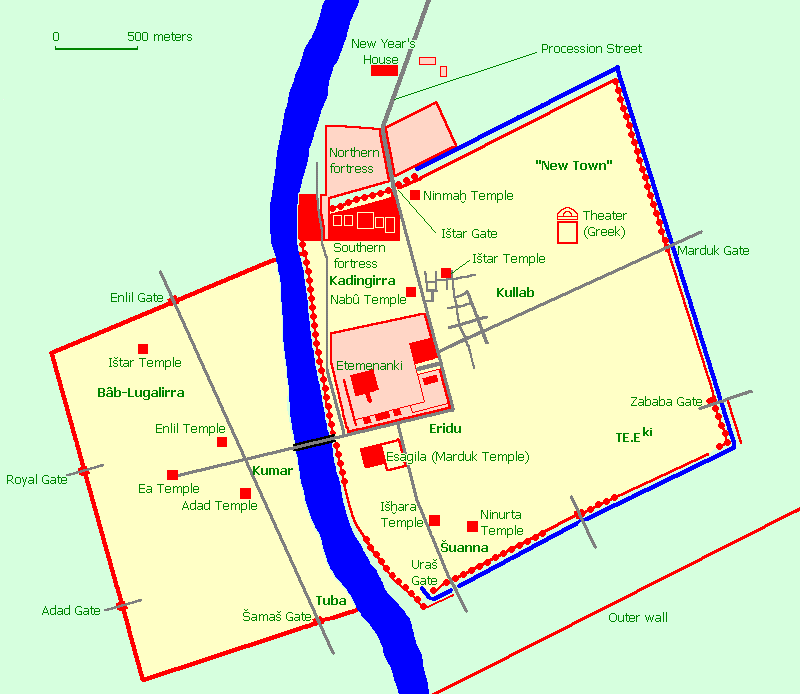
This map depicts more clearly the relative positions of Etemenanki and the Temple of Marduk.  Map of Babylon Creator Jona Lendering Licence Attribution-NonCommercial-ShareAlike 4.0 International Linked Babylon, Babylonian Empire, Capture of Babylon (Herodotus), Esagila, Etemenanki (the "Tower of Babel"), Zopyrus Categories Babylonia http://www.livius.org/pictures/a/maps/map-of-babylon/ http://www.livius.org/place/etemenanki/

This map depicts more clearly the relative positions of Etemenanki and the Temple of Marduk.
Map of Babylon
Creator
Jona Lendering
Licence
Attribution-NonCommercial-ShareAlike 4.0 International
Linked
Babylon, Babylonian Empire, Capture of Babylon (Herodotus), Esagila, Etemenanki (the “Tower of Babel”), Zopyrus
Categories
Babylonia
http://www.livius.org/pictures/a/maps/map-of-babylon/
http://www.livius.org/place/etemenanki/

He was but one Baal out of many Baalim, supreme only when his worshippers were themselves supreme. It was only when a Nebuchadnezzar or a Khammuragas was undisputed master of Babylonia that the god they adored became “the prince of the gods.”

But the other gods maintained their separate positions by his side, and in their own cities would have jealously resented any interference with their ancient supremacy. As we have seen, Nabonidos brought upon himself the anger of heaven because he carried away the gods of Marad and Kis and other towns to swell the train of Merodach in his temple at Babylon.”

 A.H. Sayce, Lectures on the Origin and Growth of Religion as Illustrated by the Religion of the Ancient Babylonians, 5th ed., London, 1898, pp. 94-7.

Plato on the Creation

“Now the creation took up the whole of each of the four elements; for the Creator compounded the world out of all the fire and all the water and all the air and all the earth, leaving no part of any of them nor any power of them outside.

His intention was, in the first place, that the animal should be as far as possible a perfect whole and of perfect parts: secondly, that it should be one, leaving no remnants out of which another such world might be created: and also that it should be free from old age and unaffected by disease.

Considering that if heat and cold and other powerful forces which unite bodies surround and attack them from without when they are unprepared, they decompose them, and by bringing diseases and old age upon them, make them waste away–for this cause and on these grounds he made the world one whole, having every part entire, and being therefore perfect and not liable to old age and disease.

And he gave to the world the figure which was suitable and also natural.

Now to the animal which was to comprehend all animals, that figure was suitable which comprehends within itself all other figures. Wherefore he made the world in the form of a globe, round as from a lathe, having its extremes in every direction equidistant from the centre, the most perfect and the most like itself of all figures; for he considered that the like is infinitely fairer than the unlike.

This he finished off, making the surface smooth all around for many reasons; in the first place, because the living being had no need of eyes when there was nothing remaining outside him to be seen; nor of ears when there was nothing to be heard; and there was no surrounding atmosphere to be breathed; nor would there have been any use of organs by the help of which he might receive his food or get rid of what he had already digested, since there was nothing which went from him or came into him: for there was nothing beside him.

Of design he was created thus, his own waste providing his own food, and all that he did or suffered taking place in and by himself.

For the Creator conceived that a being which was self-sufficient would be far more excellent than one which lacked anything; and, as he had no need to take anything or defend himself against any one, the Creator did not think it necessary to bestow upon him hands: nor had he any need of feet, nor of the whole apparatus of walking; but the movement suited to his spherical form was assigned to him, being of all the seven that which is most appropriate to mind and intelligence; and he was made to move in the same manner and on the same spot, within his own limits revolving in a circle.

All the other six motions were taken away from him, and he was made not to partake of their deviations. And as this circular movement required no feet, the universe was created without legs and without feet.

Such was the whole plan of the eternal God about the god that was to be, to whom for this reason he gave a body, smooth and even, having a surface in every direction equidistant from the centre, a body entire and perfect, and formed out of perfect bodies.

And in the centre he put the soul, which he diffused throughout the body, making it also to be the exterior environment of it; and he made the universe a circle moving in a circle, one and solitary, yet by reason of its excellence able to converse with itself, and needing no other friendship or acquaintance. Having these purposes in view he created the world a blessed god.”

Plato, Timaeus, 360 BCE. (Translated by Benjamin Jowett).

Atlantis

“Many great and wonderful deeds are recorded of your state in our histories. But one of them exceeds all the rest in greatness and valour. For these histories tell of a mighty power which unprovoked made an expedition against the whole of Europe and Asia, and to which your city put an end.

This power came forth out of the Atlantic Ocean, for in those days the Atlantic was navigable; and there was an island situated in front of the straits which are by you called the Pillars of Heracles; the island was larger than Libya and Asia put together, and was the way to other islands, and from these you might pass to the whole of the opposite continent which surrounded the true ocean; for this sea which is within the Straits of Heracles is only a harbour, having a narrow entrance, but that other is a real sea, and the surrounding land may be most truly called a boundless continent.

Now in this island of Atlantis there was a great and wonderful empire which had rule over the whole island and several others, and over parts of the continent, and, furthermore, the men of Atlantis had subjected the parts of Libya within the columns of Heracles as far as Egypt, and of Europe as far as Tyrrhenia.

This vast power, gathered into one, endeavoured to subdue at a blow our country and yours and the whole of the region within the straits; and then, Solon, your country shone forth, in the excellence of her virtue and strength, among all mankind.

She was pre-eminent in courage and military skill, and was the leader of the Hellenes. And when the rest fell off from her, being compelled to stand alone, after having undergone the very extremity of danger, she defeated and triumphed over the invaders, and preserved from slavery those who were not yet subjugated, and generously liberated all the rest of us who dwell within the pillars.

But afterwards there occurred violent earthquakes and floods; and in a single day and night of misfortune all your warlike men in a body sank into the earth, and the island of Atlantis in like manner disappeared in the depths of the sea.

For which reason the sea in those parts is impassable and impenetrable, because there is a shoal of mud in the way; and this was caused by the subsidence of the island.”

Plato, Timaeus, 360 BCE. (Translated by Benjamin Jowett).

9,000 Years of Prehistory

“Solon marvelled at his words, and earnestly requested the priests to inform him exactly and in order about these former citizens.

You are welcome to hear about them, Solon, said the priest, both for your own sake and for that of your city, and above all, for the sake of the goddess who is the common patron and parent and educator of both our cities. She founded your city a thousand years before ours, receiving from the Earth and Hephaestus the seed of your race, and afterwards she founded ours, of which the constitution is recorded in our sacred registers to be eight thousand years old.

As touching your citizens of nine thousand years ago, I will briefly inform you of their laws and of their most famous action; the exact particulars of the whole we will hereafter go through at our leisure in the sacred registers themselves. If you compare these very laws with ours you will find that many of ours are the counterpart of yours as they were in the olden time.

In the first place, there is the caste of priests, which is separated from all the others; next, there are the artificers, who ply their several crafts by themselves and do not intermix; and also there is the class of shepherds and of hunters, as well as that of husbandmen; and you will observe, too, that the warriors in Egypt are distinct from all the other classes, and are commanded by the law to devote themselves solely to military pursuits; moreover, the weapons which they carry are shields and spears, a style of equipment which the goddess taught of Asiatics first to us, as in your part of the world first to you.

Then as to wisdom, do you observe how our law from the very first made a study of the whole order of things, extending even to prophecy and medicine which gives health, out of these divine elements deriving what was needful for human life, and adding every sort of knowledge which was akin to them.

All this order and arrangement the goddess first imparted to you when establishing your city; and she chose the spot of earth in which you were born, because she saw that the happy temperament of the seasons in that land would produce the wisest of men.

Wherefore the goddess, who was a lover both of war and of wisdom, selected and first of all settled that spot which was the most likely to produce men likest herself. And there you dwelt, having such laws as these and still better ones, and excelled all mankind in all virtue, as became the children and disciples of the gods.”

Plato, Timaeus, 360 BCE. (Translated by Benjamin Jowett).  

Plato, Timaeus, 360 BCE

” … In the Egyptian Delta, at the head of which the river Nile divides, there is a certain district which is called the district of Sais, and the great city of the district is also called Sais, and is the city from which King Amasis came.

The citizens have a deity for their foundress; she is called in the Egyptian tongue Neith, and is asserted by them to be the same whom the Hellenes call Athene; they are great lovers of the Athenians, and say that they are in some way related to them.

To this city came Solon, and was received there with great honour; he asked the priests who were most skilful in such matters, about antiquity, and made the discovery that neither he nor any other Hellene knew anything worth mentioning about the times of old.

On one occasion, wishing to draw them on to speak of antiquity, he began to tell about the most ancient things in our part of the world–about Phoroneus, who is called “the first man,” and about Niobe; and after the Deluge, of the survival of Deucalion and Pyrrha; and he traced the genealogy of their descendants, and reckoning up the dates, tried to compute how many years ago the events of which he was speaking happened.

Thereupon one of the priests, who was of a very great age, said: O Solon, Solon, you Hellenes are never anything but children, and there is not an old man among you. Solon in return asked him what he meant. I mean to say, he replied, that in mind you are all young; there is no old opinion handed down among you by ancient tradition, nor any science which is hoary with age. And I will tell you why.

There have been, and will be again, many destructions of mankind arising out of many causes; the greatest have been brought about by the agencies of fire and water, and other lesser ones by innumerable other causes. There is a story, which even you have preserved, that once upon a time Paethon, the son of Helioshaving yoked the steeds in his father’s chariot, because he was not able to drive them in the path of his father, burnt up all that was upon the earth, and was himself destroyed by a thunderbolt.

Now this has the form of a myth, but really signifies a declination of the bodies moving in the heavens around the earth, and a great conflagration of things upon the earth, which recurs after long intervals; at such times those who live upon the mountains and in dry and lofty places are more liable to destruction than those who dwell by rivers or on the seashore. And from this calamity the Nile, who is our never-failing saviour, delivers and preserves us.

When, on the other hand, the gods purge the earth with a deluge of water, the survivors in your country are herdsmen and shepherds who dwell on the mountains, but those who, like you, live in cities are carried by the rivers into the sea. Whereas in this land, neither then nor at any other time, does the water come down from above on the fields, having always a tendency to come up from below; for which reason the traditions preserved here are the most ancient.

The fact is, that wherever the extremity of winter frost or of summer does not prevent, mankind exist, sometimes in greater, sometimes in lesser numbers. And whatever happened either in your country or in ours, or in any other region of which we are informed–if there were any actions noble or great or in any other way remarkable, they have all been written down by us of old, and are preserved in our temples.

Whereas just when you and other nations are beginning to be provided with letters and the other requisites of civilized life, after the usual interval, the stream from heaven, like a pestilence, comes pouring down, and leaves only those of you who are destitute of letters and education; and so you have to begin all over again like children, and know nothing of what happened in ancient times, either among us or among yourselves.

As for those genealogies of yours which you just now recounted to us, Solon, they are no better than the tales of children. In the first place you remember a single deluge only, but there were many previous ones; in the next place, you do not know that there formerly dwelt in your land the fairest and noblest race of men which ever lived, and that you and your whole city are descended from a small seed or remnant of them which survived.

And this was unknown to you, because, for many generations, the survivors of that destruction died, leaving no written word. For there was a time, Solon, before the great deluge of all, when the city which now is Athens was first in war and in every way the best governed of all cities, is said to have performed the noblest deeds and to have had the fairest constitution of any of which tradition tells, under the face of heaven.”

Plato, Timaeus, 360 BCE. (Translated by Benjamin Jowett).

Herodotus on E-Sagila

“181. This wall then which I have mentioned is as it were a cuirass for the town, and another wall runs round within it, not much weaker for defence than the first but enclosing a smaller space.

And in each division of the city was a building in the midst, in the one the king’s palace of great extent and strongly fortified round, and in the other the temple of Zeus Belos with bronze gates, and this exists still up to my time and measures two furlongs each way, being of a square shape: and in the midst of the temple is built a solid tower measuring a furlong both in length and in breadth, and on this tower another tower has been erected, and another again upon this, and so on up to the number of eight towers.

An ascent to these has been built running outside round about all the towers; and when one reaches about the middle of the ascent one finds a stopping-place and seats to rest upon, on which those who ascend sit down and rest: and on the top of the last tower there is a large cell, and in the cell a large couch is laid, well covered, and by it is placed a golden table: and there is no image there set up nor does any human being spend the night there except only one woman of the natives of the place, whomsoever the god shall choose from all the woman, as say the Chaldeans who are the priests of this god.

182. These same men say also, but I do not believe them, that the god himself comes often to the cell and rests upon the couch, as happens likewise in the Egyptian Thebes according to the report of the Egyptians, for there also a woman sleeps in the temple of the Theban Zeus (and both these women are said to abstain from commerce with men), and as happens also with the prophetess of the god in Patara of Lykia, whenever there is one, for there is not always an Oracle there, but whenever there is one, then she is shut up during the nights in the temple within the cell.

183. There is moreover in the temple at Babylon another cell below, wherein is a great image of Zeus sitting, made of gold, and by it is placed a large table of gold, and his footstool and seat are of gold also; and, as the Chaldeans reported, the weight of the gold of which these things are made is eight hundred talents.

Outside this cell is an altar of gold; and there is also another altar of great size, where full-grown animals are sacrificed, whereas on the golden altar it is not lawful to sacrifice any but young sucklings only: and also on the larger altar the Chaldeans offer one thousand talents of frankincense every year at the time when they celebrate the feast in honour of this god.

There was moreover in these precincts still remaining at the time of Cyrus, a statue twelve cubits high, of gold and solid. This I did not myself see, but that which is related by the Chaldeans I relate. Against this statue Dareios the son of Hystaspes formed a design, but he did not venture to take it: it was taken however by Xerxes the son of Dareios, who also killed the priest when he forbade him to meddle with the statue. This temple, then, is thus adorned with magnificence, and there are also many private votive-offerings.”

G.C. Macaulay, trans., The History of Herodotus, 1890, pp. Book 1, Clio, 180.

Otto Rank, Citing Aelian on the Birth of Gilgamesh

“Aelian, who lived about 200 A.D., relates in his Animal Stories the history of a boy who was saved by an eagle:

“Animals have a characteristic fondness for man. An eagle is known to have nourished a child. I shall tell the entire story, in proof of my assertion.

When Senechoros reigned over the Babylonians, the Chaldean fortunetellers foretold that the son of the king’s daughter would take the kingdom from his grandfather; this verdict was a prophecy of the Chaldeans.

The king was afraid of this prophecy, and humorously speaking, he became a second Acrisius for his daughter, over whom he watched with the greatest severity. But his daughter, fate being wiser than the Babylonian, conceived secretly from an inconspicuous man.

For fear of the king, the guardians threw the child down from the acropolis, where the royal daughter was imprisoned. The eagle, with his keen eyes, saw the boy’s fall, and before the child struck the earth, he caught it on his back, bore it into a garden, and set it down with great care.

When the overseer of the place saw the beautiful boy, he was pleased with him and raised him. The boy received the name Gilgamesh, and became the king of Babylonia.

If anyone regards this as a fable, I have nothing to say, although I have investigated the matter to the best of my ability. Also of Achaemenes, the Persian, from whom the nobility of the Persians is derived, I learn that he was the pupil of an eagle.”

Otto Rank, Myth of the Birth of the Hero, 1914, pp. 26-7.

E-Sagila, The Great Temple of Bel in Babylon

The temple or “tomb”of Bêlos, as it was also called by the Greeks, was one of the wonders of the world.

Hêrodotos, quoting probably from an earlier author, describes it in the following terms :

“The temple of Zeus Bêlos,with bronze gates which remained up to my time, was a square building two furlongs every way. In the middle of the temple was a tower of solid masonry, a furlong in length and breadth, and upon this tower another tower had been erected, and upon that again another, and so on for eight towers.

And the ascent to them was by an incline which wound round all the towers on the outside. About the middle of the incline are a resting-place and seats, where those who ascend may sit and rest. In the topmost tower is a large shrine, within which is a large and well-appointed couch, with a golden table at its side.

But no image is set up there, nor does any one pass the night there except a single woman, a native of the country, whom the god selects for himself from among all the inhabitants, as is asserted by the Chaldeans, the priests of the god.

They further say, though I cannot believe it, that the god himself visits the shrine and takes his rest upon the couch. … There is another shrine below belonging to this Babylonian temple, and containing a great statue of Zeus [Bêlos] of gold in a sitting posture, and a great golden table is set beside it.

The pedestal and chair of the statue are of gold, and, as the Chaldeans used to say, the gold was as much as 800 talents in weight. Outside the shrine is a golden altar. There is also another great altar upon which full-grown sheep are sacrificed, for upon the golden altar only sucklings are allowed to be offered.

Upon the larger altar also the Chaldeans burn each year a thousand talents of frankincense at the time when they keep the festival of the god. In this part of the temple there was still at that time a figure of a man twelve cubits high, of solid gold.”

It is clear from this description that the great temple of Babylon resembled a large square enclosure formed by huge walls of brick, within which rose a tower in eight stages. Below the tower was a shrine or temple, and outside it two altars, the smaller one of gold for special offerings, while the larger one was intended for the sacrifice of sheep as well as for the burning of incense.

We learn a good deal about this temple from the inscriptions of Nebuchadnezzar, which show that although Hêrodotos was correct in his general description of the building, he has made mistakes in the matter of details.

The Temple itself stood on the east side of Babylon, and had existed since the age of Khammuragas (B.C. 2250), and the first dynasty which had made Babylon its capital. It bore the title of E-Sagila or E-Saggil, an Accadian name signifying “the house of the raising of the head.”

Its entrance also bore the Accadian title of Ka-khilibu, which Nebuchadnezzar renders “the gate of glory.”

 A.H. Sayce, Lectures on the Origin and Growth of Religion as Illustrated by the Religion of the Ancient Babylonians, 5th ed., London, 1898, pp. 92-4.

Implications of the Gilgamesh Epic

“Among the traditions concerning his birth is one related by Ælian (Historia Animalium, XII, 21) of Gilgamos (Gilgamesh), the grandson of Sokkaros. Sokkaros, who, according to Berossus, was the first king to reign in Babylonia after the deluge, was warned by means of divination that his daughter should bear a son who would deprive him of his throne.

Thinking to frustrate the designs of fate he shut her up in a tower, where she was closely watched. But in time she bore a son, and her attendants, knowing how wroth the King would be to learn of the event, flung the child from the tower.

But before he reached the ground an eagle seized him up and bore him off to a certain garden, where he was duly found and cared for by a peasant. And when he grew to manhood he became King of the Babylonians, having, presumably, usurped the throne of his grandfather.

Here we have a myth obviously of solar significance, conforming in every particular to a definite type of sun-legend. It cannot have been by chance that it became attached to the person of Gilgamesh.

Everything in the epic, too, is consonant with the belief that Gilgamesh is a sun-god—his connexion with Shamash (who may have been his father in the tradition given by Ælian, as well as the eagle which saved him from death), the fact that no mention is made of his father in the poem, though his mother is brought in more than once, and the assumption throughout the epic that he is more than human.

Given the key to his mythical character it is not hard to perceive in his adventures the daily (or annual) course of the sun, rising to its full strength at noonday (or mid-summer), and sinking at length to the western horizon, to return in due time to the abode of men.

Like all solar deities—like the sun itself—his birth and origin are wrapped in mystery. He is, indeed, one of the ‘fatal children,’ like Sargon, Perseus, or Arthur. When he first appears in the narrative he is already a full-grown hero, the ruler and (it would seem) oppressor of Erech.

His mother, Rimat-belit, is a priestess in the temple of Ishtar, and through her he is descended from Ut-Napishtim, a native of Shurippak, and the hero of the Babylonian flood-legend. Early in the narrative he is brought into contact with the wild man Eabani, originally designed for his destruction by the gods, but with whom he eventually concludes a firm friendship.

The pair proceed to do battle with the monster Khumbaba, whom they overcome, as they do also the sacred bull sent against them by Anu. Up to the end of the Vlth tablet their conquering and triumphant career is without interruption; Gilgamesh increases in strength as does the sun approaching the zenith.

At the Vllth tablet, however, his good fortune begins to wane. Eabani dies, slain doubtless by the wrath of Ishtar, whose love Gilgamesh has rejected with scorn; and the hero, mourning the death of his friend, and smitten with fear that he himself will perish in like manner, decides to go in search of his ancestor, Ut-Napishtim (who, as sole survivor of the deluge, has received from the gods deification and immortality), and learn of him the secret of eternal life.

His further adventures have not the triumphal character of his earlier exploits. Sunwise he journeys to the Mountain of the Sunset, encounters the scorpion-men, and crosses the Waters of Death. Ut-Napishtim teaches him the lesson that all men must die (he himself being an exception in exceptional circumstances), and though he afterwards gives Gilgamesh an opportunity of eating the plant of life, the opportunity is lost.

However, Ut-Napishtim cures Gilgamesh of a disease which he has contracted, apparently while crossing the Waters of Death, and he is finally restored to Erech.

In these happenings we see the gradual sinking of the sun into the underworld by way of the Mountain of the Sunset. It is impossible for the sun to attain immortality, to remain for ever in the land of the living; he must traverse the Waters of Death and sojourn in the underworld.

Yet the return of Gilgamesh to Erech signifies the fresh dawning of the day. It is the eternal struggle of day and night, summer and winter; darkness may conquer light, but light will emerge again victorious. The contest is unending.

Some authorities have seen in the division of the epic into twelve tablets a connexion with the months of the year or the signs of the zodiac. Such a connexion probably exists, but when we consider that the artificial division of the epic into tablets scarcely tallies with the natural divisions of the poem, it seems likely that the astrological significance of the former was given to the epic by the scribes of Nineveh, who were evidently at some pains to compress the matter into twelve tablets.

Of the astro-theological significance of the narrative itself (one of its most important aspects), we shall perhaps be better able to judge when we have considered it in detail.”

Lewis Spence, Myths and Legends of Babylonia and Assyria, 1917, pp. 156-9.

Spence on the Gilgamesh Epic

“The Gilgamesh epic ranks with the Babylonian myth of creation as one of the greatest literary productions of ancient Babylonia. The main element in its composition is a conglomeration of mythic matter, drawn from various sources, with perhaps a substratum of historic fact, the whole being woven into a continuous narrative around the central figure of Gilgamesh, prince of Erech.

It is not possible at present to fix the date when the epic was first written. Our knowledge of it is gleaned chiefly from mutilated fragments belonging to the library of Assur-bani-pal, but from internal and other evidence we gather that some at least of the traditions embodied in the epic are of much greater antiquity than his reign.

Thus a tablet dated 2100 b.c. contains a variant of the deluge story inserted in the XIth tablet of the Gilgamesh epic. Probably this and other portions of the epic existed in oral tradition before they were committed to writing—that is, in the remote Sumerian period.

Assur-bani-pal was an enthusiastic and practical patron of literature. In his great library at Nineveh (the nucleus of which had been taken from Calah by Sennacherib) he had gathered a vast collection of volumes, clay tablets, and papyri, most of which had been carried as spoil from conquered lands.

He also employed scribes to copy older texts, and this is evidently how the existing edition of the Gilgamesh epic came to be written. From the fragments now in the British Museum it would seem that at least four copies of the poem were made in the time of Assur-bani-pal.

They were not long permitted to remain undisturbed. The great Assyrian empire was already declining; ere long Nineveh was captured and its library scattered, while plundering hordes burnt the precious rolls of papyrus, and buried the clay tablets in the debris of the palace which had sheltered them.

There they were destined to lie for over 2000 years, till the excavations of Sir A. H. Layard, George Smith, and others brought them to light. It is true that the twelve tablets of the Gilgamesh epic (or rather, the fragments of them which have so far been discovered) are much defaced; frequently the entire sense of a passage is obscured by a gap in the text, and this, when nice mythological elucidations are in question, is no light matter.

Yet to such an extent has the science of comparative religion progressed in recent years that we are probably better able to read the true mythological significance of the epic than were the ancient Babylonians themselves, who saw in it merely an account of the wanderings and exploits of a national hero.

The epic, which centres round the ancient city of Erech, relates the adventures of a half-human, halfdivine hero, Gilgamesh by name, who is king over Erech.

Two other characters figure prominently in the narrative—Eabani, who evidently typifies primitive man, and Ut-Napishtim, the hero of the Babylonian deluge myth. Each of the three would seem to have been originally the hero of a separate group of traditions which in time became incorporated, more or less naturally, with the other two.

The first and most important of the trio, the hero Gilgamesh, may have been at one time a real personage, though nothing is known of him historically.[1] Possibly the exploits of some ancient king of Erech have furnished a basis for the narrative.

His name (for a time provisionally read Gisdhubar, or Izdubar, but now known to have been pronounced Gilgamesh[2]) suggests that he was not Babylonian but Elamite or Kassite in origin, and from indications furnished by the poem itself we learn that he conquered Erech (or relieved the city from a besieging force) at the outset of his adventurous career.

It has been suggested also that he was identical with the Biblical Nimrod, like him a hero of ancient Babylon; but there are no other grounds for the suggestion.

So much for the historical aspect of Gilgamesh. His mythological character is more easily established. In this regard he is the personification of the sun. He represents, in fact, the fusion of a great national hero with a mythical being.

Throughout the epic there are indications that Gilgamesh is partly divine by nature,though nothing specific is said on that head. His identity with the solar god is veiled in the popular narrative, but it is evident that he has some connexion with the god Shamash, to whom he pays his devotions and who acts as his patron and protector.”

Lewis Spence, Myths and Legends of Babylonia and Assyria, 1917, pp. 154-6.

Marduk of Babylon: Baal

” … Nebuchadnezzar may invoke Merodach as “the lord of the gods,” “the god of heaven and earth,” “the eternal, the holy, the lord of all things,” but he almost always couples him with other deities–Nebo, Sin or Gula–of whom he speaks in equally reverential terms.

Even Nabonidos uses language of Sin, the Moon-god, which is wholly incompatible with a belief in the exclusive supremacy of Merodach. He calls him “the lord of the gods of heaven and earth, the king of the gods and the god of gods, who dwell in heaven and are mighty.” Merodach was, in fact, simply the local god of Babylon.

Events had raised Babylon first to the dignity of the capital of Babylonia, and then of that of a great empire, and its presiding deity had shared its fortunes. It was he who had sent forth its people on their career of conquest; it was to glorify his name that he had given them victory.

The introduction of other deities on an equal footing with himself into his own peculiar seat, his own special city, was of itself a profanation, and quite sufficient to draw upon Nabonidos his vindictive anger. The Moon-god might be worshipped at Ur; it was out of place to offer him at Babylon the peculiar honours which were reserved for Merodach alone.

Here, then, is one of the results of that localisation of religious worship which was characteristic of Babylonia. Nabonidos not only offended the priests and insulted the gods of other cities by bringing their images into Babylon, he also in one sense impaired the monopoly which the local deity of Babylon enjoyed. He thus stirred up angry feelings on both sides.

Had he himself been free from the common belief of the Babylonian in the local character of his gods, he might have effected a revolution similar to that of Hezekiah; he had, however, the superstition which frequently accompanies antiquarian instincts, and his endeavour to make Babylon the common gathering-place of the Babylonian divinities was dictated as much by the desire to make all of them his friends as by political design.

Now who was this Merodach, this patron-god of Babylon, whose name I have had so often to pronounce? Let us see, first of all, what we can learn about him from the latest of our documents, the inscriptions of Nebuchadnezzar and his successors.

In these, Merodach appears as the divine protector of Babylon and its inhabitants. He has the standing title of Bilu or “lord,” which the Greeks turned into βμλος, and which is the same as the Baal of the Old Testament. The title is frequently used as a name, and is, in fact, the only name under which Merodach was known to the Greeks and Romans.

In the Old Testament also it is as Bel that he comes before us. When the prophet declares that “Bel boweth down” and is “gone into captivity,” he is referring to Merodach and the overthrow of Merodach’s city.

To the Babylonian, Merodach was pre-eminently the Baal or “lord,” like the Baalim or “lords” worshipped under special names and with special rites in the several cities of Canaan.”

 A.H. Sayce, Lectures on the Origin and Growth of Religion as Illustrated by the Religion of the Ancient Babylonians, 5th ed., London, 1898, pp. 90-2.

Civil Centralization = Religious Centralization

“Up to the last, Babylonian religion remained local. It was this local character that gives us the key to its origin and history, and explains much that would otherwise seem inconsistent and obscure.

The endeavour of Nabonidos to undermine its local character and to create a universal religion for a centralised Babylonia, was deeply resented by both priests and people, and ushered in the fall of the Babylonian empire. The fundamental religious idea which had underlain the empire had been the supremacy of Merodach, the god of Babylon, over all other gods, not the absorption of the deities of the subject nations into a common cult.

The policy of Nabonidos, therefore, which aimed at making Merodach, not primus inter pares, but absolute lord of captive or vassal deities, shocked the prejudices of the Babylonian people, and eventually proved fatal to its author.

In Cyrus, accordingly, the politic restorer of the captive populations and their gods to their old homes, the priests and worshippers of the local divinities saw the pious adherent of the ancient forms of faith, and the real favourite of Merodach himself.

Merodach had not consented to the revolutionary policy of Nabonidos; he had, on the contrary, sympathised with the wrongs of his brother gods in Babylonia and throughout the world, and had thus deserted his own city and the renegade monarch who ruled over it.

In all this there is a sharp contrast to the main religious conception which subsequently held sway over the Persian empire, as well as to that which was proclaimed by the prophets of Judah, and in the reforms of Hezekiah and Josiah was carried out practically by the Jewish kings. The Ahura-mazda whom Dareios invokes on the rock of Behistun is not only the lord of the gods, he is a lord who will not brook another god by his side.

A penciled illustration of the Behistun Inscription.  https://commons.wikimedia.org/wiki/File:Behistun_Inscription_Eger.png

A penciled illustration of the Behistun Inscription.
https://commons.wikimedia.org/wiki/File:Behistun_Inscription_Eger.png

The supreme god of the Persian monarch is as absolute as the Persian monarch himself. In the Persian empire which was organised by Dareios, centralisation became for the first time a recognised and undisputed fact, and political centralisation went hand-in-hand with religious centralisation as well.

In Judah, a theocracy was established on the ruins of the old beliefs which had connected certain localities with certain forms of divinity, and which found such naive expression in the words of David to Saul (1 Samuel xxvi. 19): “They have driven me out this day from abiding in the inheritance of the Lord, saying, Go, serve other gods.”

The destruction of the high-places and the concentration of the worship of Yahveh in Jerusalem, was followed by the ever-increasing conviction that Yahveh was not only a jealous God who would allow none other gods besides Himself; He was also a God who claimed dominion over the whole world.”

A.H. Sayce, Lectures on the Origin and Growth of Religion as Illustrated by the Religion of the Ancient Babylonians, 5th ed., London, 1898, pp. 89-90.

The Fall of Nabonidos

“The destruction of the local cults, the attempt to unify and centralise religious worship, was to the Rab-shakeh, as it was to the Babylonian scribes, and doubtless also to many of the Jews in the time of Hezekiah, an act of the grossest impiety.

An annalistic tablet, drawn up not long after the conquest of Babylonia by Cyrus, hints that before making his final attack on the country, the Elamite prince had been secretly aided by a party of malcontents in Chaldea itself.

It is at all events significant that as soon as the army of Nabonidos was defeated, the whole population at once submitted, and that even the capital, with its almost impregnable fortifications, threw open its gates.

The revolts which took place afterwards in the reigns of Dareios and Xerxes, and the extremities endured by the Babylonians before they would surrender their city, prove that their surrender was not the result of cowardice or indifference to foreign rule. The great mass of the people must have been discontented with Nabonidos and anxious for his overthrow.

The anger of Merodach and the gods, in fact, was but a convenient way of describing the discontent and anger of an important section of the Babylonians themselves. Nabonidos did not belong to the royal house of Nebuchadnezzar; he seems to have raised himself to the throne by means of a revolution, and his attempt at centralisation excited strong local animosities against him.

Religion and civil government were so closely bound up together, that civil centralisation meant religious centralisation also; the surest sign that the cities of Babylonia had been absorbed in the capital was that the images of the gods whose names had been associated with them from time immemorial were carried away to Babylon. The cities lost their separate existence along with the deities who watched over their individual fortunes.

The removal of the gods, however, implied something more than the removal of a number of images and the visible loss of local self-government or autonomy. Each image was the centre of a particular cult, carried on in a particular temple in a particular way, and entrusted to the charge of a special body of priests.

It was no wonder, therefore, that the high-handed proceedings of Nabonidos aroused the enmity of these numerous local priesthoods, as well as of all those who profited in any way from the maintenance of the local cults.

Most of the cities which were thus deprived of their ancestral deities were as old as Babylon; many of them claimed to be older; while it was notorious that Babylon did not become a capital until comparatively late in Babylonian history.

The Sun-god of Sippara, the Moon-god of Ur, were alike older than Merodach of Babylon. Indeed, though in the age of Nabonidos the title of Bel or “lord”had come to be applied to Merodach specially, it was known that there was a more ancient Bel–Belitanas, “the elder Bel,” as the Greeks wrote the word–whose worship had spread from the city of Nipur, and who formed one of the supreme triad of Babylonian gods.”

A.H. Sayce, Lectures on the Origin and Growth of Religion as Illustrated by the Religion of the Ancient Babylonians, 5th ed., London, 1898, pp. 85-6.

The Rise of Marduk

“In an inscription upon a clay cylinder brought from Babylonia seven years ago, Cyrus is made to declare that the overthrow of Nabonidos, the last independent Babylonian monarch, was due to the anger of Bel and the other gods.

Nabonidos had removed their images from their ancient sanctuaries, and had collected them together in the midst of Babylon. The priests maintained that the deed had aroused the indignation of Merodach, “the lord of the gods,” who had accordingly rejected Nabonidos, even as Saul was rejected from being king of Israel, and had sought for a ruler after his own heart.

It was “in wrath” that the deities had ”left their shrines when Nabonidos brought them into Babylon,” and had prayed Merodach, the divine patron of the imperial city, to “go round unto all men wherever might be their seats.”

Merodach sympathised with their wrongs; “he visited the men of Sumer and Accad whom he had sworn should be his attendants,” and “all lands beheld his friend.” He chose Cyrus, king of Elam, and destined him by name for the sovereignty of Chaldea.

Cyrus, whom the Hebrew prophet had already hailed as the Lord’s Anointed, was thus equally the favourite of the supreme Babylonian god.

“Merodach, the great lord, the restorer of his people,” we are told, “beheld with joy the deeds of his vicegerent who was righteous in hand and heart. To his city of Babylon he summoned his march, and he bade him take the road to Babylon; like a friend and a comrade he went at his side.”

A single battle decided the conflict: the Babylonians opened their gates, and “without fighting or battle,” Cyrus was led in triumph into the city of Babylon.

His first care was to show his gratitude towards the deities who had so signally aided him. Their temples were rebuilt, and they themselves were restored to their ancient seats.

With all the allowance that must be made for the flattery exacted by a successful conqueror, we must confess that this is a very remarkable document. It is written in the Babylonian language and in the Babylonian form of the cuneiform syllabary, and we may therefore infer that it was compiled by Babylonian scribes and intended for the perusal of Babylonian readers.

Yet we find the foreign conqueror described as the favourite of the national god, while the last native king is held up to reprobation as the dishonorer of the gods. It is impossible not to compare the similar treatment experienced by Nebuchadnezzar and the native Jewish kings respectively at the hands of Jeremiah.

The Jewish prophet saw in the Chaldean invader the instrument of the God of Judah, just as the Babylonian scribes saw in Cyrus the instrument of the god of Babylon; and the fall of the house of David is attributed, just as much as the fall of Nabonidos, to divine anger.”

A.H. Sayce, Lectures on the Origin and Growth of Religion as Illustrated by the Religion of the Ancient Babylonians, 5th ed., London, 1898, pp. 85-6.

Dagon

Dagon, alluded to in the Scriptures, was, like Oannes, a fish-god. Besides being worshipped in Erech and its neighbourhood, he was adored in Palestine and on occasion among the Hebrews themselves. But it was in the extreme south of Palestine that his worship attained its chief importance.

He had temples at Ashdod and Gaza, and perhaps his worship travelled westward along with that of Ishtar. Both were worshipped at Erech, and where the cult of the one penetrated it is likely that there would be found the rites of the other.

Dagon his name; sea-monster, upward man
And downward fish,

as Milton expresses it, affords one of the most dramatic instances in the Old Testament of the downfall of a usurping idol.

“And the Philistines took the ark of God, and brought it from Eben-ezer unto Ashdod.

“When the Philistines took the ark of God, they brought it into the house of Dagon, and set it by Dagon.

“And when they of Ashdod arose early on the morrow, behold, Dagon was fallen upon his face to the earth before the ark of the Lord. And they took Dagon, and set him in his place again.

“And when they arose early on the morrow morning, behold, Dagon was fallen upon his face to the ground before the ark of the Lord ; and the head of Dagon and both the palms of his hands were cut off upon the threshold ; only the stump of Dagon was left to him.

“Therefore neither the priests of Dagon, nor any that come into Dagon’s house, tread on the threshold of Dagon in Ashdod unto this day.

“But the hand of the Lord was heavy upon them of Ashdod, and he destroyed them, and smote them with emerods (ed. note: hemorrhoids), even Ashdod and the coasts thereof.

“And when the men of Ashdod saw that it was so, they said, The ark of the God of Israel shall not abide with us: for his hand is sore upon us and upon Dagon our god.”

Thus in the Bible story only the ‘stump’ or fish’s tail of Dagon was left to him.

In some of the Ninevite sculptures of this deity, the head of the fish forms a kind of mitre on the head of the man, while the body of the fish appears as a cloak or cape over his shoulders and back.

This is a sure sign to the mythological student that a god so adorned is in process of quitting the animal for the human form.”

Lewis Spence, Myths and Legends of Babylonia and Assyria, 1917, pp. 151-2.

Babylonian Origins of Jewish Purim

We have already questioned whether the Scripture story of Esther is in some manner connected with the goddess Ishtar. Writing of the Jewish feast of Purim, Sir James Frazer says (Golden Bough, vol. iii, p. 153):

“ From the absence of all notice of Purim in the older books of the Bible, we may fairly conclude that the festival was instituted or imported at a comparatively late date among the Jews. The same conclusion is supported by the Book of Esther itself, which was manifestly written to explain the origin of the feast and to suggest motives for its observance.

For, according to the author of the book, the festival was established to commemorate the deliverance of the Jews from a great danger which threatened them in Persia under the reign of King Xerxes. Thus the opinion of modern scholars that the feast of Purim, as celebrated by the Jews, was of late date and Oriental origin, is borne out by the tradition of the Jews themselves.

An examination of that tradition and of the mode of celebrating the feast renders it probable that Purim is nothing but a more or less disguised form of the Babylonian festival of the Sacaea or Zakmuk. . . .

But further, when we examine the narrative which professes to account for the institution of Purim, we discover in it not only the strongest traces of Babylonian origin, but also certain singular analogies to those very features of the Sacaean festival with which we are here more immediately concerned.

The Book of Esther turns upon the fortunes of two men, the vizier Haman and the despised Jew Mordecai, at the court of a Persian king. Mordecai, we are told, had given mortal offence to the vizier, who accordingly prepares a tall gallows on which he hopes to see his enemy hanged, while he himself expects to receive the highest mark of the King’s favour by being allowed to wear the royal crown and the royal robes, and thus attired to parade the streets, mounted on the King’s own horse and attended by one of the noblest princes, who should proclaim to the multitude his temporary exaltation and glory.

But the artful intrigues of the wicked vizier miscarried and resulted in precisely the opposite of what he had hoped and expected; for the royal honours which he had looked for fell to his rival Mordecai, and he himself was hanged on the gallows which he had made ready for his foe.

In this story we seem to detect a reminiscence, more or less confused, of the Zoganes of the Sacaea, in other words, of the custom of investing a private man with the insignia of royalty for a few days, and then putting him to death on the gallows or the cross. . . .

“A strong confirmation of this view is furnished by a philological analysis of the names of the four personages. It seems to be now generally recognised by Biblical scholars that the name Mordecai, which has no meaning in Hebrew, is nothing but a slightly altered form of Marduk or Merodach, the name of the chief god of Babylon, whose great festival was the Zakmuk; and further, it is generally admitted that Esther in like manner is equivalent to Ishtar, the great Babylonian goddess whom the Greeks called Astarte, and who is more familiar to English readers as Ashtaroth.

The derivation of the names of Haman and Vashti is less certain, but some high authorities are disposed to accept the view of Jensen that Haman is identical with Humman or Homman, the national god of the Elamites, and that Vashti is in like manner an Elamite deity, probably a goddess whose name appears in inscriptions.”

Lewis Spence, Myths and Legends of Babylonia and Assyria, 1917, pp. 140-2.

Sacred Number 7

“Seven, too, was a sacred number, whose magic virtues had descended to the Semites from their Accadian predecessors. When the Chaldaean Noah escaped from the Deluge, his first act was to build an altar and to set vessels, each containing the third of an ephah, by sevens, over a bed of reeds, pine-wood and thorns.

Seven by seven had the magic knots to be tied by the witch, seven times had the body of the sick man to be anointed with the purifying oil.

As the Sabbath of rest fell on each seventh day of the week, so the planets, like the demon messengers of Anu, were seven in number, and “the god of the number seven” received peculiar honour.”

A.H. Sayce, Lectures on the Origin and Growth of Religion as Illustrated by the Religion of the Ancient Babylonians, 5th ed., London, 1898, p. 82.

Sacrifice of Children was a Babylonian Institution

” … But although the Assyrian kings are fond of boasting of their exploits in massacring or torturing their defeated enemies in honour of Assur, we find no allusions in the inscriptions of the historical period to human sacrifice.

That human sacrifices, however, were known as far back as the Accadian era, is shown by a bilingual text (K5139) which enjoins the abgal, or “chief prophet,” to declare that the father must give the life of his child for the sin of his own soul, the child’s head for his head, the child’s neck for his neck, the child’s breast for his breast.

The text not only proves that the idea of vicarious punishment was already conceived of; it also proves that the sacrifice of children was a Babylonian institution.

In the great work on astronomy called The Observations of Bel, we are told that “on the high-places the son is burnt.” The offering was consequently by fire, as in Phoenicia.

The sacrifices were accompanied, sometimes by hymns or incantations, sometimes by prayers. The prayers were all prescribed, and a large number of them have been preserved.”

A.H. Sayce, Lectures on the Origin and Growth of Religion as Illustrated by the Religion of the Ancient Babylonians, 5th ed., London, 1898, p. 78.

The Etymology of the Name “Moses”

“Josephos has preserved an extract from the Egyptian historian Manetho, which relates the Egyptian version of the story of the Exodus as it was told in the second century before our era. In this it is stated that the earlier name of Moses was Osarsiph, and that he had been priest of Heliopolis or On.

Here it is evident that Moses and Joseph have been confounded together. The name of Joseph, who married the daughter of the priest of On, has been decomposed into two elements, the first of which is the divine name Jeho, and this has been changed into its supposed Egyptian equivalent Osar or Osiris.

It is clear that, whatever might have been his opinion about the name of Joseph, Manetho had no doubt that that of Moses was purely Israelitish. It was not until he had become the Israelitish lawgiver and had ceased to be an Egyptian priest that Osarsiph took the name of Moses.

But Moses finds no satisfactory etymology in the pages of the Hebrew lexicon. It stands alone among Hebrew proper names, like Aaron and David. We do not hear of any other persons who have borne the name. If, therefore, it is Semitic, it must belong to an older stratum of Semitic nomenclature than that preserved to us in the Old Testament. We must look to other branches of the Semitic stock for its explanation.

There is only one other branch of the Semitic family whose records are earlier than those of the Hebrews. Arabic literature begins long after the Christian era, when Jewish and Greek and even Christian names and ideas had penetrated into the heart of the Arabian peninsula.

The Arabic language, moreover, belongs to a different division of the Semitic family of speech from that to which Hebrew belongs. To compare Arabic and Hebrew together is like comparing Latin with modern German. There is, however, one Semitic language which has the closest affinities to Hebrew, and this is also the language of which we possess records older than those of the Hebrew Scriptures. I need hardly say that I am referring to Assyrian.

Now the Assyrian equivalent of the Hebrew Mosheh, “Moses,” would be mâsu, and, as it happens, mâsu is a word which occurs not unfrequently in the inscriptions. It was a word of Accadian origin, but since the days of Sargon of Accad had made itself so thoroughly at home in the language of the Semitic Babylonians as to count henceforth as a genuinely Semitic term.

Mâsu signified as nearly as possible all that we mean by the word “hero.” As such, it was an epithet applied to more than one divinity; there was one god more especially for whom it became a name.

This god was the deity sometimes called Adar by Assyrian scholars, sometimes Nin-ip, but whose ordinary name among the Assyrians is still a matter of uncertainty. He was a form of the Sun-god, originally denoting the scorching sun of mid-day. He thus became invested with the sterner attributes of the great luminary of day, and was known to his worshippers as “the warrior of the gods.”

The title of Mâsu, however, was not confined to Adar. It was given also to another solar deity, Merodach, the tutelar god of Babylon and the antagonist of the dragon of chaos, and was shared by him with Nergal, whose special function it was to guard and defend the world of the dead.

But Nergal himself was but the sun of night, the solar deity, that is to say, after he had accomplished his daily work in the bright world above and had descended to illuminate for a time the world below.”

A.H. Sayce, Lectures on the Origin and Growth of Religion as Illustrated by the Religion of the Ancient Babylonians, 5th ed., London, 1898, pp. 45-7.

Commonalities Between Sargon and Moses

” … I will conclude this Lecture with a few illustrations of the extent to which the study of Babylonian religion may be expected to throw light on the earlier portions of Scripture. We have already noticed the curious parallelism which exists between the legend of Sargon’s exposure in an ark of bulrushes and the similar exposure of the great Israelitish leader Moses on the waters of the Nile.

The parallelism exists even further than this common account of their infancy. Sargon of Accad was emphatically the founder of Semitic supremacy in Babylonia; he was the great lawgiver of Babylonian legend; and to him was assigned the compilation of those works on astrology and augury from which the wise men of the Chaldeans subsequently derived their lore.

Moses was equally the legislator of the Israelites and the successful vindicator of Semitic independence from the exactions of Egyptian tyranny, and future generations quoted the books of the Hebrew law under his name.

As we have seen, Sargon was a historical personage, and popular tradition merely treated him as it has treated other heroes of the past, by attaching to him the myths and legends that had once been told of the gods.

Now the name of the great Hebrew legislator has long been a puzzle and a subject of dispute. In the Hebrew Old Testament it is connected with the Hebrew verb mashâh, “to draw out,” not, indeed, in the sense that Moses was he who had been drawn out of the water, for this would not be grammatically permissible, though Pharaoh’s daughter puns upon the idea (Exod. ii. 10), but in the sense of a leader who had drawn his people out of the house of bondage and led them through the waves of the sea.

The translators of the Septuagint, on the other hand, living as they did in Egypt, endeavoured to give the word an Egyptian form and an Egyptian etymology. With them the name is always Μωυσης, which Josephos tells us is derived from the Egyptian words , “water,” and usês, “saved from the water.”

But this etymology, apart from other imperfections, depends upon the change the translators of the Septuagint have themselves made in the pronunciation of the name.

Modern Egyptian scholars, equally willing to find for it an Egyptian derivation, have had recourse to the Egyptian messu or mes, “a son.” This word, it is true, when occurring in proper names is usually combined with the name of a deity; Rameses, for example, the Sesostris of the Greeks, being written in the hieroglyphics Ra-messu, “Lord of the Sun-god.”

But it is conceivable that we might occasionally meet with it alone, and it is also conceivable, though not very probable, that the daughter of the Egyptian king would assign to her adopted child the simple name of “son.”

It is much less conceivable that such an Egyptian name would be that by which a national hero would be afterwards known to his Semitic countrymen. It is difficult to believe that the founder of the Israelitish people would have borne a title which the Israelites did not understand, and which could remind them only of that hated Egyptian land wherein they had been slaves.”

A.H. Sayce, Lectures on the Origin and Growth of Religion as Illustrated by the Religion of the Ancient Babylonians, 5th ed., London, 1898, pp. 43-5.

Tracing Religious Ideas from Babylon to Judaism

“But it was not only through the Babylonian exile that the religious ideas of the Babylonian and the Jew came into contact with each other. It was then, indeed, that the ideas of the conquering race–the actual masters of the captives, who had long been accustomed to regard Babylonia as the home of a venerable learning and culture–were likely to make their deepest and most enduring impression; it was then, too, that the Jew for the first time found the libraries and ancient literature of Chaldea open to his study and use.

But old tradition had already pointed to the valley of the Euphrates as the primeval cradle of his race. We all remember how Abraham, it is said, was born in Ur of the Chaldees, and how the earlier chapters of Genesis make the Euphrates and Tigris two of the rivers of Paradise, and describe the building of the Tower of Babylon as the cause of the dispersion of mankind.

Now the Hebrew language was the language not only of the Israelites, but also of those earlier inhabitants of the country whom the Jews called Canaanites and the Greeks Phoenicians. Like the Israelites, the Phoenicians held that their ancestors had come from the Persian Gulf and the alluvial plain of Babylonia.

The tradition is confirmed by the researches of comparative philology. Many of the words which the Semites have in common seem to point to the neighbourhood of Babylonia as the district from which those who used them originally came, and where they called the fauna and flora of the country by common names.

Their first home appears to have been in the low-lying desert which stretches eastward of Chaldea–on the on the very side of the Euphrates, in fact, on which stood the great city of Ur, the modern Mugheir.

Here they led a nomad life, overawed by the higher culture of the settled Accadian race, until a time came when they began to absorb it themselves, and eventually, as we have seen, to dispossess and supersede their teachers.

The tribes which travelled northward and westward must, we should think, have carried with them some of the elements of the culture they had learnt from their Accadian neighbors. And such, indeed, we find to be the case.

The names of Babylonian deities meet us again in Palestine and the adjoining Semitic lands. Nebo, the Babylonian god of prophecy and literature, has given his name to towns that stood within the territories of Reuben and Judah, as well as to the Moabite mountain on which Moses breathed his last; Anu, the Babylonian god of heaven, and his female consort Anatu, re-appear in Beth-Anath, “the temple of Anatu,” and Anathoth, the birth-place of Jeremiah; and Sinai itself is but the mountain of Sin, the Babylonian Moon-god.

We may thus assume that there were two periods in the history of the Jewish people in which they came under the influence of the religious conceptions of Babylonia. There was the later period of the Babylonish exile, when the influence was strong and direct; there was also the earlier period, when the amount of influence is more hard to determine.

Much will depend upon the view we take of the age of the Pentateuch, and of the traditions or histories embodied therein. Some will be disposed to see in Abraham the conveyer of Babylonian ideas to the west; others will consider that the Israelites made their first acquaintance with the gods and legends of Babylonia through the Canaanites and other earlier inhabitants of Palestine.

Those who incline to the latter belief may doubt whether the fathers of the Canaanitish tribes brought the elements of their Babylonian beliefs with them from Chaldea, or whether these beliefs were of later importation, due to the western conquests of Sargon and his successors.”

A.H. Sayce, Lectures on the Origin and Growth of Religion as Illustrated by the Religion of the Ancient Babylonians, 5th ed., London, 1898, pp. 41-3.

The Influence of Babylonian Religion on Judaism

“But, it will be asked, what interest can the religions of Babylonia and Assyria have for us, much more an inquiry into their nature and origin? They have long since perished, like the people who professed them, and have left no apparent traces of their influence upon the nations about whom we know and care most.

The Greeks and Romans concerned themselves so little with these Eastern barbarians as neither to read nor to preserve the only Greek history of Chaldaea (ed. note: referring to Berossus) which was written by a native and professed to be derived from native accounts; we owe the fragments we have of it to the apologetic zeal of Christian controversialists.

Still less would it appear that these old people of Babylonia and Assyria can have had any influence upon the world of to-day, or have served to mould the ideas and the society of modern Europe. Such questions may be asked, and until lately it would have been hard to answer them.

And yet a moment’s consideration might have shown that there was one nation at all events which has exercised, and still exercises, a considerable intluence upon our own thought and life, and which had been brought into close contact with the religion and culture of Babylonia at a critical epoch in its history.

The influence of Jewish religion upon Christianity, and consequently upon the races that have been moulded by Christianity, has been lasting and profound. Now Jewish religion was intimately bound up with Jewish history, more intimately perhaps than has been the case with any other great religion of the world.

It took its colouring from the events that marked the political life of the Hebrew people; it developed in unison with their struggles and successes, their trials and disappointments. Its great devotional utterance, the Book of Psalms, is national, not individual; the individual in it has merged his own aspirations and sufferings into those of the whole community.

The course of Jewish prophecy is equally stamped with the impress of the national fortunes. It grows clearer and more catholic as the intercourse of the Jewish people with those around them becomes wider; and the lesson is taught at last that the God of the Jews is the God also of the whole world.

Now the chosen instruments for enforcing this lesson, as we are expressly told, were the Assyrian and the Babylonian. The Assyrian was the rod of God’s anger, while the Babylonish exile was the bitter punishment meted out to Judah for its sins.

The captives who returned again to their own land came back with changed hearts and purified minds; from henceforward Jerusalem was to be the unrivalled dwelling-place of “the righteous nation which keepeth the truth.”

Apart, therefore, from any influence which the old religious beliefs of Babylonia may have had upon the Greeks, and which, as we shall see, was not so wholly wanting as was formerly imagined, their contact with the religious conceptions of the Jewish exiles must, to say the least, have produced an effect which it is well worth our while to study.

Hitherto, the traditional view has been that this effect exhibited itself wholly on the antagonistic side; the Jews carried nothing away from the land of their captivity except an intense hatred of idolatry, more especially Babylonian, as well as of the beliefs and practices associated therewith.

Now and then, it is true, some bold spirit, like Bishop Warburton, may have ventured to propound the paradox that the doctrine of the resurrection was first learnt by the Jews in Babylonia, but it was treated generally as a paradox, and of late years, if admitted at all, was considered a proof of the influence not of the Babylonians but of their Persian conquerors.”

A.H. Sayce, Lectures on the Origin and Growth of Religion as Illustrated by the Religion of the Ancient Babylonians, 5th ed., London, 1898, pp. 38-40.

Diorite Statues

“The land of Magána was already known to the inhabitants of Babylonia. The earliest Chaldaean monuments yet discovered are those which have been excavated at Tel-loh in southern Chaldaea by a Frenchman, M. de Sarzec, and are now deposited in the Louvre.

Some of them go back almost to the very beginnings of Chaldaean art and cuneiform writing. Indeed, the writing is hardly yet cuneiform; the primitive pictorial forms of many of the characters are but thinly disguised, and the vertical direction they originally followed, like Chinese, is still preserved.

The language and art alike are Proto-Chaldaean: there is as yet no sign that the Semite was in the land. Among the monuments are seated figures carved out of stone. The stone in several instances is diorite, a stone so hard that even the modern workman may well despair of chiselling it into the lineaments of the human form.

Seated diorite statue of Gudea, prince of Lagash, dedicated to the god Ningishzida, neo-Sumerian period. Marie-Lan Nguyen (2011) https://en.wikipedia.org/wiki/Statues_of_Gudea#/media/File:Gudea_of_Lagash_Girsu.jpg

Seated diorite statue of Gudea, prince of Lagash, dedicated to the god Ningishzida, neo-Sumerian period.
Marie-Lan Nguyen (2011)
https://en.wikipedia.org/wiki/Statues_of_Gudea#/media/File:Gudea_of_Lagash_Girsu.jpg

Now an inscription traced upon one of the figures tells us that the stone was brought from the land of Magan. Already, therefore, before the time of Sargon and the rise of Semitic supremacy and civilisation, the peninsula of Sinai was not only known to the inhabitants of Chaldaea, but blocks of stone were transported from it to the stoneless plain of Babylonia, and there made plastic under the hand of the sculptor.

I have already alluded to the fact that the quarries of Sinai had been known to the Egyptians and worked by them as early as the epoch of the Third Dynasty, some 6000 years ago. Is it more than a coincidence that one of the most marvellous statues in the world, and the chief ornament of the Museum of Bulâq, is a seated figure of king Khephrên of the Fourth Dynasty, carved out of green diorite, like the statues of Tel-loh, and representing the monarch in almost the same attitude?

 Statue of Khafre in diorite. Valley Temple of Khafra, Giza. Egyptian Museum, Cairo.  Main floor - room 42. Diorite: height 168 cm, width 57 cm, depth 96 cm. JE 10062 - CG 14. https://en.wikipedia.org/wiki/Khafra#/media/File:Khafre_statue.jpg Jon Bodsworth - http://www.egyptarchive.co.uk/html/cairo_museum_10.html


Statue of Khafre in diorite. Valley Temple of Khafra, Giza. Egyptian Museum, Cairo.
Main floor – room 42. Diorite: height 168 cm, width 57 cm, depth 96 cm. JE 10062 – CG 14.
https://en.wikipedia.org/wiki/Khafra#/media/File:Khafre_statue.jpg
Jon Bodsworth – http://www.egyptarchive.co.uk/html/cairo_museum_10.html

The Babylonian work is ruder than the Egyptian work, it is true; but if we place them side by side, it is hard to resist the conviction that both belong to the same school of sculpture, and that the one is but a less skilful imitation of the other.

The conviction grows upon us when we find that diorite is as foreign to the soil of Egypt as it is to that of Babylonia, and that the standard of measurement marked upon the plan of the city, which one of the figures of Tel-loh holds upon his lap, is the same as the standard of measurement of the Egyptian pyramid-builders–the kings of the fourth and two following dynasties.

 Egyptian research has independently arrived at the conclusion that the pyramid-builders were at least as old as the fourth millennium before the Christian era. Thc great pyramids of Gizeh were in course of erection, the hieroglyphic system of writing was already fully developed, Egypt itself was thoroughly organised and in the enjoyment of a high culture and civilisation, at a time when, according to Archbishop Usher’s chronology, the world was being created.

The discoveries at Tel-loh have revealed to us a corresponding period in the history of Babylonia, earlier considerably than the age of Sargon of Accad, in which we seem to find traces of contact between Babylonia and the Egyptians of the Old Empire.

It would even seem as if the conquests of Naram-Sin in Sinai were due to the fall of the Sixth Dynasty and the overthrow of the power of the old Egyptian empire. For some centuries after that event Egypt is lost to history, and its garrisons and miners in the Sinai peninsula must have been recalled to serve against enemies nearer home.”

A.H. Sayce, Lectures on the Origin and Growth of Religion as Illustrated by the Religion of the Ancient Babylonians, 5th ed., London, 1898, pp. 31-4.

More on Sargon

“But in spite of the atmosphere of myth which came to enshroud him, as it enshrouded the persons of Kyros, of Charlemagne, and of other heroes of popular history, Sargon was a historical monarch and the founder of a really great empire.

The British Museum actually possesses an inscribed egg of veined marble which he dedicated to the Sun-god of Sippara (ed note: Shamash), and the seal of his librarian Ibni-sarru is in the hands of M. Le Clercq of Paris. What may be termed the scientific literature of the library of Nineveh makes frequent reference to him, and we learn that it was for the great library which he established in his capital city of Accad that the two standard Babylonian works on astronomy and terrestrial omens were originally compiled.

Sargon's inscribed egg for the Sun God Shamash at Sippara in the British Museum.

Sargon’s inscribed egg for the Sun God Shamash at Sippara in the British Museum.

 The work on astronomy was entitled The Observations of Bel, and consisted of no less than seventy-two books, dealing with such matters as the conjunction of the sun and moon, the phases of Venus, and the appearances of comets.

It was translated in later days into Greek by the historian Berossus and though supplemented by numerous additions in its passage through the hands of generations of Babylonian astronomers, the original work contained so many records of eclipses as to demonstrate the antiquity of Babylonian astronomy even in the remote age of Sargon himself.

But besides our knowledge of Sargon’s patronage of learning, we also know something about the civil history of his reign. A copy of its annals has come down to us. We gather from these that he was not only successful in overthrowing all opposition at home, he was also equally successful abroad.

His first campaign was against the powerful kingdom of Elam in the East, where he overthrew the enemy and mutilated their slain. Next he turned to the West, laying his yoke on Syria, and subjugating “the four quarters” of the world. Then the rival kings of Babylon and other Chaldean cities felt his power; and out of the spoil of the vanquished he built the city of Accad and gave it its name.

From this time forward his attention was chiefly devoted to the West. Year after year he penetrated into Syria, until at last, we are told, “he had neither equal nor rival;” he crossed the Mediterranean to the island we now call Cyprus, and “in the third year,” at the bounds of the setting sun, his hands conquered all peoples and his mouth decreed a single empire.

Here on the shores of Cyprus the great conqueror erected images of himself, and then carried the booty of the island to the opposite coast of Asia. Such a glimpse into the history of what became afterwards a Grecian sea, when as yet no Greeks had made their ray to their later home, is startling to those whose conceptions of authentic history have been limited by the narrow horizon of the classical world. Its trustworthiness, however, has been curiously verified by a discovery made by General de Cesnola in the treasure-vaults of a Kyprian temple among the ruins of the ancient Kurion.

A god in horned cap brandishes a mace and the forked lightening of Iva-Vul, Thunder God, and sets foot on a recumbent bull.  Behind him is a leaping ibex. In front, a man, perhaps the king, in a short coat, standing full face. Behind him a man on bended knee, possibly the owner of the cylinder. Above him, a small deer is recumbent and inverted.  Then a figure in a long garment, and 3 rows of cuneiform writing:  "Arba Istar: son of Ibu Beled: servant of the god Naram-Sin."  The king Naram-Sin, to whom a divine determinative prefix is given here, reigned in Babylonia no later than 2600 BCE.  Cyprus, plate 4300.  John L. Myres, Handbook of the Cesnola Collection of Antiquities from Cyprus, 1914.

A god in horned cap brandishes a mace and the forked lightening of Iva-Vul, Thunder God, and sets foot on a recumbent bull.
Behind him is a leaping ibex. In front, a man, perhaps the king, in a short coat, standing full face. Behind him a man on bended knee, possibly the owner of the cylinder. Above him, a small deer is recumbent and inverted.
Then a figure in a long garment, and 3 rows of cuneiform writing:
“Arba Istar: son of Ibu Beled: servant of the god Naram-Sin.”
The king Naram-Sin, to whom a divine determinative prefix is given here, reigned in Babylonia no later than 2600 BCE.
Cyprus, plate 4300.
John L. Myres, Handbook of the Cesnola Collection of Antiquities from Cyprus, 1914.

Here, among other hematite cylinders of early Babylonian origin, he found one the first owner of which describes himself as a ” servant” or ”worshipper” of “the deified Naram- Sin.” Naram-Sin was the son and successor of Sargon, and it is not likely that he would have received divine honours after the fall of the dynasty to which he belonged.

The fact that the cylinder was discovered in Cyprus seems to show that even after Sargon’s death a connection continued to exist between Cyprus and the imperial power of Babylonia. Naram-Sin, however, was more bent on the conquest of Magána, or the Sinaitic Peninsula, than upon further campaigns in the West.

Sinai, with its mines of turquoise and copper, had been a prize coveted by the Egyptians ever since the age of the Third Dynasty, and one of the first efforts of the rising rival power on the banks of the Euphrates was to gain possession of the same country.

Naram-Sin, so runs the annalistic tablet, “marched to the land of Magána; the land of Magána he conquered, and overcame its king.”

A.H. Sayce, Lectures on the Origin and Growth of Religion as Illustrated by the Religion of the Ancient Babylonians, 5th ed., London, 1898, pp. 29-31.

Sargon

“Sargon himself was a monarch whom both Accadian and Semite delighted to honour. Myths surrounded his infancy as they surrounded the infancy of Kyros, and popular legend saw in him the hero-prince who had been deserted in childhood and brought up among squalid surroundings, until the time came that he should declare himself in his true character and receive his rightful inheritance.

He was born, it was said, of an unknown father; as Mars had wooed the mother of the founder of Rome, so some god whom later tradition feared to name had wooed the mother of the founder of the first Semitic empire. She brought forth her first-born “in a secret place” by the side of the Euphrates, and placed him in a basket of rushes which she daubed with bitumen and entrusted to the waters of the river.

The story reminds us of Perseus launched upon the sea with his mother Danae in a boat, of Romulus and Remus exposed to the fury of the Tiber, and still more of Moses in his ark of bulrushes upon the Nile. The Euphrates refused to drown its future lord, and bore the child in safety to Akki “the irrigator,” the representative of the Accadian peasants who tilled the laud for their Semitic masters. In this lowly condition and among a subjugated race Sargon was brought up.

Akki took compassion on the little waif, and reared him as if he had been his own son. As he grew older he was set to till the garden and cultivate the fruit-trees, and while engaged in this humble work attracted the love of the goddess Istar.

Then came the hour of his deliverance from servile employment, and, like David, he made his way to a throne. For long years he ruled the black-headed race of Accad; he rode through subjugated countries in chariots of bronze, and crossed the Persian Gulf to the sacred isle of Dilmun.

The very name the people gave him was a proof of his predestined rise to greatness. Sargon was not his real title. This was Sarganu, which a slight change of pronunciation altered into Sargina, a word that conveyed the meaning of “constituted” or “predestined” “king” to his Accadian subjects.

It was the form assumed in their mouths by the Semitic Sarru-kinu, and thus reminded them of the Sun-god Tammuz, the youthful bridegroom of Istar who was addressed as ablu kinu or “only son,” as well as of Nebo the “very son” (ablu kinu) of thc god Merodach.

Sargina, however, was not the only name by which the king was known to them. They called him also Dádil or Dádal, a title which the Semitic scribes afterwards explained to mean “Sargon, the king of constituted right (sar-kinti), devisor of constituted law, deviser of prosperity,” though its true signification was rather “the very wise.”

A.H. Sayce, Lectures on the Origin and Growth of Religion as Illustrated by the Religion of the Ancient Babylonians, 5th ed., London, 1898, pp. 26-8.

Intimations of Antediluvian Kings

“Now the annalistic tablet takes us back reign by reign, dynasty by dynasty, to about the year 2400 B.C. Among the monarchs mentioned upon it is Khammuragas, whose reign is placed 112 years later (B.C. 2290). Of Sargon and his son Naram-Sin, however, there is no trace.

But this is not all. On the shelves of the British Museum you may see huge sun-dried bricks, on which are stamped the names and titles of kings who erected or repaired the temples where they have been found. In the dynasties of the annalistic tablet their names are as much absent as is the name of Sargon.

They must have belonged to an earlier period than that with which the list of the tablet begins, and have reigned before the time when, according to the margins of our Bibles, the flood of Noah was covering the earth, and reducing such bricks as these to their primeval slime.

But the kings who have recorded their constructive operations on the bricks are seldom connected with one another. They are rather the isolated links of a broken chain, and thus presuppose a long period of time during which their reigns must have fallen.

This conclusion is verified by another document, also coming from Babylonia and also first published by Mr. Pinches. This document contains a very long catalogue of royal names, not chronologically arranged, as is expressly stated, but drawn up for a philological purpose–that of explaining in Assyrian the Accadian and Kossaean names of the non-Semitic rulers of Babylonia.

Though the document is imperfect it embodies about sixty names which do not occur on the annalistic tablet, and must therefore be referred to an earlier epoch than that with which the latter begins.

[ … ]

Moreover, whatever might have been the original character of the Semitic occupation of Babylonia, from the time of Sargon I downwards it was of a more or less peaceable nature; Accadians and Semites mingled together, and from the mixture sprang the peculiar civilisation of Babylonia, and the peculiar type of its people.”

A.H. Sayce, Lectures on the Origin and Growth of Religion as Illustrated by the Religion of the Ancient Babylonians, 5th ed., London, 1898, pp. 23-6.

The Genesis of the Kings List

“The single fact which has shaken it to its very foundations is the discovery of the date to which the reign of Sargon of Accad must be assigned. The last king of of Babylonia, Nabonidos, had antiquarian tastes, and busied himself not only with the restoration of the old temples of his country, but also with the disinterment of the memorial cylinders which their builders and restorers had buried beneath their foundations.

It was known that the great temple of the Sun-god at Sippara, where the mounds of Abu-Habba now mark its remains, had been originally erected by Naram-Sin the son of Sargon, and attempts had been already made to find the records which, it was assumed, he had entombed under its angles. With true antiquarian zeal, Nabonidos continued the search, and did not desist until, like the Dean and Chapter of some modern cathedral, he had lighted upon “the foundation-stone” of Naram-Sin himself.

The Foundation Stone of Naram-Sin.

The Foundation Stone of Naram-Sin.

 This “foundation-stone,” he tells us, had been seen by none of his predecessors for 3200 years. In the opinion, accordingly, of Nabonidos, a king who was curious about the past history of his country, and whose royal position gave him the best possible opportunities for learning all that could be known about it, Naram-Sin and his father Sargon I, lived 3200 years before his own time, or 3750 B.C.

The date is so remote and so contrary to all our preconceived ideas regarding the antiquity of the Babylonian monarchy, that I may be excused if at first I expressed doubts as to its accuracy. We are now accustomed to contemplate with equanimity the long chronology which the monuments demand for the history of Pharaonic Egypt, but we had also been accustomed to regard the history of Babylonia as beginning at the earliest in the third millennium before our era. Assyrian scholars had inherited the chronological prejudices of a former generation, and a starveling chronology seemed to be confirmed by the statements of Greek writers.

I was, however, soon forced to re-consider the reasons of my scepticism. The cylinder on which Nabonidos accounts his discovery of the foundation-stone of Naram-Sin was brought from the excavations of Mr. Hormuzd Rassam in Babylonia, and explained by Mr. Pinches six years ago.

Soon afterwards, Mr. Pinches was fortunate enough to find among some other inscriptions from Babylonia fragments of three different lists, in one of which the kings of Babylonia were arranged in dynasties, and the number of years each king reigned was stated, as well as the number of years the several dynasties lasted.

An Assyrian copy of a similar list had been already discovered by Mr. George Smith, who, with his usual quickness of perception, saw that it must have resembled the lists from which Berossos, the Greek historian of Chaldaea, drew the materials of his chronology; but the copy was so mere a fragment that the chronological position of the kings mentioned upon it was a matter of dispute.

Happily this is not the case with the principal test published by Mr. Pinches. It had been compiled by a native of Babylon, who consequently began with the first dynasty which made Babylon the capital of the kingdom, and who seems to have flourished in the time of Nabonidos. We can check the accuracy of his statements in a somewhat curious way.

One of the two other texts brought to light by Mr. Pinches is a schoolboy’s exercise copy of the first two dynasties mentioned on the annalistic tablet. There are certain variations between thc two texts, however, which show that the schoolboy or his master must have used some other list of the early kings than that which was employed by the compiler of the tablet; nevertheless, the names and the regnal years, with one exception, agree exactly in each.

In Assyria, an accurate chronology was kept by means of certain officers, the so-called Eponyms, who were changed every year and gave their names to the year over which they presided. We have at present no positive proof that the years were dated in the same way in Babylonia; but since most Assyrian institutions were of Babylonian origin, it is probable that they were.

At all events, the scribes of a later day believed that they had trustworthy chronological evidence extending back into a dim antiquity; and when we remember the imperishable character of the clay literature of the country, and the fact that the British Museum actually contains deeds and other legal documents dated in the rein of Khammuragas, more than four thousand years ago, there is no reason why we should not consider the belief to have been justified.”

A.H. Sayce, Lectures on the Origin and Growth of Religion as Illustrated by the Religion of the Ancient Babylonians, 5th ed., London, 1898, pp. 21-3.