Samizdat

Publishing the Forbidden. All Rights Reserved. © Samizdat 2014-2026.

Gilgamesh, Enkidu and the Nameless Harlot

THE EPIC OF GILGAMISH.

“The narrative of the life, exploits and travels of Gilgamish, king of Erech, filled Twelve Tablets which formed the Series called from the first three words of the First Tablet, SHA NAGBU IMURUi.e., “He who hath seen all things.”

The exact period of the reign of this king is unknown, but in the list of the Sumerian kingdoms he is fifth ruler in the Dynasty of Erech, which was considered the second dynasty to reign after the Deluge. He was said to have ruled for 126 years.

The principal authorities for the Epic are the numerous fragments of the tablets that were found in the ruins of the Library of Nebo and the Royal Library of Ashur-bani-pal at Nineveh, and are now in the British Museum, but very valuable portions of other and older versions (including some fragments of a Hittite translation) have now been recovered from various sources, and these contribute greatly to the reconstruction of the story.

The contents of the Twelve Tablets may be briefly described thus–

THE FIRST TABLET.

The opening lines describe the great knowledge and wisdom of Gilgamish, who saw everything, learned everything, under stood everything, who probed to the bottom the hidden mysteries of wisdom, and who knew the history of everything that happened before the Deluge.

He travelled far over sea and land, and performed mighty deeds, and then he cut upon a tablet of stone an account of all that he had done and suffered. He built the wall of Erech, founded the holy temple of E-Anna, and carried out other great architectural works.

He was a semi-divine being, for his body was formed of the “flesh of the gods,” and “two-thirds of him were god, and one-third was man,” The description of his person is lost. As Shepherd (i.e., King) of Erech he forced the people to toil overmuch, and his demands reduced them to such a state of misery that they cried out to the gods and begged them to create some king who should control Gilgamish and give them deliverance from him.

The gods hearkened to the prayer of the men of Erech, and they commanded the goddess Aruru to create a rival to Gilgamish. The goddess agreed to do their bidding, and having planned in her mind what manner of being she intended to make, she washed her hands, took a piece of clay, cast it on the ground, and made a male creature like the god En-urta. His body was covered all over with hair. The hair of his head was long like that of a woman, and he wore clothing like that of Sumuqan, the god of cattle.

He was different in every way from the people of the country, and his name was Enkidu. He lived in the forests on the hills, ate herbs like the gazelle, drank with the wild cattle, and herded with the beasts of the field. He was mighty in stature, invincible in strength, and obtained complete mastery over all the creatures of the forests in which he lived.

One day a certain hunter went out to snare game, and he dug pit-traps and laid nets, and made his usual preparations for roping in his prey. But after doing this for three days he found that his pits were filled up and his nets smashed, and he saw Enkidu releasing the beasts that had been snared.

The hunter was terrified at the sight of Enkidu, and went home hastily and told his father what he had seen and how badly he had fared. By his father’s advice he went to Erech, and reported to Gilgamish what had happened.

When Gilgamish heard his story he advised him to act upon a suggestion which the hunter’s father had already made, namely that he should hire a harlot and take her out to the forest, so that Enkidu might be ensnared by the sight of her beauty, and take up his abode with her.

The hunter accepted this advice, and having found a harlot to help him in removing Enkidu from the forests, he set out from Erech with her and in due course arrived at the forest where Enkidu lived, and sat down by the place where the beasts came to drink.

On the second day when the beasts came to drink and Enkidu was with them, the woman carried out the instructions which the hunter had given her, and when Enkidu saw her cast aside her veil, he left his beasts and came to her, and remained with her for six days and seven nights. At the end of this period he returned to the beasts with which he had lived on friendly terms, but as soon as the gazelle winded him they took to flight, and the wild cattle disappeared into the woods.”

E.A. Wallis Budge, The Babylonian Story of the Deluge and the Epic of Gilgamish1929, pp. 41-3.

In the End, Dwelling at the Mouth of the Rivers

[THE ABUBU (CYCLONE) AND ITS EFFECTS DESCRIBED.]

“97. As soon as something of dawn shone in the sky

98. A black cloud from the foundation of heaven came up.

99. Inside it the god Adad thundered,

100. The gods Nabû and Sharru (i.e., Marduk) went before,

101. Marching as messengers over high land and plain,

102. Irragal (Nergal) tore out the post of the ship,

103. En-urta went on, he made the storm to descend.

104. The Anunnaki brandished their torches,

105. With their glare they lighted up the land.

106. The whirlwind (or, cyclone) of Adad swept up to heaven.

107. Every gleam of light was turned into darkness.

108. . . . . . the land . . . . . as if had laid it waste.

109. A whole day long [the flood descended] . . .

110. Swiftly it mounted up . . . . . [the water] reached to the mountains

111. [The water] attacked the people like a battle.

112. Brother saw not brother.

113. Men could not be known (or, recognized) in heaven.

114. The gods were terrified at the cyclone.

115. They shrank back and went up into the heaven of Anu.

116. The gods crouched like a dog and cowered by the wall.

117. The goddess Ishtar cried out like a woman in travail.

118. The Lady of the Gods lamented with a sweet voice [saying]:

[ISHTAR’S LAMENT.]

119. May that former day be turned into mud,

120. Because I commanded evil among the company of the gods.

121. How could I command evil among the company of the gods,

122. Command battle for the destruction of my people?

123. Did I of myself bring forth my people

124. That they might fill the sea like little fishes?

[UTA-NAPISHTIM’S STORY CONTINUED.]

125. The gods, the Anunnaki wailed with her.

126. The gods bowed themselves, and sat down weeping.

127. Their lips were shut tight (in distress) . . .

128. For six days and nights

129. The wind, the storm raged, and the cyclone overwhelmed the land.

[THE ABATING OF THE STORM.]

130. When the seventh day came the cyclone ceased, the storm and battle

131. which had fought like an army.

132. The sea became quiet, the grievous wind went down, the cyclone ceased.

133. I looked on the day and voices were stilled,

134. And all mankind were turned into mud,

135. The land had been laid flat like a terrace.

136. I opened the air-hole and the light fell upon my cheek,

137. I bowed myself, I sat down, I cried,

138. My tears poured down over my cheeks.

139. I looked over the quarters of the world, (to] the limits of ocean.

140. At twelve points islands appeared.

141. The ship grounded on the mountain of Nisir.

142. The mountain of Nisir held the ship, it let it not move.

143. The first day, the second day, the mountain of Nisir held the ship and let it not move.

144. The third day, the fourth day, the mountain of Nisir held the ship and let it not move.

145. The fifth day, the sixth day, the mountain of Nisir held the ship and let it not move.

146. When the seventh day had come

147. I brought out a dove and let her go free.

148. The dove flew away and [then] came back;

149. Because she had no place to alight on she came back.

150. I brought out a swallow and let her go free.

151. The swallow flew away and [then] came back;

152. Because she had no place to alight on she came back.

153. 1 brought out a raven and let her go free.

154. The raven flew away, she saw the sinking waters.

155. She ate, she waded (?), she rose (?), she came not back.

[UTA-NAPISHTIM LEAVES THE SHIP.]

156. Then I brought out [everything] to the four winds and made a sacrifice;

157. I set out an offering on the peak of the mountain.

158. Seven by seven I set out the vessels,

159. Under them I piled reeds, cedarwood and myrtle (?).

160. The gods smelt the savour,

161. The gods smelt the sweet savour.

162. The gods gathered together like flies over him that sacrificed.

[SPEECH OF ISHTAR, LADY OF THE GODS.]

163 Now when the Lady of the Gods came nigh,

164. She lifted up the priceless jewels which Anu had made according to her desire, [saying]

165. O ye gods here present, as I shall never forget the sapphire jewels of my neck

166. So shall I ever think about these days, and shall forget them nevermore!

167. Let the gods come to the offering,

168. But let not Enlil come to the offering,

16q. Because he took not thought and made the cyclone,

170. And delivered my people over to destruction.”

[THE ANGER OF ENLIL.]

171. Now when Enlil came nigh

172. He saw the ship; then was Enlil wroth

173. And he was filled with anger against the gods, the Igigi [saying]:

174. Hath any being escaped with his life?

175. He shall not remain alive, a man among the destruction

[SPEECH OF EN-URTA.]

176. Then En-urta opened his mouth and spake

177. And said unto the warrior Enlil:

178. Who besides the god Ea can make a plan?

179. The god Ea knoweth everything that is done.

18o. The god Ea opened his mouth and spake

181. And said unto the warrior Enlil,

182. O Prince among the gods, thou warrior,

183. How, how couldst thou, not taking thought, make a cyclone?

184. He who is sinful, on him lay his sin,

185. He who transgresseth, on him lay his transgression.

186. But be merciful that [everything] be not destroyed be long-suffering that [man be not blotted out].

187. Instead of thy making a cyclone,

188. Would that the lion had come and diminished mankind.

189. Instead of thy making a cyclone

190. Would that the wolf had come and diminished mankind.

191. Instead of thy making a cyclone

192. Would that a famine had arisen and [laid waste] the land.

193. Instead of thy making a cyclone

194. Would that Irra (the Plague god) had risen up and [laid waste] the land.

195. As for me I have not revealed the secret of the great gods.

196. I made Atra-hasis to see a vision, and thus he heard the secret of the gods.

197. Now therefore take counsel concerning him.

[ENLIL DEIFIES UTA-NAPISHTIM AND HIS WIFE.]

198. Then the god Enlil went up into the ship,

199. He seized me by the hand and brought me forth.

200. He brought forth my wife and made her to kneel by my side.

201. He touched our brows, he stood between us, he blessed us [saving],

202. Formerly Uta-Napishtim was a man merely,

203. But now let Uta-Napishtim and his wife be like unto us gods.

204. Uta-Napishtim shall dwell afar off, at the mouth of the rivers.

[UTA-NAPISHTIM ENDS HIS STORY OF THE DELUGE.]

205. And they took me away to a place afar off, and made me to dwell at the mouth of the rivers.”

E.A. Wallis Budge, The Babylonian Story of the Deluge and the Epic of Gilgamish1929, pp. 35-40.

The Tale of Uta-Napishtim

[FIRST SPEECH OF EA TO UTA-NAPISHTIM WHO IS SLEEPING IN A REED HUT.]

“21. O House of reeds, O House of reeds! O Wall. O Wall!

22. O House of reeds, hear! O Wall, understand!

23. O man of Shurippak, son of Ubar-Tutu,

24. Throw down the house, build a ship,

25. Forsake wealth, seek after life,

26. Hate possessions, save thy life,

27. Bring all seed of life into the ship.

28. The ship which thou shalt build,

29. The dimensions thereof shall be measured,

30. The breadth and the length thereof shall be the same.

31. Then launch it upon the ocean.

[UTA-NAPISHTIM’S ANSWER TO EA.]

32. I understood and I said unto Ea, my lord:

33. See, my lord, that which thou hast ordered,

34. I regard with reverence, and will perform it,

35. But what shall I say to the town, to the multitude, and to the elders?

[SECOND SPEECH OF EA.]

36. Ea opened his mouth and spake

37. And said unto his servant, myself,

38. Thus, man, shalt thou say unto them:

39. Ill-will hath the god Enlil formed against me,

40. Therefore I can no longer dwell. in your city,

41. And never more will I turn my countenance upon-the soil of Enlil.

42. I will descend into the ocean to dwell with my lord Ea.

43. But upon you he will rain riches

44. A catch of birds, a catch of fish

45. . . . an [abundant] harvest,

46. . . . the sender of . . .

47. . . . shall make hail [to fall upon you].

[THE BUILDING OF THE SHIP.]

48. As soon as [something of dawn] broke . . .

    [Lines 49-54 broken away.]

55. The child . . . brought bitumen,

56. The strong [man] . . . brought what was needed.

57. On the fifth day I laid down its shape.

58. According to the plan its walls were 10 gar, (i.e. 120 cubits) high,

59. And the width of its deck (?) was equally 10 gar.

60. I laid down the shape of its forepart and marked it out (?).

61. I covered (?) it six times.

62. . . . I divided into seven,

63. Its interior I divided into nine,

64. Caulking I drove into the middle of it.

65. I provided a steering pole, and cast in all that was needful.

66. Six sar of bitumen I poured over the hull (?),

67. Three sar of pitch I poured into the inside.

68. The men who bear loads brought three sar of oil,

69. Besides a sar of oil which the tackling (?) consumed,

70. And two sar of oil which the boatman hid.

71. I slaughtered oxen for the [work] people,

72. I slew sheep every day.

73. Beer, sesame wine, oil and wine

74. I made the people drink as if they were water from the river.

75. I celebrated a feast as if it had been New Year’s Day.

76. I opened [a box of ointment], I laid my hands in unguent.

77. Before the sunset (?) the ship was finished.

78. [Since] . . . was difficult.

79. The shipbuilders brought the . . . of the ship, above and below,

80. . . . two-thirds of it.

[THE LOADING OF THE SHIP.]

81. With everything that I possessed I loaded it (i.e., the ship).

82. With everything that I possessed of silver I loaded it.

83. With everything that I possessed of gold I loaded it.

84. With all that I possessed of all the seed of life I loaded it.

85. I made to go up into the ship all my family and kinsfolk,

86. The cattle of the field, the beasts of the field, all handicraftsmen I made them go up into it.

87. The god Shamash had appointed me a time (saying)

88. The sender of . . . . . will at eventide make a hail to fall;

89. Then enter into the ship and shut thy door.

90. The appointed time drew nigh;

91. The sender of . . . . . made a hail to fall at eventide.

92. I watched the aspect of the [approaching] storm,

93. Terror possessed me to look upon it,

94. I went into the ship and shut my door.

95. To the pilot of the ship, Puzur-Enlil the sailor

96. I committed the great house (i.e., ship), together with the contents thereof.”

E.A. Wallis Budge, The Babylonian Story of the Deluge and the Epic of Gilgamish1929, pp. 33-5.

The 11th Tablet of the Epic of Gilgamesh and the Quest for Human Immortality

THE BABYLONIAN LEGEND OF THE DELUGE AS TOLD TO THE HERO GILGAMISH BY HIS ANCESTOR UTA-NAPISHTIM, WHO HAD BEEN MADE IMMORTAL BY THE GODS.

“The form of the Legend of the Deluge given below is that which is found on the Eleventh of the Series of Twelve Tablets in the Royal Library at Nineveh, which described the life and exploits of Gilgamish, an early king of the city of Erech.

As we have seen above, the Legend of the Deluge has probably no original connection with the Epic of Gilgamish, but was introduced into it by the editors of the Epic at a comparatively late period, perhaps even during the reign of Ashur-bani-pal (B.C. 669-626).

… It is … only necessary to state here that Gilgamish, who was horrified and almost beside himself when his bosom friend and companion Enkidu died, meditated deeply how he could escape death himself. He knew that his ancestor Uta-Napishtim had become immortal, therefore he determined to set out for the place where Uta-Napishtim lived so that he might obtain from him the secret of immortality.

Guided by a dream, Gilgamish set out for the Mountain of the Sunset, and, after great toil and many difficulties, came to the shore of a vast sea. Here he met Ur-Shanabi, the boatman of Uta-Napishtim, who was persuaded to carry him in his boat over the “waters of death,” and at length he landed on the shore of the country of Uta-Napishtim.

The immortal came down to the shore and asked the newcomer the object of his visit, and Gilgamish told him of the death of his great friend Enkidu, and of his desire to escape from death and to find immortality. Uta-Napishtim having made to Gilgamish some remarks which seem to indicate that in his opinion death was inevitable,

1. Gilgamish said unto him, to Uta-Napishtim the remote:

2. “I am looking at thee, Uta-Napishtim.

3. Thy person is not altered; even as am I so art thou.

4. Verily, nothing about thee is changed; even as am I so art thou.

5. A heart to do battle doth make thee complete,

6. Yet at rest (?) thou dost lie upon thy back.

7. How then hast thou stood the company of the gods and sought life?”

Thereupon Uta-Napishtim related to Gilgamish the Story of the Deluge, and the Eleventh Tablet continues thus

8. Uta-Napishtim said unto him, to Gilgamish:

9. “I will reveal unto thee, O Gilgamish, a hidden mystery,

10. And a secret matter of the gods I will declare unto thee.

11. Shurippak, a city which thou thyself knowest,

12. On [the bank] of the river Puratti (Euphrates) is situated,

13. That city is old; and the gods [dwelling] within it

14. Their hearts induced the great gods to make a windstorm (a-bu-bi),

15. There was their father Anu,

16. Their counsellor, the warrior Enlil,

17. Their messenger En-urta [and]

18. Their prince Ennugi.

19. Nin-igi-ku, Ea, was with them [in council] and

20. reported their word to a house of reeds.”

E.A. Wallis Budge, The Babylonian Story of the Deluge and the Epic of Gilgamish1929, pp. 30-2.

The Legend of the Deluge According to Berossus

” … Berosus, it is true, is not a very ancient authority, for he was not born until the reign of Alexander the Great, but he was a learned man and was well acquainted with the Babylonian language, and with the ancient literature of his country, and he wrote a history of Babylonia, some fragments of which have been preserved to us in the works of Alexander Polyhistor, Eusebius, and others.

The following is a version of the fragment which describes the flood that took place in the days of Xisuthras, the tenth King of the Chaldeans, and is of importance for comparison with the rendering of the Legend of the Deluge, as found on the Ninevite tablets, which follows immediately after.

THE LEGEND OF THE DELUGE ACCORDING TO BEROSUS.

“After the death of Ardates, his son Xisuthrus reigned eighteen sari. In his time happened a great Deluge; the history of which is thus described. The Deity, Cronus, appeared to him in a vision, and warned him that upon the 15th day of the month Daesius there would be a flood, by which mankind would be destroyed.

He therefore enjoined him to write a history of the beginning, procedure and conclusion of all things; and to bury it in the city of the Sun at Sippara; and to build a vessel, and take with him into it his friends and relations; and to convey on board everything necessary to sustain life, together with all the different animals, both birds and quadrupeds, and trust himself fearlessly to the deep.

Having asked the Deity, whither he was to sail? he was answered, ‘To the Gods ‘: upon which he offered up a prayer for the good of mankind. He then obeyed the divine admonition; and built a vessel 5 stadia in length, and 2 in breadth.

Into this he put everything which he had prepared; and last of all conveyed into it his wife, his children, and his friends.

After the flood had been upon the earth, and was in time abated, Xisuthrus sent out birds from the vessel; which, not finding any food nor any place whereupon they might rest their feet, returned to him again. After an interval of some days, he sent them forth a second time; and they now returned with their feet tinged with mud. He made a trial a third time with these birds; but they returned to him no more: from whence he judged that the surface of the earth had appeared above the waters.

He therefore made an opening in the vessel, and upon looking out found that it was stranded upon the side of some mountain; upon which he immediately quitted it with his wife, his daughter, and the pilot.

Xisuthrus then paid his adoration to the earth, and, having constructed an altar, offered sacrifices to the gods, and, with those who had come out of the vessel with him, disappeared.

They, who remained within, finding that their companions did not return, quitted the vessel with many lamentations, and called continually on the name of Xisuthrus.

Him they saw no more; but they could distinguish his voice in the air, and could hear him admonish them to pay due regard to religion; and likewise informed them that it was upon account of his piety that be was translated to live with the gods; that his wife and daughter, and the pilot, had obtained the same honour.

To this he added that they should return to Babylonia; and, it was ordained, search for the writings at Sippara, which they were to make known to mankind: moreover that the place, wherein they then were, was the land of Armenia. The rest having heard these words, offered sacrifices to the gods; and taking a circuit journeyed towards Babylonia.” (Cory, Ancient Fragments, London, 1832, p. 26 ff.)

E.A. Wallis Budge, The Babylonian Story of the Deluge and the Epic of Gilgamish1929, pp. 28-30.

The Sumerians Considered the Deluge an Historic Event

” … It is, at all events, well known that the Sumerians regarded the Deluge as an historic event, which they were, practically, able to date, for some of their records contain lists of kings who reigned before the Deluge, though it must be confessed that the lengths assigned to their reigns are incredible. After their rule it is expressly noted that the Flood occurred, and that, when it passed away, kingship came down again from on high.

It is not too much to assume that the original event commemorated in the Legend of the Deluge was a serious and prolonged inundation or flood in Lower Babylonia, which was accompanied by great loss of life and destruction of property.

The Babylonian versions state that this inundation or flood was caused by rain, but passages in some of them suggest that the effects of the rainstorm were intensified bv other physical happenings connected with the earth, of a most destructive character.

The Hebrews also, as we may see from the Bible, had alternative views as to the cause of the Deluge. According to one, rain fell upon the earth for forty days and forty nights (Gen. vii, 12), and according to the other the Deluge came because “all the fountains of the great deep” were broken up, and “the flood-gates of heaven were opened” (Gen. vii, ii).

The latter view suggests that the rain flood was joined by the waters of the sea. Later tradition, derived partly from Babylonian and partly from Hebrew sources, asserts, e.g., in the Cave of Treasures, a Syriac treatise composed probably at Edessa about the fifth or sixth century A.D., that when Noah had entered the Ark and the door was shut …

“… the floodgates of the heavens were opened it and the foundations of the earth were rent asunder,” and that “the ocean, that great sea which surroundeth the whole world, poured forth its floods. And whilst the floodgates of heaven were open, and the foundations of the earth were rent asunder, the storehouses of the winds burst their bolts, and storms and whirlwinds swept forth, and ocean roared and hurled its floods upon the earth.”

The ark was steered over the waters by an angel who acted as pilot, and when that had come to rest on the mountains of Kardô (Ararat),

“God commanded the waters and they became separated from each other. The celestial waters were taken up and ascended to their own place above the heavens whence they came. The waters which had risen up from the earth returned to the lowermost abyss, and those which belonged to the ocean returned to the innermost part thereof.”

Many authorities seeking to find a foundation of fact for the Legend of the Deluge in Mesopotamia have assumed that the rain-flood was accompanied either by an earthquake or a tidal-wave, or by both. There is no doubt that the cities of Lower Babylonia were nearer the sea in the Sumerian Period than they are at present, and it is a generally accepted view that the head of the Persian Gulf lay farther to the north at that time. A cyclone coupled with a tidal wave is a sufficient base for any of the forms of the Legend now known.

A comparison of the contents of the various Sumerian and Babylonian versions of the Deluge that have come down to us shows us that they are incomplete. And as none of them tells so connected and full a narrative of the prehistoric shipbuilder as Berosus, a priest of Bêl, the great god of Babylon, it seems that the Mesopotamian scribes were content to copy the Legend in an abbreviated form.”

E.A. Wallis Budge, The Babylonian Story of the Deluge and the Epic of Gilgamish1929, pp. 27-8.

The Library of Ashur-bani-pal

ASHUR-BANI-PAL, BOOK-COLLECTOR AND PATRON OF LEARNING.

“Ashur-bani-pal (the Asnapper of Ezra iv, 10) succeeded his father Esarhaddon B.C. 669, and at a comparatively early period of his reign he seems to have devoted himself to the study of the history of his country, and to the making of a great Private Library.

The tablets that have come down to us prove not only that he was as great a benefactor of the Library of the Temple of Nebo as any of his predecessors, but that he was himself an educated man, a lover of learning, and a patron of the literary folk of his day.

In the introduction to his Annals, as found inscribed on his great ten-sided prism in the British Museum, he tells us how he took up his abode in the Crown Prince’s dwelling from which Sermacherib and Esarhaddon had ruled the Assyrian Empire, and in describing his own education he says:

“I, Ashur-bani-pal, within it (i.e., the palace) understood the wisdom of Nebo, all the art of writing of every craftsman, of every kind, I made myself master of them all (i.e., of the various kinds of writing).”

These words suggest that Ashur-bani-pal could not only read cuneiform texts, but could write like a skilled scribe, and that he also understood all the details connected with the craft of making and baking tablets.

Having determined to form a Library in his palace he set to work in a systematic manner to collect literary works. He sent scribes to ancient seats of learning, e.g., Ashur, Babylon, Cuthah, Nippur, Akkad, Erech, to make copies of the ancient works that were preserved there, and when the copies came to Nineveh he either made transcripts of them himself, or caused his scribes to do so for the Palace Library.

In any case he collated the texts himself and revised them before placing them in his Library. The appearance of the tablets from his Library suggests that he established a factory in which the clay was cleaned and kneaded and made into homogeneous, well-shaped tablets, and a kiln in which they were baked, after they had been inscribed.

The uniformity of the script upon them is very remarkable, and texts with mistakes in them are rarely found. How the tablets were arranged in the Library is not known, but certainly groups were catalogued, and some tablets were labelled.

Groups of tablets were arranged in numbered series, with “catch lines,” the first tablet of the series giving the first line of the second tablet, the second tablet giving the first line of the third tablet, and so on.

Ashur-bani-pal was greatly interested in the literature of the Sumerians, i.e., the non-Semitic people who occupied Lower Babylonia about B.C. 3500 and later. He and his scribes made bilingual lists of signs and words and objects of all classes and kinds, all of which are of priceless value to the modem student of the Sumerian and Assyrian languages.”

E.A. Wallis Budge, The Babylonian Story of the Deluge and the Epic of Gilgamish1929, pp. 15-17.

The Library of the Temple of Nebo in Nineveh

NEBO AND HIS LIBRARY AT NINEVEH.

“Nothing is known of the early history of the Library of the Temple of Nebo at Nineveh, but there is little doubt that it was in existence in the reign of Sargon II.

Authorities differ in their estimate of the attributes that were assigned to Nebo (Nabu) in Pre-Babylonian times, and “cannot decide whether he was a water-god, or a fire-god, or a corn-god, but he was undoubtedly associated with Marduk, either as his son or as a fellow-god.

It is certain that as early as B.C. 2000 he was regarded as one of the “Great Gods” of Babylonia, and in the fourteenth century B.C. his cult was already established in Assyria. He had a temple at Nimrûd in the ninth century B.C., and King Adad-nirari (B.C. 811-783) set up six statues in it to the honour of the god; two of these statues are now in the British Museum.

The same Adad-nirari also repaired the Nebo temple at Nineveh. Under the last Assyrian Empire Nebo was believed to possess the wisdom of all the gods, and to be the “All-wise ” and “All-knowing.” He was the inventor of all the arts and sciences, and the source of inspiration in wise and learned men, and he was the divine scribe and past master of all the mysteries connected with literature and the art of writing (dup-sharrute).

Ashur-bani-pal addresses him as “Nebo, the mighty son, the director of the whole of heaven and of earth, holder of the tablet, bearer of the writing-reed of the tablet of destiny, lengthener of days, vivifier of the dead, stablisher of light for the men who are troubled.”

In the reign of Sargon II the Temple of Nebo at Kuyûnjik was repaired, and probably at that time a library was housed in it. Layard found some of the remains of Nebo’s Library in the South West Palace, but it must have been transferred thither, for the temple of Nebo lay farther north, near the south corner of Ashur-bani-pal’s palace.

Nebo’s temple at Nineveh bore the same name as his very ancient temple at Borsippa (the modem Birs-i-Nimrûd), viz., “E-ZIDA.”

Legends of Creation and Dragons

” … Both the source of the original form of the Legend of the Fight between Ea and Apsu, and Marduk and Tiâmat, and the period of its composition are unknown, but there is no doubt that in one form or another it persisted in Mesopotamia for thousands of years.

The apocryphal book of “Bel and the Dragon” shows that a form of the Legend was in existence among the Babylonian Jews long after the Captivity, and the narrative relating to it associates it with religious observances.

But there is no foundation whatsoever for the assertion which has so often been made that the Two Accounts of the Creation which are given in the early chapters in Genesis are derived from the Seven Tablets of Creation described in the preceding pages. It is true that there are many points of resemblance between the narratives in cuneiform and Hebrew, and these often illustrate each other, but the fundamental conceptions of the Babylonian and Hebrew accounts are essentially different.

In the former the earliest beings that existed were foul demons and devils, and the God of Creation only appears at a later period, but in the latter the conception of God is that of a Being Who existed in and from the beginning, Almighty and Alone, and the devils of chaos and evil are His servants.

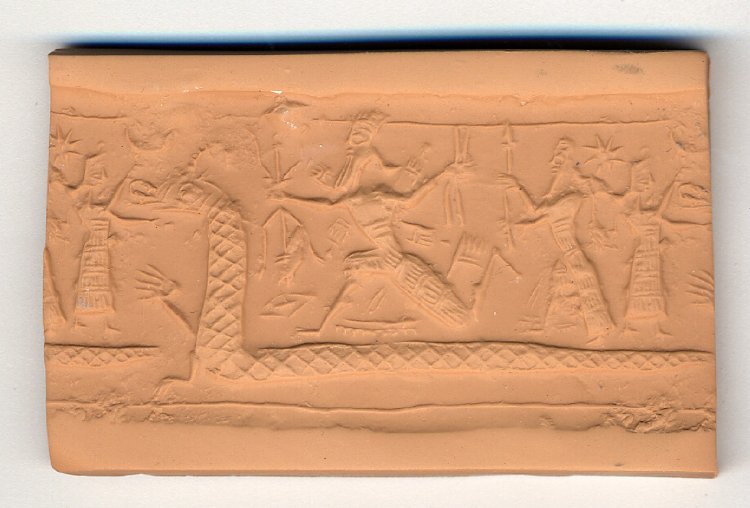
The seal may illustrate a scene from the epic of creation in which the forces of chaos, led by Tiamat, are defeated by a god representing cosmic order, probably Ninurta.

The seal may illustrate a scene from the epic of creation in which the forces of chaos, led by Tiamat, are defeated by a god representing cosmic order, probably Ninurta.

Among the primitive Semitic peoples there were probably many versions of the story of the Creation; and the narrative told by the Seven Tablets is, no doubt, one of them in a comparatively modern form.

It is quite clear that the Account of the Creation given in the Seven Tablets is derived from very ancient sources, and a considerable amount of literary evidence is now available for reconstructing the history of the Legend.

Thus in the Sumerian Account the narrative of the exploits of the hero called ZIUSUDU 19  begins with a description of the Creation and then goes on to describe a Flood, and there is little doubt that certain passages in this text are the originals of the Babylonian version as given in the Seven Tablets.

In the Story of ZIUSUDU, however, there is no mention of any Dragon. And there is reason to think that the Legend of the Dragon had originally nothing whatever to do with the Creation, for the texts of fragments of two distinct Accounts 20 of the Creation describe a fight between a Dragon and some deity other than Marduk.

In other Accounts the Dragon bears a strong resemblance to the Leviathan of Psalm civ, 26; Job xli, 1. In the one text he is said to be 50 biru 21 in length, and 1 biru in thickness; his mouth was 6 cubits (about 9 feet) wide, and the circumference of his ears 12 cubits (18 feet).

He was slain by a god whose name is unknown, and the blood continued to flow from his body for three years, three months, one day and one night.

In the second text the Dragon is 60 biru long and his thickness is 30 biru; the diameter of each eye is half a biru, and his paws are 20 biru long.

Thus there is every reason for believing that the Legend as it is given in the Seven Tablets is the work of some editor, who added the Legend of the Creation to the Legend of the Dragon in much the same way as the editor of the Gilgamish Legends included an account of the Deluge in his narrative of the exploits of his hero.

All forms of the Legend of the Creation and of the Dragon were popular in Babylonia, and one of them achieved so much notoriety that the priest employed recited it as an incantation to charm away the toothache.

The literary form of the text of the Seven Tablets fulfils the requirements of Semitic poetry in general. The lines usually fall into couplets, the second line being the antiphon of the first, e.g.:–

“When in the height heaven was not named,
And the earth beneath did not yet bear a name.”

Thus we have:–

enuma elish || lâ nabû shamamu
shaplish ammatum || shuma lâ zakrat

E.A. Wallis Budge, The Babylonian Legends of the Creation and the Fight Between Bel and the Dragon, 1921.

The Fifty Names of Marduk

” … it is clear that a dispute broke out between Marduk and the gods after he had created them, and the tradition of it has made its way into the religious literatures of the Hebrews, Syrians, Arabs, Copts and Abyssinians.

The cuneiform texts tell us nothing about the cause of the dispute, but tradition generally ascribes it to the creation of man by the supreme God; and it is probable that all the apocryphal stories which describe the expulsion from heaven of the angels who contended against God under the leadership of Satan, or Satnael, or Iblîs, are derived from a Babylonian original which has not yet been found.

The “Fifty Names,” or laudatory epithets mentioned above, find parallels in Seventy-five Praises of Rā, sung by the Egyptians under the XIXth dynasty, 15 and in the Ninety-nine Beautiful Names of Allâh, which are held in such great esteem by the Muḥammadans. 16

The respect in which the Fifty Names were held by the Babylonians is well shown by the work of the Epilogue on the Seventh Tablet, where it is said, “Let them be held in remembrance, let the first-comer (i.e., any and every man) proclaim them; let the wise and the understanding consider them together. Let the father repeat them and teach them to his son. Let them be in the ears of the herdsman and the shepherd.”

The object of the writer of the Fifty Names was to show that Marduk was the “Lord of the gods,” that the power, qualities and attributes of every god were enshrined in him, and that they all were merely forms of him.

This fact is proved by the tablet (No. 47,406), 17 which contains a long list of gods who are equated with Marduk in his various forms. 18

The tendency in the later Babylonian religion to make Marduk the god above all gods has led many to think that monotheistic conceptions were already in existence among the Babylonians as early as the period of the First Dynasty, about 2000 B.C. It is indisputable that Marduk obtained his pre-eminence in the Babylonian Pantheon at this early period.

But some authorities deny the existence of monotheistic conceptions among the Babylonians at that time, and attribute Marduk’s kingship of the gods to the influence of the political situation of the time, when Babylon first became the capital of the country, and mistress of the greater part of the known world.

Material for deciding this question is wanting, but it may be safely said that whatever monotheistic conceptions existed at that time, their acceptance was confined entirely to the priests and scribes. They certainly find no expression in the popular religious texts.”

E.A. Wallis Budge, The Babylonian Legends of the Creation and the Fight Between Bel and the Dragon, 1921.

Mankind Was Created from the Blood of a God and Earth

” … When Marduk had arranged heaven and earth, and had established the gods in their places, the gods complained that their existence was barren, because they lacked worshippers at their shrines and offerings.

To make a way out of this difficulty Marduk devised another “cunning plan,” and announced his intention of creating man out of “blood and bone” DAMI IṢṢIMTUM .

We have already quoted (see p. 11) the statement of Berosus that man was created out of the blood of a god mixed with earth; here, then, is the authority for his words.

Marduk made known to Ea his intention of creating man, and Ea suggested that if one of the gods were sacrificed the remainder of them should be set free from service, presumably to Marduk.

Thereupon Marduk summons a council of the gods, and asks them to name the instigator of the fight in which he himself was the victor.

In reply the gods named Kingu, Tiâmat’s second husband, whom they seized forthwith, and bound with fetters and carried to Ea, and then having “inflicted punishment upon him they let his blood.”

From Kingu’s blood Ea fashioned mankind for the service of the gods.

Now among the texts which have been found on the tablets at Ḳal’at Sharḳât is an account of the creation of man which differs from the version given in the Seven Tablets of Creation, but has two features in common with it. These two features are:

(1) the council of the gods to discuss the creation of man;

(2) the sacrifice which the gods had to make for the creation of man. In the variant version two (or more) gods are sacrificed, Ilu Nagar Ilu Nagari.e., “the workmen gods,” about whom nothing is known.
The place of sacrifice is specified with some care, and it is said to be “Uzu-mu-a, or the bond of heaven and earth.” Uzu-mu-a may be the bolt with which Marduk locked the two halves of Tiâmat into place.

The Anunnaki, wishing to give an expression of their admiration for Marduk’s heroism, decided to build him a shrine or temple. To this Marduk agreed, and chose Babylon, i.e., the “Gate of God,” for its site.

The Anunnaki themselves made the bricks, and they built the great temple of E-Sagila at Babylon. When the temple was finished, Marduk re-enacted the scene of creation; for, as he had formerly assigned to each god his place in the heavens, so now he assigned to each god his place in E-Sagila.

The tablet ends with a long hymn of praise which the Anunnaki sang to Marduk, and describes the summoning of an assembly of the gods to proclaim ceremonially the great Fifty Names of this god. Thus the gods accepted the absolute supremacy of Marduk.”

E.A. Wallis Budge, The Babylonian Legends of the Creation and the Fight Between Bel and the Dragon, 1921.

Again, Berossus

“Versions in Greek of the Legends found by George Smith had long been known to classical scholars, owing to the preservation of fragments of them in the works of later Greek writers, e.g., Eusebius, Syncellus, and others.

The most important of these is derived from the History of Babylonia, which was written in Greek by BEROSUS, a priest of Bel-Marduk, i.e., the “Lord Marduk,” at Babylon, about 250 B.C. In this work Berosus reproduced all the known historical facts and traditions derived from native sources which were current in his day.

It is therefore not surprising to find that his account of the Babylonian beliefs about the origin of things corresponds very closely with that given in the cuneiform texts, and that it is of the greatest use in explaining and partly in expanding these texts. His account of the primeval abyss, out of which everything came, and of its inhabitants reads:–

“There was a time in which there existed nothing but darkness and an abyss of waters, wherein resided most hideous beings, which were produced on a two-fold principle. There appeared men, some of whom were furnished with two wings, others with four, and with two faces. They had one body but two heads; the one that of a man, the other of a woman; and likewise in their several organs both male and female. Other human figures were to be seen with the legs and horns of goats; some had horses’ feet; while others united the hind-quarters of a horse with the body of a man, resembling in shape the hippo-centaurs. Bulls likewise were bred there with the heads of men, and dogs with four told bodies, terminated in their extremities with the tails of fishes; horses also with the heads of dogs; men too and other animals, with the heads and bodies of horses and the tails of fishes. In short, there were creatures in which were combined the limbs of every species of animals. In addition to these, fishes, reptiles, serpents, with other monstrous animals, which assumed each other’s shape and countenance. Of all which were preserved delineations in the temple of Belus at Babylon.” (Cory, Ancient Fragments, London, 1832, pp. 24-26.)

E.A. Wallis Budge, The Babylonian Legends of the Creation and the Fight Between Bel and the Dragon, 1921.

Sumerian Sacred Stories, c. 3500 BCE

” … it is quite as obvious that for the history of the progress of our civilization as we see and know it today, it is the tone and temper, the word and spirit of the ancient mythologies, those of the Greeks and Hebrews, of the Hindus and Iranians, of the Babylonians and Egyptians, which are of prime significance. It is the spiritual and religious concepts revealed in these ancient literatures which permeate the modern civilized world.

Still almost entirely unknown to this very moment is Sumerian mythology, the sacred stories of the non-Semitic, non-Indo-European people which in historical times, from approximately 3500 to 2000 B.C., inhabited Sumer, the relatively small land situated between the Tigris and Euphrates Rivers and stretching from the Persian Gulf northward approximately as far as modern Bagdad; a land that may be aptly described as the culture cradle of the entire Near East.

Should the reader turn, for example, to Hastings’ Encyclopedia of Religion and Ethics29 and examine the very long article on the cosmogonic or creation myths of the world, he will find a large and relatively exhaustive list of peoples, ancient and modern, cultured and primitive, whose cosmogonic concepts are described and analyzed. But he will look in vain for Sumerian cosmogony.

Similarly, the collection entitled Mythology of All the Races 30 devotes thirteen volumes to an analysis of the more important mythologies in the world; here, too, however, there will be found few traces of Sumerian mythology. Whatever little is known of Sumerian mythology is largely surmised from the modified, redacted, and in a sense, garbled versions of the Babylonians who conquered the Sumerians toward the very end of the third millennium B.C., and who used the Sumerian stories and legends as a basis and nucleus for the development of their own myths.

But it is a known fact that in the long stretch of time between approximately 3500 and 2000 B.C. it was the Sumerians who represented the dominant cultural group of the entire Near East. It was the Sumerians who developed and probably invented the cuneiform system of writing; who developed a well integrated pantheon together with spiritual and religious concepts which influenced profoundly all the peoples of the Near East; who, finally, created and developed a literature rich in content and effective in form.

Moreover, the following significant fact must be borne in mind. By the end of the third millennium B.C. Sumer had already ceased to exist as a political entity and Sumerian had already become a dead language, for by that time Sumer had been overrun and conquered by the Semites, and it is the Semitic Accadian language which gradually became the living, spoken tongue of the land.

Nevertheless Sumerian continued to be used as the literary and religious language of the Semitic conquerors for many centuries to come, like Greek in the Roman period and like Latin in the Middle Ages. Indeed for many centuries the study of the Sumerian language and literature remained the basic pursuit of the scribal schools and intellectual and spiritual centers not only of the Babylonians and Assyrians, but also of the many surrounding peoples such as the Elamites, Hurrians, Hittites, and Canaanites.

Obviously, then, both because of their content as well as because of their age, the Sumerian mythological tales and concepts must have penetrated and permeated those of the entire Near East. A knowledge of the Sumerian myths and legends is therefore a prime and basic essential for a proper approach to a scientific study of the mythologies current in the ancient Near East, for it illuminates and clarifies to no small extent the background behind their origin and development.” i

Samuel Noah Kramer, Sumerian Mythology, 1944, pp. 27-9.

On the Literature of Ancient Sumer

” … Now let us compare this date with that of the various ancient literatures known to us at present.

In Egypt, for example, one might have expected an ancient written literature commensurate with its high cultural development. And, indeed, to judge from the pyramid inscriptions, the Egyptians in all probability did have a well developed written literature in the third millennium B. C.

Unfortunately it must have been written largely on papyrus, a readily perishable material, and there is little hope that enough of it will ever be recovered to give a reasonably adequate cross-section of the Egyptian literature of that ancient period.

Then, too, there is the hitherto unknown ancient Canaanite literature which has been found inscribed on tablets excavated in the past decade by the French at Rash-esh-Shamra in northern Syria.

These tablets, relatively few in number, indicate that the Canaanites, too, had a highly developed literature at one time. They are dated approximately 1400 B. C., that is, they were inscribed over half a millennium later than our Sumerian literary tablets. 21

As for the Semitic Babylonian literature as exemplified by such works as the Epic of Creation, the Epic of Gilgamesh, etc., it is not only considerably later than our Sumerian literature, but also includes much that is borrowed directly from it. 22

We turn now to the ancient literatures which have exercised the most profound influence on the more spiritual aspects of our civilization. These are the Bible, which contains the literary creations of the Hebrews; the Iliad and Odyssey, which are filled with the epic and mythic lore of the Greeks; the Rig-veda, which contains the literary products of ancient India; and the Avesta, which contains those of ancient Iran.

None of these literary collections were written down in their present form before the first half of the first millennium B. C.

Our Sumerian literature, inscribed on tablets dating from approximately 2000 B.C., therefore antedates these literatures by more than a millennium. Moreover, there is another vital difference.

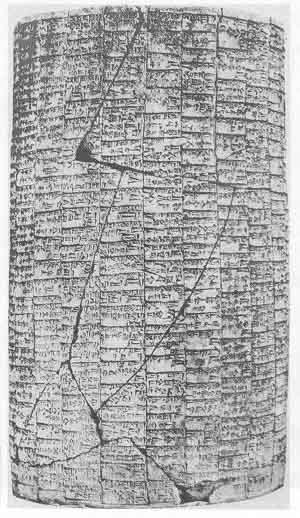
pl04

"To judge from the script, the Nippur cylinder illustrated on this plate 
(8383 in the Nippur collection of the University Museum) may date as early 
as 2500 B. C. Although copied and published by the late George Barton as 
early as 1918, its contents, which center about the Sumerian air-god Enlil 
and the goddess Ninhursag, are still largely unintelligible. Nevertheless, 
much that was unknown or misunderstood at the time of its publication is now 
gradually becoming clarified, and there is good reason to hope that the not 
too distant future will see the better part of its contents ready for 
translation."

-Samuel Noah Kramer, Sumerian Mythology, 1944, p. 18.

The texts of the Bible, of the Iliad and Odyssey, and of the Rig-veda and Avesta, as we have them, have been modified, edited, and redacted by compilers and redactors with varied motives and diverse points of view.

Not so our Sumerian literature; it has come down to us as actually inscribed by the ancient scribes of four thousand years ago, unmodified and uncodified by later compilers and commentators.”

Samuel Noah Kramer, Sumerian Mythology, 1944, pp. 19-20.

The Pillars of Seth

OF THE SIRIADIC COLUMNS.
FROM JOSEPHUS.

“All these (the sons of Seth), being naturally of a good disposition, lived happily in the land without apostatising, and free from any evils whatsoever: and they studiously turned their attention to the knowledge of the heavenly bodies and their configurations.

And lest their science should at any time be lost among men, and what they had previously acquired should perish, (inasmuch as Adam had acquainted them that a universal aphanism, or destruction of all things, would take place alternately by the force of fire and the overwhelming powers of water), they erected two columns, the one of brick and the other of stone, and engraved upon each of them their discoveries; so that, in case the brick pillar should be dissolved by the waters, the stone one might survive to teach men the things engraved upon it, and at the same time inform them that a brick one had formerly been also erected by them.

It remains even to the present day in the land of Siriad.”158 ―Extracted from Josephus Antiquities of the Jews Book i. ch. 2.

NOTE BY THE EDITOR. “We do not here propose to renew the inquiry concerning the celebrated antediluvian columns, or stelae, on which the lore of this primaeval world, with all its wisdom, was said to be transmitted.

Plato, it is well-known, speaks of these columns in the opening of the Timaeus. We shall examine, in the 5th book, whether this be anything more than a figurative description, and how far we may be justified in assuming any connection between the Egyptian legend and the two pillars of Seth mentioned by Josephus. (Antiq. i., ch. 2).

These pillars, it is obvious, have reference to the Book of Enoch 159; perhaps also to the pillars of Akikarus, or Akicharus, the Prophet of Babylon, (or the Bosphorus), whose wisdom Democritus is said to have stolen, and on which Theophrastus composed a treatise.

In the Egyptian traditions that have come down to us, these primaeval stelae do not make their appearance until the third and fourth centuries. They are first mentioned in the so-called Fragments of Hermes, in Stobaeus; afterwards, in Zosimus of Panopolis, evidently in the colouring of Judaising-Christian writers; but, in their worst shape, in the fourth century, in the work of an impostor who assumed the name of Manetho.

That in this latter instance, at least, they were connected with the narrative of Josephus, is shown by their allusion to the ‘Syriadic Country.'”―Extracted from Bunsen’s Egypt’s Place in History, vol. 1., p. 7, 8.

E. Edmond Hodges, Cory’s Ancient Fragments, 3d ed., 1876, pp. 151-2.

Moses, Joseph, and the Jews

OF ABRAHAM AND HIS DESCENDANTS AND OF MOSES AND THE LAND OF ISRAEL.
FROM JUSTIN, OUT OF TROGUS POMPEIUS.
Book xviii. 3, 3, 5. Book xxxvi. 2, 3, 6.

“The origin of the Jews was from Damascus, a most famous city of Syria, whence also the Assyrian kings, and queen Semiramis sprang. The name of the city was given it from king Damascus, in honour of whom the Syrians consecrated the sepulchre of his wife Arathis as a temple, and regard her as a goddess worthy of the most sacred worship.

After Damascus, Azelus, 122 and then Adores, Abraham, and Israhel were their kings. But a prosperous family of ten sons made Israhel more famous than any of his ancestors. Having divided his kingdom in consequence, into ten governments, he committed them to his sons, and called the whole people Jews, from Judas, who died soon after the division, and ordered his memory to be held in veneration by them all, as his portion was shared among them.

The youngest of the brothers was Joseph, whom the others, fearing his extraordinary abilities, secretly made prisoner, and sold to some foreign merchants. Being carried by them into Egypt, and having there, by his great powers of mind, made himself master of the arts of magic, he found, in a short time, great favour with the king; for he was eminently skilled in prodigies, and was the first to establish the science of interpreting dreams.

And nothing, indeed, of divine, or human law seems to have been unknown to him; so that he foretold a famine or dearth in the land (of Egypt), some years before it happened, and all Egypt would have perished by famine, had not the king, by his advice, ordered the corn to be laid up for several years: such being the proofs of his knowledge, that his admonitions seemed to proceed, not from a mortal, but a god.

His son was Moses, whom, besides the inheritance of his father’s knowledge, the comeliness of his person also recommended. But the Egyptians, being troubled with scabies and leprosy, and moved by some oracular prediction, expelled him, with those who had the disease, out of Egypt, that the distemper might not spread among a greater number.

Becoming leader, accordingly, of the exiles, he carried off by stealth the sacred utensils of the Egyptians, who, endeavouring to recover them by force of arms, were obliged by tempests to return home; and Moses, having reached Damascus, the birth-place of his fore-fathers, took possession of Mount Sinai; on his arrival at which, after having suffered, together with his followers, from a seven days’ fast in the deserts of Arabia, he consecrated every seventh day, (according to the present custom of the nation), for a fast-day, and to be perpetually called a Sabbath, because that day had ended at once their hunger and their wanderings.

And, as they remembered that they had been driven from Egypt for fear of spreading infection, they took care, in order that they might not become odious, from the same cause, to the inhabitants of the country, to have no communication with strangers; a rule which, from having been adopted on that particular occasion, gradually became a custom and part of their religion.

After the death of Moses, his son Aruas 123 was made priest for celebrating the rites which they brought from Egypt, and soon after created king; and ever afterwards, it was a custom among the Jews to have the same chiefs both for kings and priests; and, by uniting religion with the administration of justice, it is almost incredible how powerful they became.”

―Extracted from the Philippine History of Justin, the Abbreviator of Trogus Pompeius.

E. Edmond Hodges, Cory’s Ancient Fragments, 3d ed., 1876, pp. 78-81.

Giants Again, and Abraham

FROM EUPOLEMUS.
CONCERNING THE TOWER OF BABEL, AND ABRAHAM.

“The City of Babylon owes its foundation to those who were saved from the catastrophe of the Flood; these were the giants, (Heb. נפלים = fallen ones), and they built the tower which is noticed in history. But the tower being overthrown by the interposition of God, the giants were scattered over all the earth.

He says, moreover, that in the tenth generation, in the City of Babylonia, called Camarina (which, by some, is called the city Urie, and which signifies a city of the Chaldeans), there lived, the thirteenth in descent, (a man named), Abraham, a man of a noble race and superior to all others in wisdom.

Of him they relate that he was the inventor of astrology and the Chaldean magic, and that on account of his eminent piety he was esteemed by God. It is further said, that under the directions of God he removed and lived in Phoenicia, and there taught the Phoenicians the motions of the sun and moon, and all other things; for which reason he was held in great reverence by their king.” 121―Extracted from Eusebius, Preparatio Evangelica, 9.

E. Edmond Hodges, Cory’s Ancient Fragments, 3d ed., 1876, p. 77.

On the Confusion of Tongues

ALEXANDER POLYHISTOR.
CONCERNING THE TOWER OF BABEL.

“The Sibyl says, that when all men formerly spoke the same language, some among them undertook to erect a large and lofty tower, in order to climb into heaven. But God, (or the gods), sending forth a whirlwind, frustrated their design and gave to each tribe a particular language of its own, which (confusion of tongues) is the reason that the name of that city is called Babylon.”

“After the Flood, Titan and Prometheus lived, and Titan undertook a war against Kronus.”

―Extracted from Syncellus, 44. Josephus’ Antiquities of the Jews, i. chap. 4.; Eusebius, Preparatio Evangelica, 9.

FROM THE SIBYLLINE ORACLES.

“But when the judgments of Almighty God
Were ripe for execution ; when the tower
Rose to the skies upon Assyria’s plain,
And all mankind one language only knew:
A dread commission from on high was given
To the fell whirlwinds, which with dire alarms
Beat on the tower, and to its lowest base
Shook it convulsed. And now all intercourse,
By some occult and overruling power,
Ceased among men. By utterance they strove,
Perplexed and anxious, to disclose their mind,
But their lip failed them ; and in lieu of words
Produced a painful babbling sound : the place
Was thence called Babel; by the apostate crew
Named from the event. Then severed, far away
They sped, uncertain, into realms unknown:
Thus kingdoms rose, and the glad world was filled.”

The Sibyl having named Kronus, Titan, and Iapetus (Japheth) as the three sons of the Patriarch (Noah), who governed the world in the tenth generation, after the Flood, and mentioned the division of the world into three parts, (viz, by Shem, Ham, and Japhetti), over which each of the Patriarchs ruled in peace, then relates the death of Noah, and the war between Kronus and Titan.

N.B. The translation given above is from Vol. IV. of Bryant’s Ancient Mythology. The fragment above given is mentioned by Josephus; and some lines are quoted by the Christian Fathers, Athenagoras and Theophilus of Antioch.”

E. Edmond Hodges, Cory’s Ancient Fragments, 3d ed., 1876, pp. 75-6.

On the Deluge, from Berosus, via Alexander Polyhistor

” … Belus also formed the stars, and the sun and the moon, together with the five planets. (In the second book was the history of the ten kings of the Chaldeans, and the periods of each reign, which consisted collectively of one hundred and twenty-sari, or 432,000 years, reaching to the time of the Flood.

For Alexander, surnamed Polyhistor, as from the writings of the Chaldeans, enumerating the kings from the ninth, Ardates, to Xisuthrus, who is called by them the tenth, proceeds in this manner:)

After the death of Ardates, his son, Xisuthrus, succeeded, and reigned eighteen sari. In his time happened the great Deluge; the history of which is given in this manner. The Deity, Kronus, appeared to him in a vision, and gave him notice, that upon the fifteenth day of the month Daesia103 there would be a flood, by which mankind would be destroyed.

He therefore enjoined him to commit to writing a history of the beginning, progress, and final conclusion of all things, down to the present term; and to bury these accounts securely in the city of the Sun104 at Sippara; and to build a vessel, and to take with him into it his friends and relations; and to convey on board everything necessary to sustain life, and to take in also all species of animals that either fly, or rove upon the earth; and trust himself to the deep.

Having asked the Deity, whither he was to sail? he was answered, “To the Gods:” upon which he offered up a prayer for the good of mankind. And he obeyed the divine admonition: and built a vessel five stadia in length, and in breadth two. Into this he put everything which he had got ready; and last of all conveyed into it his wife, children, and friends.

After the Flood had been upon the earth, and was in time abated, Xisuthrus sent out some birds105 from the vessel, which, not finding any food, nor any place to rest their feet, returned to him again. After an interval of some days, he sent them forth a second time, and they now returned with their feet tinged with mud.

He made a trial a third time with these birds, but they returned to him no more; from whence he formed a judgment, that the surface of the earth was now above the waters. Having, therefore, made an opening in the vessel, and finding, upon looking out, that the vessel was driven to the side of a mountain, he immediately quitted it, being attended by his wife, his daughter, and the pilot.

Xisuthrus immediately paid his adoration to the earth, and, having constructed an altar, offered sacrifices106 to the gods.

These things being duly performed, both Xisuthrus, and those who came out of the vessel with him, disappeared. They who remained in the vessel, finding that the others did not return, came out, with many lamentations, and called continually on the name of Xisuthrus.

They saw him no more, but could distinguish his voice in the air, and could hear him admonish them to pay due regard to the gods. He likewise informed them that it was upon account of his piety that he was translated107 to live with the gods; that his wife and daughter, with the pilot, had obtained the same honour.

To this he added that he would have them make the best of their way to Babylonia, and search for the writings at Sippara, which were to be made known to all mankind: and that the place where they then were was the land of Armenia.108 The remainder having heard these words, offered sacrifices to the gods; and taking a circuit, journeyed towards Babylonia.

The vessel, being thus stranded in Armenia, some part of it yet remains in the Gordyaean 109 mountains in Armenia; and the people scrape off the bitumen,110 with which it had been outwardly coated, and make use of it by way of an alexipharmic 111 and amulet.

In this manner they returned to Babylon; and having found the writings at Sippara, they set about building cities, and erecting temples: and Babylon was thus inhabited again.” ―Syncellus. Chron. 28. Eusebius. Chron. 5, 8.

E. Edmond Hodges, Cory’s Ancient Fragments, 3d ed., 1876, pp. 60-3.

On Oannes, from Berosus, via Alexander Polyhistor

“BEROSUS, in his first book concerning the history of Babylonia, informs us that he lived in the time of Alexander, the son of Philip. And he mentions that there were written accounts preserved at Babylon with the greatest care, comprehending a term of fifteen myriads of years. These writings contained a history of the heavens and the sea; of the birth of mankind; also of those who had sovereign rule; and of the actions achieved by them.

And, in the first place, he describes Babylonia as a country which lay between the Tigris and Euphrates. [ … ]

The part of Babylonia which bordered upon Arabia was barren, and without water; but that which lay on the other side had hills, and was fruitful. At Babylon there was (in these times) a great resort of people of various nations, who inhabited Chaldea, and lived without rule and order, like the beasts of the field.

In the first year there made its appearance, from a part of the Erythraean sea which bordered upon Babylonia, an animal endowed with reason, who was called Oannes. (According to the account of Apollodorus) the whole body of the animal was like that of a fish; and had under a fish’s head another head, and also feet below, similar to those of a man, sub-joined to the fish’s tail. His voice, too, and language was articulate and human; and a representation of him is preserved even to this day.

This Being, in the day-time, used to converse with men; but took no food at that season; and he gave them an insight into letters, and sciences, and every kind of art. He taught them to construct houses, to build temples, to compile laws, and explained to them the principles of geometrical knowledge. He made them distinguish the seeds of the earth, and showed them how to collect fruits.

In short, he instructed them in everything which could tend to soften manners and humanise mankind. From that time, so universal were his instructions, nothing material has been added by way of improvement.

When the sun set it was the custom of this Being to plunge again into the sea, and abide all night in the deep; for he was amphibious.

After this, there appeared other animals, like Oannes, of which Berosus promises to give an account when he comes to the history of the kings.”

E. Edmond Hodges, Cory’s Ancient Fragments, 3d ed., 1876, pp. 56-8.

The True Pronunciation of the Ineffable Name, From an Assyrian Inscription

” … And not only names of Biblical places, but of Biblical persons are to be found there; as Hezekiah and Jehoahaz, Ahab and Jehu, and Hazael, Sennacherib, Esarhaddon, and Nebuchadnezzar.

Under this head of scriptural illustration will come the deeply interesting fact, that we now obtain evidence of the true pronunciation of the sacred and incommunicable name of God. It is, we believe, generally admitted among Hebrew scholars, that the name Jehovah, as the designation of the supreme God, is incorrect.

The Jews never pronounce this name.8

You never meet with it in the New Testament; showing that even at that time either the true pronunciation was lost, or it was considered unlawful to pronounce it, which is the statement of Philo Judaeus, confirmed by Josephus.

Some Hebraists contend for Yahveh as the correct pronunciation, but with little proof. We learn, however, from an Assyrian inscription of Sargon’s that the correct pronunciation of the most sacred name of God amongst the Semitic people was Ya-u, or Yahu.

In the Cyprus Inscription of Sargon we read of a certain Ya-hu-bidi, king of Hamath. Now as this king’s name is preceded by the sign indicating a god, it is evident that his name is a compound of some divine name, such as Yahu’s servant, in which it resembles the Hebrew name Jehoahaz, more correctly Yeho-ahaz “one who holds to Yeho,” or Jehovah. In the book of Psalms, too, we are told to praise God by his name Yah, which is an abbreviated form of Yahu.

Lastly. That this was the most sacred name of God as taught in the mysteries we learn from Macrobius and Plutarch. We may assume, therefore, from the very accurate mode of Assyrian vocalization, that we have here the correct pronunciation of a Semitic name as found in an Assyrian inscription, and that Ya-hu, or Ya-ho, and not Jehovah, is the correct pronunciation of what has been called “the ineffable name” of the Most High.”

E. Edmond Hodges, Cory’s Ancient Fragments, 3d ed., 1876, p.xxviii-p.xxx.

Ashur-bani-pal

” … The records of Ashur-bani-pal cease after 640 B.C., so that we are unable to follow the events of his reign during its last fourteen years. Apparently peace prevailed everywhere. The great monarch, who was a pronounced adherent of the goddess cults, appears to have given himself up to a life of indulgence and inactivity.

Under the name Sardanapalus he went down to tradition as a sensual Oriental monarch who lived in great pomp and luxury, and perished in his burning palace when the Medes revolted against him. It is evident, however, that the memory of more than one monarch contributed to the Sardanapalus legend, for Ashur-bani-pal had lain nearly twenty years in his grave before the siege of Nineveh took place.

In the Bible he is referred to as “the great and noble Asnapper,” and he appears to have been the emperor who settled the Babylonian, Elamite, and other colonists “in the cities of Samaria.”

He erected at Nineveh a magnificent palace, which was decorated on a lavish scale. The sculptures are the finest productions of Assyrian art, and embrace a wide variety of subjects–battle scenes, hunting scenes, and elaborate Court and temple ceremonies. Realism is combined with a delicacy of touch and a degree of originality which raises the artistic productions of the period to the front rank among the artistic triumphs of antiquity.

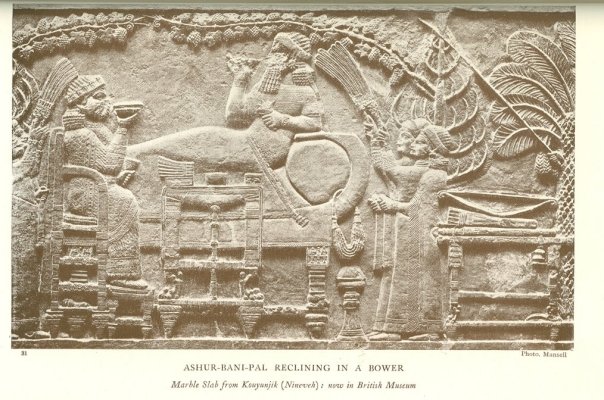
Ashur-bani-pal in the palace of Nineveh.

Ashur-bani-pal boasted of the thorough education which he had received from the tutors of his illustrious father, Esarhaddon. In his palace he kept a magnificent library. It contained thousands of clay tablets on which were inscribed and translated the classics of Babylonia.

To the scholarly zeal of this cultured monarch is due the preservation of the Babylonian story of creation, the Gilgamesh and Etana legends, and other literary and religious products of remote antiquity. Most of the literary tablets in the British Museum were taken from Ashur-bani-pal’s library.”

Donald A. Mackenzie, Myths of Babylonia and Assyria, 1915, pp. 486-7.

Bel-Merodach Returns to Babylon

” … Babylon welcomed its new king–a Babylonian by birth and the son of a Babylonian princess. The ancient kingdom rejoiced that it was no longer to be ruled as a province; its ancient dignities and privileges were being partially restored.

But one great and deep-seated grievance remained. The god Merodach was still a captive in the temple of Ashur.

No king could reign aright if Merodach were not restored to E-sagila. Indeed he could not be regarded as the lord of the land until he had “taken the hands of Bel.”

The ceremony of taking the god’s hands was an act of homage. When it was consummated the king became the steward or vassal of Merodach, and every day he appeared before the divine one to receive instructions and worship him. The welfare of the whole kingdom depended on the manner in which the king acted towards the god.

If Merodach was satisfied with the king he sent blessings to the land; if he was angry he sent calamities. A pious and faithful monarch was therefore the protector of the people.

This close association of the king with the god gave the priests great influence in Babylon. They were the power behind the throne. The destinies of the royal house were placed in their hands; they could strengthen the position of a royal monarch, or cause him to be deposed if he did not satisfy their demands.

A king who reigned over Babylon without the priestly party on his side occupied an insecure position. Nor could he secure the co-operation of the priests unless the image of the god was placed in the temple. Where king was, there Merodach had to be also.

Shamash-shum-ukin pleaded with his royal brother and overlord to restore Bel Merodach to Babylon. Ashur-bani-pal hesitated for a time; he was unwilling to occupy a less dignified position, as the representative of Ashur, than his distinguished predecessor, in his relation to the southern kingdom.

At length, however, he was prevailed upon to consult the oracle of Shamash, the solar lawgiver, the revealer of destiny. The god was accordingly asked if Shamash-shum-ukin could “take the hands of Bel” in Ashur’s temple, and then proceed to Babylon as his representative.

In response, the priests of Shamash informed the emperor that Bel Merodach could not exercise sway as sovereign lord so long as he remained a prisoner in a city which was not his own.

Ashur-bani-pal accepted the verdict, and then visited Ashur’s temple to plead with Bel Merodach to return to Babylon.

“Let thy thoughts,” he cried, “dwell in Babylon, which in thy wrath thou didst bring to naught. Let thy face be turned towards E-sagila, thy lofty and divine temple. Return to the city thou hast deserted for a house unworthy of thee. O Merodach! lord of the gods, issue thou the command to return again to Babylon.”

Thus did Ashur-bani-pal make pious and dignified submission to the will of the priests. A favourable response was, of course, received from Merodach when addressed by the emperor, and the god’s image was carried back to E-sagila, accompanied by a strong force.

Ashur-bani-pal and Shamash-shum-ukin led the procession of priests and soldiers, and elaborate ceremonials were observed at each city they passed, the local gods being carried forth to do homage to Merodach.

Babylon welcomed the deity who was thus restored to his temple after the lapse of about a quarter of a century, and the priests celebrated with unconcealed satisfaction and pride the ceremony at which Shamash-shum-ukin “took the hands of Bel.”

The public rejoicings were conducted on an elaborate scale. Babylon believed that a new era of prosperity had been inaugurated, and the priests and nobles looked forward to the day when the kingdom would once again become free and independent and powerful.”

Donald A. Mackenzie, Myths of Babylonia and Assyria, 1915, pp. 480-2.

On the Neo-Platonic Forgeries

IN giving to the public a new edition of Cory’s Ancient Fragments I have endeavoured to respond to the wishes of numerous literary friends by furnishing a brief account of the several authors to whom we are indebted for these extracts, and, at the same time, some information respecting the decipherment of the hieroglyphic texts of Egypt, and the cuneiform records of Nineveh and Babylon.

The first edition of this work appeared in 1828, the second in 1832; therefore, at a time when Egyptian scholarship was still in its infancy, while cuneiform research had not yet seen the light. The discoveries of Champollion, Young, Birch, Bunsen, Brugsch, Chabas, Le Page Renouf, Godwin, and a host of other scholars in the former field of research, and of Layard, Botta, Rawlinson, Norris, Oppert, Menant, George Smith, Sayce, Fox Talbot, and Schrader in the latter, have furnished so much valuable information respecting the ancient empires of Egypt and Assyria, that we can no longer rest satisfied with the meagre accounts transmitted to us by the classic writers concerning times and people with which they were themselves but imperfectly acquainted.

At a time, therefore, when, thanks to the labours of the distinguished scholars above named, we can read with considerable facility and astonishing certainty the papyri of Egypt and the clay-tablets of Babylon, it behoves us to pause for a moment, and consider how this wonderful mine of ancient treasures was discovered, and the means by which it has been worked.

Cory’s Fragments constitute a fitting supplement to the fragments which have been exhumed from the mounds of Nineveh, and rescued from the tombs and mummy-pits of Egypt. Considered in this light they will be found to explain and complete one another; for, in the one we have Assyrians and Egyptians speaking for themselves each in his own tongue; in the other the information is supplied through a Greek channel, and reaches us, no doubt, more or less coloured by the media through which it has passed.

It is only when we place the two accounts side by side that we are in a position to estimate their respective values, and reproduce the half obliterated lines. “The contents of this volume,” says Cory, in his preface, “are fragments, which have been translated from foreign languages into Greek, or have been quoted, or transcribed, by Greeks from foreign authors; or, have been written in the Greek language by foreigners who have had access to the archives of their own countries.”

[ … ]

I have also referred the student to authorised translations of cuneiform and hieroglyphic texts, whenever I thought that any additional light was thrown by them upon the statements contained in these Fragments. Lastly, it remains only for me to say in this place that I have omitted Cory’s preface entirely, as resting chiefly upon the long-exploded learning of Jacob Bryant, Faber, and Parkhurst; and have dispensed altogether with the Neo-Platonic forgeries which Cory had placed at the end, bearing the titles respectively of, Oracles of Zoroaster, the Hermetic Creed, the Orphic, Pythagorean, and other fragments, of doubtful authenticity and of little value.

We now possess, thanks to the labours of MM. Anquetil Duperron, Spiegel, and Haug, all the remains of the so-called Zend-Avesta, of which only a small portion the Gathas are regarded by competent scholars as genuine. Comparing these so-called Oracles of Zoroaster with the genuine fragments, we have every reason to reject them as spurious.

Such as they are, however, they will be found, translated into English, in Stanley’s Lives of the Philosophers. I have preferred, therefore, in the present edition, to omit this farrago of metaphysico-philosophical nonsense, and have added several fragments of other ancient authors containing matter of greater importance.”

E. Richmond Hodges, Cory’s Ancient Fragments of the Phoenician, Carthaginian, Babylonian, Egyptian and Other Authors, London: Reeves & Turner, 1876, pp. vii-xiii.

I.P. Cory on Paganism

” … But the internal heresies of the Church were not the only ill effects which the misguided zeal of the fathers, in forcing upon Plato the doctrine of the Trinity, brought about.

Though it is possible, that by pointing out some crude similarity of doctrine, they might have obtajned some converts by rendering Christianity less unpalatable to the philosophical world of that day, yet the weapon was skilfully turned against them, and with unerring effect, when the Pagans took upon them to assert that nothing new had been revealed in Christianity; since, by the confessions of its very advocates, the system was previously contained in the writings of Plato.

In the third century, Ammonius Saccas, universally acknowledged to have been a man of consummate ability, taught that every sect, Christian, Heretic or Pagan, had received the truth, and retained it in their varied legends. He undertook, therefore, to unfold it from them all, and to reconcile every creed.

And from his exertions sprung the celebrated Eclectic school of the later Platonists. Plotinus, Amelius, Olympius, Porphyrius, Jamblichus, Syrianus, and Proclus, were among the celebrated professors who succeeded Ammonius in the Platonic chair, and revived and kept alive the spirit of Paganism, with a bitter enmity to the Gospel, for near three hundred years.

The Platonic schools were at length closed by the edict of Justinian; and seven wise men, the last lights of Platonism, Diogenes, Hermias, Eulalius, Priscianus, Damascius, Isidorus and Simplicius retired indignantly from the persecutions of Justinian, to realize the shadowy dreams of the republic of Plato, under the Persian despotism of Chosroes.16

From the writings of these philosophers is collected the bulk of the Oracles of Zoroaster. A few of them were first published by Ludovicus Tiletanus at Paris, with the commentaries of Pletho, to which were subsequently added those of Psellus. Chief part of them, however, were collected by Franciscus Patricius, and published with the Hermetic books at the end of his Nova Philosophia.

To the labours of Mr. Taylor we are indebted for the addition of about fifty more, and for the references to the works from whence all were extracted. I have arranged them according to the subjects, which are said to be occultly discussed in the Parmenides of Plato, viz.: Cause or God, the Ideal Intelligible or Intellectual world, Particular Souls, and the Material world.

And I have placed under a separate head the Magical and Philosophical precepts and directions. There can be no question but that many of these Oracles are spurious; all those, for instance, which relate to the Intelligible and Intellectual orders, which were confessedly obtained in answers given by dæmons, raised for that purpose by the Theurgists;17 who, as well as all the later Platonists, made pretensions to magic, not only in its refinements, which they were pleased to designate Theurgy, but also in that debased form which we should call common witchcraft.

Nevertheless, several of the Oracles seem to be derived from more authentic sources, and, like the spurious Hermetic books which have come down to us, probably contain much of the pure Sabiasm of Persia, and the doctrines of the Oriental philosophy.”

I.P. Cory, Ancient Fragments, 1832, Introduction.

I.P. Cory on Egypt, the Basest of Kingdoms

” … The Laterculus or Canon of the Kings of Thebes, was compiled from the archives of that city, by Eratosthenes, the librarian of Ptolemæus Philadelphus. It is followed by the Old Egyptian Chronicle, with a Latin version of the same, from the Excerpta Barbara, and another from the Armenian Chronicle of Eusebius: they contain a summary of the dynasties of Egypt.

To these succeed the Egyptian dynasties of Manetho, whose introductory letter to king Ptolemæus, given in a subsequent page, explains the nature of his work, and the materials from whence it was compiled. I have placed the six different versions of the Dynasties of Manetho that are extant confronting each other.

The Canon of the kings of Egypt from Josephus, I have compiled from the historical fragments of Manetho: and I have thrown it into the form of a Canon to facilitate comparison. I have next given a very important Canon, the first part of which, from Mestraim to the end of the seventeenth dynasty, is preserved by Syncellus only: from the beginning of the eighteenth it is continued also in the fragments of Eusebius: and from hence to the conclusion, four different versions of it will be found.

To these are added the Canons of all the kings of Egypt, mentioned by Diodorus Siculus and Herodotus. They were originally compiled by Scaliger, but I have corrected them and given them with several very important additions in the original words of the authors, instead of in the words of Scaliger himself.

They are followed by the Canon of Theophilus Antiochenus. And after several very important chronological extracts upon the antiquities of Egypt, I have completed the Dynasties, with a Canon of the early Egyptian, Chaldæan, and Assyrian Kings, from the Syriac Chronicle of Bar-hebræus: which I have placed beside each other as they are synchonized by that author, and given them in the English letters corresponding to the Syriac, instead of adopting the Latinized names of the translators.

I have, therefore, comprised in this part of the work, no less than nineteen catalogues of the Egyptian kings, with all the various readings that occur in the different versions of the same. They have been compiled with the greatest care, and I have purposely abstained from all reference to the Hieroglyphics, that I might not be misled by any preconceived opinion.

At a time, when indefatigable research is every day bringing to light new and interesting circumstances, it would be absurd to attempt to give anything but the roughest outline of Egyptian history. I shall merely observe, then, that after the dispersion from Babel, the children of Mizraim went off to Egypt, of which they appear to have continued some time in undisturbed possession.

Menes Misor or Mestraim, the Mizraim of the Scriptures, and planter of the nation, is naturally placed as the first sovereign of the united realm, at the head of all the catalogues. And perhaps the dominion of Athothis was equally extensive; for his name occurs in the Laterculus of Eratosthenes, and as the Thoth or Taautus of Sanchoniatho.

After him the country seems to have been divided into several independent monarchies, some of whose princes may perhaps be found among the fourteen first dynasties. That the country was so divided, and that the first dynasties were not considered successive by the ancients, we have the authority of Artapanus and Eusebius.

The first historical fragment of Manetho, from Josephus, gives an account of the invasion and expulsion of a race of foreigners, who were styled Hycsos or Shepherd kings; whose princes are identified with the seventeenth dynasty of all the Canons except that given by Syncellus as the canon of Africanus, in which they are placed as the fifteenth.

Of what family they were, whence they came, and to what country they retired, have heen the subjects of almost as many hypotheses as writers; I shall not venture a remark upon a problem, of which there is every reason shortly to expect a satisfactory solution.

Josephus and the Fathers confound them with the Israelites, who appear rather to be referred to by the second fragment as the lepers, who were so cruelly ill-treated by the Egyptians, and afterwards laid waste the country, assisted by a second invasion of the Shepherds.

To these fragments I have subjoined six other very curious notices of the exodus of the Israelites and the final expulsion of the Shepherds; which events appear to have been connected with one another, as well as with the emigration of the Danaan colonies to Greece, not only in time, but by circumstances of a political nature, and to have occurred during the sovereignty of the eighteenth dynasty.

Tacitus has also noticed the exodus, but in terms evidently copied from some of those which I have given: we have but few and scanty notices of the kings of Egypt, even in Diodorus and Herodotus.

Its conquest by Nebucchadnezzar is related by Berossus, and after two or three temporary gleams of independence, it sunk at length into a province of the Persian empire, and from that day to the present, according to the denunciation of the prophet, Egypt has been the basest of kingdoms, and under the yoke of strangers.”

I.P. Cory, Ancient Fragments, 1832, Introduction.

There Were Giants

” … But if all the nations, or even the upper classes of those nations, which bear the name, be the sons of Cush, one-third of the present human race must be the descendants of that patriarch. Indeed, before the introduction of Ionism, Epiphanius and others appear to have included all mankind under the name of Scuths. The first apostacy might have been introduced by Cush, and its followers have borne his name; which the succeeding heresy of Nimrod could not obliterate.

The Scythian nations of Touran and the North were generally addicted to the Scythic superstition; and whenever they rolled back the tide of war upon their ancient rivals; the idols temples and cities were the objects upon which they satiated their revenge.

They were esteemed excommunicated, and of the Giant race, Nephelim, Rephaim and Anakim. The Scuths of Iran were also of the Giant race, with Nimrod as their chief. Of the Titanian war there appears to be a double aspect. When the Scuths of Touran are the Giants, the war between them and the Ionim is the subject of the legend; and they are the Giants cast out into Cimmerian darkness, and buried under mountains.

The other view presents both parties conjointly before the schism, as the Nephelim, Apostates or Giants, engaged in carrying on the war against Heaven itself. And in these accounts we find more frequent allusions to the Tower and its supernatural overthrow.

The catastrophe at Babel completed the dispersion. On the division of the earth and planting of the nations, there are some very curious notices extant. But whether Nimrod and his immediate adherents survived, and retained possession of Babylon, or transferred their seat of government to Nineveh and founded the great Iranian empire, or whether that empire and city were founded by Assur and the sons of Shem, is still a subject of dispute.

We find Nimrod, however, under the well-known title of Alorus, at the head of the two Chaldæan dynasties, mentioned above: but these appear rather to refer to the antediluvian patriarchs than to the proper kings of Chaldæa.

The first dynasty of Chaldæan Kings is placed by almost all chronologists as the first Iranian dynasty, that of Nimrod under the name of Evechius, and his immediate descendants. Evexius is also placed by Polyhistor as the first Chaldæan king. The dynasty of the Arabian kings of Chaldæan is placed by Eusebius, Syncellus and others, as well as by Berossus, next in the order of succession.

They have likewise been supposed to be a Scythic nation, which broke in upon the empire from the Scythian settlements of Cashgar, and obtained possession either of the entire empire, or only of the city of Babylon, during the period of its desolation, with the plains of Shinar and the country round the head of the Persian gulf, from whence they were expelled, and discharged themselves upon Palestine as the Palli or Philistines, and upon Egypt as the Hycsos or Shepherd Kings.

Next in succession, according to Eusebius and Syncellus, or perhaps contemporary with the preceding, came the long line of the great dynasty of the Assyrian Kings, who held the empire of the world for ten or twelve centuries, till their dominion was wrested from them by the Medes in the time of Thonus Concolerus, the Sardanapalus of the Greek historians.

The different catalogues of the great Assyrian succession that are extant, will be found among the Dynasties. The overthrow of the Assyrian empire was followed by several years of universal anarchy, bloodshed and revolution. And it is ascertained, that it was during this scene of confusion that Jonah was sent upon his mission to stop its progress at Nineveh.

[ … ]

The Babylonians acquired a temporary independence at the fall of the Assyrian empire, but after two or three short reigns they were subdued by Senecherib. Syria also became an independent kingdom, and prospered for a time, till again reduced under the Assyrian yoke. Persia at the same time arose, and alone maintained its independence against the growing power of the Medes and the new Assyrian dynasty, till the successes of Cyrus raised it above them all, and vested the empire of the world in the Persian race.

The Assyrian empire revived under Nabonasar, supposed to be the same with the Salmanasar of the Scriptures. Of this dynasty three several catalogues will be found, the Ecclesiastical and Astronomical canons preserved by Syncellus, and the celebrated canon of Ptolemæus, besides some other notices of the successors of Nabonasar, among the supplemental Chaldæan fragments.

The first princes of the line appear to have fixed their residence at Nineveh, and among them we may recognize the Tiglath Pileser, Senecherib, and Esar Haddon of the Scriptures. Their race appears to have terminated in Saracus, another Sardanapalus.

Nabopollasar, a successful rebel, began the last line of the Assyrian and Chaldæan monarchs. He transferred the seat of empire to Babylon, and in his reign, his celebrated son, Nebuchadnezzar, extended his conquests over the bordering kingdoms of the north and west, by the reduction of Syria, Phœnicia, Judæa, Egypt, and Arabia; an accurate account of which is transmitted by Berossus.

On the death of his father, Nebuchadnezzar succeeded to the throne. Concerning him we have several very interesting fragments from Berossus, and one from Megasthenes. In these are detailed the splendor of his works at Babylon, its celebrated walls, and brazen gates; its temples, palaces, and hanging gardens.

The prophesy of Nebuchadnezzar, probably alludes to the public notification of Daniel’s interpretation of his vision.”

I.P. Cory, Ancient Fragments, 1832, Introduction.

Prophecies of Isaiah

” … It is believed that Judah and other disaffected States were dealt with about this time. Manasseh had succeeded Hezekiah at Jerusalem when but a boy of twelve years. He appears to have come under the influence of heathen teachers.

For he built up again the high places which Hezekiah his father had destroyed; and he reared up altars for Baal, and made a grove, as did Ahab king of Israel; and worshipped all the host of heaven, and served them….

And he built altars for all the host of heaven in the two courts of the house of the Lord. And he made his son pass through the fire, and observed times, and used enchantments, and dealt with familiar spirits and wizards: he wrought much wickedness in the sight of the Lord, to provoke him to anger.

And he set a graven image of the grove that he had made in the house, of which the Lord said to David, and to Solomon his son, In this house, and in Jerusalem, which I have chosen out of all tribes of Israel, will I put my name for ever.

Isaiah ceased to prophesy after Manasseh came to the throne. According to Rabbinic traditions he was seized by his enemies and enclosed in the hollow trunk of a tree, which was sawn through.

Other orthodox teachers appear to have been slain also. “Manasseh shed innocent blood very much, till he had filled Jerusalem from one end to another.”

It is possible that there is a reference to Isaiah’s fate in an early Christian lament regarding the persecutions of the faithful:

“Others had trial of cruel mockings and scourgings, yea, moreover of bonds and imprisonment: they were stoned, they were sawn asunder, were tempted, were slain with the sword.”

There is no Assyrian evidence regarding the captivity of Manasseh.

“Wherefore the Lord brought upon them (the people of Judah) the captains of the host of the king of Assyria, which took Manasseh among the thorns, and bound him with fetters, and carried him to Babylon. And when he was in affliction, he besought the Lord his God, and humbled himself greatly before the God of his fathers, and prayed unto him: and he was intreated of him, and heard his supplication, and brought him again to Jerusalem into his kingdom.”

It was, however, in keeping with the policy of Esarhaddon to deal in this manner with an erring vassal. The Assyrian records include Manasseh of Judah (MenasÍ of the city of Yaudu) with the kings of Edom, Moab, Ammon, Tyre, Ashdod, Gaza, Byblos, &c, and “twenty-two kings of Khatti” as payers of tribute to Esarhaddon, their overlord. Hazael of Arabia was conciliated by having restored to him his gods which Sennacherib had carried away.”

Donald A. Mackenzie, Myths of Babylonia and Assyria, 1915, pp. 473-4.

I.P Cory on the Tower of Babel

” … Mankind appear to have dwelt some time in Armenia, and the Patriarch allotted to his descendants the different regions of the earth, with commands to separate into distinct communities.

His injunctions, however, were disobeyed, and great numbers, perhaps all the human race, started from Armenia in a body, and, according to the Scriptures, journied westward, but according to Berossus, travelled by a circuitous route to the plains of Shinar.

By combining the two narratives, we may conclude that they followed the winding course of the Euphrates, till they halted upon those celebrated plains, where the enterprising spirit of Nimrod tempted him to aspire to the dominion of the world, and to found the Tower and City of Babel as the metropolis of his future universal empire.

Upon the Tower of Babel and the events connected with it, will be found some very interesting fragments from Abydenus, from Hestiæus, a very ancient Greek writer, from the Babylonian Sibyl, and from Eupolemus. I have added also a curious extract from the Sibylline oracles.

In these fragments are detailed the erection of the Tower, the dispersion of its contrivers, and the confusion of the languages; with the additional circumstances of the violent destruction of the building,3 and the Titanian war, which forms so remarkable an event in all traditions of the heathens.

Previously to the erection of the Tower, men appear very generally to have apostatized from the patriarchal worship. About this time a further deviation from the truth took place; and upon the first and more simple corruption was engrafted an elaborate system of idolatry.

Some account of these deviations will be found in the extracts from Epiphanius, Cedrenus, and the Paschal chronicle. What is mentioned under the name of Barbarism, was probably the primeval patriarchal worship. lt was succeeded by a corrupted form of superstition which is known among the ancients under the name of Scuthism, or Scythism, which was most prevalent from the flood to the building of the Tower.

The new corruption, at that time introduced by Nimrod, was denominated Ionism,4 or Hellenism: and both are still flourishing in the East under the well-known appellations of Brahmenism and Buddhism; whose priests appear to have continued in an uninterrupted succession from the Brahmanes and Germanes, the philosophical sects of India mentioned by Megasthenes and Clitarchus.

By the introduction of a more degenerate superstition, Nimrod appears to have aimed at the establishment of an universal monarchy in himself and his descendants, of which Babylon was to have been the metropolis, and the Tower, the central temple of their idolatries.

All who attended him seem to have entered into the project, so far as he might have thought proper to divulge it, and to have assisted in the erection of the tower and city. But subsequent events shew that the proposed form of government and system of theology, though asquiesced in by the majority, did not command universal approbation. And the whole project was marred by the miraculous interposition of the Almighty.

What concurring circumstances might have operated to the dispersion, we have no clue to in the narrative of Moses. He mentions the miraculous confusion of the languages, and that the Lord scattered the people abroad from thence upon the face of all the earth; and they left off to build the city.

But if we may credit the heathen accounts above referred to, with which the Hindoo, and indeed almost every remnant of traditionary lore concur; a schism, most probably both of a political and religious nature, was the result; a bitter war was carried on, or at least a bloody field was fought; from which the Scuths, defeated and excommunicated by their brethren, betook themselves, in haughty independence, to the mountains of Cashgar and the north:5 whilst some violent and supernatural catastrophe, by the overthrow of the Tower, completed the dispersion.”

I.P. Cory, Ancient Fragments, 1832, Introduction.

I.P Cory on Berossus

” … In the fragments of Berossus again we have perhaps some few traces of the antediluvian world. Like Sanchoniatho, Berossus seems to have composed his work with a serious regard for truth. He was a Babylonian by birth, and flourished in the reign of Alexander the Great, and resided for some years at Athens.

As a priest of Belus, he possessed every advantage which the records of the temple and the learning and traditions of the Chaldæans could afford. He appears to have sketched his history of the earlier times from the representations upon the walls of the temple. From written and traditionary knowledge he must have learned several points too well authenticated. to be called in question; and correcting the one by the other, and at the same time blending them as usual with Mythology, he has produced the strange history before us.

The first fragment preserved by Alexander Polyhistor is extremely valuable, and contains a store of very curious information. The first book of the history apparently opens naturally enough with a description of Babylonia. Then referring to the paintings, the author finds the first series a kind of preface to the rest.

All men of every nation appear assembled in Chaldæa: among them is introduced a personage who is represented as their instructor in the arts and sciences, and informing them of the events which had previously taken place. Unconscious that Noah is represented under the character of Oannes, Berossus describes him, from the hieroglyphical delineation, as a being literally compounded of a fish and a man, and as passing the natural, instead of the diluvian night in the ocean, with other circumstances indicative of his character and life.

The instructions of the Patriarch are detailed in the next series of paintings. In the first of which, I conceive, the Chaos is pourtrayed by the confusion of the limbs of every kind of animal: the second represents the creation of the universe: the third the formation of mankind: others again that of animals, and of the heavenly bodies.

The second book appears to have comprehended the history of the antediluvian world: and of this the two succeeding fragments seem to have been extracts. The historian, as usual, has appropriated the history of the world to Chaldæa.

He finds nine persons, probably represented as kings, preceding Noah, who is again introduced under the name Xisuthrus, and he supposes that the representation was that of the first dynasty of the Chaldæan kings.

From the universal consent of history and tradition he was well assured that Alorus or Orion, the Nimrod of the Scriptures, was the founder of Babylon and the first king: consequently he places him at the top, and Xisuthrus follows as the tenth.

The destruction of the records by Nabonasar left him to fill up the intermediate names as he could: and who are inserted, is not easy so to determine.2

Berossus has given also a full and accurate description of the deluge, which is wonderfully consonant with the Mosaic account. We have also a similar account, or it may be an epitome of the same from the Assyrian history of Abydenus, who was a disciple of Aristotle, and a copyist from Berossus. I have given also a small extract from the Fragments of Nicholaus Damascenus, relative to the deluge and the ark, whose wreck is said by him as well as Berossus, Chrysostom, and other writers, to have remained upon Ararat even at the very time in which they wrote.”

I.P. Cory, Ancient Fragments, 1832, Introduction.

I.P Cory on Sanchoniatho

 ” … Or all nations were once assembled together in a single place and in a single community; where they adopted a corrupt form of religion, which they afterwards respectively carried with them into the lands that they colonized.

[ … ]

 In the same manner we may ascertain the region from which mankind originally dispersed. Both in ancient and modern times the Greeks have been accused of a kind of plagiarism, which was the prevailing custom of every nation upon earth. Egypt and India, and Prœnicia, no less than Greece, have appropriated to themselves, and assigned within their own territorial limits, the localities of the grand events of primeval history, with the birth and achievements of the Gods and Heroes, the Deluge, the origin of the arts and the civilization of mankind.

And their claims have found more able supporters, only because they have not been so obviously liable to refutation. Yet by rejecting each country, whose claims rest upon no better foundation than its own local histories, and retaining those only, whose pretensions are substantiated by the concurrent testimony of the rest; it may be shown, independently of Scripture, that the primitive settlements of mankind were in such places, and attended with such circumstances, as the Scripture instructs us was the case.

Of the transactions previous to the Deluge there are but few and faint memorials among the heathens. One of the most authentic may be found in the remains of the Prœnician History of Sanchoniatho, who is considered to be the most ancient writer of the heathen world. In what age he wrote is uncertain: but his history was composed in the Prœnician language, and its materials collected from the archives of the Prœnician cities. It was translated into Greek by Philo Byblius, and for the preservation of these fragments we are indebted to the care of Eusebius.

The Cosmogony I shall have occasion to refer to hereafter: as one of the most ancient, it is extremely valuable, and as it speaks more plainly than the rest, it affords a key to their interpretation.

The Generations contain many very curious passages. In the first is an allusion to the fall: in the second Genus may be Cain: after which we lose the traces of similarity: at the fifth there is an interruption. But taking up the thread of inquiry, at the end, in Taautus or Thoyth, we may recognize Athothis, the second king of Egypt, the Hermes Trismegistus, who againt appears as the adviser of Cronus. His predecessor Misor then corresponds with Mizraïm, the first king of Egypt, the Menes and Mines of the dynasties.

In the preceding generation is Amynus, Amon, or Ham, the same with the Cronus, of what by the historian is supposed to be a different but contemporary line. An ascent higher we find, Agrus, the husbandman, who was worshipped in Phœnicia as the greatest of the gods: he corresponds with Noah, the Ouranus of the other line, whose original name was Epigeus or Autochthon.

Sanchoniatho seems to have been a very diligent inquirer, and intimates at the conclusion that the generations contain the real history of those early times, stripped of the fictions and allegories with which it had been obscured by the son of Thabion, the first hierophant of Prœnicia. That such is the case, we are assured by Philo Byblius, in the remarks on Sanchoniatho with which he prefaces his translation of the work. The passage also informs us that the history thus disguised was handed down to Isiris, the brother of Chna the first Prœnician, apparently alluding to Mizraïm the brother of Canaan.

It is very remarkable that he has placed these characters in the true order of succession, though in all the traditions of the heathens they are generally confounded with one another. It is also remarkable that Sanchoniatho is almost the only heathen writer upon antiquities who makes no direct mention of the deluge, though several obscure allusions to it may be found in the course of the fragment.

Were we assured of his silence upon the point in the parts of his work that have been lost, the omission might still be accounted for from his avowed determination to suppress what he considered merely allegorical, for he would find the traditions of the deluge so intimately blended with those relating to the creation, that in endeavouring to disengage the truth from the fable he might easily be induced to suppose that they related to the same event.

For explanation of his fragment upon the mystical sacrifice of the Prœnicians, I must refer to the very curious dissertations by Bryant and Mr. Faber.

Sanchoniatho wrote also a history of the serpent, a single fragment of which is preserved by Eusebius.”

I.P. Cory, Ancient Fragments, 1832, Introduction.

Destroyer of Babylon

” … In 691 B.C. Sennacherib again struck a blow for Babylonia, but was unable to depose Mushezib-Merodach. His opportunity came, however, in 689 B.C. Elam had been crippled by raids of the men of Parsua (Persia), and was unable to co-operate with the Chaldaean king of Babylon.

Sennacherib captured the great commercial metropolis, took Mushezib-Merodach prisoner, and dispatched him to Nineveh.

Then he wreaked his vengeance on Babylon.

For several days the Assyrian soldiers looted the houses and temples, and slaughtered the inhabitants without mercy. E-sagila was robbed of its treasures, images of deities were either broken in pieces or sent to Nineveh: the statue of Bel-Merodach was dispatched to Asshur so that he might take his place among the gods who were vassals of Ashur.

“The city and its houses,” Sennacherib recorded, “from foundation to roof, I destroyed them, I demolished them, I burned them with fire; walls, gateways, sacred chapels, and the towers of earth and tiles, I laid them low and cast them into the Arakhtu.”

“So thorough was Sennacherib’s destruction of the city in 689 B.C.,” writes Mr. King, “that after several years of work, Dr. Koldewey concluded that all traces of earlier buildings had been destroyed on that occasion. More recently some remains of earlier strata have been recognized, and contract-tablets have been found which date from the period of the First Dynasty.

Moreover, a number of earlier pot-burials have been unearthed, but a careful examination of the greater part of the ruins has added little to our knowledge of this most famous city before the Neo-Babylonian period.”

[ … ]

Sennacherib’s palace was the most magnificent building of its kind ever erected by an Assyrian emperor. It was lavishly decorated, and its bas-reliefs display native art at its highest pitch of excellence.

The literary remains of the time also give indication of the growth of culture: the inscriptions are distinguished by their prose style. It is evident that men of culture and refinement were numerous in Assyria. The royal library of Kalkhi received many additions during the reign of the destroyer of Babylon.

46800

Like his father, Sennacherib died a violent death. According to the Babylonian Chronicle he was slain in a revolt by his son “on the twentieth day of Tebet” (680 B.C). The revolt continued from the “20th of Tebet” (early in January) until the 2nd day of Adar (the middle of February). On the 18th of Adar, Esarhaddon, son of Sennacherib, was proclaimed king.

Berosus states that Sennacherib was murdered by two of his sons, but Esarhaddon was not one of the conspirators. The Biblical reference is as follows:

“Sennacherib … dwelt at Nineveh. And it came to pass, as he was worshipping in the house of Nisroch (?Ashur) his god, that Adrammelech and Sharezer (Ashur-shar-etir) his sons smote him with the sword: and they escaped into the land of Armenia (Urartu). And Esarhaddon his son reigned in his stead.”

Ashur-shar-etir appears to have been the claimant to the throne.

Donald A. Mackenzie, Myths of Babylonia and Assyria, 1915, pp. 468-70.

Destruction of Sennacherib

According to Berosus, the Babylonian priestly historian, the camp of Sennacherib was visited in the night by swarms of field mice which ate up the quivers and bows and the (leather) handles of shields. Next morning the army fled.

The Biblical account of the disaster is as follows:

And it came to pass that night, that the angel of the Lord went
out, and smote the camp of the Assyrians an hundred and four score
and five thousand: and when they arose early in the morning,
behold, they were all dead corpses. So Sennacherib king of Assyria
departed, and went and returned and dwelt at Nineveh.

A pestilence may have broken out in the camp, the infection, perhaps, having been carried by field mice. Byron’s imagination was stirred by the vision of the broken army of Assyria.

The Assyrian came down like a wolf on the fold,
And his cohorts were gleaming with purple and gold;
And the sheen of their spears was like stars of the sea,
When the blue wave rolls nightly on deep Galilee.

Like the leaves of the forest when summer is green,
That host with their banners at sunset were seen;
Like the leaves of the forest when autumn hath blown,
That host on the morrow lay withered and strown.

For the Angel of Death spread his wings on the blast,
And breathed on the face of the foe as he passed;
And the eyes of the sleepers waxed deadly and chill,
And their hearts but once heaved–and forever grew still!

And there lay the steed with his nostril all wide,
But through it there rolled not the breath of his pride;
And the foam of his gasping lay white on the turf,
And cold as the spray of the rock-beating surf.

And there lay the rider distorted and pale,
With the dew on his brow, and the rust on his mail;
And the tents were all silent–the banners alone–
The lances uplifted–the trumpet unblown.

And the widows of Asshur are loud in their wail,
And the idols are broke in the temple of Baal;
And the might of the Gentile, unsmote by the sword,
Hath melted like snow in the glance of the Lord.

Before this disaster occurred Sennacherib had to invade Babylonia again, for the vassal king, Bel-ibni, had allied himself with the Chaldaeans and raised the standard of revolt.

The city of Babylon was besieged and captured, and its unfaithful king deported with a number of nobles to Assyria. Old Merodach Baladan was concerned in the plot and took refuge on the Elamite coast, where the Chaldaeans had formed a colony. He died soon afterwards.”

Donald A. Mackenzie, Myths of Babylonia and Assyria, 1915, pp. 466-7.

The Assassination of Sargon

Thus “Sargon the Later” entered at length into full possession of the empire of Sargon of Akkad. In Babylonia he posed as an incarnation of his ancient namesake, and had similarly Messianic pretensions which were no doubt inspired by the Babylonian priesthood. Under him Assyria attained its highest degree of splendour.

He recorded proudly not only his great conquests but also his works of public utility: he restored ancient cities, irrigated vast tracts of country, fostered trade, and promoted the industries. Like the pious Pharaohs of Egypt he boasted that he fed the hungry and protected the weak against the strong.

” … Sargon found time during his strenuous career as a conqueror to lay out and build a new city, called Dur-Sharrukin, “the burgh of Sargon,” to the north of Nineveh. It was completed before he undertook the Babylonian campaign. The new palace was occupied in 708 B.C. Previous to that period he had resided principally at Kalkhi, in the restored palace of Ashur-natsir-pal III.

He was a worshipper of many gods. Although he claimed to have restored the supremacy of Ashur “which had come to an end,” he not only adored Ashur but also revived the ancient triad of Anu, Bel, and Ea, and fostered the growth of the immemorial “mother-cult” of Ishtar.

Before he died he appointed one of his sons, Sennacherib, viceroy of the northern portion of the empire. He was either assassinated at a military review or in some frontier war. As much is suggested by the following entry in an eponym list.

Eponymy of Upahhir-belu, prefect of the city of Amedu …

According to the oracle of the Kulummite(s)…. A soldier

(entered) the camp of the king of Assyria (and killed him?), month

Ab, day 12th, Sennacherib (sat on the throne).

The fact that Sennacherib lamented his father’s sins suggests that the old king had in some manner offended the priesthood. Perhaps, like some of the Middle Empire monarchs, he succumbed to the influence of Babylon during the closing years of his life.

It is stated that “he was not buried in his house,” which suggests that the customary religious rites were denied him, and that his lost soul was supposed to be a wanderer which had to eat offal and drink impure water like the ghost of a pauper or a criminal.”

Donald A. Mackenzie, Myths of Babylonia and Assyria, 1915, pp. 462-4.

The Ten Lost Tribes

” … Shalmaneser died before Samaria was captured, and may have been assassinated. The next Assyrian monarch, Sargon II (722-705 B.C.), was not related to either of his two predecessors. He is referred to by Isaiah, and is the Arkeanos of Ptolemy. He was the Assyrian monarch who deported the “Lost Ten Tribes.”

“In the ninth year of Hoshea” (and the first of Sargon) “the king of Assyria took Samaria, and carried Israel away into Assyria, and placed them in Halah and in Habor by the river of Gozan, and in the cities of the Medes.”

In all, according to Sargon’s record, “27,290 people dwelling in the midst of it (Samaria) I carried off.”

They (the Israelites) left all the commandments of the Lord their God, and made them molten images, even two calves, and made a grove, and worshipped all the host of heaven (the stars), and served Baal.

And they caused their sons and their daughters to pass through the fire, and used divination and enchantments, and sold themselves to do evil in the sight of the Lord, to provoke him to anger. Therefore the Lord was very angry with Israel, and removed them out of his sight: there was none left but the tribe of Judah only.

And the king of Assyria brought men from Babylon, and from Cuthah, and from Ava, and from Hamath, and from Sepharvaim, and placed them in the cities of Samaria instead of the children of Israel: and they possessed Samaria, and dwelt in the cities thereof….

And the men of Babylon made Succoth-benoth, and the men of Cuth (Cuthah) made Nergal, and the men of Hamath made Ashima, and the Avites made Nibhaz and Tartak, and the Sepharites burnt their children in fire to Adram-melech and Anam-melech, the gods of Sepharvaim.

A number of the new settlers were slain by lions, and the king of Assyria ordered that a Samaritan priest should be sent to “teach them the manner of the God of the land.” This man was evidently an orthodox Hebrew, for he taught them “how they should fear the Lord…. So they feared the Lord,” but also “served their own gods … their graven images.”

There is no evidence to suggest that the “Ten Lost Tribes,” “regarding whom so many nonsensical theories have been formed,” were not ultimately absorbed by the peoples among whom they settled between Mesopotamia and the Median Highlands.

The various sections must have soon lost touch with one another. They were not united like the Jews (the people of Judah), who were transported to Babylonia a century and a half later, by a common religious bond, for although a few remained faithful to Abraham’s God, the majority of the Israelites worshipped either the Baal or the Queen of Heaven.”

Donald A. Mackenzie, Myths of Babylonia and Assyria, 1915, pp. 455-6.

The Enduring, Syncretic Cult of the Great Mother

” … Tashmit, whose name signifies “Obedience,” according to Jastrow, or “Hearing,” according to Sayce, carried the prayers of worshippers to Nebo, her spouse.

As Isis interceded with Osiris, she interceded with Nebo, on behalf of mankind. But this did not signify that she was the least influential of the divine pair. A goddess played many parts: she was at once mother, daughter, and wife of the god; the servant of one god or the “mighty queen of all the gods.”

The Great Mother was, as has been indicated, regarded as the eternal and un-decaying one; the gods passed away, son succeeding father; she alone remained. Thus, too, did Semiramis survive in the popular memory, as the queen-goddess of widespread legends, after kings and gods had been forgotten.

To her was ascribed all the mighty works of other days in the lands where the indigenous peoples first worshipped the Great Mother as Damkina, Nina, Bau, Ishtar, or Tashmit, because the goddess was anciently believed to be the First Cause, the creatrix, the mighty one who invested the ruling god with the powers he possessed–the god who held sway because he was her husband, as did Nergal as the husband of Eresh-ki-gal, queen of Hades.

The multiplication of well-defined goddesses was partly due to the tendency to symbolize the attributes of the Great Mother, and partly due to the development of the great “Lady” in a particular district where she reflected local phenomena and where the political influence achieved by her worshippers emphasized her greatness.

Legends regarding a famous goddess were in time attached to other goddesses, and in Aphrodite and Derceto we appear to have mother deities who absorbed the traditions of more than one local “lady” of river and plain, forest and mountain.

Semiramis, on the other hand, survived as a link between the old world and the new, between the country from which emanated the stream of ancient culture and the regions which received it. As the high priestess of the cult, she became identified with the goddess whose bird name she bore, as Gilgamesh and Etana became identified with the primitive culture-hero or patriarch of the ancient Sumerians, and Sargon became identified with Tammuz.

No doubt the fame of Semiramis was specially emphasized because of her close association, as Queen Sammu-rammat, with the religious innovations which disturbed the land of the god Ashur during the Middle Empire period.”

Donald A. Mackenzie, Myths of Babylonia and Assyria, 1915, pp. 436-8.

The Legends of Queen Semiramis

The legends of Semiramis indicate that Sammu-rammat was associated like Queen Tiy with the revival of mother worship.

As we have said, she went down to tradition as the daughter of the fish goddess, Derceto. Pliny identified that deity with Atargatis of Hierapolis.

In Babylonia the fish goddess was Nina, a developed form of Damkina, spouse of Ea of Eridu. In the inscription on the Nebo statue, that god is referred to as the “son of Nudimmud” (Ea). Nina was the goddess who gave her name to Nineveh, and it is possible that Nebo may have been regarded as her son during the Semiramis period.

The story of Semiramis’s birth is evidently of great antiquity. It seems to survive throughout Europe in the nursery tale of the “Babes in the Wood.” A striking Indian parallel is afforded by the legend of Shakuntala, which may be first referred to for the purpose of comparative study.

Shakuntala was the daughter of the rishi, Viswamitra, and Menaka, the Apsara (celestial fairy). Menaka gave birth to her child beside the sacred river Malini.

“And she cast the new-born infant on the bank of that river and went away. And beholding the newborn infant lying in that forest destitute of human beings but abounding with lions and tigers, a number of vultures sat around to protect it from harm.”

A sage discovered the child and adopted her. “Because,” he said, “she was surrounded by Shakuntas (birds), therefore hath she been named by me Shakuntala (bird protected).”

Semiramis was similarly deserted at birth by her Celestial mother. She was protected by doves, and her Assyrian name, Sammu-rammat, is believed to be derived from “Summat“–“dove,” and to signify “the dove goddess loveth her.”

Simmas, the chief of royal shepherds, found the child and adopted her. She was of great beauty like Shakuntala, the maiden of “perfect symmetry,” “sweet smiles,” and “faultless features,” with whom King Dushyanta fell in love and married in Gandharva fashion.

Semiramis became the wife of Onnes, governor of Nineveh, and one of the generals of its alleged founder, King Ninus. She accompanied her husband to Bactria on a military campaign, and is said to have instructed the king how that city should be taken.

Ninus fell in love with Semiramis, and Onnes, who refused to give her up, went and hanged himself. The fair courtesan then became the wife of the king.

The story proceeds that Semiramis exercised so great an influence over the impressionable King Ninus, that she persuaded him to proclaim her Queen of Assyria for five days. She then ascended the throne decked in royal robes. On the first day she gave a great banquet, and on the second thrust Ninus into prison, or had him put to death. In this manner she secured the empire for herself. She reigned for over forty years.

Professor Frazer inclines to the view that the legend is a reminiscence of the custom of appointing a mock king and queen to whom the kingdom was yielded up for five days. Semiramis played the part of the mother goddess, and the priestly king died a violent death in the character of her divine lover.

“The mounds of Semiramis which were pointed out all over Western Asia were said to have been the graves of her lovers whom she buried alive…. This tradition is one of the surest indications of the identity of the mythical Semiramis with the Babylonian goddess Ishtar or Astarte.”

As we have seen, Ishtar and other mother goddesses had many lovers whom they deserted like La Belle Dame sans Merci (pp. 174-175).

As Queen of Assyria, Semiramis was said to have cut roads through mountainous districts and erected many buildings. According to one version of the legend she founded the city of Babylon. Herodotus, however, says in this connection:

“Semiramis held the throne for five generations before the later princess (Nitocris)…. She raised certain embankments, well worthy of inspection, in the plain near Babylon, to control the river (Euphrates), which, till then, used to overflow and flood the whole country round about.”

Lucian, who associates the famous queen with “mighty works in Asia,” states that she was reputed by some to be the builder of the ancient temple of Aphrodite in the Libanus, although others credited it to Cinyras, or Deukalion.

Several Median places bear her name, and according to ancient Armenian tradition she was the founder of Van, which was formerly called “Shamiramagerd.” Strabo tells that unidentified mountains in Western Asia were named after Semiramis.

Indeed, many of the great works in the Tigro-Euphrates valley, not excepting the famous inscription of Darius, were credited to the legendary queen of Babylonia and Assyria. She was the rival in tradition of the famous Sesostris of Egypt as a ruler, builder, and conqueror.

All the military expeditions of Semiramis were attended with success, except her invasion of India. She was supposed to have been defeated in the Punjab. After suffering this disaster she died, or abdicated the throne in favour of her son Ninyas.

The most archaic form of the legend appears to be that she was turned into a dove and took flight to heaven in that form. After her death she was worshipped as a dove goddess like “Our Lady of Trees and Doves” in Cyprus, whose shrine at old Paphos was founded, Herodotus says, by Phoenician colonists from Askalon.

Fish and doves were sacred to Derceto (Attar), who had a mermaid form. “I have beheld”, says Lucian, “the image of Derceto in Phoenicia. A marvellous spectacle it is. One half is a woman, but the part which extends from thighs to feet terminates with the tail of a fish.”

Donald A. Mackenzie, Myths of Babylonia and Assyria, 1915, pp. 423-6.

The Royal Library of Kalkhi

” … The prominence given to Nebo, the god of Borsippa, during the reign of Adad-nirari IV is highly significant.

He appears in his later character as a god of culture and wisdom, the patron of scribes and artists, and the wise counsellor of the deities. He symbolized the intellectual life of the southern kingdom, which was more closely associated with religious ethics than that of war-loving Assyria.

A great temple was erected to Nebo at Kalkhi, and four statues of him were placed within it, two of which are now in the British Museum. On one of these was cut the inscription, from which we have quoted, lauding the exalted and wise deity and invoking him to protect Adad-nirari and the lady of the palace, Sammu-rammat, and closing with the exhortation, “Whoso cometh in after time, let him trust in Nebo and trust in no other god.”

The priests of Ashur in the city of Asshur must have been as deeply stirred by this religious revolt at Kalkhi as were the priests of Amon when Akhenaton turned his back on Thebes and the national god to worship Aton in his new capital at Tell-el-Amarna.

It would appear that this sudden stream of Babylonian culture had begun to flow into Assyria as early as the reign of Shalmaneser III, and it may be that it was on account of that monarch’s pro-Babylonian tendencies that his nobles and priests revolted against him.

Shalmaneser established at Kalkhi a royal library which was stocked with the literature of the southern kingdom. During the reign of Adad-nirari IV this collection was greatly increased, and subsequent additions were made to it by his successors, and especially Ashur-nirari IV, the last monarch of the Middle Empire.

The inscriptions of Shamshi-Adad, son of Shalmaneser III, have literary qualities which distinguish them from those of his predecessors, and may be accounted for by the influence exercised by Babylonian scholars who migrated northward.

To the reign of Adad-nirari belongs also that important compilation the Synchronistic History of Assyria and Babylonia, which deals with the relations of the two kingdoms and refers to contemporary events and rulers.”

Donald A. Mackenzie, Myths of Babylonia and Assyria, 1915, pp. 422-3.

Human Sacrifice in Ancient Babylon

” … All the younger gods, who displaced the elder gods as one year displaces another, were deities of fertility, battle, lightning, fire, and the sun; it is possible, therefore, that Ashur was like Merodach, son of Ea, god of the deep, a form of Tammuz in origin.

His spirit was in the solar wheel which revolved at times of seasonal change. In Scotland it was believed that on the morning of May Day (Beltaine) the rising sun revolved three times. The younger god was a spring sun god and fire god. Great bonfires were lit to strengthen him, or as a ceremony of riddance; the old year was burned out.

Indeed the god himself might be burned (that is, the old god), so that he might renew his youth. Melkarth was burned at Tyre. Hercules burned himself on a mountain top, and his soul ascended to heaven as an eagle.

These fiery rites were evidently not unknown in Babylonia and Assyria. When, according to Biblical narrative, Nebuchadnezzar “made an image of gold” which he set up “in the plain of Dura, in the province of Babylon,” he commanded:

“O people, nations, and languages… at the time ye hear the sound of the cornet, flute, harp, sackbut, psaltery, dulcimer, and all kinds of musick… fall down and worship the golden image.”

Certain Jews who had been “set over the affairs of the province of Babylonia,” namely, “Shadrach, Meshach, and Abed-nego,” refused to adore the idol.

They were punished by being thrown into “a burning fiery furnace”, which was heated “seven times more than it was wont to be heated.” They came forth uninjured.

In the Koran it is related that Abraham destroyed the images of Chaldean gods; he “brake them all in pieces except the biggest of them; that they might lay the blame on that.” According to the commentators the Chaldaeans were at the time “abroad in the fields, celebrating a great festival.”

To punish the offender Nimrod had a great pyre erected at Cuthah.

“Then they bound Abraham, and putting him into an engine, shot him into the midst of the fire, from which he was preserved by the angel Gabriel, who was sent to his assistance.”

Eastern Christians were wont to set apart in the Syrian calendar the 25th of January to commemorate Abraham’s escape from Nimrod’s pyre.

It is evident that the Babylonian fire ceremony was observed in the spring season, and that human beings were sacrificed to the sun god. A mock king may have been burned to perpetuate the ancient sacrifice of real kings, who were incarnations of the god.

Isaiah makes reference to the sacrificial burning of kings in Assyria:

“For through the voice of the Lord shall the Assyrian be beaten down, which smote with a rod. And in every place where the grounded staff shall pass, which the Lord shall lay upon him, it shall be with tabrets and harps: and in battles of shaking will he fight with it.

For Tophet is ordained of old; yea, for the king it is prepared: he hath made it deep and large: the pile thereof is fire and much wood: the breath of the Lord, like a stream of brimstone, doth kindle it.”

When Nineveh was about to fall, and with it the Assyrian Empire, the legendary king, Sardanapalus, who was reputed to have founded Tarsus, burned himself, with his wives, concubines, and eunuchs, on a pyre in his palace. Zimri, who reigned over Israel for seven days, “burnt the king’s house over him with fire.”

Saul, another fallen king, was burned after death, and his bones were buried “under the oak in Jabesh”.

In Europe the oak was associated with gods of fertility and lightning, including Jupiter and Thor. The ceremony of burning Saul is of special interest. Asa, the orthodox king of Judah, was, after death, “laid in the bed which was filled with sweet odours and divers kinds of spices prepared by the apothecaries’ art: and they made a very great burning for him” (2 Chronicles, xvi, 14).

Jehoram, the heretic king of Judah, who “walked in the way of the kings of Israel,” died of “an incurable disease. And his people made no burning for him like the burning of his fathers” (2 Chronicles, xxi, 18, 19).

The conclusion suggested by the comparative study of the beliefs of neighbouring peoples, and the evidence afforded by Assyrian sculptures, is that Ashur was a highly developed form of the god of fertility, who was sustained, or aided in his conflicts with demons, by the fires and sacrifices of his worshippers.”

Donald A. Mackenzie, Myths of Babylonia and Assyria, 1915, pp. 348-51.

The Zodiac is Babylonian

” … Each month was also controlled by a zodiacal constellation.

In the Creation myth of Babylon it is stated that when Merodach engaged in the work of setting the Universe in order he “set all the great gods in their several stations,” and “also created their images, the stars of the Zodiac, and fixed them all.”

Our signs of the Zodiac are of Babylonian origin. They were passed on to the Greeks by the Phoenicians and Hittites. “There was a time,” says Professor Sayce, “when the Hittites were profoundly affected by Babylonian civilization, religion, and art….”

They “carried the time-worn civilizations of Babylonia and Egypt to the furthest boundary of Egypt, and there handed them over to the West in the grey dawn of European history…. Greek traditions affirmed that the rulers of Mykenae had come from Lydia, bringing with them the civilization and treasures of Asia Minor.

The tradition has been confirmed by modern research. While certain elements belonging to the prehistoric culture of Greece, as revealed at Mykenae and elsewhere, were derived from Egypt and Phoenicia, there are others which point to Asia Minor as their source. And the culture of Asia Minor was Hittite.”

The early Babylonian astronomers did not know, of course, that the earth revolved round the sun. They believed that the sun travelled across the heavens flying like a bird or sailing like a boat. In studying its movements they observed that it always travelled from west to east along a broad path, swinging from side to side of it in the course of the year.

This path is the Zodiac–the celestial “circle of necessity.” The middle line of the sun’s path is the Ecliptic. The Babylonian scientists divided the Ecliptic into twelve equal parts, and grouped in each part the stars which formed their constellations; these are also called “Signs of the Zodiac.” Each month had thus its sign or constellation.”

Donald A. Mackenzie, Myths of Babylonia and Assyria, 1915, pp. 305-7.

Origins of the Sacred Marriage

” … The Great Mother goddess was worshipped from the earliest times, and she bore various local names. At Comana in Pontus she was known to the Greeks as Ma, a name which may have been as old as that of the Sumerian Mama (the creatrix), or Mamitum (goddess of destiny); in Armenia she was Anaitis; in Cilicia she was Ate (‘Atheh of Tarsus); while in Phrygia she was best known as Cybele, mother of Attis, who links with Ishtar as mother and wife of Tammuz, Aphrodite as mother and wife of Adonis, and Isis as mother and wife of Osiris.

The Great Mother was in Phoenicia called Astarte; she was a form of Ishtar, and identical with the Biblical Ashtoreth. In the Syrian city of Hierapolis she bore the name of Atargatis, which Meyer, with whom Frazer agrees, considers to be the Greek rendering of the Aramaic ‘Athar-‘Atheh–the god ‘Athar and the goddess ‘Atheh. Like the “bearded Aphrodite,” Atargatis may have been regarded as a bisexual deity.

Some of the specialized mother goddesses, whose outstanding attributes reflected the history and politics of the states they represented, were imported into Egypt–the land of ancient mother deities–during the Empire period, by the half-foreign Rameses kings; these included the voluptuous Kadesh and the warlike Anthat.

In every district colonized by the early representatives of the Mediterranean race, the goddess cult came into prominence, and the gods and the people were reputed to be descendants of the great Creatrix. This rule obtained as far distant as Ireland, where the Danann folk and the Danann gods were the children of the goddess Danu.

Among the Hatti proper–that is, the broad-headed military aristocracy–the chief deity of the pantheon was the Great Father, the creator, “the lord of Heaven,” the Baal. As Sutekh, Tarku, Adad, or Ramman, he was the god of thunder, rain, fertility, and war, and he ultimately acquired solar attributes.

A famous rock sculpture at Boghaz-Köi depicts a mythological scene which is believed to represent the Spring marriage of the Great Father and the Great Mother, suggesting a local fusion of beliefs which resulted from the union of tribes of the god cult with tribes of the goddess cult.

So long as the Hatti tribe remained the predominant partner in the Hittite confederacy, the supremacy was assured of the Great Father who symbolized their sway. But when, in the process of time, the power of the Hatti declined, their chief god “fell… from his predominant place in the religion of the interior,” writes Dr. Garstang. “But the Great Mother lived on, being the goddess of the land.”

Donald A. Mackenzie, Myths of Babylonia and Assyria, 1915, pp. 267-8.

Satanic Defiance

“Hail, horrors! hail,
Infernal world! and thou, profoundest Hell,
Receive thy new possessor—one who brings
A mind not to be changed by place or time.
The mind is its own place, and in itself
Can make a Heaven of Hell, a Hell of Heaven.
What matter where, if I be still the same,
And what I should be, all but less than he
Whom thunder hath made greater? Here at least
We shall be free; th’ Almighty hath not built
Here for his envy, will not drive us hence:
Here we may reign secure; and, in my choice,
To reign is worth ambition, though in Hell:
Better to reign in Hell than serve in Heaven.”

Excerpt From: Milton, John. Paradise Lost. iBooks.
This material may be protected by copyright.

Check out this book on the iBooks Store.

Hammurabi Restored the Temples

” … Hammurabi’s reign was long as it was prosperous. There is no general agreement as to when he ascended the throne–some say in 2123 B.C., others hold that it was after 2000 B.C.–but it is certain that he presided over the destinies of Babylon for the long period of forty-three years.

There are interesting references to the military successes of his reign in the prologue to the legal Code. It is related that when he “avenged Larsa,” the seat of Rim-Sin, he restored there the temple of the sun god.

Other temples were built up at various ancient centres, so that these cultural organizations might contribute to the welfare of the localities over which they held sway. At Nippur he thus honoured Enlil, at Eridu the god Ea, at Ur the god Sin, at Erech the god Anu and the goddess Nana (Ishtar), at Kish the god Zamama and the goddess Ma-ma, at Cuthah the god Nergal, at Lagash the god Nin-Girsu, while at Adab and Akkad, “celebrated for its wide squares,” and other centres he carried out religious and public works.

In Assyria he restored the colossus of Ashur, which had evidently been carried away by a conqueror, and he developed the canal system of Nineveh.

[ … ]

Hammurabi referred to himself in the Prologue as “a king who commanded obedience in all the four quarters.” He was the sort of benevolent despot whom Carlyle on one occasion clamoured vainly for–not an Oriental despot in the commonly accepted sense of the term.

As a German writer puts it, his despotism was a form of Patriarchal Absolutism. “When Marduk (Merodach),” as the great king recorded, “brought me to direct all people, and commissioned me to give judgment, I laid down justice and right in the provinces, I made all flesh to prosper.”

That was the keynote of his long life; he regarded himself as the earthly representative of the Ruler of all–Merodach, “the lord god of right,” who carried out the decrees of Anu, the sky god of Destiny.”

Donald A. Mackenzie, Myths of Babylonia and Assyria, 1915.

Magicians Were Poets, and Poets Were Magicians

” … The numerous incantations which were inscribed on clay tablets and treasured in libraries, do not throw much light on the progress of medical knowledge, for the genuine folk cures were regarded as of secondary importance, and were not as a rule recorded.

But these metrical compositions are of special interest, in so far as they indicate how poetry originated and achieved widespread popularity among ancient peoples. Like the religious dance, the earliest poems were used for magical purposes.

They were composed in the first place by men and women who were supposed to be inspired in the literal sense; that is, possessed by spirits. Primitive man associated “spirit” with “breath,” which was the “air of life,” and identical with wind.

The poetical magician drew in a “spirit,” and thus received inspiration, as he stood on some sacred spot on the mountain summit, amidst forest solitudes, beside a’ whispering stream, or on the sounding shore. …

Or, perhaps, the bard received inspiration by drinking magic water from the fountain called Hippocrene, or the skaldic mead which dripped from the moon.

The ancient poet did not sing for the mere love of singing: he knew nothing about “Art for Art’s sake.” His object in singing appears to have been intensely practical. The world was inhabited by countless hordes of spirits, which were believed to be ever exercising themselves to influence mankind.

The spirits caused suffering; they slew victims; they brought misfortune; they were also the source of good or “luck.” Man regarded spirits emotionally; he conjured them with emotion; he warded off their attacks with emotion; and his emotions were given rhythmical expression by means of metrical magical charms.

Poetic imagery had originally a magical significance; if the ocean was compared to a dragon, it was because it was supposed to be inhabited by a storm-causing dragon; the wind whispered because a spirit whispered in it.

Love lyrics were charms to compel the love god to wound or possess a maiden’s heart–to fill it, as an Indian charm sets forth, with “the yearning of the Apsaras (fairies);” satires conjured up evil spirits to injure a victim; and heroic narratives chanted at graves were statements made to the god of battle, so that he might award the mighty dead by transporting him to the Valhal of Odin or Swarga of Indra.

Similarly, music had magical origin as an imitation of the voices of spirits–of the piping birds who were “Fates,” of the wind high and low, of the thunder roll, of the bellowing sea. So the god Pan piped on his reed bird-like notes, Indra blew his thunder horn, Thor used his hammer like a drumstick, Neptune imitated on his “wreathed horn” the voice of the deep, the Celtic oak god Dagda twanged his windy wooden harp, and Angus, the Celtic god of spring and love, came through budding forest ways with a silvern harp which had strings of gold, echoing the tuneful birds, the purling streams, the whispering winds, and the rustling of scented fir and blossoming thorn.

Modern-day poets and singers, who voice their moods and cast the spell of their moods over readers and audiences, are the representatives of ancient magicians who believed that moods were caused by the spirits which possessed them–the rhythmical wind spirits, those harpers of the forest and songsters of ocean.”

Donald A. Mackenzie, Myths of Babylonia and Assyria, 1915.

Magical Practices in Ancient Babylonia

” … magic flourished like tropical fungi. Indeed, the worker of spells was held in high repute, and his operations were in most cases allowed free play.

There are only two paragraphs in the Hammurabi Code which deal with magical practices. It is set forth that if one man cursed another and the curse could not be justified, the perpetrator of it must suffer the death penalty.

Provision was also made for discovering whether a spell had been legally imposed or not. The victim was expected to plunge himself in a holy river. If the river carried him away it was held as proved that he deserved his punishment, and “the layer of the spell” was given possession of the victim’s house.

A man who could swim was deemed to be innocent; he claimed the residence of “the layer of the spell,” who was promptly put to death.

With this interesting glimpse of ancient superstition the famous Code opens, and then strikes a modern note by detailing the punishments for perjury and the unjust administration of law in the courts.

[ … ]

When a patient was wasted with disease, growing thinner and weaker and more bloodless day by day, it was believed that a merciless vampire was sucking his veins and devouring his flesh. It had therefore to be expelled by performing a magical ceremony and repeating a magical formula. The demon was either driven or enticed away.

A magician had to decide in the first place what particular demon was working evil. He then compelled its attention and obedience by detailing its attributes and methods of attack, and perhaps by naming it.

Thereafter he suggested how it should next act by releasing a raven, so that it might soar towards the clouds like that bird, or by offering up a sacrifice which it received for nourishment and as compensation.

Another popular method was to fashion a waxen figure of the patient and prevail upon the disease demon to enter it. The figure was then carried away to be thrown in the river or burned in a fire.”

Donald A. Mackenzie, Myths of Babylonia and Assyria, 1915.

Legal Rights of Women and Vestal Virgins

” … A girl might also obtain a limited degree of freedom by taking vows of celibacy and becoming one of the vestal virgins, or nuns, who were attached to the temple of the sun god. She did not, however, live a life of entire seclusion.

If she received her due proportion of her father’s estate, she could make business investments within certain limits. She was not, for instance, allowed to own a wineshop, and if she even entered one she was burned at the stake. Once she took these vows she had to observe them until the end of her days.

If she married, as she might do to obtain the legal status of a married woman and enjoy the privileges of that position, she denied her husband conjugal rites, but provided him with a concubine who might bear him children, as Sarah did to Abraham.

These nuns must not be confused with the unmoral women who were associated with the temples of Ishtar and other love goddesses of shady repute.

The freedom secured by a married woman had its legal limitations. If she became a widow, for instance, she could not remarry without the consent of a judge, to whom she was expected to show good cause for the step she proposed to take.

Punishments for breaches of the marriage law were severe. Adultery was a capital crime; the guilty parties were bound together and thrown into the river.

If it happened, however, that the wife of a prisoner went to reside with another man on account of poverty, she was acquitted and allowed to return to her husband after his release. In cases where no plea of poverty could be urged the erring women were drowned.

The wife of a soldier who had been taken prisoner by an enemy was entitled to a third part of her husband’s estate if her son was a minor, the remainder was held in trust. The husband could enter into possession of all his property again if he happened to return home.

Divorce was easily obtained. A husband might send his wife away either because she was childless or because he fell in love with another woman. Incompatibility of temperament was also recognized as sufficient reason for separation. A woman might hate her husband and wish to leave him.

“If,” the Code sets forth, “she is careful and is without blame, and is neglected by her husband who has deserted her,” she can claim release from the marriage contract. But if she is found to have another lover, and is guilty of neglecting her duties, she is liable to be put to death.

A married woman possessed her own property. Indeed, the value of her marriage dowry was always vested in her. When, therefore, she divorced her husband, or was divorced by him, she was entitled to have her dowry refunded and to return to her father’s house. Apparently she could claim maintenance from her father.

A woman could have only one husband, but a man could have more than one wife. He might marry a secondary wife, or concubine, because he was without offspring, but “the concubine,” the Code lays down, “shall not rank with the wife.”

Another reason for second marriage recognized by law was a wife’s state of health. In such circumstances a man could not divorce his sickly wife. He had to support her in his house as long as she lived.

[ … ]

The legal rights of a vestal virgin were set forth in detail. If she had received no dowry from her father when she took vows of celibacy, she could claim after his death one-third of the portion of a son. She could will her estate to anyone she favoured, but if she died intestate her brothers were her heirs.

When, however, her estate consisted of fields or gardens allotted to her by her father, she could not disinherit her legal heirs. The fields or gardens might be worked during her lifetime by her brothers if they paid rent, or she might employ a manager on the “share system.”

Vestal virgins and married women were protected against the slanderer. Any man who “pointed the finger” against them unjustifiably was charged with the offense before a judge, who could sentence him to have his forehead branded.

It was not difficult, therefore, in ancient Babylonia to discover the men who made malicious and unfounded statements regarding an innocent woman. Assaults on women were punished according to the victim’s rank; even slaves were protected.

Women appear to have monopolized the drink traffic. At any rate, there is no reference to male wine sellers. A female publican had to conduct her business honestly, and was bound to accept a legal tender. If she refused corn and demanded silver, when the value of the silver by “grand weight” was below the price of corn, she was prosecuted and punished by being thrown into the water. Perhaps she was simply ducked.

As much may be inferred from the fact that when she was found guilty of allowing rebels to meet in her house, she was put to death.”

Donald A. Mackenzie, Myths of Babylonia and Assyria, 1915.

Marriage Babylonian Style

” Of special interest are the laws which relate to the position of women. In this connection reference may first be made to the marriage-by-auction custom, which Herodotus described as follows:

“Once a year in each village the maidens of age to marry were collected all together into one place, while the men stood round them in a circle. Then a herald called up the damsels one by one, and offered them for sale. He began with the most beautiful. When she was sold for no small sum of money, he offered for sale the one who came next to her in beauty. All of them were sold to be wives.

The richest of the Babylonians who wished to wed bid against each other for the loveliest maidens, while the humbler wife-seekers, who were indifferent about beauty, took the more homely damsels with marriage portions.

For the custom was that when the herald had gone through the whole number of the beautiful damsels, he should then call up the ugliest–a cripple, if there chanced to be one–and offer her to the men, asking who would agree to take her with the smallest marriage portion. And the man who offered to take the smallest sum had her assigned to him.

The marriage portions were furnished by the money paid for the beautiful damsels, and thus the fairer maidens portioned out the uglier. No one was allowed to give his daughter in marriage to the man of his choice, nor might anyone carry away the damsel whom he had purchased without finding bail really and truly to make her his wife; if, however, it turned out that they did not agree, the money might be paid back. All who liked might come, even from distant villages, and bid for the women.”

This custom is mentioned by other writers, but it is impossible to ascertain at what period it became prevalent in Babylonia and by whom it was introduced. Herodotus understood that it obtained also in “the Illyrian tribe of the Eneti,” which was reputed to have entered Italy with Antenor after the fall of Troy, and has been identified with the Venetians of later times. But the ethnic clue thus afforded is exceedingly vague.

There is no direct reference to the custom in the Hammurabi Code, which reveals a curious blending of the principles of “Father right” and “Mother right.” A girl was subject to her father’s will; he could dispose of her as he thought best, and she always remained a member of his family; after marriage she was known as the daughter of so and so rather than the wife of so and so. But marriage brought her freedom and the rights of citizenship. The power vested in her father was never transferred to her husband.

A father had the right to select a suitable spouse for his daughter, and she could not marry without his consent. That this law did not prevent “love matches” is made evident by the fact that provision was made in the Code for the marriage of a free woman with a male slave, part of whose estate in the event of his wife’s death could be claimed by his master.

When a betrothal was arranged, the father fixed the “bride price,” which was paid over before the contract could be concluded, and he also provided a dowry. The amount of the “bride price” might, however, be refunded to the young couple to give them a start in life.

If, during the interval between betrothal and marriage, the man “looked upon another woman,” and said to his father-in-law, “I will not marry your daughter,” he forfeited the “bride price” for breach of promise of marriage.”

Donald A. Mackenzie, Myths of Babylonia and Assyria, 1915.

The Stele of Hammurabi

Cuneiform Excerpt Stele of Hammurabi

Our knowledge of the social life of Babylon and the territory under its control is derived chiefly from the Hammurabi Code of laws, of which an almost complete copy was discovered at Susa, towards the end of 1901, by the De Morgan expedition.

Full Stele of Hammurabi

The laws were inscribed on a stele of black diorite 7 ft. 3 in. high, with a circumference at the base of 6 ft. 2 in. and at the top of 5 ft. 4 in. This important relic of an ancient law-abiding people had been broken in three pieces, but when these were joined together it was found that the text was not much impaired.

On one side are twenty-eight columns and on the other sixteen. Originally there were in all nearly 4000 lines of inscriptions, but five columns, comprising about 300 lines, had been erased to give space, it is conjectured, for the name of the invader who carried the stele away, but unfortunately the record was never made.

Apex Stele of Hammurabi

On the upper part of the stele, which is now one of the treasures of the Louvre, Paris, King Hammurabi salutes, with his right hand reverently upraised, the sun god Shamash, seated on his throne, at the summit of E-sagila, by whom he is being presented with the stylus with which to inscribe the legal code.

Both figures are heavily bearded, but have shaven lips and chins. The god wears a conical headdress and a flounced robe suspended from his left shoulder, while the king has assumed a round dome-shaped hat and a flowing garment which almost sweeps the ground.

Donald A. Mackenzie, Myths of Babylonia and Assyria, 1915.

Hanging Gardens of Babylon, Temple of E-sagila, Bel Merodach, Tower of Babel

” … In Greek times Babylon was famous for the hanging or terraced gardens of the “new palace,” which had been erected by Nebuchadnezzar II.

These occupied a square which was more than a quarter of a mile in circumference. Great stone terraces, resting on arches, rose up like a giant stairway to a height of about three hundred and fifty feet, and the whole structure was strengthened by a surrounding wall over twenty feet in thickness.

So deep were the layers of mould on each terrace that fruit trees were grown amidst the plants of luxuriant foliage and the brilliant Asian flowers. Water for irrigating the gardens was raised from the river by a mechanical contrivance to a great cistern situated on the highest terrace, and it was prevented from leaking out of the soil by layers of reeds and bitumen and sheets of lead.

Spacious apartments, luxuriously furnished and decorated, were constructed in the spaces between the arches and were festooned by flowering creepers. A broad stairway ascended from terrace to terrace.

The old palace stood in a square nearly four miles in circumference, and was strongly protected by three walls, which were decorated by sculptures in low relief, representing battle scenes and scenes of the chase and royal ceremonies. Winged bulls with human heads guarded the main entrance.

Another architectural feature of the city was E-sagila, the temple of Bel Merodach, known to the Greeks as “Jupiter-Belus.” The high wall which enclosed it had gates of solid brass. “In the middle of the precinct,” wrote Herodotus,

“there was a tower of solid masonry, a furlong in length and breadth, upon which was raised a second tower, and on that a third, and so on up to eight.

The ascent to the top is on the outside, by a path which winds round all the towers. When one is about halfway up, one finds a resting-place and seats, where persons are wont to sit some time on their way to the summit.

On the topmost tower there is a spacious temple, and inside the temple stands a couch of unusual size, richly adorned, with a golden table by its side.

There is no statue of any kind set up in the place, nor is the chamber occupied of nights by anyone but a single native woman, who, as the Chaldaeans, the priests of this god, affirm, is chosen for himself by the deity out of all the women of the land.”

A woman who was the “wife of Amon” also slept in that god’s temple at Thebes in Egypt. A similar custom was observed in Lycia.

“Below, in the same precinct,” continued Herodotus, “there is a second temple, in which is a sitting figure of Jupiter, all of gold. Before the figure stands a large golden table, and the throne whereon it sits, and the base on which the throne is placed, are likewise of pure gold….

Outside the temple are two altars, one of solid gold, on which it is only lawful to offer sucklings; the other, a common altar, but of great size, on which the full-grown animals are sacrificed.

It is also on the great altar that the Chaldaeans burn the frankincense, which is offered to the amount of a thousand talents’ weight, every year, at the festival of the god.

In the time of Cyrus there was likewise in this temple a figure of a man, twelve cubits high, entirely of solid gold…. Besides the ornaments which I have mentioned, there are a large number of private offerings in this holy precinct.”

Donald A. Mackenzie, Myths of Babylonia and Assyria, 1915.

Herodotus on the Glory of Babylon

“The rise of Babylon inaugurated a new era in the history of Western Asia.

[ … ]

Considerable wealth had accumulated at Babylon when the Dynasty of Ur reached the zenith of its power. It is recorded that King Dungi plundered its famous “Temple of the High Head,” E-sagila, which some identify with the Tower of Babel, so as to secure treasure for Ea’s temple at Eridu, which he specially favoured.

His vandalistic raid, like that of the Gutium, or men of Kutu, was remembered for long centuries afterwards, and the city god was invoked at the time to cut short his days.

No doubt, Hammurabi’s Babylon closely resembled the later city so vividly described by Greek writers, although it was probably not of such great dimensions.

According to Herodotus, it occupied an exact square on the broad plain, and had a circumference of sixty of our miles. “While such is its size,” the historian wrote, “in magnificence there is no other city that approaches to it.” Its walls were eighty-seven feet thick and three hundred and fifty feet high, and each side of the square was fifteen miles in length.

The whole city was surrounded by a deep, broad canal or moat, and the river Euphrates ran through it.

[ … ]

(Herodotus continues): In the circuit of the wall are a hundred gates, all of brass, with brazen lintels and side posts.” These were the gates referred to by Isaiah when God called Cyrus:

I will loose the loins of kings, to open before him the two leaved gates; and the gates shall not be shut: I will go before thee, and make the crooked places straight; I will break in pieces the gates of brass, and cut in sunder the bars of iron.

The outer wall was the main defence of the city, but there was also an inner wall less thick but not much inferior in strength. In addition, a fortress stood in each division of the city. The king’s palace and the temple of Bel Merodach were surrounded by walls.

All the main streets were perfectly straight, and each crossed the city from gate to gate, a distance of fifteen miles, half of them being interrupted by the river, which had to be ferried. As there were twenty-five gates on each side of the outer wall, the great thoroughfares numbered fifty in all, and there were six hundred and seventy-six squares, each over two miles in circumference.

From Herodotus we gather that the houses were three or four stories high, suggesting that the tenement system was not unknown, and according to Q. Curtius, nearly half of the area occupied by the city was taken up by gardens within the squares.”

Donald A. Mackenzie, Myths of Babylonia and Assyria, 1915.