Samizdat

Publishing the Forbidden. All Rights Reserved. © Samizdat 2014-2026.

Mystical Spelling of the Divine Name

“In the writings of the ‘Iyyun circle, the sefiroth undergo a transformation: each one, indeed even each of the thirty-two paths of the Sophia, becomes an autonomous world in which the theosophist immerses himself.

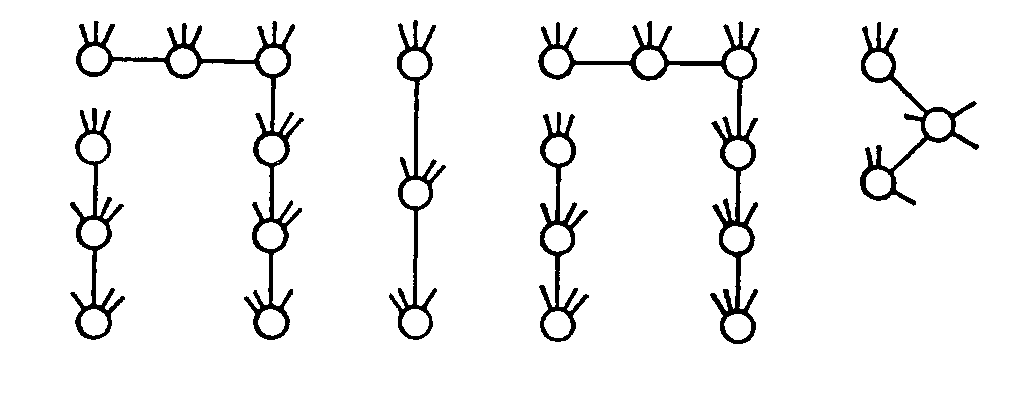
In fact, even the mystical spelling of the divine name with twenty-four points, which Pseudo-Hai transmits here and which no doubt goes back to Oriental sources of Jewish magic, is interpreted in this manner.

The spelling obviously imitates the magical alphabet and characters as they are frequently found in amulets and that, in Jewish magic, are encountered, for example, in the old “alphabets of the angels.”

They appear below:

angelic_alphabet

The twenty-four points or stars of this script correspond, according to the author, to the twenty-four books of the biblical canon, which are perhaps woven from this “hidden name.”

The author instructs the initiate that each of these points in and of itself represents an entire world. This use of the term “worlds” for different levels of being is undoubtedly Neoplatonic. It first penetrated into kabbalistic literature in the ‘Iyyun circle.

As we have seen, Isaac the Blind speaks of the “world of separation” below the sefiroth, but it seems he still did not take the step of considering the sefiroth themselves as just so many worlds. The upper world is henceforth no longer that of the separate intelligences, as it was for the philosophers and in Isaac’s fragments on cosmogony, but the world of the divine emanations itself. In the “Book of the Unity” of Pseudo-Hammai it is said that before Creation all the powers were intertwined and hidden in God,

“ … until there came the time of the will of the first Acting One, and they emerged from potentiality to spiritual reality, and the emanation of the upper world emanated to that of the tenth fundamental stone which is called, in the language of the sages of the mysteries, the “condensed light,” ‘or ‘abh. On account of its condensation they also name it “mixed darkness,” for all the powers of the flames are mixed in it, but are also differentiated in it, and it is the foundation of all the spiritual and corporeal worlds . . . and the last seal of all the [other] seals [emanated in the higher sefiroth].”

Gershom Scholem, Origins of the Kabbalah, pp. 328-30.

The Four Principle Sefiroth

“We thus encounter pell-mell the names of sefiroth, a new light-mysticism, notions of the Merkabah, and cosmological powers. Moses of Burgos had before him a later redaction of this list, which exhibited significant variants and which apparently strove to identify the first ten potencies with the ten sefiroth of the tradition that had meanwhile become canonical.

In these potencies the unknowable God gives the appearance of assuming a body, and his kabhod is, just as in the old Shi’ur Qomah, the “body of the Shekhinah.” God Himself is, in a Neoplatonic image (which likewise must have come from ibn Gabirol’s poem “The Royal Crown”) “the soul of souls.”

Below the kabhod there extend, in the form of the primordial man, the four “camps of the Shekhinah,” which are also the four primordial elements and the four realms of the archangels. Here the “body of the Shekhinah” is inexplicably separated from the primordial man.

In an equally inexplicable manner the elements are correlated with four of the aforementioned thirteen potencies, which apparently also correspond to the four principal sefiroth.

These are the hashmal (corresponding to hesed), the cloud (corresponding to Stern Judgment), the Throne of Splendor (corresponding to tif’ereth), as well as the ‘ofan of greatness (corresponding to malkhuth). This is not directly stated but implicitly understood.”

Gershom Scholem, Origins of the Kabbalah, p. 317.

The Supreme Mystery

“Whereas one of these names thus illustrates the way from magic to Neoplatonic mysticism, the other marks the way from the theory of language of the grammarians to the magic of names, that is, in the opposite direction. Both currents meet in an impressive manner in the Book ‘Iyyun and related writings.

The sequel no longer makes any direct reference to the primordial darkness. First, an “order of the master of the world” is expounded, then an “order of Metatron,” the second part obviously being conceived as some sort of explanation of the Shi’ur Qomah.

The two parts describe, in their own fashion and constantly confusing Merkabah gnosis with Neoplatonic images, the potencies by means of which God acts at Creation as well as the supreme hierarchies of essences emanating from him, the hawwayoth.

The exposition quotes other, presumably also fictitious, writings. At the end of the text it suddenly seems as if R. Ishmael had read all the foregoing aloud to Nehunya ben Haqqanah, as if everything had come from the aforementioned book of Hekhaloth.

The framework of the old Merkabah literature clearly serves here as a receptacle for contents that are alien to it. There is scarcely any relationship between these ideas (in which the doctrine of the sefiroth is mentioned only very incidentally) and the world of the Book Bahir.

The thirteen potencies manifested from the supreme mystery, setherelyon ha-ne ‘elam—no doubt the aforementioned primordial darkness—are enumerated by name. They are:

  1. The primordial hokhmah;
  2. The wondrous or hidden light, ‘or mufla;
  3. Hashmal;
  4. The cloud, ‘arafel;
  5. The throne of splendor;
  6. The ‘ofan of greatness;
  7. The cherub;
  8. The wheels of the Merkabah;
  9. The surrounding ether;
  10. The curtain;
  11. The Throne of Glory;
  12. The place of the souls, also called “chambers of greatness”;
  13. The outer Holy Temple.”

Gershom Scholem, Origins of the Kabbalah, p. 316.

The Magical Name Araritha

“But here the magical name by means of which heaven is sealed is Araritha, and the corresponding name for the earth is ‘EHWY. The latter name, which in the writings of this group frequently serves as an object of mystical speculation, is obviously not a secret name belonging to the theurgic tradition but an artificial product composed of the four consonants employed in Hebrew as matres lectionis.

Abraham ibn Ezra and Yehudah Halevi were the first to propose interpretations of these four letters as the most spiritual elements among the consonants, and hence best suited to form the symbols of the divine spirit in the body of the world and the elements of the two most important divine names in the Torah: ‘Ehyeh and YHWH.

In due course a magical primordial Tetragrammaton was formed, designating the unity of these two names and said to precede them. However, the name Araritha can be found in very old magical texts of the German Hasidim as the secret name of the hashmal in the vision of Ezekiel 1:4.

The same name also appears in a magical piece from the Gaonic period, the “Prayer of Rab Hamnunah the Elder.” In the Book ‘Iyyun, these names are interpreted in the spirit of a Neoplatonic concept of God: they indicate his static as well as his dynamic unity, which also maintains its identity in its oppositions.”

Gershom Scholem, Origins of the Kabbalah, pp. 315-6.

The Sound of the Alef

“Before all Creation he rested, transcendent, in himself, hidden in the power of his own reality. But at the beginning of Creation, “His kabhod became manifest, and the explication of his knowledge consisted in five things.” The author in fact names, but does not explain, these five things, which lead to gnosis. They obviously belong to the sphere of language mysticism and are called tiqqun, ma ‘ amar, seruf, mikhlal, heshbon.

It appears that they constitute the processes by which the letters are placed in harmony (tiqqun), assembled into words (ma’ amar), permutated (seruf), collected together in all their combinations (mikhlal), and calculated according to their numerical value (heshbon). Here, too, the process of emanation coincides with the process of language, but the details do not become clear.

These five events are, as the author says in a curious image, “united in the ramifications of the root of movement [probably meaning the root of the movement of language], which is strengthened in the root of the thirteen pairs of opposites” and unfolds from a thin breath, the sound of the ‘alef, into the name of God (if I understand this difficult text correctly).

These thirteen pairs of opposites are, at the same time, the thirteen middoth derived from Exodus 34:6, which play such a great role in Jewish theology as the modes of God’s action. God acts in the middoth positively as well as negatively, which enables us to perceive a connection with the kabbalistic notion of middah that we found in Isaac.

Here, however, not the sefiroth are meant but the powers or modes of action that are enclosed in the first sefirah and erupt from it. It is in these five modes of the movement of language that everything is realized “like a source for the flame and a flame for the source” prolonged “up to the unfathomable and infinite light, which is concealed in the excess of the hidden darkness. And the knowledge of the unity and of its principle refers to this darkness.”

The divine unity acts therefore out of the effusive darkness from which come all the lights, which are connected to it as the flame to its source. This world of images does not appear to me far removed from that of John Scotus Erigena and Pseudo-Denys the Areopagite; it is more closely related to them than to the world of the Bahir.

Among the Hebrew Neoplatonists such language is not used to express the divine unity, and we touch here upon a possible connection that will emerge more often in the course of this investigation. It seems that the kabbalists of Provence combined the doctrine of the aeons, as found among the gnostics and in the Bahir, with Erigena’s doctrine of the causae primordiales, which in all their multiplicity are nevertheless the unity of the divine sapientia.

Such a relationship is historically plausible. It is not difficult to suppose that the first kabbalists of Provence and Aragon, around 1180-1220, had direct or indirect knowledge of Scotus Erigena, whose influence reached its high point at that time, just before the condemnation of 1210. Many Cathars too seem to have made use of Erigena’s work as is suggested by two extant testimonies. Writings of Erigena were no rarity in the cities where the first kabbalists lived, before Honorius III ordained the destruction of all copies found in France.

But from this speculative and novel introduction, the Book ‘Iyyun proceeds to an explanation of the primordial darkness and the potencies issuing from it. This explanation claims to be a kind of commentary on a Hekhaloth text by Nehunya ben Haqqanah that however, is not identical with any of the Hekhaloth writings known to us. It is apparently against this commentary and, by the same token, against the Book ‘Iyyun in general (along with the Bahir and other writings) that the antikabbalistic attack in Meir ben Simon’s epistle is directed.

Around 1245, therefore, the existence of such a commentary on the Hekhaloth, “where one finds things in the spirit of their [namely, the kabbalists’] heresy” was known in Provence. This text names the signet rings sealing heaven and earth much as we also find them in the Wertheimer version of the “Greater Hekhaloth” (chap. 23).

Gershom Scholem, Origins of the Kabbalah, pp. 313-5.

On the Lost Book of the Speculation

“What is surprising in this text is that it constitutes an irruption of Neoplatonic language and concepts into older cosmological and Merkabah teachings, as far removed from the language of the Bahir as it is from that of Isaac the Blind.

The few extant pages appear to have been carelessly thrown together without any sense of structure, and the exposition is in part erratic and opaque. The book is written in a pure Hebrew and in a curiously enthusiastic style. The long superscription says:

“ … The “Book of the Speculation” of the great master Rab Hammai, chief of those who speak of the subject of the inner [hidden] sefiroth, and he unveiled in it the essence of the whole reality of the hidden glory, whose reality and nature no creature can comprehend, [and of all that] in a truthful manner, such as it [the hidden kabhod?] is in the indistinct unity, in the perfection of which the higher and the lower are united, and it [this kabhod] is the foundation of all that is hidden and manifest, and from it goes forth all that is emanated from the wondrous unity. And Rab Hammai has interpreted these subjects according to the method of the doctrine of the Merkabah—’al derekh ma- ‘aseh merkabah—and commented upon the prophecy of Ezekiel.”

The language used in this superscription, as well as in the beginning of the work, is purely speculative. The notion of indistinct unity (‘ahduth shawah) is unknown in prekabbalistic Hebrew texts. The term, as becomes quite clear in the writings of Azriel of Gerona, refers to that unity in which all oppositions become “equal,” that is, identical.

This concept, and the idea of a coincidentia oppositorum in God and the highest sefiroth—which subsequently plays such an important role, particularly in Azriel—seems to appear here for the first time. According to Azriel, God is …

“ … the One who is united in all of His powers, as the fire’s flame is united in its colors, and His powers emanate from His unity as the light of the eyes proceeds from the black of the eye, and they are all emanated from one another like perfume from perfume and light from light, for one emanates from the other, and the power of the emanator is in the emanated, without the emanator suffering any loss.”

Gershom Scholem, Origins of the Kabbalah, p. 312.

The Lost Book of Rab Hammai

“The tendency of these writings to enumerate celestial beings and their names is sometimes reminiscent of the catalogues to be found in the Pistis Sophia and other gnostic (Mandaean) texts of a later period. Isaac Cohen, who preserved for us many such lists and enumerations, attributed them to a particular group of kabbalists who had not walked the “royal road” followed by the others.

The source of these lists (as distinct from the demonological speculations discussed previously) is said to be a source he called the Book of Rab Hammai, which he claims to have found in Provence in three copies: one in Narbonne, in the possession of the aforementioned anonymous Hasid, and two in Aries.

Here we find ourselves in a very curious situation. The Book of Hammai is lost; Moses of Burgos, Isaac’s disciple, still quoted further catalogues of archons of a gnostic character; the name appears in several other writings that in all probability also originated in Provence.

But no historical personage by this name is known. Whether the Amora Hamma ben Hanina has been transformed into a pseudepigraphic author, or the name Rahmai, rahmai, known to us from the Bahir has perhaps become a Rab Hammai, rab_hammai  or whether we are simply dealing with a new fiction, can no longer be determined.

In the most important of the extant texts, Hammai appears as a speculative author of the eleventh or twelfth century who already relied upon pseudepigraphic kabbalistic writings circulating in the name of Hai Gaon (d.1040). In addition to a “Book of the Unity,” Sefer ha-Yihud, from which only some quotations remain, we have a small tract entitled Sefer ha-‘Iyyun, “Book of the Speculation” (or “Contemplation”), preserved in numerous manuscripts.”

Gershom Scholem, Origins of the Kabbalah, pp. 310-1.

The First Sefirah is Passed Over in Silence

“After the resurrection, the righteous and the average realize a new progress in their spiritual and moral perfection, one that takes them beyond everything they attained in their lives. By this adherence to the seven divine middoth, all will share perpetually in the gift of prophecy.

From a brief allusion of ibn Sahula (f. 34a), we can infer that on several occasions Isaac expressed his views on eschatological matters, in the context of which he may also have discussed the preparation for redemption by means of the purification of souls during their transmigrations.

In the extant texts, however, there is no clear statement on this subject, though on one occasion Isaac quotes a relevant passage from the Bahir, section 105.

Isaac of Acre states that in his commentary on Yesirah Isaac the Blind made a hidden allusion to the distinction between the migration of souls (gilgul) and the impregnation of souls (ibbur) as being two different things, but I have not been able to locate this allusion.

It should be clear from the foregoing that Isaac the Blind already had at his disposal a complete system of kabbalistic symbolism, partly inherited from tradition and partly elaborated by himself which he applied to a great variety of biblical and rabbinic subjects.

His epistle to Gerona, which has survived, offers a brief explanation of the last psalm, apparently in response to a question. The psalmist’s tenfold invitation to praise God is interpreted as an allusion to the ten sefiroth, though the first sefirah is passed over in silence, and Isaac counts downward beginning with hokhmah.

His mystical allusions in this epistle scarcely differ from the instructions he gives for the mystical kawwanoth at prayer; there too, he briefly describes the process by which the mystic first traverses the world of the sefiroth from below upward during the profession of the divine unity, the Shema’ Yisrael, and then, in his meditation on the word ‘ehad, “one!” completes and closes the circle of his kawwanah, from above downward.”

Gershom Scholem, Origins of the Kabbalah, pp. 308-9.

Debhequth is Communio

“It is this contact, connection, or communio with God that is designated by the Hebrew term debhequth. This kabbalistic concept has its origins in the terminology of the medieval Jewish theologians, especially Bahya ibn Paquda and Abraham ibn Ezra, who employed the biblical verb dabhaq (“adhere, cleave to,”) to express the contact of the soul with God or the divine light. The biblical injunction Deuteronomy 13:5 is cited by Isaac’s pupils as their master’s cue for this doctrine:

“ … Our master the Hasid said: The essential thing in the divine service of the mystics [maskilim] and those who meditate on His name, lies in this [verse]: “and cleave to Him.” And this is a cardinal principle of Torah and of prayer, that one make one’s thought conform with one’s faith, as though it were cleaving to what is above, in order to conjoin the name [of God] in its letters and to link the ten sefiroth to Him as a flame is joined to the coal. With his mouth he must express it according to its paraphrase, but in his heart, he must conjoin it in its true structure.”

Debhequth is therefore not unio but communio. In the sense the term acquired in kabbalistic usage it always contains an element of distance despite its character of intimacy. Debhequth is not becoming one with God but entering into an infinitely close liaison with him, roughly corresponding to that called adhaeresis by medieval Christian mystics.

In Hebrew, debhequth can denote the process as well as the state attained through it. The instrument of this process is the kawwanah. Isaac and his disciples do not speak of ecstasy, of a unique act of stepping outside oneself in which human consciousness abolishes itself.

Debhequth does not consist in tempestuously rushing toward God and becoming absorbed in him; it is a constant state, nurtured and renewed through meditation. In contrast to some later schools, the old kabbalists did not go any further, and in this remained true to their Jewish-theistic character. For them, debhequth or the mystical communio is not, as for many non-Jewish mystics, a transitional stage leading to still higher regions.

Any pantheistic overstepping of the limits they fixed for themselves in their interpretation of the mystical path is far from their thoughts.”

Gershom Scholem, Origins of the Kabbalah, pp. 302-3

The Secret Signature of the Letters

“Isaac’s picture of the universe rests, therefore, on the idea that the different realms of Creation, each according to its rank in the hierarchy of things, are in communication with the roots of all being as given in the world of the sefiroth.

The limited powers proceed from the unlimited powers, and the secret signature of the letters acts in everything, but nowhere more clearly than in man. But to the current that flows downward there corresponds another, upward movement.

When Isaac says in his commentary on Yesirah (end of chapter 3) that “all things return to the root of their true being,” he means, in this context, that a thing can act only in that which is related to its principle.

But his disciples already understood expressions of this kind in the sense of a return of all things to God. “Everything issues from the first Cause, and everything returns to the first Cause.”

Such a return can have both an ontological and an eschatological aspect. Even before the end of all things all being seeks to return, in accordance with its nature, to its origin, in the spirit of the ancient philosophical thesis of the appetitus naturalis, which the Neoplatonists above all rendered popular in the Middle Ages.

But also, the eschatological nuance of a “restoration of all things to their original being,” hashabath kol ha-debharim le-haw-wayatham, is not absent among Isaac’s pupils, who probably derived it from him.”

Gershom Scholem, Origins of the Kabbalah, pp. 299-300.

On the Apocatastasis

“Only in the messianic era will the position of Sammael be restored; the Throne of God, which for the present is damaged, will then be repaired.

It thus appears that Isaac the Blind was a follower of the doctrine of the ultimate “restoration of Satan,” the apocatastasis.

Since, as is well known, Judaism recognized no official dogmatic authority that was entitled to determine the content of the faith, this question too, which played such an important role in the history of the Christian churches, remained open and a subject of dispassionate discussion.

Opinions were divided, and many mystics adhered to the “restoration” doctrine. Later kabbalistic theories exhibiting the same tendency, such as Joseph ibn Gikatilla’s Mystery of the Serpent, probably owe their inspiration to Isaac the Blind.

What is curious in the case of Isaac is that Sammael did not fall from his exalted rank, as one would expect, at the time of Adam’s sin—for which the Aggadah holds him responsible—but only at the time of the battle against Amaleq.

In this detail he was not followed by later kabbalists; even when they defended the doctrine of apocatastasis they placed it in relation to the reestablishment of the harmony of all things, which had been disturbed by Adam’s original sin.

However, also for ibn Gikatilla (as for Isaac), the serpent drew his original power directly from the sacred domain of the emanations, standing outside its “walls” and acting as the genius of the entire sublunar world. There, too, the rebellion of the serpent introduces disorder into the harmonious union of the worlds and isolates Sammael as genius of evil.

Isaac’s view that the supreme angelic powers draw their influx directly from the tenth sefirah is also found in Ezra, who attests to having received “from the lips of the son of the master,” that is, from Isaac the Blind, the doctrine “that Metatron is only a messenger, and not a specific thing bearing that name.

Rather, every messenger is called in Greek metator, and perhaps the messengers received the influx of the [tenth sefirah] named ‘atarah to fulfill their mission.”

Metatron is therefore not a proper name at all but a designation for the whole category of celestial powers performing a mission. This conception is far more prosaic than that taught by his father, the Rabad (cf. the passage quoted, p. 212), in his commentary on the Talmud.

Is this the whole truth about Isaac’s view, or merely an occasional remark? No other kabbalist ever denied the existence of a specific angelic being called Metatron, even if he adopted Isaac’s etymology.

The etymology itself is apparently taken from the old talmudic dictionary ‘Arukh of Nathan ben Yehiel of Rome, which was well known in Provence (as metator). Isaac obviously did not think of identifying Metatron with the last sefirah, the Shekhinah, although the identification is found later, among the first generation of Catalan kabbalists.”

Gershom Scholem, Origins of the Kabbalah, pp. 298-9.

On the Evil Status of Goats

“Nevertheless, many extant fragments prove that Isaac had a certain interest in questions relating to the nature of Sammael, whose name had become for the Jews of the Middle Ages, the principal one associated with the devil and his dominion. The following dictum of Isaac makes good sense when viewed against the background of the large number of shepherds populating the western Languedoc:

He who lives with herds of sheep, even if it is in the high mountains and in the desert wastes, which are uninhabited, has no need to fear Satan and the evil powers, for no evil spirit rules among them. But he who lives among goats [of him it can be said] that even when he is surrounded by ten houses and a hundred men, an evil spirit rules over them.

In another fragment, we learn that Sammael’s origins lie in the power of the sefirah pahad, channeled to him through the last sefirah “without any other intermediary.” He has, therefore, a legitimate position in the sacred totality of Creation.

It was only when he pitted himself in the war of Amaleq against Israel and the sacred order it represents—a war that has always been interpreted in Jewish tradition as a metaphysical event of enormous significance—that he lost this legitimate place. Since then he receives his power only indirectly, from planetary spirits, and “no longer by the path of the primordial order of Creation.”

Gershom Scholem, Origins of the Kabbalah, p. 297.

Sammael and Lilith, Adam and Eve

“In Provence, Aramaic texts appeared that could in fact have arrived there, at least in part, directly from the Orient in the twelfth century, even if they did not necessarily reach the circle of Rabad and his family. It seems, however, that in some of the earliest circles of kabbalists further variations were composed in an obviously artificial Aramaic on these same themes of the demonological hierarchies.

Remnants of these compositions still exist, for example, the pseudo-gaonic responsum on the conjuration of the prince of the demons, which incidentally also speaks of the revelation of the prophet Elijah during the night of the Day of Atonement. Already the earliest stratum of these texts distinguished between an old and a young Lilith and is familiar with strange names for the demonic rulers of the three realms of the ether and for their spouses, the Jewish names being combined with those of an obviously foreign provenance.

“The old Lilith is the wife of Sammael; both of them were born at the same hour in the image of Adam and Eve, and they embrace one another. Ashmedai, the great king of the demons, took as his wife the young Lilith, daughter of the king; his name is Qafsafuni and the name of his wife is Mehetabel, daughter of Hatred [from Gen. 36:39], and her daughter Lilitha.”

The fact that the spouse of the last king of Edom (in the list given in Genesis 36) figures as a demon suggests a reinterpretation of the list of these kings that turned them into the archons of darkness. Sammael too appears in these sources as the ruler of Edom—a Jewish code word, since the early Middle Ages, for Christianity, which was regarded as originating from the realm of darkness.”

Gershom Scholem, Origins of the Kabbalah, pp. 295-6.

Sammael and Lilith and the Hierarchy of Darkness

“On the other hand, what might very well be of Oriental origin are purely mythical statements regarding the realm of demons, in which kabbalistic ideas like the doctrine of the sefiroth or the idea of emanation in general play no role.

These doctrines are mentioned by Isaac Cohen as coming from theurgic texts, which he connects with the “Lesser Hekhaloth” and a Sefer Malbush which, however, bear no relation to the old theurgic texts known by these names.

In these sources, Sammael and Lilith appear for the first time as the demonic couple placed at the head of the hierarchy of darkness. The connection between this strange mythic construction and the properly kabbalistic theories was only established later by the editors, the brothers Isaac and Jacob Cohen or their teachers.

The great antiquity of these ideas, the details of which I do not wish to discuss here, is also attested by the fact that the very old etymology, borrowed by the Gnostics of the second century from Jewish circles, of the name of the devil Sammael—a name that arose concurrently with that of Beliar—is still preserved here: the “blind archon,” sar summa.”

Gershom Scholem, Origins of the Kabbalah, p. 294.

Intertwining Branches of Good and Evil

“But it is not only the good that has its origin in the irradiation of lights of the emanation; there also exists a positive evil, which is related to the root of death. In this way Isaac adopts a modified form of the corresponding idea of the Bahir concerning the nature of evil.

The oppositions discussed in chapter 4 of the Book Yesirah, in connection with the seven consonants of the Hebrew alphabet that can be pronounced in two different ways, also include that of life and death; and Isaac explains that “after the cause of life, the cause of death was emanated.”

Also at the beginning of chapter 2 he emphasizes that in each case the poles of oppositions come “from an autonomous principle.” Death is therefore something more and something other than the mere cessation of life. It has a positive root.

Certainly Isaac stresses at the same time that in the world of the sefiroth and of the “inner essences,” good and bad are not yet dissociated from one another but are harmoniously united, be-‘ah-duth ube-shalom. Only when the “roots” continue to develop into a tree—and in the emanation that later derives from it and to which the double letters correspond—does evil also exist in isolation.

Otherwise, Isaac’s thinking remains determined by the image of the organic body (on chap. 4). The letters are like the branches of the tree and in them the intertwined pattern of good and evil is unfolded, so that each good middah also has its corresponding evil and vice versa.”

Gershom Scholem, Origins of the Kabbalah, p. 293.

Man as the “Great Seal”

“The divine power spreading from the sefiroth into Creation, from the world of the Throne and the angels outward, also descends below the human domain to living beings of a lower order, even to plants.

Trees, too, have a mystical root in those of Paradise, which represent the primordial images of all future trees. Everything below is linked to that which is above, to which it owes its existence, until it is linked by a chain of this kind to the Infinite.

”All creatures on earth depend on the higher powers, and these on still higher, up to the infinite cause.”

This cosmic chain is, at least in the realm of the sefiroth, a magnetic one. The sefiroth and logoi “rise above themselves like something rising under the influence of a magnet and thus their end [in the words of the Book Yesirah] is [enclosed] in its beginning” (on 1:7).

But in addition to the connection through emanation there is also one through vision, sefiyah. In connection with Yesirah 1:6, we learn that this vision itself is the magnetic act of communication in which everything ascends to its origins.

The Book of Creation says that the vision of the sefiroth is like lightning, and Isaac explains:

“The vision is the meditation of one thing out of the other. . . . Every cause is taken up and rises and then looks down from a cause that is higher than itself. . . . Everything is in the other and in communication with the other.”

Thus, not only does God contemplate the depths of his own wisdom when he produces the world, but a contemplative communication of the same kind also takes place among the sefiroth.

The contemplation of the mystic in a state of kawwanah is thus not unlike that which occurs among the spiritual essences themselves. In creation, it is not the divine middoth, the “fathers,” that act directly but rather the derivative middoth, toladoth, which issue from them. In isolation, without communicating with “fathers” or “mothers,” they are unable to produce anything.

Man too is inserted into this process. He is …

” … built out of combinations of the letters” (chap. 3). “And this higher edifice of spirit [ruah] that directs him [also] directs the All, and thus the All is connected to the upper and the lower ones and is composed of the world, the year and the soul. . . . And the soul is the determining factor in the All” (ibid.).

Man, our text continues, is “the quintessence of all creatures, a great seal, in which the beginning and the end” of all creatures are enclosed.”

Gershom Scholem, Origins of the Kabbalah, p. 290.

The Mystical Radicalism of Isaac

“It corresponds to the sefirah of the divine Mercy, or tifereth. The lowest sefirah, on the other hand, contains, by virtue of its correspondence to the action of divine judgment in the world, the Oral Torah, which is black fire burning upon an underlayer of white fire. “But the form of the letters is without vowels and is only potentially engraved in this black fire, which is like ink [on white parchment].” In the white fire itself the forms of the letter still do not actually appear, and where they do so we are already (in the symbolism of the black fire) in the domain of the Oral Torah.

“ … And thus the Written Torah cannot adopt corporeal form, except through the power of the Oral Torah; that is, that the former cannot be truly understood without the latter, just as the mode of divine Mercy can only be grasped and perceived through the mode of Judgment. And the figures of color, gawwanim, of black, which are those of Judgment, rise up and spread out over the configurations of white, which are those of Mercy, like the light of the coal. For the power of the colored configuration of the flames prevails until the light of the coal can no longer be perceived at all because of the excess of flames covering it.”

The simile of the coal and its flames is the same as that employed by Isaac so often in his commentary on Yesirah. The mystical Written Torah is still hidden, as it were, under the invisible form of the white light represented by the parchment of the Torah scroll and is in no way perceptible to the ordinary eye.

It is only when the mystical lights, in the play of flames, sometimes veer away from one another that they offer a momentary glimpse of the white light or the sphere of divine Mercy. At such moments, “many a prophet” can “snatch, by means of the ‘crown of royalty,’ [the last sefirah, accessible to their contemplation] something of this mystical splendor, each according to the spiritual degree of which he is worthy.” But this can be no more than a momentary intuition.

A truly lasting contemplation of this hidden form of the white light is as inconceivable as that of the sun by a terrestrial eye. Only Moses, the master of all the prophets, could attain a continuous contemplation of this “luminous mirror” and by virtue of his prophetic rank enter into spiritual communication with it.

The language of this symbolism is identical to that found in other of Isaac’s fragments. Hidden behind mystical symbols, we find a conception according to which there simply is no Written Torah within reach of the ordinary mortal.

Everything we call by that name has already passed through the mediation of the Oral Torah. The Torah apprehensible to man is not the hidden form in the white light but precisely the obscure light that already had adopted definite forms and determinations and that thereby designates the quality of divine Sternness, the quality of Judgment.

The Torah scroll itself symbolizes that. The ink and the parchment form a unity. But the element rendered visible by the ink is the blackness, the “obscure mirror” of the Oral Torah; the true secret of the Written Torah, which embraces everything, is contained in the signs, still not visible, of the white parchment.

In a word, there is only an Oral Torah, and the concept of a Written Torah has its place, in the final analysis, in the mystical domain, the sphere accessible only to the prophets. Therefore, here, at the very beginning of the historical appearance of the Kabbalah in the West, we have a thesis whose mystical radicalism can hardly be surpassed and was in fact not surpassed in the entire history of the Kabbalah.

It proves, more than anything else we know of him, that Isaac was a genuine esotericist. Isaac’s fragment fell into oblivion, but his thesis was taken up and elaborated more than once in the history of the Kabbalah, at times in much less veiled language.”

Gershom Scholem, Origins of the Kabbalah, pp. 288-9.

The Mah ‘Elohim of Genesis 1:2

“In another way, however, Isaac’s mysticism of language is easier to understand. From the Sophia, which we have come to know as the primordial Torah as yet undifferentiated by language, the voice is formed in the next sefirah, binah. This voice is not yet audible and is still hidden; it becomes audible only at the later stages of emanation and at the end of this process becomes articulated speech.

But already the hidden voice becomes differentiated, by prolonging itself, into many letters. “Hewn in the pneuma,” which is binah, they acquire, according to Isaac, an exterior and an interior, body and soul. This power of the letters flows into the world beneath the sefiroth, forming on the celestial sphere the secret but nonetheless primordial images of all things in the figure of the 231 gates of this sphere; the gates represent the combinations, two by two, of the elements of the Hebrew alphabet.

There are 462 such combinations, but the other half of this power remains above the sphere. Hence the letters, no matter how they are combined, are only the visible ramifications of the one promordial name.

It remains unsaid, however, whether this primordial name is the Tetragrammaton, the name ‘ehyeh, or some other mystical name underlying both of these. The entire process of emanation remains condensed in all the letters, and “in each individual letter are contained all ten sefiroth” (3:2).

The letter becomes, therefore, a world in itself encapsulating the whole future as something already preformed in it. “In each individual letter there are subtle, inward, and hidden essences ‘without what’ [that have not become anything definite].

Whatever could be chiseled out of them was already in them, just as all a man’s descendants are already in him.”

These secret essences in the letters, which exert their influence in the midst of creation, are conceived “in the manner of the essences given in the Sophia.” It is quite possible that the “whatless” being, being without quiddity, to which this passage refers and which is hidden in the letters, had something to do with the punning definition of the Sophia, given by Isaac’s disciples as being the “potency of the what.” This conception is in perfect accord with the quotation from the Yesirah commentary.

Similar ideas on the development of the world of the sefiroth and what lies below it are found, albeit expressed with enigmatic brevity, in Isaac’s commentary on Genesis 1 (which already ibn Sahula admitted was partly incomprehensible).

Mention is made there of a progression from the “splendor to the Sophia” toward the “light of the Intellect” as the content of the creation of the first day, which, as the mystical primordial day, contained within itself “in spirit, though not yet in their form” all the essences. It is only with the diffusion of the light of the intellect that the light of all other things radiated therefrom; and it seems that for Isaac, the primordial creation of the first day embraces all ten sefiroth.

He interprets the events of the second day of creation as constituting a transition representing the “extension of the spirit in the form.” The souls, too, only “extend in the form” on the second day. We do not learn what constitutes this specifically formative power of the spirit, which is the mah ‘elohim of Genesis 1:2. It is a pneuma that comes from the sefiroth of hokhmah and binah, “and it is called among the sages the power that shapes the form.”

The “sages” named here must be the philosophers, judging by the terminology employed; in the Midrash one finds no such expression. From this supreme pneuma, apparently, come all the souls, which are stamped with the letters engraved in the spirit.”

Gershom Scholem, Origins of the Kabbalah, pp. 285-7.

The Letters of the Great Name

“Whatever the precise nature of the supreme sefirah, hokhmah is in any case the “beginning of being” as it is also the “beginning of the dibbur.” Prom hokhmah, all the sefiroth proceed in a clear chain of emanations. In terms of Isaac’s language-mysticism, the divine things are at the same time the divine words. The ideas are names.

This motif, already prefigured in the Bahir where the sefiroth coincided with the ten logoi, now appears in a much profounder form. For the kabbalist, evidently, language-mysticism is at the same time a mysticism of script and of letters. The relation between script and language is a constitutive principle for the Kabbalah.

In the spiritual world, every act of speaking is concurrently an act of writing, and conversely every writing is potential speech, destined to become audible. The speaker engraves, as it were, the three-dimensional space of the word on the plane of the ether.

The script, which for the philologist is only a secondary and otherwise rather useless image of real speech, is for the kabbalist the true repository of its secrets. The phonographic principle of a natural transposition of speech into script and vice versa manifests itself in the Kabbalah in the idea that the sacred letters themselves are the lineaments and signs that the modern phoneticist would want upon his disc.

The creative word of God is legitimately stamped upon just these sacred lines. Beyond language lies the unarticulated reflection, the pure thought, the mute profundity, one could say, in which the nameless reposes. Prom hokhmah on there opens up, identical with the world of the sefiroth, the world of the pure name as a primordial element of language. This is the sense in which Isaac understood the saying of Yesirah 2:5, according to which all language proceeds from a name. The tree of divine powers, which formed the sefiroth in the Bahir, is here transposed to the ramifications of the letters in this great name.

But more than that of the tree, Isaac liked the simile of the coal and the flames (shalhabiyoth) that are fed by it, inspired by another passage of Yesirah (1:7) to which he often has recourse:

“ … Their root [that is, that of language and things] is in a name, for the letters are like branches, which appear in the manner of flickering flames, which are mobile, and nevertheless linked to the coal, and in the manner of the leaves of the tree, its boughs and branches, whose root is always in the tree . . . and all the debharim become form and all the forms proceed only from the one name, just as the branch comes from the root. It follows therefore that everything is in the root, which is the one name (on 2:5).

The world of language is therefore actually the “spiritual world.” Only that which lives in any particular thing as language is its essential life.

Raising the above to the level of kabbalistic discourse, the words, dibburim, constitute the world of the sefiroth, which are united in their configurations in order to form letters, just as, conversely, the words themselves are the configurations of letters.

Isaac uses both images though their kaleidoscopic relations are not entirely transparent. In any case, letters are for him the elements of the universal script. According to him, the Hebrew word for letters, ‘othiyoth, derives from the verb ‘atha, to come; the letters are “things which come from their cause,” thus, that which “proceeds” from the root.

But each of these elements comprises in ever new configurations all the sefiroth: “In every letter there are the ten sefiroth.” Thus we are told, in connection with Yesirah 4:1 that the ten sefiroth are “inner [or: hidden] essences” whose inner [hidden] being is contained in the hokhmah, and that they are at the same time the roots of principles in which good and evil are still united.

“They [the sefiroth] begin to grow forth like a tree whose beginnings are unrecognizable, until a plant issues from them.” The verbs employed by the Book Yesirah to describe the formation of the letters that God “hewed” in the pneuma suggest to Isaac the image of a mountain from which raw stones are extracted, then hewed and chiseled, and from which well-ordered edifices come into being.

This “edifice” is the world, but the world of the sefiroth as such also represents a building of this type that issues from its elements, and, in the last analysis, from the hokhmah. The sphere in which this hewing of the innermost elements takes place is not the hidden Sophia, where everything is still conceived as united without form, but the sefirah that follows it, binah or teshubah (“that to which all returns”), which is itself a mystical hyle from which the forms are chiseled.”

Gershom Scholem, Origins of the Kabbalah, pp. 277-9.

The Unknowable

“To this correspond two statements of Isaac that refer to the hidden subject of the third person, past tense, which Hebrew does not mark by a specific termination. In his comment on Genesis 1, he says: “In every place [in the Scriptures] where you find simply bam’, ‘asa, ‘he created, he made,’ know that it [the subject] is above the pure thought.”

But in his commentary on Yesirah 1:1 he explains the hidden subject of the verb haqaq, as “that which thought cannot attain.” Since for Isaac (who knows nothing of a definition of the Will as the first emanated being) the mahshabah itself is the first sefirah, then that which it cannot attain would therefore be nothing other than ‘en-sof, which is itself transcendent and hidden in relation to thinking.

The pure thought would be the supreme creative sphere of being, while ‘en-sof, as the Unknowable, already existed before all thought. Quite possibly this was in fact Isaac’s opinion, and I find nothing in his own statements to contradict this supposition. The difficulty, however, lies in the fact that all his disciples, Ezra ben Solomon, Azriel, Jacob ben Shesheth, and above all his own nephew, Asher ben David, who was closest to him, identify the Unknowable, at times explicitly, at times implicitly, with the first sefirah.

The rules of simple logic would lead to the conclusion that Isaac is the common source of this identification. The divine Thought would then be that which cannot be attained by human thought, and Isaac would therefore employ the word mahshabah in different senses: in one context it would designate the Thought of God, but in the expression “that which cannot be attained by thought,” the reference would be to human thought.

However, in the fragment of his commentary on Genesis, he even speaks, as we saw, of that which is above the “pure Thought,” that is, above the divine Thought. I cannot resolve this difficulty without doing violence to the texts. The unknowable in God is identified by the Christian Neoplatonist, Scotus Erigena, with the Nothing from which all creation proceeds.”

Gershom Scholem, Origins of the Kabbalah, pp. 270-2.

The En-Sof

“They are called in his works the Infinite (‘en-sof), Thought, and Speech. The principle of Speech, dibbur, is divided into the plurality of speeches and words, by which he often means the seven lower sefiroth, called not only dibburim but also debharim. In Hebrew dabhar means “word” as well as “thing,” and this coincidence was obviously decisive for the formation of Isaac’s thought.

The sefiroth, above all the seven lower ones, are the words or things “which shape reality.” They take the place of the ma’amaroth, the logoi of the Bahir. The “Thought,” too, already comes from this text, as we saw in the previous chapter. But what is entirely new is the emphasis laid on a domain of the divine that is above all reflective contemplation, indeed above the divine Thought itself, a domain called by Isaac “the cause of Thought” and designated by a new term: ‘en-sof.

The birth of this concept is of great interest for the history of the Kabbalah. This designation is usually explained as a borrowing from Neoplatonism. Christian Ginsburg, whose essay on the Kabbalah has been appropriated by many authors (who do not always bother to acknowledge their source), says:

“ … Any doubt upon this subject must be relinquished when the two systems are compared. The very expression En Sof which the Kabbalah uses to designate the Incomprehensible One, is foreign, and is evidently an imitation of the Greek Apeiros. The speculations about the En Sof, that he is superior to actual being, thinking and knowing, are thoroughly Neo-Platonic.”

Ginsburg, however, proceeded on the completely erroneous assumption that the oldest document of the authentic Kabbalah was the Neoplatonic catechism on the sefiroth composed by Azriel, Isaac’s disciple. There the notion is in fact explained in a manner that comes particularly close to Neoplatonic thought. But this says nothing about the origin of the concept. Indeed, the expression is strange, by virtue of its very grammatical formation.

It certainly is not a rendering of a fixed philosophical idiom, whether it be from the Greek or from the corresponding Arabic (la-nihaya)—in spite of the readiness with which some scholars have adopted this view.

The form ‘en-sof corresponds in no way to the translations of privative notions in medieval Hebrew literature: in these the conjunction Ulti always precedes the negated notion; the negation ayin is never employed for this purpose. Thus “inconceivable” is rendered by bil-ti-mussag and not by ‘en hassagah, and “infinite” is Ulti ba’al-takh-lith and not ‘en-sof.

The form ‘en-sof is altogether unusual, and Graetz had good reason to see it in a proof of the late origin of the term. However, he should have added that in the Hebrew literature of the Middle Ages, too, it represents a completely isolated phenomenon. It is only in biblical literature that we find forms such as ‘en ‘onim or ‘en ‘eyyal, for powerless. Subsequently, locutions of this kind disappear completely.

How, then, are we to understand the origin of the term ‘en-sof? It did not result from a deliberate translation, but from a mystical interpretation of texts that contain the composite term ‘en-sof in a perfectly correct adverbial sense, and not as a specific concept. The doctrine of Saadya Gaon, in particular, abounds with affirmations of the infinity of God—in fact, it is asserted at the very beginning of his well-known “Supplication” (Siddur R. Saadia [1941], 47), and in the old Hebrew paraphrase, known among the Provençal Kabbalists as well as the German Hasidim, it is reiterated incessantly.

Tobias ben Eliezer, who wrote around 1097, also stressed precisely this quality of God, in the context of a reference to the mystical Hekhaloth writings. For him God is “the first up to the unfathomable, the primordial beginning up to the infinite (‘ad ‘en-takhlith), among the last up to infinity (‘ad ‘en-sof). ” The adverbial construction is perfectly correct.

“Up to infinity” results from a combination of “up to there, where there is no end.” Expressions of this kind, in which ‘en-sof has the function of an adverbial complement, are found with particular frequency in the writings of Eleazar of Worms. We find the same usage in the Bahir (cf. p. 130 preceding). Thus, Eleazar writes, for example: “When he thinks of that which is above, he should not set any limit to this thought, but thus [should he think of God]:

” … high, higher up to the Boundless [‘ad ‘en-qes]; down deep, who can find him; and the same above in the expanse of all the heavens . . . and outside the heavens up to the infinite [le’en- sof].” Or: “in the Throne of Glory are engraved holy names, which are not transmitted to any mortal, and which sing hymns unto infinity [meshorerim shiroth le’en-sof].”

The transition here from the innumerable hymns sung by holy names and angels to a hypostasis that, as a mystical reader might perhaps conceive it, “sings hymns to ‘en-sof” seems easy enough. The term ‘en-sof came into being when one of the Provençal kabbalists read this combination of words that actually represents a phrase as a noun, possibly influenced by the aforementioned kind of adverbial composites and perhaps also by some expressions in the Bahir.”

Gershom Scholem, Origins of the Kabbalah, pp. 265-7.

Eschatological Elevation of the Soul After Death

“The Bahir’s idea of the sefiroth appears in Isaac’s writings in a fully crystallized form. In his commentary on the Yesirah 4:3, the verse 1 Chronicles 29:11 is used for the first time as a biblical reference for the names and the sequence of the seven lower sefiroth, especially the first five among them: “Yours, Lord, are the greatness (gedullah), might (geburah), splendor (tif’ereth), triumph (nesah), and majesty (hod)—yes all (kol) that is in heaven and on earth; to You, Lord, belong kingship (mamlakhah) and preeminence above all.”

From here come the designations not yet used in the Bahir, of gedullah for hesed, tif’ereth for ‘emeth, and hod. Isaac himself for the most part uses the names hesed and pahad (as in the Bahir) instead of gedullah and geburah. The name tif’ereth, however, is already familiar to him.

Whereas the word kol, occurring in the aforementioned verse, already served in the Bahir as an epithet designating the “Righteous,” Isaac uses for this sefirah the noun “Righteous” and the epithet “Foundation of the world.” For the last sefirah, on the other hand, he employs almost exclusively an epithet still not familiar to the Bahir, although it is undoubtedly alluded to there.

This epithet is ‘atarah, a synonym for kether, which designates the lowest of the ten “crowns.” Like the Bahir, he names the first three sefiroth kether or mahshabah, hokhmah and binah.

In his commentary on Yesirah, Isaac mentions many of these sefiroth in the framework of fixed schemata, but this does not always enable us to comprehend the sequence of the sefiroth within them. What is strange is that in point of fact the structure of the sefiroth beyond the supreme three only interests him in detail when it is a question of prayer mysticism, or the interpretation of certain ritual commandments. They have their importance as stages of the contemplative ascent or of the eschatological elevation of the soul, after death, to even higher spheres.

But never are any coherent thoughts presented concerning their function and structure. This is particularly the case for the potencies of tif’ereth, yesod and ‘atarah, which play an especially important role in the evolution of the doctrine of the sefiroth. In contrast to this lack of interest in detail, one discerns in Isaac a more pronounced interest in the totality of the spiritual potencies expressed in language and, in a more general manner, in spiritual entities.

Having said that, the terminological differences between concepts like sefiroth, middoth, letters (of the alphabet) and hawwayoth (literally: essences) are by no means always clear, and their interpretation is often fraught with difficulties.

However, these difficulties are closely related to what is truly new in Isaac’s Kabbalah. Indeed, from the historical point of view their interest lies in the combination of the world of ideas of the Bahir and the entirely new elements that erupt, inspired by gnostic ideas, into the oldest form of the Kabbalah as represented by the Bahir.

This combination reflects speculative interests whose origin is no longer essentially determined by Gnosticism but rather by Neoplatonism and a language mysticism generated by the latter. Isaac is visibly struggling with new thoughts for which he is as yet unable to find clear and definitive expression. The awkwardness of his new terminology militates against the supposition that this lack of clarity, which often makes it so difficult to penetrate his meaning, is intentional.

His new terminology seems to be derived from philosophy, although we cannot identify its philosophical sources in the Hebrew tradition. The special importance of Isaac’s commentary on the Yesirah lies in the attempt to read into the old texts the new, speculative thoughts of a contemplative mystic. But we are no less surprised by the boldness with which he presents far-reaching ideas in his other cosmological fragments and in his remarks concerning the mystical theory of sacrifice. The particular manner in which Isaac applies his ideas to the task of man, to the connection between the terrestrial and the celestial worlds, and to eschatological matters merits closer consideration.

The path of the mystic, described by Isaac at the beginning of his commentary on the Yesirah, is (as Isaac of Acre already recognized in his paraphrase of several of these passages in his own commentary) that of systematically uncovering the divine—by means of reflective contemplation and within the innermost depths of such contemplation. Isaac postulates three stages in the mystery of the deity and its unfolding in creation and revelation.”

Gershom Scholem, Origins of the Kabbalah, pp. 263-5.

Finally, Here is the True Kabbalah

“The transition from the usual meaning of the word Kabbalah to the esoteric nuance was easily made. We find the first sign of it in Yehudah ben Barzilai. Speaking of the creation of the Holy Spirit, which is the Shekhinah, he says: “The sages did not deal with it at length, in order that men would not come to form ideas concerning ‘what is above,’ etc. and that is why they were accustomed to transmitting this thing in whispers and in secret, as a tradition to their pupils and to the sages.”

The ordinary expression “to transmit something as Kabbalah [orally]” here acquires through the addition of the adverbs “in whispers and in secret” the quality of an esoteric tradition. Somewhat similar is the use of the term in an Arabic text of 1223 that counters Maimonides in its assertion that where the Kabbalah of the sages of Israel is mentioned the reference is to the baraithoth of the Hekhaloth literature as the true interpretation of Ma’aseh Merkabah (A. Harkavy, in his appendix Hadashim gam Yeshanim to the Hebrew translation of Graetz’s Geschichte 5:47).

But contrary to Harkavy’s view, this passage in no way proves that the term Kabbalah in its novel, technical sense was known in the Orient in 1223. That, precisely, is Kabbalah, in the sense of the Provençal school. But Eleazar of Worms also cites traditions of this kind—for example, with respect to the names of the angels—as “Kabbalah.” Besides, still other expressions were used in Isaac’s circle. In a letter sent to Gerona, Isaac himself speaks in this sense of hokhmah, wisdom or science, without adding the adjective penimith, “esoteric,” although this often occurs in other places.

In the twelfth century, the expression of sefarim penimiyyim appears in France for writings considered there as esoteric literature, such as Seder ‘Eliyahu Zutta.

In the liturgical manual Sefer ha-Manhig, composed in 1204 by Abraham ben Nathan ha-Yarhi of Lunel, who in his youth had studied with the Rabad, the “Greater Hekhaloth” are twice designated by this term.”

Gershom Scholem, Origins of the Kabbalah, pp. 261-3.

Yoser Bereshith

“In its initial stage of development in the circle of the Rabad, the doctrine of kawwanah differed in at least one important and instructive point from the form in which it was to become familiar to his successors. As soon as the kabbalists grasped the fundamental difference between the Emanator and the emanated, between the hidden God, subsequently to be called by them ‘en-sof, and the attributes or sefiroth by which he manifested himself and through which he acts, they immediately emphasized the thesis that there can be no kawwanoth addressed directly to ‘en-sof.

The nature of the hidden God excludes any such possibility. If we could meet him in kawwanah he would no longer be that hidden God, whose concealment and transcendence cannot be sufficiently emphasized. It would therefore only be logical for the kabbalists to argue that kawwanah could be related only to his middoth, the being and reality of which affect us, whereas kawwanah directed toward ‘en-sof is impossible.

When the kabbalists’ propaganda in favor of mystical prayer reached wider circles, this thesis, with its far from innocent implications, must have incensed a good number of people. In the circle of the Rabad, however, we still find kawwanoth directed without the least scruple toward the “Cause of causes,” which is but a philosophical expression for the Lord of the attributes and of the other causes that depend upon him.

We find here certain prayers directed to the Creator of the world, yoser bereshith, but also others in which the kawwanah is addressed directly to the Cause of causes. The difference between the latter and the Creator of the world has already been discussed previously. Kawwanoth of this kind had already disappeared by the time of Rabad’s son.

It is precisely this difference in the conception of the kawwanah that proves the genuineness of these traditions, which at least partially contradict the communis opinio of later generations. One may suppose that the doctrine of the kawwanah initially represented a sort of compromise between different tendencies.

Some of the oldest kabbalists still considered the direct orientation toward the Cause of causes to be possible, although the pleroma of middoth, potencies or forms whose nature was not yet speculatively defined, already absorbed their interest. Their gnostic way of seeing things likewise penetrated their prayer mysticism, without being able to overcome it entirely.

In sum, we can in fact say that this oldest Kabbalah was nourished by two sources: the elaboration of ancient traditional literary sources that served as a kind of raw material and the illuminations experienced by certain individuals for whom “at the beginning a door was opened to the science of the Kabbalah.”

These illuminations no longer occur, as in the time of the Merkabah mystics, by way of an ecstatic ascent to the divine Throne. The transmission of celestial mysteries concerning cosmogony and the Merkabah no longer takes place, either, in the ways indicated in the Hekhaloth literature.

The difference is considerable. Instead of rapture and ecstasy we now have meditation, absorption in oneself, and the pious, inward communion, debhequth, with the divine. The doctrine of the mystical kawwanah in prayer is about to supplant the doctrine of the ascent of the soul. The objective elements, so to speak, of the Hekhaloth literature (that is, the descriptions of the world of the Merkabah) serve as the foundation for a reinterpretation that conceives of everything that had existed there in terms of mystical symbols.”

Gershom Scholem, Origins of the Kabbalah, pp. 246-7.

Revelation of Elijah

“Already in the case of the first Spanish kabbalists, among the disciples of Isaac the Blind, the magical elements in their doctrine of the kawwanah occasionally come to the fore, as we have seen. Similar elements are discernible in the “mysteries of the prayer” of the German Hasidim, in that he who prays must think of the various names of angels as they relate—in respect to the mysticism of words and numbers—to the words of the traditional prayer. But in the earliest kabbalist circles, as far as our information extends, this magical element is missing; at least it does not manifest itself openly.

The teaching of the mystical kawwanah in prayer corresponds perfectly, it seems to me, to the objective and psychological conditions surrounding a doctrine born into an exclusive circle of men who possess the gift of meditation. With it, a new layer is added to the old gnostic elements that were contained in the tradition of the Bahir, elements that these men continued to develop in greater detail.

The creation of this doctrine bears the seal of the vita contemplativa. No element of the old Kabbalah better corresponds to the tradition of a revelation of Elijah, and we may regard this tradition as testimony that in this circle something really new had burst forth from the depths. An indication, if not an absolute proof, of this connection may be found in the fact that the remarks concerning the revelation Elijah is supposed to have vouchsafed to Isaac the Blind or his teachers are found precisely in texts in which the kawwanoth of prayer were collected by the Spanish kabbalists at the end of the thirteenth century.

No other specific doctrine among the kabbalists expressly relates to this revelation and this, perhaps, provides us with a key to our problem. A notion analogous to that of gilluy ‘Eliyahu can be found in Sufi mysticism in the accounts of revelations of Khidr (the Muslim metamorphosis of Elijah). Reports or testimonies concerning such revelations exist with regard to Muhi al-din ibn Arabi (1165-1240) of Andalusia, who shortly before 1200 —the time of Rabad and Isaac the Blind—was still wandering about in Spain (cf. G. Husaini, The Pantheism of Ibn Arabi, 28.).”

Gershom Scholem, Origins of the Kabbalah, pp. 245-6.

Living Prayer is an Encounter

“It is difficult to determine to what extent this kawwanah also contained, from the outset, a magical element of action whose goal was to force the divine middoth, toward which the intention of the mediation was directed, to emanate something of their power upon the person who prays.

The oldest of these kawwanoth to have been preserved, those of Jacob the Nazirite and the Rabad, are undoubtedly instructions relating to mystical mediations in the sense explained here, and nothing in them indicates the pursuit of another, magical aim. But let us not be deceived on this point: the differences between these domains are sometimes extremely subtle and the transition from the realm of pure contemplation to that of magic can take place in a completely unexpected manner.

Sometimes it simply depends upon the forms of expression employed in the prayer. In the abstract, we can easily imagine that, by the manner in which he expressed the sense of his prayer, the person who prayed hoped to draw to himself a power from above or, in other words, to attain a position in which his prayer would be heard. This kind of prayer may well be called magical.

We might contrast it with another, pure form of prayer in which the person who prays rises spiritually from degree to degree and strives to become contemplatively absorbed in the domain of the highest middoth or of the divine Thought itself; such a prayer may be said to contain a mystical kawwanah. In terms of abstract definitions of this kind, the kawwanoth of the oldest kabbalists certainly incline toward mysticism. But I strongly doubt whether in the concrete act of prayer performed with kawwanah, the distinction can be maintained.

The living prayer is indeed, as Yehudah Halevi formulated it in one of his poems, an encounter: “As I went towards you, I found you on the road towards me.”

It is entirely possible that here, too, the two elements come together. Only in extreme cases does the encounter of the human and the divine will assume an unequivocally clear form that is entirely magical or altogether free of magical elements. The history of the doctrine of the kawwanah among the kabbalists may serve as a typical example of the various possibilities latent in every mystical doctrine of prayer.”

Gershom Scholem, Origins of the Kabbalah, pp. 244-5.

Inner Intention of Mystical Meditation

“This brings us back to the question of the actual content of the “revelations of Elijah” as they were disclosed to these mystics of Narbonne, Posquières, and Lunel. Are we to suppose that it merely concerned religious exaltation or revelations of mysteries of diverse kinds, explanations of one thing or another, visions connected with the Merkabah, such as could be deduced, for example, from the description contained in the document under discussion? In that case there would be nothing really new; the experience would merely add more information to a framework whose basic outline was already known beforehand to the praying ascetic.

Or should we perhaps see in these revelations a genuinely new phenomenon that was added to the kabbalistic tradition of the Bahir and lent it a specific character? Since we possess no reliable documents on this subject, it is difficult to answer this question with any certainty. Nevertheless, I would be inclined to interpret our reports in the sense of the second possibility. What was really new in the Kabbalah of the circle of the Provençal scholars and perushim, I would venture to guess, was their doctrine of the mystical meditations at prayer.

It was indeed apparent at the end of the last chapter that here and there texts concerning the mystical meaning of prayer or of specific prayers are already found in the Bahir and that, for example, a verse that plays as important a role in the liturgy as the Qedushah (Isa. 6:3) was there correlated with the aeons or sefiroth. But in the Bahir we are dealing with commentaries, not with instructions for meditations intended to accompany recitation of the verse at the very moment of prayer.

What is a new step and what surpasses this position is the linking of the individual words of the main prayers with specific sefiroth. This development gave rise, among the kabbalists, to the doctrine of kawwanah, which occupies such a major position in the history of the Kabbalah.

In his recitation—for according to talmudic prescription the prayers must be uttered aloud not only thought—he who prays must concentrate his soul upon one or several divine middoth. In this sense the kawwanah represents only a practical application of the doctrine of the existence of the sefiroth or aeons in the world of the Godhead. The prayer is a symbolic reiteration of processes that occur in the pleroma of the deity.

Hence it no longer resembles the old magical prayers that also, as we have seen, filtered through into the circles of the Hasidim and the first kabbalists. There too the person who prays pronounces magical words or holy names, largely incomprehensible nomina barbara that make up part of the text of the prayer itself. The kawwanah, on the other hand, represents a process that takes place exclusively within the domain of thought. It is most remarkable indeed that kabbalistic usage is, in this respect, very similar to that of the scholastics for whom intentio does not mean ”intention” in our usual sense but rather the energy or tension of the act of cognition. (The etymology would be derived from the tension of the bow when directing the arrow.)

The kawwanah of meditation is the tension with which the consciousness (of a person performing a prayer or another ritual act) is directed to the world or object before him. Nothing is pronounced but the words of the statutory prayers, as they had been fixed of old, but the mystical meditation mentally accompanies the current of words and links them to the inner intention of the person who is praying.

Among the German Hasidim the beginnings of such a process seem to be inherent in the prayer itself; among the kabbalists of Provence these initial stages led to a comprehensive discipline of contemplation concerned with man’s communication with God.”

Gershom Scholem, Origins of the Kabbalah, pp. 242-4.

Conversing with Moses and Metatron

“From a somewhat earlier period, around 1200, comes the Hebrew protocol, recorded in Rouen, of the appearance of a prophet of the same type, R. Shemuel ha-Nabi, who conversed, in the presence of witnesses, with Moses and the angel Metatron as well as with the tosafist masters Rabbenu Tam and R. Elias of Paris, and who communicated mystical revelations dealing with talmudic matters.

Similar revelations concerning talmudic and halakhic questions likewise occurred in the Languedoc, in the neighborhood of the Rabad and the same generation. Even if we regard as metaphorical rather than strictly mystical the expressions employed by Rabad (see pp. 205-6) with regard to the manifestation of the Holy Spirit in his school, the occurrence of such revelations is conclusively proven by the curious case of Jacob of Marvège (today in the Department of Lozère), who flourished around 1200.

He sought the answers to halakhic problems through “dream questions,” she’eloth halom, that is, through a visionary procedure. Alongside figures of this kind there also appeared pure mystics whose illuminations were of an inward kind that resulted, when the occasion warranted it, in esoteric doctrines.

How did these revelations come about? Did they appear spontaneously, without preparation, to mystically inclined souls, or were they the result of specific acts and rituals that required a certain preparation? Is it possible that a theurgic element also played a role? There is no unequivocal answer to these questions. We do, however, possess certain testimonies suggesting that in this Provençal circle such revelations were linked, at least in part, to a specific ritual and that they were even tied to a particular day.”

Gershom Scholem, Origins of the Kabbalah, pp. 239-40.

Two Angels at the Feast of Tabernacles

“The relatively simple content of that tradition also corresponds to Jacob’s other angelological statements, with which we have already become acquainted on page 208. Jacob is said to have received from a certain R. Nehorai in Jerusalem the tradition that the ritual of libations of water and wine on the Feast of Tabernacles was practiced in the Temple of Jerusalem because “at this ritual two angels were present, whose function it was to bring the fruits to ripeness and to lend them flavor.”

One of these angels is certainly Gabriel, whose function (according to B. Sanhedrin 95b) is to cause the fruit to ripen. The other is probably Michael. Water and wine seem to symbolize the qualities of Grace (water) and Sternness (wine), much as in the Book Bahir. Whether this symbolism came from the Orient—together with the angelological tradition —or whether it belongs exclusively to the Provençal stratum of the Bahir cannot be established with certainty.

We know nothing else about this R. Nehorai, and the doctrine of the sefiroth is implied in no other twelfth-century text that can definitely be said to have been composed in the Orient. This pilgrimage of “Rabbenu Jacob Hasid,” which I see no reason to doubt, must have taken place at the earliest not long after the conquest of Jerusalem by Saladin, after 1187; before that, under the rule of the Crusaders, access to the city was generally forbidden to Jews.

It cannot be fixed at a date prior to the time Jacob the Nazirite commenced his esoteric studies; it was on the contrary, occasioned by those studies. According to the preceding argument, we have in fact every reason to suppose that such studies were already in vogue before 1187 in the circle of Posquières and of Lunel.

Later legends of the Spanish kabbalists related the visit of the old kabbalist of Lunel to the Orient to the interest in the Kabbalah allegedly displayed by Maimonides toward the end of his life. Our R. Jacob is supposed to have gone to Egypt, where he initiated Maimonides in the esoteric science. This legend, whose origin around 1300 I have examined elsewhere, has no historical value. Even the writings of Abraham, the son of Maimonides, whose penchant for mystical religiosity is quite obvious, draw their inspiration from Sufi sources and do not evince the slightest familiarity with kabbalistic ideas, as has already been mentioned on page 12.

Our discussion of the groups of Jewish ascetics in France devoting themselves to a contemplative life gives added urgency to the question of a possible relationship between the emergence of the Kabbalah and Catharism in the middle of the twelfth century. The only scholar who, to my knowledge, has raised the problem—albeit in a rather aphoristic style—was Moses Gaster in his programmatic The Origin of the Kabbalah (Ramsgate, 1894). It is doubtful, however, whether such a relationship can be deduced with certainty from an analysis of the oldest kabbalistic traditions.

The information regarding the beliefs of Cathar groups or individuals contained in Cathar sources or in the acts of the Inquisition reveal few if any elements parallel to kabbalistic doctrine. There is, no doubt, a general similarity in the fundamental assumption common to both groups regarding the reality of a separate higher world belonging entirely to God himself and in which there occur certain dramatic events that have their counterpart in the lower world.”

Gershom Scholem, Origins of the Kabbalah, pp. 233-4.

Men with Mystical Tendencies

“The similarities between this phenomenon and Christian monasticism on the one hand and the condition of the perfecti or bonshommes among the Cathars on the other, are especially striking, despite the clear divergences resulting from the different attitudes of Judaism and Christianity toward celibacy. The Nazirites are not simply hasidim in the well-defined sense of the Book of the Pious and German Hasidism.

But it is evident that we are dealing with a parallel stratum in the Jewish communities, many of whose members undoubtedly also inclined toward the more radical demands of German Hasidism. At the end of his halakhic work Rabad himself picked out of his talmudic material precisely that definition of hasiduth that most closely approximated the mentality of the German Hasidim.

R. Ezra of Gerona, in his commentary on the aggadoth, also calls Jacob the Nazirite by the name Jacob the Hasid. What is important for us is the existence of a stratum with society that by its very definition and vocation had the leisure for a contemplative life. It goes without saying that such a stratum could give rise to men with mystical tendencies.

Members of this group are also mentioned in the earliest kabbalistic sources after Jacob the Nazirite as representatives of a mystical tradition; the names may as well be those of historical personalities as of fictitious figures appearing in pseudepigraphic documents. Indeed, it is precisely the fictitious character of these names of perushim and nezirim that seems so characteristic of the mood prevailing in these kabbalistic circles.”

Gershom Scholem, Origins of the Kabbalah, pp. 229-31.

Echoes of the Nezirim

“In this generation in France and especially in its southern part we hear with increasing frequency of scholars called by the epithet ha-parush, the ascetic, or ha-nazir, the Nazirite. The exact definition of these terms is provided by a regulation that was undoubtedly composed in this region at the beginning of the thirteenth century, or at best a short time earlier. There it is said that …

“ … one should appoint scholars whose vocation it is to occupy themselves incessantly with the Torah, so that the community might fulfill the duty of the study of the Torah, and in order that the reign of heaven sustain no loss. Perushim [literally: those who are separated, detached] is the name given to scholars who devote themselves exclusively to the study of the Torah; they are called in the language of the Mishnah perushim and in the language of the Bible nezirim—and this detachment [from worldly affairs] leads to purity.”

From this definition it is evident that this institution in France has nothing in common with the ascetic movement of the “Mourners of Zion,” ‘abele siyon, that several centuries earlier had been widespread in the Near East, and above all in Palestine. The traveler Benjamin of Tudela still found remnants of it in Jerusalem in the twelfth century.

The origin of the perushim is, rather, connected with the religious enthusiasm that gripped France in the twelfth century, finding expression in the Jewish milieu as well as in the surrounding Christian world, including the reform movements and their religious heresies.

Naturally, the very choice of words already reflects the spirit of asceticism that characterized the period. These perushim took upon themselves the “yoke of the Torah” and completely detached their thoughts from the affairs of this world. They did not engage in commerce and sought to attain purity.”

Gershom Scholem, Origins of the Kabbalah, p. 229.

Conjuring Shaddiel

“In the middle of the thirteenth century there lived in Narbonne an old kabbalist, also a disciple of Eleazar of Worms, “of whose teacher it was attested [that is, by the people of Narbonne, and not only by the former student himself] that Elijah, may his memory be blessed, revealed himself to him every Day of Atonement.”

Whether this teacher was the Eleazar just named or some other Provençal kabbalist is not clear. But the identity of the teacher is of less importance for us than the information concerning the date when the prophet Elijah regularly appeared to him. In the Talmud such an appearance of Elijah on the Day of Atonement is mentioned, to my knowledge, only once in passing ( Yoma 19b) and not as something that is repeated periodically. This revelation, whose supreme value is thrown into sharp relief by the fact of its occurrence on the most sacred day of the year, was certainly attained only after spiritual preparation and special concentration.

We possess two texts that give an exact description of the magic rituals for conjuring up the archon who is in charge of the mysteries of the Torah. These rituals take place precisely during the night of the Day of Atonement. The first of these texts is a responsum attributed to two fictitious Babylonian geonim of the eleventh century that appears to have been composed in Provence around 1200 in an artificial Aramaic.

We are given here, among other things, an utterly fantastic report concerning a very peculiar procedure that the scholars of earlier times supposedly followed on that night in order to conjure up “Shaddiel, the great king of the demons (shedim) who rule in the air,” thereby to acquire possession and knowledge of “all the mysteries of heaven.”

This mixture of angelology and demonology is very strange. It seems to me impossible that this ritual, transferred in this instance to Babylonia, was ever really practiced. But it does indicate the mood of the group from which it stems.

The second part likewise contains theurgic instructions, but these, we may assume, describe a ritual that was actually performed. These directions constitute only one link in a long chain of incantations given since very early times for conjuring up the “archons of the Torah.”

At the end of the “Greater Hekhaloth” there is a text, Sar Torah, that is also found independently and has the same aim. We possess several other conjurations of this kind that originated in the Orient and passed, in part, into the manuscripts of the German Hasidim. This text too, which similarly prescribes the eve and the night of the Day of Atonement as the time for the performance of these rituals, certainly originated in materials that came from Babylonia through Italy to France.

But the content, half conjuration and half prayer, leaves no doubt that in its extant form it was edited in France. The text contains a long list of things that one of these perushim wished to learn from the archon of the Torah. He desires that his heart be opened to the study of the Torah, with special emphasis on the various types of gematria and number-mysticism and on the comprehension of various talmudic disciplines—such as cosmogony, the Merkabah, the divine glory, the kabhod—as well as many other specific subjects of the talmudic tradition that the author considered worth knowing.

There is nothing to indicate the author’s acquaintance with the Kabbalah; his area of interest coincides, regarding theosophical matters as well, with that of the German and French Hasidim. At the same time, we learn that in those circles too one hoped for revelations concerning the exoteric and esoteric Torah during the night of the Day of Atonement. We have before us, therefore, the sort of prayer that Jacob the Nazirite might have recited had he wished to prepare himself for a revelation of this kind.”

Gershom Scholem, Origins of the Kabbalah, pp. 240-2.

Metaphysical Anti-Semitism

“The coupling of masculine and feminine potencies in the upper world, which subsequently came to play such a significant role in the doctrines of the Spanish kabbalists, seems also to have been known in Cathar circles. Here too we should assume a common source in the ancient gnosis rather than immediate influences. However, it is plausible that some details were taken over by the Cathars from Jewish mystics as, for example, the idea, well known to us from the Hekhaloth texts, that Israel was the name of a celestial angel.

Such ideas may also have been introduced into the movement by Jews who attached themselves to the Cathars. Thus, we learn for example that at the end of the twelfth century, a weaver named Johannes Judaeus stood at the head of the Italian Cathars as their bishop. The name would suggest, though it by no means proves, Jewish origin. The surname Judaeus does not always signify Jewish lineage in the Middle Ages.

Another angelological doctrine to be found only among the Cathars and in the kabbalistic traditions of Moses de Leon and the Zohar asserts that the prophet Elijah was an angel descended from heaven. The ideas of the two groups resembled one another, here and there, on the subject of the soul’s fate in the terrestrial paradise and its entry into the celestial paradise after the last judgment, and regarding the garments worn by the souls before their birth that are then preserved in heaven during their earthly existence. But all of these are disparate, and unconnected details, and they concern points of secondary interest only.

As regards the fundamental conceptions, there could of course be no real agreement between the two movements, since in their rejection of the world as the creation of Satan and of the Torah as the law of Satan, the Cathars go much further in their metaphysical anti-Semitism than does the Catholic Church. Besides, the Jewish scholars of Provence were thoroughly conscious of the gulf separating the Jewish conception of the world from that of the Cathars.”

Gershom Scholem, Origins of the Kabbalah, pp. 236-7.

The Brides of Satan

“We may also detect a certain resemblance between the doctrine in the Bahir of Satan as the seducer of souls, as the prince of tohu and the material world fashioned from it, and the conceptions of the Cathars with regard to the role of Satan. To be sure, the texts of the Bahir are formulated in a thoroughly Jewish manner, and from the standpoint of the history of religions might also be rooted in other traditions of an earlier period.

One detail found in the older scholarly literature on the Cathars would certainly seem to provide an unexpected parallel to certain sources of kabbalistic demonology. This is the idea of the two wives of Satan, which is preserved in various statements on the diabolical hierarchy collected by the brothers Jacob and Isaac Cohen of Soria, who brought them back from their travels in Provence around the middle of the thirteenth century.

It would conform to a surprising extent with the same idea, inferred by C. Schmidt from a remark of the generally exceedingly well informed Cistercian Peter de Vaux-Cernay, to the effect that the two biblical figures Ahalah and Ahalibah (Ezek. 23:4) were regarded by certain Cathars as the two wives of Satan.

In reality, however, the source in question refers to the two wives of the supreme deity, of whom one was the mother of Christ while the other was that of Satan. The analogy with the demonological speculations of the Kabbalah is therefore spurious; besides, these speculations have no direct relation to the doctrine of the aeons and the sefiroth, with which they must have become linked at a later date. Most probably the sources of the demonological systems that emerged in Provence, go back to the Orient, although the statements on this subject in the texts available to Isaac Cohen were pseudepigraphic in character.

Incidentally, the idea of Lilith as one of the wives, or even as the true wife, of Satan originated in these sources and subsequently passed into the Zohar. Earlier Oriental sources of Jewish magic mention no such marriage and seem to know nothing about a bride or wife of Satan.”

Gershom Scholem, Origins of the Kabbalah, p. 235.

Heresy in the Bahir

“It is in this sense, above all, that the raising of the hands in Aaron’s blessing (Lev. 9:22) and during the battle against Amaleq (Exod. 17:11) is explained. The raising of the hands in the priestly blessing, at the end of the ‘Amidah prayer, corresponds to the raising of the hands after the sacrifice (section 87): it is a gesture marking the union of the sefiroth, which are specifically mentioned here as being contained in one another.

The victory of Israel over Amaleq when Moses raised his hands is on the same level. Moses directed the “concentration of the heart,” kawwanath ha-leb, to that middah that is named Israel and that contains the Torah of Truth.

“He indicated with the ten fingers of his hands, that [this middah] gave permanence to the ten [logoi], so that if it [this middah] would not assist Israel, the ten logoi would no longer be sanctified every day—and then Israel was victorious.”

The expression kawwanath ha-leb is taken from the Targum and the Midrash and means concentration of the spirit; from the Book Bahir on it was used by the kabbalists in the sense of “mystical meditation” on the sefiroth. It serves as the fundamental concept of their mysticism of prayer. The Midrash already states that Israel’s prayer is not heard now, for it does not know the full, explicit name of God, shem ha-meforash. If, therefore, someone knows this secret, his prayer will be heard. The same idea is very boldly developed in an interpretation of Habakkuk 3:10 in section 95:

“If there are in Israel enlightened men and such as know the secret of the venerable name and raise their hands, they will be heard immediately, for it says [Isa. 58:9]: “Then, when you call, the Lord will answer.” [This is to be understood as follows:] If you invoke [that which is indicated by the word] ‘az, God answers. And what does this ‘az [composed of ‘alef and zayin] signify? This teaches that it is not permitted to invoke the ‘alef alone or to pray to it, but only together with the two letters that are connected with it and that sit highest in the royal dominion. And together with the ‘alef, they are three. Seven of the logoi [still] remain, and that is signified by [the letter] zayin [whose numerical value is seven] and of this it is also said [Exod. 15:1]: “Then sang,” ‘az yashir, [that is, the ‘az praised] “Moses and the Israelites.”

This reinterpretation of the Hebrew word ‘az utilizes an old nonmystical midrash in which this word in Exodus 15:1 is interpreted according to the numerical value of the two consonants, as if Moses had said: “Let us praise the one who thrones above the seven heavens.”

The new idea is: if you invoke (in your kawwanah ) the ten logoi that represent the secret of the true name of God, then God answers! It is understandable that this passage, which speaks so clearly of a prayer addressed to the logoi and sefiroth, would have been considered offensive.

It evidently was one of the many heretical utterances that, according to Meir ben Simon of Narbonne, filled the Bahir. He specifically taxed the kabbalists with praying to the sefiroth as intermediaries instead of to God, thus making themselves guilty of polytheism.”

Gershom Scholem, Origins of the Kabbalah, pp. 194-6.

Fallen Spirits

“The same symbolism occurs in the Bahir, but without any antinomian overtones. The souls finally return home to the “house of the father,” whence the king’s son had taken them in order to bring them to his bride. This is reminiscent of the interpretation suggested by many earlier researchers for the gnostic “Hymn of the Soul,” an interpretation that evinces a tendency similar to that with which kabbalists—whether they were historically correct or not— read the symbolism of their sources. In fact, the “house of the father” appears there in a similar context.

The further exposition of this theme in sections 126-127 is rather curious. Once again reinterpreting a talmudic dictum, this text explains that the Messiah can come only when all the souls “in the body of the man” are exhausted and have ended their migration.

“Only then may the ‘new [souls]’ come out, and only then is the son of David allowed to be born. How is that? Because his soul comes forth new among the others.”

The soul of the Messiah is therefore not subject to migration. Here the kabbalistic doctrine evinces a characteristic note of its own. We are not dealing with a reminiscence from earlier doctrines of reincarnation such as are known to us in certain Judéo-Christian doctrines concerning the true prophet, as in the Pseudo-Clementines, which also exercised considerable influence upon corresponding idea among Shiite sects in Islam. There the soul of Adam, the true prophet, traverses the aeon, this world, in many shapes until it finally finds repose in the appearance of the Messiah.

Later on, the kabbalists themselves developed this idea independently, in their assumed chain of reincarnations— Adam-David-Messiah; this doctrine, however, is not known before the end of the thirteenth century. Could this thesis of the Bahir have come into being in the Orient, perhaps even in conscious opposition to certain current ideas? Did it develop completely independent of them? It is difficult to answer these questions.

The German Hasidim know nothing at all of the transmigration of souls and the ideas associated with it, as is shown by the detailed work of Eleazar of Worms on the soul, Hokhmath ha-Nefesh. According to the pessimistic view of the Cathars, all the souls in this world are nothing but fallen spirits. Here, too, there is a distinct contrast to the doctrine of the Bahir, which considers the descent of “new” souls, at any rate, as possible and determined by the good deeds of Israel.”

Gershom Scholem, Origins of the Kabbalah, pp. 190-1.

The Realm of Mixture

“According to the Aggadah, the Torah was given twenty-six generations after the creation of the world. But according to the rabbinic interpretation of Psalm 105, God gave His “word” (that is, the Torah) after 1,000 generations had passed. The contradiction is resolved by the talmudic Aggadah by saying that God had dispersed 974 generations of impious men among all the future generations where, in fact, they are the evildoers.

In the Bahir, these evil ones are therefore the bad grapevines, which, however, are not denied the opportunity to submit to a new test and to emerge as righteous. Section 39 says the same thing when it speaks of all the souls flying “up to 1,000 generations” from the mystical region of the Sabbath. The idea that the generation that goes is, according to the number of existing souls, the same as that which returns (section 86), points in the same direction. Here, too, the justification, as we have seen, resulted from the revision of an aggadic parable in the Talmud.

Only if Israel is worthy will it receive the new souls coming from the Sabbath or the east—from the seventh logos (section 104). The majority of the souls must wander until they are redeemed and can return from the world of mixture. The collection of the semen that is dispersed in the cosmos, the realm of mixture, is an old gnostic symbol that acquired great significance in the mystery rites of certain antinomian gnostic sects.”

Gershom Scholem, Origins of the Kabbalah, pp. 189-90.

Tracing the Doctrine of the Transmigration of Souls

“What matters here is the fact that this doctrine is taught as a mystery, accessible to initiates only, yet at the same time the author also takes it so much for granted that he does not consider it as requiring a special justification. The Cathars too taught it as a secret, which is not surprising since the Church had formally and dogmatically condemned this doctrine, and anyone adhering to it was automatically considered a heretic.

The details of this doctrine as taught by the Cathars are very different. Thus the Bahir does not know the idea of a migration into animal bodies or into any but human forms of existence. The doctrine of the transmigration of souls appeared as an answer to the question of theodicy:

“Why do things go well for an evildoer and badly for a righteous man? Because the righteous man was already [once] in the past an evildoer and he is now being punished. But does one punish a person for [wrongs committed in] the days of his youth? … I do not speak of the [same] life; I speak of the fact that he was already there in the past. His companions said to him: How long will you still speak obscure words?”

In response, R. Rahmai expounds to them, Isaiah 5:2, the parable of the owner of the vineyard who repeatedly replanted and pruned because the grapes were not growing well.

“How often? He said: until the thousandth generations, for it is written [Ps. 105:8]: “The promise He gave for a thousand generations.” And that is the meaning of the dictum [in Hagigah 13b]: 974 generations were wanting; then God arose and implanted them in every generation.” (section 135)

The objections here show that the questioners were completely ignorant of the esoteric doctrine to which the apocryphal R. Rahmai refers. His statements are incomprehensible to them. The notion is taught not in a coherent theoretical exposition but, as is also the case in other passages of the Bahir relating to this doctrine, in the form of parables.

The parable makes express mention of only three unsuccessful attempts to improve the vineyard. It is not clear whether this is already an allusion to the later idea of a triple transmigration. The talmudic passage that is interpreted here in the sense of the transmigration of souls knows nothing of it either.”

Gershom Scholem, Origins of the Kabbalah, pp. 188-9.

Ioel, Yahoel, Metatron

“This no doubt explains the special connection between most of the commandments and the particular interpretation of the mystery of the Shekhinah, already discussed at the end of section 8 (p. 178, herein). In fulfilling a commandment, man brings into view some of the hidden reflection that rests upon the entire world and upon each of its particulars as well as upon every action; in this manner he thus unites himself with the historical totality of the ecclesia of Israel and with the Shekhinah, which is its innermost part and its mystical reality.

The sefiroth were thus conceived as the interior side of this Shekhinah, as powers that only manifest themselves outwardly in her and through her agency. But even if in this way we can shed some light on the relationship of the oldest kabbalists to the world of their symbols, the historical formation of these symbols themselves can only be adequately explained through their connection with the remnants of the gnostic doctrine of the aeons.

The quotation from Eleazar of Worms shows, moreover, that here the “daughter,” whether gnostic or aggadic, can also be easily identified with the figure of Metatron, the angel or envoy whom God sends before Israel according to Exodus 23:20. This identification is frequently found in Hasidic writings as well as in old kabbalistic documents.

This is clearly a promotion of Metatron, who in the Merkabah gnosis also bears the name Yahoel. The angel himself becomes a figure of the kabhod. An analogous case is presented by the Manichees; according to Theodoret, the light virgin is named loel, which is nothing other than the Hebrew Yahoel, though I would consider this as hardly more than a coincidence. The Book Bahir itself, as I have already stressed, has preserved no speculations concerning Metatron.”

Gershom Scholem, Origins of the Kabbalah, p. 187.

Malkhuth, Mystery of All Mysteries

“Most significant in this regard is a passage of his Sefer ha-Hokhmah, a commentary on the mystical forty-two-letter name of God. In a text on the tefillin of God, which are composed of the prayers (tefilloth) of Israel, it is said of the crown (‘atarah), which by these prayers ascends from below to rest upon God’s head then to be called Aktariel, in thoroughly kabbalistic language:

“For the tefillah sits at God’s left like a bride by a bridegroom, and she is called the king’s daughter, sometimes she is also called, according to her mission [to those here below] daughter of the voice [the talmudic expression for the celestial voice that mortals sometimes hear]. Of this Solomon said [reinterpreting Proverbs 8:30]: And I was Shekhinah by him, and the name of the Shekhinah is ‘ehyeh [I was] and the word next to it [in the verse] can also be explained, according to the Targum, as “she became great.”

For she is called the king’s daughter because the Shekhinah is with him in his house and it is to this that reference is made [in Ps. 91:1] to the dwelling in the shadow of shaddai [sel, “shadow,” being taken here in the sense of ‘esel, “by”] which means: He has a shadow which is called “by him” and this is the tenth kingdom, malkhuth, and it is the mystery of all mysteries. And we know that the word sod, mystery, can be interpreted [by the method of letter-mysticism] as the word malkhuth.

On every side of the Shekhinah are the crowns of royalty. And she herself is 236,000 myriads of parasangs long [that is, she is the theophany of God upon his throne, as described in the Shi’ur Qomah]. . . . And she directs the world and is named angel of God by virtue [of this her] mission, but with her no separation [from God] takes place.

And of this the verse [Exod. 23:20] said: I am sending an angel before you. This is the Shekhinah. And it is in this sense that the sages explain the verse [Num. 16:4]: Moses fell on his face, that is, because the Shekhinah was [there], he prostrated himself before God. That is why the prophets saw the Shekhinah, which is emanated, as it is said in Sefer Hekhaloth that the Shekhinah dwells beneath the cherub, and [originally] angels and men saw it.

But when the generation of Enoch sinned, the Shekhinah ascended heavenward. As for the Creator and Master of the Shekhinah, he is hidden from all and has neither measure [as in the Shi’ur Qomah] nor likeness, and no eye saw him. . . . And this is the mystery of the crown and the mystery of the Shekhinah, and whoever has this knowledge has a part in the world to come, inherits both worlds, and is saved from the judgment of Gehenna and he is beloved above and cherished below.”

Gershom Scholem, Origins of the Kabbalah, pp. 184-5.

On the Oral Transmission

“On the other hand it would be a mistake to overlook the possibility that such an esoteric conception of the symbols of the Merkabah in the spirit of the Book Bahir might be found in the writings of Eleazar of Worms, especially as he refers to an oral tradition concerning the mystical significance of such symbols.

“When it is said in the book of the Merkabah that the angels who are placed over the doors of the seven Hekhaloth ride fiery horses that eat fiery coals. . . . It is well known that there is no eating and drinking in the supernal regions. But if I were to write down the interpretation, someone who is not worthy might see it and arrive at corrupt conceptions of it. . . . That is why [such an interpretation can be transmitted] only by way of tradition, kabbalah, that is to say, through oral transmission.”

The first kabbalists also interpreted the prophets’ descriptions of the Merkabah and the revelations of the authors of the Hekhaloth literature as symbols of profoundly spiritual states. It is not without reason that the anonymous kabbalistic commentary on the Merkabah, whose true author can be identified as Jacob ben Cohen of Soria, is attributed in some manuscripts to “the Kabbalah of the Hasid R. Eliezer of Worms.”

In Narbonne around 1250, Jacob Cohen and his brother Isaac met a “Hasid and kabbalist,” a pupil of Eleazar, who apparently knew how to combine the Hasidic tradition with the kabbalistic tradition of the Provençal group. Perhaps this anonymous disciple was more loyal to the oral transmission of his teacher’s ideas than we are able to conclude from a simple comparison of his writings with those of the earliest kabbalists.”

Gershom Scholem, Origins of the Kabbalah, pp. 183-4.

The Double Hokhmah

“In fact, they occasionally seem to force this hypothesis upon us. In that case it is not too much to assume that the gnostic material of Oriental origin in the Book Bahir, once it was received and adopted by a circle of religiously agitated and productive men, amply suffices to explain the inner development of the Kabbalah up to, and including, the Zohar. But how are we to understand the development that led to that ferment, the evidence of which we have before us in the Book Bahir itself? On this point we are forced to assume the existence of some kind of connection, whether in literary or oral form, with older, premedieval materials.

Certain details, as far as I can see, can have no other explanation and above all cannot be attributed to fortuitous coincidences. They prove that the gnostic symbolisms that occupied a meaningful and comprehensible position within their own framework—as for example in the system of the Valentinian gnosis—found their way into Jewish sources, largely detaching themselves, of course, from their organic connection with gnostic mythology.

Today we can no longer (or not yet?) say anything about the nature of these sources, or whether, perhaps, there once existed entire systems of a Jewish character parallel to the classic systems of Gnosticism or to the later gnostic ramifications of the kind that survived in the Aramaic-Syrian linguistic area, such as, for example, the Mandaean gnosis. Only obscure traces of these sources, not a system but merely fragments of symbols, seem to have come into the hands of the redactors of the Bahir. Nevertheless, their attraction was still strong enough to stimulate the combination of old material with new associations of ideas and, thus, to give it a new content.

A surprising detail of this kind is the doctrine of the double Sophia or hokhmah that among the first kabbalists and as early as the Book Bahir, served as a model for similar symbols occupying a double position within the framework of the divine world, the pleroma.

Thus we have a double “Fear of God” (sections 97, 129, 131), a double “Justice” (sedeq, sections 50, 133), a double he in the Tetragrammaton YHWH (section 20), and also, without a doubt, a double Shekhinah (section 11). The region and position of these power symbols (“the lower he; the lower Justice”) are always, in this case, close to the margin and termination of the world of the aeons, and are connected with the symbolism of the Shekhinah.

But these expositions in the Bahir are most precise in just those instances where they are related to the double hokhmah. That should give us cause for thought. The Gnostics, especially those of the Valentinian school, developed the idea of two aeons that are both called Sophia. One, the “upper Sophia,” is high above, in the world of the pleroma; the other, however, which is also related to the symbolism of the “virgin of light,” is found at its lower end.

The gnostic myth of the cosmic drama told of the fall of the lower Sophia, which succumbed to the temptation of the hyle and fell from the pleroma into the lower worlds, where it is either wholly, or at least in certain parts of its luminous being, “in exile.” Even so, this lower, fallen Sophia remains related to the pneuma, the highest constitutive part of the human soul, the contact between these two entities being described by means of different symbols in different systems. This divine spark in man is connected with the drama of the exile of the “lower Sophia.”

It is precisely in the corresponding levels of the structure of the divine middoth that we find, in different passages of the Bahir, the two hypostases or aeons named hokhmah, as the second and the tenth sefirah. Wisdom simply is, in section 96 for example, the upper Wisdom, the “beginning of the paths of God” in the midst of creation.

When God placed this Wisdom in the heart of Solomon he adapted the upper Wisdom to the form of the lower Wisdom, which he was able to grasp. In the form of the lower Wisdom, which is the “daughter” whom God, as it were, gave in marriage to Solomon, “the thirty-two paths of the Sophia,” all the powers and ways of the pleroma are united (sections 43, 62, 67).”

Gershom Scholem, Origins of the Kabbalah, pp. 91-2.

The Shekhinah is Bakol

“The pseudepigraphic disguise that lends it the appearance of an ancient teaching cannot deceive us concerning the true character of this dictum. “The rabbis have taught: Kol, Abraham’s daughter, is not dead. She still exists, and whoever sees her has made a great find, as it is said [Prov. 8:17]: and those who seek me will find me.”

By means of this verse from Proverbs, the daughter is clearly identified as the hokhmah or Sophia, which would be in accord with the symbolism of the Shekhinah in the Bahir, itself related to the mysticism of the Sophia (see following).

It is quite possible that the author of this dictum, preserved only in the Yemenite midrash, knew of an interpretation similar to the one that we read in the Bahir, and which must therefore already have been known in the Orient. But it is just as possible that he produced a similar interpretation quite independently stimulated by the desire to allegorize a strange phrase.

The tradition of the German Hasidim, around 1250, also shows familiarity with older materials that dealt with the interpretation of the Bakol of Genesis 24:1, though in a direction somewhat different from that taken in the Bahir. In connection with this same verse, Ephraim ben Shimshon (ca. 1240) cited a dictum of the adepts of esotericism, ba ‘ale ha-sod, according to which this blessing consisted in God’s charge to the “Prince of the Divine Presence” to grant Abraham’s every wish.

The role of the Shekhinah in the Book Bahir is here assumed by the angel Yahoel, the oldest name of Metatron, prince of the angels, whose relation to the patriarch is not only known from the Apocalypse of Abraham (early second century C.E.), but was also familiar to the German Hasidim of the twelfth century.

However, the particular exegesis relating the word Bakol to Yahoel probably originated in Germany, for it is based on the gematria method of interpretation practiced there at that time.

Whether there is a relation between the Bahir’s reference to the Shekhinah and the idea of the universal presence of the Shekhinah as current at the time particularly among the German Hasidim I would not venture to decide. Such a connection, if it exists, would rest upon a punning interpretation of the Talmud: “The Shekhinah is in every place” (Baba Bathra 25a). By abridging this phrase to shekhinah bakol, “the Shekhinah is in all things,” an association is suggested with the bakol in Genesis 24:1: the Shekhinah is Bakol.

Another example of such a reinterpretation can be found in section 126. The Talmud relates a dictum of the Babylonian amora R. Assi: “The son of David will not come until all the souls in the ‘body’ are exhausted” (Yebamoth 62a, 63b). Here “body” means the storehouse of the préexistent, unborn souls. This traditional interpretation was evidently also known to the Bahir. But there this dictum is further interpreted as a cue for the doctrine of the transmigration of souls: the “body” mentioned there would be the body of man, through which the souls must wander.”

Gershom Scholem, Origins of the Kabbalah, pp. 88-90.

Bakol = Shekhinah

“But what about the oldest text, the Book Bahir itself? Here, too, many passages show that we are dealing with a later exegesis, which reinterprets, on the basis of a medieval mentality, older material that had already become authoritative and confers upon it a symbolic character.

Assuredly, biblical verses could already be interpreted in the talmudic era as symbolic of events taking place on a higher plane of being. The psychological distance between the gnostic exegetes, Jewish or not, and the biblical canon is evident. The elaboration of pagan mythology in terms of gnostic exegesis, as, for example, in the “Naassene sermon” preserved by Hippolytus, indicates a similar psychological distance between ancient myth and its new interpretation.

The Bahir already presents this type of interpretation of the talmudic Aggadah. This can be seen not only in the many passages in which parables drawn from aggadic literature in the Talmud and the Midrash, where they have a perfectly exoteric significance, are transposed to a mystical plane, the new parable often becoming, in the process, much more strange and problematic than the one upon which it is based; we can observe it above all when talmudic quotations themselves are treated as old materials of this kind.

Only during a period when, for the pious consciousness of broad sections of the Jewish population, the Aggadah itself could already claim the authority of a sacred text, and at a time when for other circles its very extravagance became a problem—from the eighth century onward, after the emergence of Karaism—is a passage like section 52 of the Bahir possible. The Talmud, Baba Bathra 16b, transmits various opinions with regard to the value of the birth of daughters.

In this connection, a discussion is reported between mishnaic teachers (second century) concerning Genesis 24:1: “And the Lord had blessed Abraham in all things.” “What is meant by ‘in all things?’ R. Meir explained: it means that he had no daughter. R. Yehudah said: Abraham had a daughter whose name was Bakol [literally: with all things].”

The Bahir made this last remark the object of a mystical exegesis, which elevated the strange statement concerning the daughter Bakol to an allegorical plane. Bakol thus becomes a designation for the Shekhinah, the last of the divine powers, which is mentioned at the end of section 51 and to the symbolism of which I shall return. Abraham is there designated as the father of this Shekhinah. Section 52 then continues:

“And whence did Abraham have a daughter? [we learn that] from the verse [Gen. 24:1] the Lord had blessed Abraham with “all things” and [Scripture also] says [Isa. 43:7] “every one” will be called by my Name, etc. Was this “blessing” his daughter or not? [another version: Or was it rather his mother?] Yes, she was his daughter. It is like a king who had a perfect servant . . . Then the king said: What should I give to this servant or what should I do for him? There is nothing left for me to do but to recommend him to my brother, so that he may counsel, protect, and honor him. The servant went home with the king’s great brother and learned his ways. The brother grew very fond of him and called him his friend, as it is said [Isa. 41:8]: Abraham, my friend. He said: What shall I give him or what shall I do for him? Lo, I have made a beautiful vessel, and inside it are beautiful gems to which none can be compared, and they are the jewels of kings. I shall give them to him, and he may partake of them instead of me. That is what is written: God blessed Abraham with “all things.”

Gershom Scholem, Origins of the Kabbalah, pp. 87-8,

Jewish Gnosticism

“The decisive step beyond the other gnostic systems consists in the fixing of the number of these powers or aeons at ten, according to the ten sefiroth of the Book of Creation and the ten words of creation through which, according to the ancient Aggadah, God called the world into existence.

Once the number of these “qualities” or middoth of God was fixed they came to be associated with a large number of symbolic names, since each of the epithets by which God could be presented or named was necessarily related to one or another of the middoth. In the Bahir we can still recognize quite clearly the efforts that were made to introduce a more or less consistent terminology in the use of these symbols in relation to specific sefiroth, though it took some time until this process of the definitive crystallization of the symbolism of the old Kabbalah came to its final conclusion.

The different attempts often contradict one another. While the commentators of the Kabbalah strove to bring the symbols into accord or to unify them, the historian naturally has no interest in a harmonistic exegesis of this kind. We shall see several examples that suggest conflicting traditions that were simply juxtaposed in the Bahir. Here, too, the choice of symbols and appellations for this or that sefirah duplicates the process by which the Gnostics designated their aeons. They liked to adopt as names of aeons abstract terms such as thought, wisdom, penitence, truth, grace, greatness, silence, or images such as father, mother, abyss, etc.

These designations, some of which are identical with those found in the ancient documents while others were newly created in accordance with the methods of gnostic exegesis, fill the pages of the Bahir. There, however, they are derived from biblical verses or even the aggadic dicta of the rabbis.

Once again the question is posed: should we admit, at least for one of the strata of the book, the existence of vestiges of an ancient Jewish gnosis, of fragments that antedate the Middle Ages and in which anonymous Jewish Gnostics sought to express their mystical conception of the divinity without impairing their Jewish monotheism?

Or are we dealing with attempts by medieval men, who felt themselves newly stimulated for one reason or another, to view traditions that were intrinsically and purely Jewish from a gnostic perspective? Is our material essentially nothing but the well-known and straightforward Jewish tradition, the adaptation and transformation of which into symbols proves just how great was the psychological and temporal distance between these later authors and the period when the aggadic sayings originally crystallized?

This is the fundamental question that imposes itself upon the reader of the Bahir. It is a question that cannot be answered on the basis of general considerations; only a careful examination of the details can help us here. I do not hesitate, for my part, to affirm that the literature of the Spanish Kabbalah, especially that imbedded in the Zohar, clearly reveals a psychological attitude that, in the Middle Ages, led men to recast ancient talmudic and midrashic material according to an entirely new spirit by means of an exegetical and homiletical method that in its structure was gnostic, but that reached its full development only under the influence of the Bahir.”

Gershom Scholem, Origins of the Kabbalah, pp. 85-6.

The Powers of God

“Moreover, a large part of the book consists of mystical variations on motifs from the Book Yesirah. In fact, the term sefiroth was taken by the Bahir from that work, though it is no longer understood in the sense of ideal numbers that contain within them all the powers of creation, as was the case with the author of the Yesirah.

The sefiroth now signify the aeons, the powers of God, which are also his attributes. The term sefiroth, however, does not occupy an important place in the Bahir. It appears only in section 87, where the ten fingers raised in the benediction of the priests are found to be “an allusion to the ten sefiroth by means of which heaven and earth are sealed.”

In the Book Yesirah itself, only six of the sefiroth perform this function, and in this particular instance the term is evidently identified with a different conception. This is also indicated by the book’s new explanation of the meaning of the term sefiroth.

The word is not derived from safar, to count, but from sappir, sapphire. They are thus sapphirine reflections of the divinity, and Psalm 19:2: “The heavens declare the glory of God,” is interpreted by the author in accordance with this etymology: “the heavens shine in the sapphirine splendor of the glory of God.”

This mystical etymology subsequently became classic in kabbalistic literature. In view of the fragmentary condition of the book, it may not be possible to infer very much from the fact that the term sefiroth is missing in other parts of the text. It nevertheless remains surprising that the notion of the sefiroth was, so to speak, eliminated from just those passages that are very clearly based upon the Book of Creation, but appears as something known and self-evident in precisely a passage that otherwise has no connection with the motifs of the Book Yesirah.

Instead, these aeons, if we may speak of them as such, are described in completely different terms. These names reflect the fullness of meaning and “multivalence” of the aeons in gnostic mythology. They are, as we have seen, the powers of God.”

Gershom Scholem, Origins of the Kabbalah, pp. 81-2.

Shema’ Yisrael

“The passage occurs in connection with a statement of Rabbi Rahmai concerning the expression “twelve tribes of God” in Psalms 122:4. It follows rather abruptly on a relatively long magical text devoted to the names of God and is found in connection with the symbolism of the “source” that also appears in important passages elsewhere in the book.

Starting from the conception of God as the origin of a source that irrigates everything else, the text interprets the twelve tribes in the upper world as the channels through which the water of the source is conducted. This source is perhaps the name of God, which, through the twelve channels, indicates the thirteen attributes of the divinity, deduced by Talmudic theology from Exodus 34:6.

The discourse concerning the elements of language appears as the continuation of this section 82. The vowels have the form of points, therefore of circles; the consonants, on the other hand, are square, which is in the nature of the Hebrew script.

And just as there is a chain of analogies: God—soul—vowel—circle, so also the corresponding members of each pair should be correlated, to wit, the primordial images of the twelve tribes—bodies—consonants —square. It is difficult to separate one series of symbolism from the other. If these symbols are themselves older, then the pair vowel-consonant which figures among them must also belong to an older tradition reaching back beyond the book Kuzari. In that case the continuation of the paragraph, at first sight enigmatic, can also be interpreted in a logical and consistent manner. The text says:

“And the vowel comes along the way of the “channels” to the consonants through the scent of the sacrifice, and it descends from there, as it is frequently said: the savor is a thing which descends toward God. For [the first] YHWH [of the two four-letter divine names mentioned one after another in Exod. 34:6] descends toward [the second] YHWH, and that is the meaning of Scripture [Deut. 6:4]: “Hear 0 Israel, YHWH our God, YHWH is one.’”

Here, therefore, the symbolism is transferred to the magic of the sacrifice. Through the savor of the sacrifice the current of life enters from the soul, which is the source, into the attributes, which are the tribes, the consonants or the bodies. By means of a sacramental magic it is attracted toward them through the twelve channels introduced in section 82 in the form of a simile. And corresponding to this mysterious event at the hour of sacrifice, in the prayer, which mystically replaces the sacrifice, is the “unification” of the name of God in the formula of Shema’ Yisrael.”

Gershom Scholem, Origins of the Kabbalah, pp. 64-5.

Miracles

“And as for thee, Joseph, the son of Jacob, shall be a symbol of thee. For his brethren sold him into the land of Egypt from Syria, the country of Laba (Laban), and on his going down into the land of Egypt there arose a famine in Syria and in all the world. And through his going down he called his kinsfolk and delivered them from famine and gave them a habitation in the land of Egypt, the name whereof is Geshen (Goshen). For he himself was King under Pharaoh, King of Egypt.

“Similarly the Saviour Who shall come from thy seed shall set thee free by His coming, and shall bring thee out of Sheol, where until the Saviour cometh thou shalt suffer pain, together with thy fathers; and He will bring thee forth. For from thy seed shall come forth a Saviour Who shall deliver thee, thee and those who were before thee, and those who shall [come] after thee, from Adam to His coming in the kin of your kin, and He shall make thee to go forth from Sheol as Joseph brought out his kinsfolk from the famine, that is to say the first Sheol in the land of famine, so also shall the Saviour bring out of Sheol you who are His kinsfolk. And as afterwards the Egyptians made [the kinsmen of Joseph] slaves, so also have the devils made you slaves through the error of idols.

“And as Moses brought his kinsmen out of the servitude [of Egypt], so shall the Saviour bring you out of the servitude of Sheol. And as Moses wrought ten miracles and punishments (or, plagues) before Pharaoh the King, so the Saviour Who shall come from thy seed shall work ten miracles for life before thy people. And as Moses, after he had wrought the miracles, smote the sea and made the people to pass over as it were on dry land, so the Saviour Who shall come shall overthrow the walls of Sheol and bring thee out. And as Moses drowned Pharaoh with the Egyptians in the Sea of Eritrea, so also shall the Saviour drown Satan and his devils in Sheol; for the sea is to be interpreted by Sheol, and Pharaoh by Satan, and his hosts of Egyptians by devils.

“And as Moses fed them [with] manna in the desert without toil, so shall the Saviour feed you with the food of the Garden (i.e. Paradise) for ever, after He hath brought you out from Sheol. And as Moses made them to dwell in the desert for forty years, without their apparel becoming worn out, or the soles of their feet becoming torn, so the Saviour shall make you to dwell without toil after the Resurrection.

And as Joshua brought them into the Land of Promise, so shall the Saviour bring you into the Garden of Delight. And as Joshua slew the seven Kings of Canaan, so shall the Saviour slay the seven heads of ‘Iblis. [i..e. Satan, the Devil] And as Joshua destroyed the people of Canaan, so shall the Saviour destroy sinners and shut them up in the fortress of Sheol. And as thou hast built the house of God, so shall churches be built upon the tops of the mountains.”

E.A. Wallis Budge, The Kebra Nagast, [1922], p. 110-1, at sacred-texts.com

Gabriel, the Angel, on the Pearl

“And again, there shall be unto thee a sign that the Saviour shall come from thy seed, and that He shall deliver thee with thy fathers and thy seed after thee by His coming. Your salvation was created in the belly of Adam in the form of a Pearl before Eve. And when He created Eve out of the rib He brought her to Adam, and said unto them, ‘Multiply you from the belly of Adam.’ The Pearl did not go out into Cain or Abel, but into the third that went forth from the belly of Adam, and it entered into the belly of Seth.”

“And then passing from him that Pearl went into those who were the firstborn, and came to Abraham. And it did not go from Abraham into his firstborn Ishmael, but it tarried and came into Isaac the pure. And it did not go into his firstborn, the arrogant Esau, but it went into Jacob the lowly one. And it did not enter from him into his firstborn, the erring Reuben, but into Judah, the innocent one. And it did not go forth from Judah until four sinners had been born, but it came to Fares (Perez), the patient one.”

“And from him this Pearl went to the firstborn until it came into the belly of Jesse, the father of thy father. And then it waited until six men of wrath had been born, and after that it came to the seventh, David, [David was the eighth of Jesse’s sons] thy innocent and humble father; for God hateth the arrogant and proud, and loveth the innocent and humble. And then it waited in the loins of thy father until five erring fools had been born, when it came into thy loins because of thy wisdom and understanding.”

“And then the Pearl waited, and it did not go forth into thy firstborn. For those good men of his country neither denied Him nor crucified Him, like Israel thy people; when they saw Him Who wrought miracles, Who was to be born from the Pearl, they believed on Him when they heard the report of Him. And the Pearl did not go forth into thy youngest son ‘Adrami. For those good men neither crucified Him nor denied Him when they saw the working of miracles and wonders by Him that was to be born from the Pearl, and afterwards they believed in Him through His disciples.”

“Now the Pearl, which is to be your salvation, went forth from thy belly and entered into the belly of ‘Iyorbe’am (Rehoboam) thy son, because of the wickedness of Israel thy people, who in their denial and in their wickedness crucified Him. But if He had not been crucified He could not have been your salvation. For He was crucified without sin, and He rose [again] without corruption. And for the sake of this He went down to you into Sheol, and tore down its walls, that He might deliver you and bring you out, and show mercy upon all of you.”

“Ye in whose bellies the Pearl shall be carried shall be saved with your wives, and none of you shall be destroyed, from your father Adam unto him that shall come, thy kinsman ‘Eyakem (Joachim), and from Eve thy mother, the wife of Adam, to Noah and his wife Tarmiza, to Tara (Terah) and his wife ‘Aminya, and to Abraham and his wife Sara (Sarah), and to Isaac and his wife Rebka (Rebecca), and to Jacob and his wife Leya (Leah), and to Yahuda and his bride Te’emar (Tamar), and to thy father and his wife Bersabeh (Bathsheba), and to thyself and Tarbana thy wife, and to Rehoboam thy son and his wife ‘Amisa, and to Iyo’akem (Joachim) thy kinsman, who is to come, and his wife Hanna.”

“None of you who shall have carried the Pearl shall be destroyed, and whether it be your men or your women, those who shall have carried the Pearl shall not be destroyed. For the Pearl shall be carried by the men who shall be righteous, and the women who have carried the Pearl shall not be destroyed, for they shall become pure through that Pearl, for it is holy and pure, and by it they shall be made holy and pure; and for its sake and for the sake of Zion He hath created the whole world.”

“Zion hath taken up her abode with thy firstborn and she shall be the salvation of the people of Ethiopia for ever; and the Pearl shall be carried in the belly of ‘Ayorbe’am (Rehoboam) thy son, and shall be the saviour of all the world. And when the appointed time hath come this Pearl shall be born of thy seed, for it is exceedingly pure, seven times purer than the sun. And the Redeemer shall come from the seat of His Godhead, and shall dwell upon her, and shall put on her flesh, and straightway thou thyself shalt announce to her what my Lord and thy Lord speaketh to me.”

“I am Gabriel the Angel, the protector of those who shall carry the Pearl from the body of Adam even to the belly of Hanna, so that I may keep from servitude and pollution you wherein the Pearl shall dwell. And Michael hath been commanded to direct and keep Zion wheresoever she goeth, and Uriel shall direct and keep the wood of the thicket [Compare Gen. xxii, 13] which shall be the Cross of the Saviour. And when thy people in their envy have crucified Him, they shall rush upon His Cross because of the multitude of miracles that shall take place through it, and they shall be put to shame when they see its wonders.”

“And in the last times a descendant of thy son ‘Adramis shall take the wood of the Cross, the third [means of] salvation that shall be sent upon the earth. The Angel Michael is with Zion, with David thy firstborn, who hath taken the throne of David thy father. And I am with the pure Pearl for him that shall reign for ever, with Rehoboam thy second son; and the Angel Uriel is with thy youngest son ‘Adrami[s]. This have I told thee, and thou shalt not make thy heart to be sad because of thine own salvation and that of thy son.”

And when Solomon had heard these words, his strength came [back] to him on his bed, and he prostrated himself before the Angel of God, and said, “I give thanks unto the Lord, my Lord and thy Lord, O thou radiant being of the spirit, because thou hast made me to hear a word which filleth me with gladness, and because He doth not cut off my soul from the inheritance of my father because of my sin, and because my repentance hath been accepted after mine affliction, and because He hath regarded my tears, and hath heard my cry of grief, and hath looked upon my affliction, and hath not let me die in my grief, but hath made me to rejoice before my soul shall go forth from my body.”

“Henceforward [the thought of] dying shall not make me sorrowful, and I will love death as I love life. Henceforward I will drink of the bitter cup of death as if it were honey, and henceforward I will love the grave as if it were an abode of costly gems. And when I have descended and have been thrust down deep into Sheol because of my sins, I shall not suffer grief, because I have heard the word which hath made me glad. And when I have gone down into the lowest depth of the deepest deep of Sheol, because of my sins, what will it matter to me?”

“And if He crush me to powder in His hand and scatter me to the ends of the earth and to the winds because of my sins, it will not make me sorrowful, because I have heard the word that hath made me to rejoice, and God hath not cut my soul off from the inheritance of my fathers. And my soul shall be with the soul of David my father, and with the soul of Abraham, and Isaac, and Jacob my fathers. And the Saviour shall come and shall bring us out from Sheol with all my fathers, and my kinsmen, old and young.”

“And as for my children, they shall have upon earth three mighty angels to protect them. I have found the kingdom of the heavens, and the kingdom of the earth. Who is like unto God, the Merciful, Who showeth mercy to His handiwork and glorifieth it, Who forgiveth the sins of the sinners and Who doth not blot out the memorial of the penitent? For His whole Person is forgiveness, and His whole Person is mercy, and to Him belongeth praise.” Amen.”

E.A. Wallis Budge, The Kebra Nagast, p. 111-4. [1922], at sacred-texts.com

Shiva, Kali, Illusion, Brahman

“The Shaivites envision the pure consciousness of Vast Face as Shiva, and the energy of that consciousness as His consort the Goddess Kali.

The Vedantic philosophy of advaita (non-duality) regards all Name and Form as illusory, and the Brahman (i.e. the Ayn) alone exists.

[Many] Buddhists perform variations of Vast Face meditation practices taught by Gautama Buddha (regarded as the eighth incarnation of Vishnu by Hindus) and other bodhisattvas (souls who reach enlightenment but remain incarnate to teach and help others awaken).

The Buddha practiced jnana yoga (lit. union through direct perception of the Ayn) and taught ashtanga yoga (lit. eight-limbed yoga of concentration and discrimination).

He sat under the Bodhi Tree, renouncing all experiences on all planes of existence. Seeing that all the koshas (Sanskrit words for shells of embodied existence) were empty, he perceived the ultimate Truth of Pure Being in nirvana.

The Vast Face Taoists follow “quietist practices” that lead them to Stillness in the Tao. The principal mood, or bhava, of Vast Face Yoga is called the “shanti bhava” peaceful mood).”

–Daniel Feldman, Qabala: The Mystical Heritage of the Children of Abraham, 2001, pg.  172-3.