Samizdat

Publishing the Forbidden. All Rights Reserved. © Samizdat 2014-2025.

Month: March, 2015

Portents of the Moon

“No. 234.

When Mars approaches the Moon and stands, the Moon will cause evil to inhabit the land.

When a planet stands at the left horn of the Moon, the king will act mightily.

When a star stands at the left front of the Moon, the king will act mightily.

When a star stands at the left rear of the Moon, the king of Akkad will work mightily.

When Virgo (Dilgan) stands at its left horn, in that year the vegetables of Akkad will prosper.

When Virgo (Dilgan) stands above it, in that year the crops of the land will prosper.

When a star stands at the left horn of the Moon, a hostile land will see evil.

When a star stands at its left horn, there will be an eclipse of the king of Aharrû.

The Gan-ba of that land will be diminished; it will rain.

When a star stands at its left horn, an eclipse of the king of Aharrû will take place.

When at its left horn a star (stands) Rammanu will devour in a hostile land (or) an eclipse will take place, (or) an eclipse of the king of Aharrû: his land will be diminished.

From Zakir.”

Reginald Campbell Thompson, The Reports of the Magicians and Astrologers of Nineveh and Babylon, Vol. II, London, 1900, p. lxxiv.

Nimrod, Abram, and Idolatry

“Many Jewish legends bring Abram into relationship with Nimrod, the mythical King of Babylon. According to legend Abram was originally an idolater, and many stories are preserved respecting his conversion. Jewish legend states that the Father of the Faithful originally followed his father Terah’s occupation, which was that of making and selling images of clay; and that, when very young, he advised his father

“to leave his pernicious trade of idolatry by which he imposed on the world.”

The Jewish Rabbins relate that on one occasion, his father Terah having undertaken a considerable journey, the sale of the images devolved on him, and it happened that a man who pretended to be a purchaser asked him how old he was.

“Fifty years,” answered the Patriarch.

“Wretch that thou art,” said the man, “for adoring at that age a thing which is only one day old!”

Abram was astonished; and the exclamation of the old man had such an effect upon him, that when a woman soon after brought some flour, as an offering to one of the idols, he took an axe and broke them to pieces, preserving only the largest one, into the hand of which he put the axe. Terah returned home and inquired what this havoc meant.

Abram replied that the deities had quarrelled about an offering which a woman had brought, upon which the larger one had seized an axe and destroyed the others. Terah replied that he must be in jest, as it was impossible that inanimate statues could so act; and Abram immediately retorted on his father his own words, showing him the absurdity of worshipping false deities. But Terah, who does not appear to have been convinced, delivered Abram to Nimrod, who then dwelt in the Plain of Shinar, where Babylon was built.

Nimrod, having in vain exhorted Abram to worship fire, ordered him to be thrown into a burning furnace, exclaiming—

“Let your God come and take you out.”

As soon as Haran, Abram’s youngest brother, saw the fate of the Patriarch, he resolved to conform to Nimrod’s religion; but when he saw his brother come out of the fire unhurt, he declared for the “God of Abram,” which caused him to be thrown in turn into the furnace, and he was consumed.

A certain writer, however, narrates a different version of Haran’s death. He says that he endeavoured to snatch Terah’s idols from the flames, into which they had been thrown by Abram, and was burnt to death in consequence.”

Lewis Spence, Myths and Legends of Babylonia and Assyria, 1917, pp. 51-2.

There Were Giants

“It is strange that the dispersion of tribes at Babel should be connected with the name of Nimrod, who figures in Biblical as well as Babylonian tradition as a mighty hunter.

Epiphanius states that from the very foundation of this city (Babylon) there commenced an immediate scene of conspiracy, sedition, and tyranny, which was carried on by Nimrod, the son of Chus the Ethiopian. Around this dim legendary figure a great deal of learned controversy has raged. Before we examine his legendary and mythological significance, let us see what legend and Scripture say of him.

In the Book of Genesis (chap. x, 8,  ff.) he is mentioned as “a mighty hunter before Yahweh: wherefore it is said, Even as Nimrod the mighty hunter before the Lord.” He was also the ruler of a great kingdom. “The beginning of his kingdom was Babel, and Erech, and Accad, and Calneh in the land of Shinar. Out of that land went forth Asshur” (that is, by compulsion of Nimrod) “and builded Nineveh,” and other great cities.

In the Scriptures Nimrod is mentioned as a descendant of Ham, but this may arise from the reading of his father’s name as Cush, which in the Scriptures indicates a coloured race. The name may possibly be Cash and should relate to the Cassites.

It appears then that the sons of Cush or Chus, the Cassites, according to legend, did not partake of the general division of the human race after the fall of Babel, but under the leadership of Nimrod himself remained where they were. After the dispersion, Nimrod built Babylon and fortified the territory around it. It is also said that he built Nineveh and trespassed upon the land of Asshur, so that at last he forced Asshur to quit that territory.[3]

The Greeks gave him the name of Nebrod or Nebros, and preserved or invented many tales concerning him and his apostasy, and concerning the tower which he is supposed to have erected. He is described as a gigantic person of mighty bearing, and a contemner of everything divine; his followers are represented as being equally presumptuous and overbearing. In fact he seems to have appeared to the Greeks very much like one of their own Titans.

Nimrod has been identified both with Merodach, the tutelar god of Babylon, and with Gilgamesh, the hero of the epic of that name, with Orion, and with others. The name, according to Petrie, has even been found in Egyptian documents of the XXII Dynasty as ‘Nemart.’

Nimrod seems to be one of those giants who rage against the gods, as do the Titans of Greek myth and the Jotunn of Scandinavian story. All are in fact earth-gods, the disorderly forces of nature, who were defeated by the deities who stood for law and order. The derivation of the name Nimrod may mean ‘rebel.’

In all his later legends, for instance, those of them that are related by Philo in his De Gigantibus (a title which proves that Nimrod was connected with the giant race by tradition), he appears as treacherous and untrustworthy. The theory that he is Merodach has no real foundation either in scholarship or probability. As a matter of fact the Nimrod legend seems to be very much more archaic than any piece of tradition connected with Merodach, who indeed is a god of no very great antiquity.”

Lewis Spence, Myths and Legends of Babylonia and Assyria, 1917, pp. 49-51.

Portents of Venus

“No. 207.

Venus is appearing at sunset in the Tropic of Cancer: this is its interpretation.

When Venus appears in Siwan, there will be a slaughter of the enemy.

When Venus appears in the Tropic of Cancer, the king of Akkad will have no rival.

Five or six days ago it reached Allul. This is its interpretation.

When Venus (Uza) approaches Allul, there will be obedience and welfare in the land: the gods will have mercy on the land.

Empty . . (?) will be full and the crops of the land will prosper; the sick in the land will recover. Pregnant women will perfect their offspring. The great gods will show favour to the sanctuaries of the land, the houses of the great gods will be renewed. ( Uza = Venus.)

From Šumaï.”

Reginald Campbell Thompson, The Reports of the Magicians and Astrologers of Nineveh and Babylon, Vol. II, London, 1900, pp. lxix-lxx.

Martian Portents of Evil

“No. 195.

When Jupiter stands in front of Mars, there will be corn and men will be slain, (or) a great army will be slain.

When Jupiter and Mars . . . the god will devour (or) rains will be given upon the land. (Ustaddanu šutadunu resolved?)

When Mars approaches Jupiter, there will be a great devastation in the land.

When Jupiter and a planet, their stars face, evil will befall the land.

When Mars (Lubad-dir) and Jupiter (Rabú) approach, there will be a slaughter of cattle. (Lubad-dir is Mars, Rabú is Jupiter.)

Mars has approached Jupiter. When Mars (Šanamma) approaches Jupiter, in that year the king of Akkad will die and the crops of that land will be prosperous.

This omen is evil for the lands; let the king, my lord, make a Nambulbi-ceremony to avert the evil.

From Nabû-ikiša of Borsippa.”

Reginald Campbell Thompson, The Reports of the Magicians and Astrologers of Nineveh and Babylon, Vol. II, London, 1900, pp. lxvii-lxviii.

A Star as a Portent of Slaughter

“No. 187

(Obv. 1-6). When Jupiter (Sagmigar) passes to the place of sunset, there will be a dwelling securely, kindly peace will descend on the land. (It appeared in front of Allul.)

When Jupiter (Sagmigar) assumes a brilliance in the tropic of Cancer and (becomes?) Nibiru, Akkad will overflow with plenty, the king of Akkad will grow powerful.

(Rev. 5 ff.) When a great star like fire rises from sunrise and disappears at sunset, the troops of the enemy in battle (or) the troops of the enemy in slaughter will be slain.

At the beginning of thy reign Jupiter was seen in its right position; may the lord of gods make thee happy and lengthen thy days!

From Asaridu, the son of Damka.”

Reginald Campbell Thompson, The Reports of the Magicians and Astrologers of Nineveh and Babylon, Vol. II, London, 1900, p. lxvi.

A Magician and a Handmaiden

“No. 183.

When a bright star appears in the ecliptic (?), there will be a slaughter of Elam with the sword.

When the Sun reaches its zenith in a parhelion (?), the king will grow angry and raise the sword. (Explanation of ideograph.)

Jupiter has stood for a month over its reckoned time. When Jupiter passes to sunset, the land will dwell peacefully. Jupiter has stood for a month over its reckoned time.

Marcheswan is the month of the king, my lord.

(Rev. 5 ff.). The handmaiden of the king, my lord, has gone (?) to Akkad; I cannot tarry, [for] she has run away; let the king, my lord, [send and] fetch her and give her to me.

From Bil-li’, son of Igibi, the magician.”

Reginald Campbell Thompson, The Reports of the Magicians and Astrologers of Nineveh and Babylon, Vol. II, London, 1900. pp. lxiv-lxv.

Politics Among the Magicians and Astrologers

“No. 124.

When the Moon reaches the Sun and with it fades out of sight, its horns being dim, there will be truth in the land, and the son will speak the truth with his father. (On the fourteenth the Moon was seen with the Sun.)

When the Moon and the Sun are invisible, the king will increase wisdom; the king of the land, the foundation of his throne will be secure. (On the fourteenth day the Moon was seen with the Sun.)

When the Moon and Sun are seen with one another on the fourteenth, there will be silence, the land will be satisfied; the gods intend Akkad for happiness. Joy in the heart of the people. The cattle of Akkad will lie down securely in the pasture-places.

When a dark halo surrounds the Moon, it gathers clouds, that month will bring rain. When its horns are dim, a flood will come. (On the fourteenth the Moon was seen with the Sun.)

About the people concerning whom I sent to the king, my lord, the king does not say ‘Why ?’ but has said ‘let them bring them hither.’

Now the king knows I hold no land in Assyria: I, what is my family to them, or what my life? Who is my god, who is my lord, to whom and how are my eyes turned?

Now let my lord king, lor whose life I pray Samas, send it unto Ahisa, by royal authority, and let his messenger bring the people: let the governor of Babylon cause him to leave.

Let Nabu-itir-napsati, my son, the king’s servant, come, that with me he may visit (?) the king.”

Reginald Campbell Thompson, The Reports of the Magicians and Astrologers of Nineveh and Babylon, Vol. II, London, 1900. pp. lvi-lvii.

Zodiacal Portents

“No. 117.

When the greater halo surrounds the Moon, that land will be enlarged, destructions will surround men.

When it surrounds and Cancer (Alhit) stands within it, the king of Akkad will prolong life.

When Regulus stands within it, women will bear male children.

When the greater halo surrounds the Moon and is thin, there will be a giving of years to the king.

(A great halo has surrounded it and has remained for many nights and is uninterrupted.)

From Sapiku, of Borsippa.”

Reginald Campbell Thompson, The Reports of the Magicians and Astrologers of Nineveh and Babylon, Vol. II, London, 1900. p. lv.

On the Tower of Babel and the Confusion of Tongues

“Many attempts have been made to attach the legend of the confusion of tongues to certain ruined towers in Babylonia, especially to that of E-Sagila, the great temple of Merodach, and some remarks upon this most interesting tale may not be out of place at this point. The myth is not found in Babylonia itself, and in its best form may be discovered in Scripture. In the Bible story we are told that every region was of one tongue and mode of speech.

As men journeyed westward from their original home in the East, they encountered a plain in the land of Shinar where they settled. In this region they commenced building operations, constructed a city, and laid the foundations of a tower, the summit of which they hoped would reach to heaven itself.

It would appear that this edifice was constructed with the object of serving as a great landmark to the people so that they should not be scattered over the face of the earth, and the Lord came down to view the city and the tower, and he considered that as they were all of one language this gave them undue power, and that what they imagined to themselves under such conditions they would be able to achieve.

So the Lord scattered them abroad from thence over the face of every region, and the building of the tower ceased and the name of it was called ‘Babel,’ because at that place the single language of the people was confounded.

Of course it is merely the native name of Babylon, which translated means ‘gate of the god,’ and has no such etymology as the Scriptures pretend,—the Hebrews confusing their verb balal, ‘to confuse or confound,’ with the word babel.

The story was no doubt suggested by one of the temple towers of Babylon. Over and over again we find in connexion with the Jewish religion that anything which savours of presumption or unnatural aspiration is strongly condemned. The ambitious effort of the Tower of Babel would thus seem abhorrent to the Hebrews of old.

The strange thing is that these ancient towers or zikkurats, as the Babylonians called them, were intended to serve as a link between heaven and earth, just as does the minaret of the Mahommedan mosque.

The legend of the confusion of tongues is to be traced in other folk-lores than that of Babylon. It is found in Central America, where the story runs that Xelhua, one of the seven giants rescued from the deluge, built the great pyramid of Cholula in order to besiege heaven.

The structure was, however, destroyed by the gods, who cast down fire upon it and confounded the language of its builders. Livingstone found some such myth among the African tribes around Lake Ngami, and certain Australian and Mongolian peoples possess a similar tradition.”

Lewis Spence, Myths and Legends of Babylonia and Assyria, 1917, pp. 47-9.

Comparative Myths of the Deluge

“It is interesting to note that Sisuthrus, the hero of this deluge story, was also the tenth Babylonian king, just as Noah was the tenth patriarch. The birds sent out by Sisuthrus strongly recall the raven and dove despatched by Noah; but there are several American myths which introduce this conception.

Birds and beasts in many cosmologies provide the nucleus of the new world which emerges from the waters which have engulfed the old. Perhaps it is the beaver or the muskrat which dives into the abyss and brings up a piece of mud, which gradually grows into a spacious continent; but sometimes birds carry this nucleus in their beaks. In the myth under consideration they return with mud on their feet, which is obviously expressive of the same idea. Attempts have been made to show that a great difference exists between the Babylonian and Hebrew story. Undoubtedly the two stories have a common origin.

The first Babylonian version of the myth dates from about 2000 b.c. and its text is evidently derived from a still older tablet. It seems likely that this was in turn indebted to a still more archaic version, which probably recounted the earliest type of the myth.

This perhaps related how the earth and its inhabitants were not to the liking of the Creator, and how he resolved to recreate the whole. The great ocean-dragon was therefore called in to submerge the world, after which the Creator re-moulded it and set the survivor and his family upon it as the ancestors of a new human race. It is possible also that the great sea-dragon, or serpent, which was slain by the Creator, may have flooded the earth with his blood as he expired: there is an Algonquin Indian myth to this effect.

In an old cuneiform text, in fact, the year of the deluge is alluded to as “the year of the raging serpent.” The wise man who takes refuge in the ship or ark is warned by a dream of the forthcoming deluge. In some North American Indian myths he is warned by friendly animals. The mountain, too, as a place of refuge for the ark, is fairly common in myth.

We have dealt in Chapter II with the creation myth found in Berossus, and with this ends the part of his history which is of any importance.”

Lewis Spence, Myths and Legends of Babylonia and Assyria, 1917, pp. 45-6.

Signs in the Heavens

“No. 94.

Last night a halo surrounded the Moon, and Jupiter (Sagmigar) and Scorpio stood within it.

When a halo surrounds the Moon and Jupiter (Sagmigar) stands within it, the king of Akkad will be besieged.

When a halo surrounds the Moon and Jupiter (Nibiru) stands within it, there will be a slaughter of cattle and beasts of the field.

(Marduk is Umunpauddu at its appearance; when it has risen for two (or four ?) hours it becomes Sagmigar; when it stands in the meridian it becomes Nibiru.)

When a halo surrounds the Moon and Scorpio stands in it, it will cause men to marry princesses (or) lions will die and the traffic of the land will be hindered.

(These are from the series ‘When a halo surrounds the Moon and Jupiter stands within it, the king of Aharru will exercise might and accomplish the defeat of the land of his foe.’ This is unpropitious.)

From Nabu-mušisi.”

Reginald Campbell Thompson, The Reports of the Magicians and Astrologers of Nineveh and Babylon, Vol. II, London, 1900. p. lii.

Omens and Gossip From the Royal Fortunetellers

“No. 90.

To the king of countries, my lord, thy servant Bil-ušizib (?)

May Bel, Nebo and Samas bless the king, my lord.

When the Sun stands within the halo of the Moon, in all lands they will speak the truth, the son will speak the truth with his father.

(Saturn has stood within the Moon’s halo.)

When a halo surrounds the Moon and Allul stands within it, the king of Akkad will prolong his life.

When a “river” surrounds the Moon, there will be great inundations and rains. (Allul has stood within the Moon’s halo.)

(Obv. 10-Rev .5 mutilated, Re 6v (iff.).

Arad-Gula . . . Bi’l-ikisa (?) in my presence I heard . . . this . . . which Mardia heard …. the chief: Yadi’, the chief, and the chieftainess of all the land of Yakimanu before the general in Van they appointed, and now they say ‘the murderer of our lord shall not grow great before us.’

Let the lord of kings ask the general (that he may hear the health of the king), how it troubles (?) me: and Mardia, who is chief of the servants of the household of the general, his lord, when I had left, entered under Nérgal-ašarid: the interpreter (?) and the chief officers he brought before Nirgal-asarid.

They entered into agreements and carried away to their homes a talent of silver with them ….”

Reginald Campbell Thompson, The Reports of the Magicians and Astrologers of Nineveh and Babylon, Vol. II, London, 1900. p. li.

Berossus on the Babylonian Account of the Deluge

“More important is his account of the deluge. There is more than one Babylonian version of the deluge: that which is to be found in the Gilgamesh Epic is given in the chapter dealing with that poem. As Berossus’ account is quite as important, we shall give it in his own words before commenting upon it:

“ After the death of Ardates, his son (Sisuthrus) succeeded and reigned eighteen sari. In his time happened the great deluge; the history of which is given in this manner. The Deity, Cronus, appeared to him in a vision; and gave him notice, that upon the fifteenth day of the month Dsesius there would be a flood, by which mankind would be destroyed. He therefore enjoined him to commit to writing a history of the beginning, procedure, and final conclusion of all things, down to the present term; and to bury these accounts securely in the City of the Sun at Sippara. He then ordered Sisuthrus to build a vessel, and to take with him into it his friends and relations; and trust himself to the deep. The latter implicitly obeyed: and having conveyed on board every thing necessary to sustain life, he took in also all species of animals, that either fly, or rove upon the surface of the earth.

Having asked the Deity whither he was to go, he was answered, To the gods: upon which he offered up a prayer for the good of mankind. Thus he obeyed the divine admonition: and the vessel, which he built, was five stadia in length, and in breadth two. Into this he put every thing which he had got ready; and last of all conveyed into it his wife, children, and friends. After the flood had been upon the earth, and was in time abated, Sisuthrus sent out some birds from the vessel; which not finding any food, nor any place to rest their feet, returned to him again. After an interval of some days; he sent them forth a second time: and they now returned with their feet tinged with mud.

He made trial a third time with these birds : but they returned to him no more: from whence he formed a judgment, that the surface of the earth was now above the waters. Having therefore made an opening in the vessel, and finding upon looking out, that the vessel was driven to the side of a mountain, he immediately quitted it, being attended with his wife, children, and the pilot. Sisuthrus immediately paid his adoration to the earth: and having constructed an altar, offered sacrifices to the gods. These things being duly performed, both Sisuthrus, and those who came out of the vessel with him, disappeared. They, who remained in the vessel, finding that the others did not return, came out with many lamentations and called continually on the name of Sisuthrus.

Him they saw no more; but they could distinguish his voice in the air, and could hear him admonish them to pay due regard to the gods; and likewise inform them, that it was upon account of his piety that he was translated to live with the gods; that his wife and children, with the pilot, had obtained the same honour. To this he added, that he would have them make the best of their way to Babylonia, and search for the writings at Sippara, which were to be made known to all mankind. The place where these things happened was in Armenia. The remainder having heard these words, offered sacrifices to the gods; and, taking a circuit, journeyed towards Babylonia.”

Berossus adds, that the remains of the vessel were to be seen in his time upon one of the Corcyrean mountains in Armenia; and that people used to scrape off the bitumen, with which it had been outwardly coated, and made use of it by way of an antidote for poison or amulet. In this manner they returned to Babylon; and having found the writings at Sippara, they set about building cities and erecting temples; and Babylon was thus inhabited again.”

Lewis Spence, Myths and Legends of Babylonia and Assyria, 1917, pp. 42-5.

Astrological Omens

“No. 88.

When the Moon out of its calculated time tarries and is not seen, there will be an invasion of a mighty city.

(It was invisible on the fifteenth; on the sixteenth it was seen with the Sun.)

When Mars stands opposite a planet, corn will be valuable.

When a comet reaches the path of the Sun, Gan-ba will be diminished; an uproar will happen twice.

These words concern Akkad.

(Mars left an interval of four degrees (?) away from Saturn, it did not approach : to … it reached.

(So) I determine. Without fail (?) let him make a nam-bul-bi ceremony for it.)

When the Moon appears on the sixteenth, the king of Subarti will grow powerful and will have no rival.”

Reginald Campbell Thompson, The Reports of the Magicians and Astrologers of Nineveh and Babylon, Vol. II, London, 1900. p. l.

The Evil of Lunar Eclipses

“No. 85.

When the Moon disappears, evil will befall the land.

When the Moon disappears out of its reckoning, an eclipse will take place. (The Moon disappeared on the twenty-fourth day.)

When a halo surrounds the Sun on the day of the Moon’s disappearance, an eclipse of the left side of the Moon will take place.

In Kislew a watch was kept for the eclipse, the halo surrounding the Sun and the disappearance of the Moon (being the causes of the watch for an eclipse in Kislew) having been observed.

May the king, my lord, know, and may he rest happy.

From Irassi-ilu, the king’s servant (the greater).”

Reginald Campbell Thompson, The Reports of the Magicians and Astrologers of Nineveh and Babylon, Vol. II, London, 1900. p. xlviii.

The Royal Astrologer Asaridu Reports

“No. 48. When the Moon appears on the first of Kislew, the king of Akkad wherever he goes will ravage the land (or) the king of Akkad wherever his face is set will rule the land.

(On the fourteenth day the Moon was seen with the Sun.)

There will be an overthrowing of fortresses and downfall of garrisons ; there will be obedience and good will in the land.

As for the rest, the king (will see?) their good luck. May the king soon hear a happy report and greeting.

From Asaridu.”

Reginald Campbell Thompson, The Reports of the Magicians and Astrologers of Nineveh and Babylon, Vol. II, London, 1900. p. xli.

Tablets of Astrology and Omens in the Royal Library of Nineveh

“When Assurbanipal, king of Assyria, b.c. 668-626, added to the royal library at Nineveh, his contribution of tablets included many series of documents which related exclusively to the astrology of the ancient Babylonians, who in turn had borrowed it with modifications from the Sumerian invaders of the country.

Among these must be mentioned the Series which was commonly called The Day of Bel, and which was declared by the learned of the time to have been written in the time of the great Sargon I, king of Agade, c. 3800 B.C.

With such ancient works as these to guide them, the profession of deducing omens from daily events reached such a pitch of importance in the last Assyrian Empire, that a system of making periodical reports came into being, and by these the king was informed of all occurrences in the heavens and on the earth, and the results of astrological studies in respect to future events. The heads of the astrological profession were men of high rank and position, and their office was hereditary (see Diod., II, 29).

[ … ]

The variety of the information contained in these reports is best gathered from the fact that they were sent from cities so far removed from each other as Assur in the north and Erech in the south, and it can only be assumed that they were dispatched by runners or men mounted on swift horses.

As reports also come from Dilbat, Kutha, Nippur and Borsippa, all cities of ancient foundation, the king was probably well acquainted with the general course of events in his empire.”

Reginald Campbell Thompson, The Reports of the Magicians and Astrologers of Nineveh and Babylon, Vol. II, London, 1900. pp. xv-xvi, xvii.

The Twilight of Babylon

“Nabonidus (555-539 b.c.) was the last of the Babylonian kings—a man of a very religious disposition and of antiquarian tastes. He desired to restore the temple of the moon-god at Harran and to restore such of the images of the gods as had been removed to the ancient shrines. But first he desired to find out whether this procedure would meet with the approval of the god Merodach. To this end he consulted the augurs, who opened the liver of a sheep and drew thence favourable omens.

But on another occasion he aroused the hostility of the god and incidentally of the priests of E-Sagila by preferring the sun-god to the great Bel of Babylon. He tells us in an inscription that when restoring the temple of Shamash at Sippar he had great difficulty in unearthing the old foundation-stone, and that, when at last it was unearthed, he trembled with awe as he read thereon the name of Naram-sin, who, he says, ruled 3200 years before him.

But destiny lay in wait for him, for Cyrus the Persian invaded Babylonia in 538 b.c., and after defeating the native army at Opis he pressed on to Babylon, which he entered without striking a blow. Nabonidus was in hiding, but his place of concealment was discovered. Cyrus, pretending to be the avenger of Bel-Merodach for the slights the unhappy Nabonidus had put upon the god, had won over the people, who were exceedingly wroth with their monarch for attempting to remove many images of the gods from the provinces to the capital.

Cyrus placed himself upon the throne of Babylon and about a year before his death (529 b.c.) transferred the regal power to his son, Cambyses.

Assyrian-Babylonian history here ceases and is merged into Persian. Babylonia recovered its independence after the death of Darius. A king styling himself Nebuchadrezzar III arose, who reigned for about a year (521-520 b.c.), at the end of which time the Persians once more returned as conquerors. A second revolt in 514 b.c. caused the partial destruction of the walls, and finally the great city of Babylon became little better than a quarry out of which the newer city of Seleucia and other towns were built.”

Lewis Spence, Myths and Legends of Babylonia and Assyria, 1917, pp. 40-2.

Chaldean Astronomy and Magic

“For more than two thousand years the records of Babylonian and Assyrian astronomy lay buried and forgotten under the ruins of Assyrian palaces, and all that was known of the subject came from a few passages in the Bible and in the works of Greek and Roman writers.

To the Hebrews the sorceries of Babylon were an accursed thing, and the prophet Isaiah scoffs at them in these words:

“Stand now with thine enchantments, and with the multitude of thy sorceries, wherein thou hast laboured from thy youth; if so be thou shalt be able to profit, if so be thou mayest prevail.

Thou art wearied in the multitude of thy counsels. Let now the astrologers, the stargazers, the monthly prognosticators, stand up, and save thee from these things that shall come upon thee.” (Isaiah 47:12).

Among Greek writers Strabo (died a.d. 24) asserted that the Chaldeans were skilled in astronomy and the casting of horoscopes, and Aelian (3rd century a.d.) mentions the fact that both the Babylonians and Chaldeans enjoyed a reputation for possessing a knowledge of astronomy.

Achilles Tatius  (6th century) reports the existence of a tradition to the effect that the Egyptians mapped the heavens, and that they inscribed their knowledge on their pillars; the same tradition declared that the Chaldeans claimed the glory of this science, the foundation of which they attributed to the god Bel.

For this last belief there seems to be some evidence in a statement of Berosus, to the effect that the god Bel created the stars and sun and moon, and the five planets. Diodorus Siculus, a contemporary of Augustus, tells us that the Babylonian priests observed the position of certain stars in order to cast horoscopes, and that they interpreted dreams and derived omens from the movement of birds and from eclipses and earthquakes.

The general evidence of serious writers leads us to believe that astrology formed part of the religious system of the Babylonians, and it certainly exercised considerable influence over the minds of the dwellers between the Tigris and the Euphrates.

In any case, the reputation of the Chaldeans, i.e., the Babylonians and Assyrians, for possessing magical powers was so widespread, that the very name Chaldean at a comparatively early date became synonymous with magician.”

Reginald Campbell Thompson, The Reports of the Magicians and Astrologers of Nineveh and Babylon, Vol. II, London, 1900. pp. xiii-xiv.

The Madness of Nebuchadnezzar II

“Twelve months after this Nebuchadrezzar was in the midst of his palace at Babylon, boasting of what he had accomplished during his reign, when a voice from heaven spake, saying :

“O King Nebuchadrezzar, to thee it is spoken, the kingdom is departed from thee,”

and straightway was Nebuchadrezzar driven from man and he did eat grass as an ox and his body was wet with the dew of heaven, till his hair was grown like eagle’s feathers and his nails like bird’s claws.

At the termination of his time of trial Nebuchadrezzar lifted his eyes to heaven, and praising the Most High admitted his domination over the whole earth. Thus was the punishment of the boaster completed.

Building Inscription of King Nebuchadnezar II at the Ishtar Gate. An abridged excerpt says:  "I (Nebuchadnezzar) laid the foundation of the gates down to the ground water level and had them built out of pure blue stone. Upon the walls in the inner room of the gate are bulls and dragons and thus I magnificently adorned them with luxurious splendour for all mankind to behold in awe." https://en.wikipedia.org/wiki/Nebuchadnezzar_II

Building Inscription of King Nebuchadnezar II at the Ishtar Gate. An abridged excerpt says:
“I (Nebuchadnezzar) laid the foundation of the gates down to the ground water level and had them built out of pure blue stone. Upon the walls in the inner room of the gate are bulls and dragons and thus I magnificently adorned them with luxurious splendour for all mankind to behold in awe.”
https://en.wikipedia.org/wiki/Nebuchadnezzar_II

It has been stated with some show of probability that the judgment upon Nebuchadrezzar was connected with that weird disease known as lycanthropy, from the Greek words lukos, a wolf, and anthropos, a man. It develops as a kind of hysteria and is characterized by a belief on the part of the victim that he has become an animal.

There are, too, cravings for strange food, and the afflicted person runs about on all fours. Among primitive peoples such a seizure is ascribed to supernatural agency, and garlic or onion—the common scourge of vampires—is held to the nostrils.”

Lewis Spence, Myths and Legends of Babylonia and Assyria, 1917, p. 40.

The Second Dream of Nebuchadnezzar II

“But Daniel’s three companions—Shadrach, Me-shach, and Abednego—refused to worship a golden image which the King had set up, and he commanded that they should be cast into a fiery furnace, through which they passed unharmed.

This circumstance still more turned the heart of Nebuchadrezzar in the direction of the God of Israel. A second dream which he had, he begged Daniel to interpret. He said he had seen a tree in the midst of the earth of more than natural height, which flourished and was exceedingly strong, so that it reached to heaven. So abundant was the fruit of this tree that it provided meat for the whole earth, and so ample its foliage that the beasts of the field had shadow under it, and the fowls of the air dwelt in its midst.

A spirit descended from heaven and called aloud, demanding that the tree should be cut down and its leaves and fruit scattered, but that its roots should be left in the earth surrounded by a band of iron and brass. Then, ordering that the tree should be treated as if it were a man, the voice of the spirit continued to ask that it should be wet with the dew of heaven, and that its portion should be with the beasts in the grass of the earth.

“Let his heart be changed from a man’s,” said the voice,

“and let a beast’s heart be given him ; and let seven times pass over him.”

Then was Daniel greatly troubled. He kept silence for a space until the King begged him to take heart and speak. The tree, he announced, represented Nebuchadrezzar himself, and what had happened to it in the vision would come to pass regarding the great King of Babylon.

He would be driven from among men and his dwelling would be with the beasts of the field. He would be made to eat grass as oxen and be wet with the dew of heaven, and seven times would pass over him, till he knew and recognized that the Most High ruled in the kingdom of man and gave it to whomsoever he desired.”

Lewis Spence, Myths and Legends of Babylonia and Assyria, 1917, pp. 38-9.

The First Dream of Nebuchadnezzar II

“The King, hearing of this circumstance, sent for them and found them much better informed than all his magicians and astrologers.

Nebuchadrezzar dreamed dreams, and informed the Babylonian astrologers that if they were unable to interpret them they would be cut to pieces and their houses destroyed, whereas did they interpret the visions they would be held in high esteem.

They answered that if the King would tell them his dream they would show the interpretation thereof; but the King said that if they were wise men in truth they would know the dream without requiring to be told it, and upon some of the astrologers of the court replying that the request was unreasonable, he was greatly incensed and ordered all of them to be slain.

But in a vision of the night the secret was revealed to Daniel, who begged that the wise men of Babylon be not destroyed, and going to a court official he offered to interpret the dream.

He told the King that in his dream he had beheld a great image, whose brightness and form were terrible. The head of this image was of fine gold, the breast and arms of silver, and the other parts of brass, excepting the legs which were of iron, and the feet which were partly of that metal and partly of clay.

But a stone was cast at it which smote the image upon its feet and it brake into pieces and the wind swept away the remnants. The stone that had smitten it became a great mountain and filled the whole earth.

Then Daniel proceeded to the interpretation. The King, he said, represented the golden head of the image; the silver an inferior kingdom which would rise after Nebuchadrezzar’s death; and a third of brass which should bear rule over all the earth.

The fourth dynasty from Nebuchadrezzar would be as strong as iron, but since the toes of the image’s feet were partly of iron and partly of clay, so should that kingdom be partly strong and partly broken.

Nebuchadrezzar was so awed with the interpretation that he fell upon his face and worshipped Daniel, telling him how greatly he honoured the God who could have revealed such secrets to him; and he set him as ruler over the whole province of Babylon, and made him chief of the governors over all the wise men of that kingdom.”

Lewis Spence, Myths and Legends of Babylonia and Assyria, 1917, pp. 37-8.

The First Jewish Exile

“But strangely enough the older seat of power, Babylon, still flourished to some extent.

By superhuman exertions, Nebuchadrezzar II (or Nebuchadnezzar), who reigned for forty-three years, sent the standard of Babylonia far and wide through the known world. In 567 b.c. he invaded Egypt.

In one of his campaigns he marched against Jerusalem and put its king, Jehoiakim, to death, but the king whom the Babylonian monarch set up in his place was deposed and the royal power vested in Zedekiah.

Zedekiah revolted in 558 b.c. and once more Jerusalem was taken and destroyed, the principal inhabitants were carried captive to Babylon, and the city was reduced to a condition of insignificance.

This, the first exile of the Jews, lasted for seventy years. The story of this captivity and of Nebuchadrezzar’s treatment of the Jewish exiles is graphically told in the Book of Daniel, whom the Babylonians called Belteshazzar.

Daniel refused to eat the meat of the Babylonians, probably because it was not prepared according to Jewish rite. He and his companions ate pulse and drank water, and fared upon it better than the Babylonians on strong meats and wines.”

Lewis Spence, Myths and Legends of Babylonia and Assyria, 1917, pp. 36-7.

Ashurbanipal’s Great Library of Nineveh

“But if Assur-bani-pal was effeminate and lax in government, he was the first great patron of literature. It is to his magnificent library at Nineveh that we owe practically all that we have preserved of the literature that was produced in Babylonia.

He saw that the southern part of his empire was far more intellectual and cultured than Assyria, and he despatched numerous scribes to the temple schools of the south, where they copied extensively from their archives every description of literary curiosity— hymns, legends, medical prescriptions, myths and rituals were all included in the great library at Nineveh. These through the labours of Layard and Rassam have been restored to us.

It is a most extraordinary instance of antiquarian zeal in an epoch which we regard as not far distant from the beginnings of verifiable history. Nearly twenty thousand fragments of brick, bearing the results of Assur-bani-pal’s researches, are housed in the British Museum, and this probably represents only a portion of his entire collection.

Political motives have been attributed to Assur-bani-pal in thus bringing together such a great library. It has been argued that he desired to make Assyria the centre of the religious influence of the empire. This would derogate greatly from the view that sees in him a king solely fired with the idea of preserving and retaining all that was best in ancient Babylonian literature in the north as well as in the south, and having beside him for his own personal use those records which many circumstances prove he was extremely desirous of obtaining. Thus we find him sending officials on special missions to obtain copies of certain works.

It is also significant that Assur-bani-pal placed his collection in a library and not in a temple—a fact which, discounts the theory that his collection of literature had a religious-political basis.”

Lewis Spence, Myths and Legends of Babylonia and Assyria, 1917, pp. 35-6.

Semiramis was Legendary, Mythical, and Real

“It was through the researches of Professor Lehmann-Haupt of Berlin that the true personal significance of Semiramis was recovered. Until the year 1910 the legends of Diodorus and others were held to have been completely disproved and Semiramis was regarded as a purely mythical figure. Old Bryant in his Antient Mythology, published at the beginning of last century, proves the legendary status of Semiramis to his own satisfaction.

He says :

“It must be confessed that the generality of historians have represented Semiramis as a woman, and they describe her as a great princess who reigned in Babylon; but there are writers who from their situation had opportunities of better intelligence, and by those she is mentioned as a deity. The Syrians, says Athenagoras, worshipped Semiramis, and adds that she was esteemed the daughter of Dercatus and the same as the Suria Dea. . .

Semiramis was said to have been born at Ascalon because Atargatus was there worshipped under the name of Dagon, and the same memorials were preserved there as at Hierapolis and Babylon. These memorials related to a history of which the dove was the principal type. It was upon the same account that she was said to have been changed to a dove because they found her always depicted and worshipped under that form. . . .

From the above I think it is plain that Semiramis was an emblem and that the name was a compound of Sama-ramas, or ramis, and it signified ‘the divine token,’ a type of providence, and as a military ensign, (for as such it was used) it may with some latitude be interpreted ‘the standard of the most High.’ It consisted of the figure of a dove, which was probably encircled with the iris, as those two emblems were often represented together. All who went under that standard, or who paid any deference to that emblem, were styled Semarim or Samorim. It was a title conferred upon all who had this device for their national insigne.”

There is much more of this sort of thing, typical of the mythic science of the eighteenth and early nineteenth centuries. It is easy to see how myth became busy with the name of the Assyrian Queen, whose exploits undoubtedly aroused the enthusiasm not only of the Assyrians themselves but of the peoples surrounding them. Just as any great work in ancient Britain was ascribed to the agency of Merlin or Arthur, so such monuments as could not otherwise be accounted for were attributed to Semiramis. Western Asia is monumentally eloquent of her name, and even the Behistun inscriptions of Darius have been placed to her credit. Herodotus states that one of the gates of Babylon was called after her, and that she raised the artificial banks that confined the river Euphrates. Her fame lasted until well into the Middle Ages’, and the Armenians called the district round Lake Van, Shamiramagerd.

There is very little doubt that her fame became mingled with that of the goddess Ishtar: she possesses the same Venus-like attributes, the dove is her emblem, and her story became so inextricably intertwined with that of the Babylonian goddess that she ultimately became a variant of her. The story of Semiramis is a triumphant vindication of the manner in which by certain mythical processes a human being can attain the rank of a god or goddess, for Semiramis was originally very real indeed. A column discovered in 1909 describes her as “a woman of the palace of Samsi-rammon, King of the World, King of Assyria, King of the Four Quarters of the World.”

This dedication indicates that Semiramis, or, to give her her Assyrian title, Sammuramat, evidently possessed an immense influence over her husband, Samsi-rammon, and that perhaps as queen-mother that influence lasted for more than one reign, so that the legend that after a regency of forty-two years she delivered up the kingdom to her son, Ninyas, may have some foundation in fact. She seems to have made war against the Medes and Chaldeans. The story that on relinquishing her power she turned into a dove and disappeared may mean that her name, Sammuramat, was easily connected with the Assyrian summat, the word for “dove;” and for a person of her subsequent legendary fame the mythical connexion with Ishtar is easily accounted for.”

Lewis Spence, Myths and Legends of Babylonia and Assyria, 1917, pp. 27-9.

The Legend of Queen Semiramis

” … It was during this campaign, says Diodorus Siculus, that Ninus first beheld Semiramis. Her precise legendary or mythical origin is obscure. Some writers aver that she was the daughter of the fish-goddess Ataryatis, or Derketo, and Oannes, the Babylonian god of wisdom… Ataryatis was a goddess of Ascalon in Syria, and after birth her daughter Semiramis was miraculously fed by doves until she was found by one Simmas, the royal shepherd, who brought her up and married her to Onnes, or Menon, one of Ninus’s generals.

He fell by his own hand, and Ninus thereupon took Semiramis to wife, having profoundly admired her ever since her conduct at the capture of Bactria, where she had greatly distinguished herself. Not long afterward Ninus died, leaving a son called Ninyas.

During her son’s minority Semiramis assumed the regency, and the first great work she undertook was the interment of her husband, whom she buried with great splendour, and raised over him a mound of earth no less than a mile and a quarter high and proportionally wide, after which she built Babylon.

This city being finished, she made an expedition into Media ; and wherever she went left memorials of her power and munificence. She erected vast structures, forming lakes and laying out gardens of great extent, particularly in Chaonia and Ecbatana. In short, she leveled hills, and raised mounds of an immense height, which retained her name for ages.

After this she invaded Egypt and conquered Ethiopia, with the greater part of Libya; and having accomplished her wish, and there being no enemy to cope with her, excepting the kingdom of India, she resolved to direct her forces toward that quarter.

She had an army of 3,000,000 foot, 500,000 horse, and 100,000 chariots. For the passing of rivers and engaging the enemy by water she had procured 2000 ships, to be so constructed as to be taken to pieces for the advantage of carriage: which ships were built in Bactria by men from Phoenicia, Syria, and Cyprus. With these she fought a naval engagement with Strabrobates, King of India, and at the first encounter sunk a thousand of his ships.

After this she built a bridge over the river Indus, and penetrated into the heart of the country. Here Strabrobates engaged her. Being deceived by the numerous appearance of her elephants, he at first gave way, for being deficient in those animals she had procured the hides of 3000 black oxen, which, being properly sewn and stuffed with straw, presented the appearance of so many elephants. All this was done so naturally that even the real elephants of the Indian king were deceived.

But the stratagem was at last discovered, and Semiramis was obliged to retreat, after having lost a great part of her army. Soon after this she resigned the government to her son Ninyas, and died. According to some writers, she was slain by his hand.

Lewis Spence, Myths and Legends of Babylonia and Assyria, 1917, pp. 25-7.

The Tel el Amarna Letters Between Assyrian Kings and Egyptian Pharaohs

” … What the Babylonian chronologists called ‘the First Dynasty of Babylon’ fell in its turn, and it is claimed that a Sumerian line of eleven kings took its place. Their sway lasted for 368 years—a statement which is obviously open to question.

These were themselves overthrown and a Kassite dynasty from the mountains of Elam was founded by Kandis (c . 1780 B.C.) which lasted for nearly six centuries. These alien monarchs failed to retain their hold on much of the Asiatic and Syrian territory which had paid tribute to Babylon and the suzerainty of Palestine was likewise lost to them.

It was at this epoch, too, that the high-priests of Asshur in the north took the title of king, but they appear to have been subservient to Babylon in some degree. Assyria grew gradually in power. Its people were hardier and more warlike than the art-loving and religious folk of Babylon, and little by little they encroached upon the weakness of the southern kingdom until at length an affair of tragic proportions entitled them to direct interference in Babylonian politics.

[ … ]

The circumstances which necessitated this intervention are not unlike those of the assassination of King Alexander of Serbia and Draga, his Queen, that happened 3000 years later.

The Kassite king of Babylonia had married the daughter of Assur-yuballidh of Assyria. But the match did not meet with the approval of the Kassite faction at court, which murdered the bridegroom-king.

This atrocious act met with swift vengeance at the hands of Assur-yuballidh of Assyria, the bride’s father, a monarch of active and statesmanlike qualities, the author of the celebrated series of letters to Amen-hetep IV of Egypt, unearthed at Tel-el-Amarna.

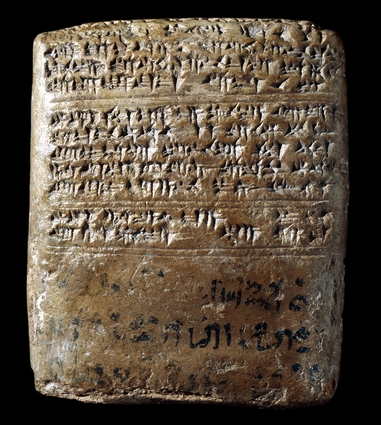
This clay tablet is part of a collection of 382 cuneiform documents discovered in 1887 in Egypt, at the site of Tell el-Amarna. ... The majority date to the reign of Amenhotep IV (Akhenaten) (1352-1336 BC), the heretic pharaoh who founded a new capital at Tell el-Amarna. This letter is written in Akkadian, the diplomatic language of Mesopotamia at the time. It is addressed to Amenhotep III from Tushratta, king of Mitanni (centred in modern Syria). Tushratta calls the pharaoh his 'brother', with the suggestion that they are of equal rank. The letter starts with greetings to various members of the royal house including Tushratta's daughter Tadu-Heba, who had become one of Amenhotep's many brides. ... Tushratta goes on to inform Amenhotep that, with the consent of the goddess Ishtar, he has sent a statue of her to Egypt. He hopes that the goddess will be held in great honour in Egypt and that the statue may be sent back safely to Mitanni. Three lines of Egyptian, written in black ink, have been added, presumably when the letter arrived in Egypt. The addition includes the date 'Year 36' of the king. W.L. Moran, The Amarna letters (John Hopkins University Press, Baltimore, 1992) http://www.britishmuseum.org/explore/highlights/highlight_objects/me/l/clay_tablet_letter,_egypt_2.aspx

This clay tablet is part of a collection of 382 cuneiform documents discovered in 1887 in Egypt, at the site of Tell el-Amarna. …
The majority date to the reign of Amenhotep IV (Akhenaten) (1352-1336 BC), the heretic pharaoh who founded a new capital at Tell el-Amarna.
This letter is written in Akkadian, the diplomatic language of Mesopotamia at the time. It is addressed to Amenhotep III from Tushratta, king of Mitanni (centred in modern Syria). Tushratta calls the pharaoh his ‘brother’, with the suggestion that they are of equal rank. The letter starts with greetings to various members of the royal house including Tushratta’s daughter Tadu-Heba, who had become one of Amenhotep’s many brides. …
Tushratta goes on to inform Amenhotep that, with the consent of the goddess Ishtar, he has sent a statue of her to Egypt. He hopes that the goddess will be held in great honour in Egypt and that the statue may be sent back safely to Mitanni.
Three lines of Egyptian, written in black ink, have been added, presumably when the letter arrived in Egypt. The addition includes the date ‘Year 36’ of the king.
W.L. Moran, The Amarna letters (John Hopkins University Press, Baltimore, 1992)
http://www.britishmuseum.org/explore/highlights/highlight_objects/me/l/clay_tablet_letter,_egypt_2.aspx

He led a punitive army into Babylonia, hurled from the throne the pretender placed there by the Kassite faction, and replaced him with a scion of the legitimate royal stock. This king, Burna-buryas, reigned for over twenty years, and upon his decease the Assyrians, still nominally the vassals of the Babylonian Crown, declared themselves independent of it.

Not content with such a revolutionary measure, under Shalmaneser I (1300 B.C.) they laid claim to the suzerainty of the Tigris-Euphrates region, and extended their conquests even to the boundaries of far Cappadocia, the Hittites and numerous other confederacies submitting to their yoke.

Shalmaneser’s son, Tukulti-in-Aristi, took the city of Babylon, slew its king, Bitilyasu, and thus completely shattered the claim of the older state to supremacy. He had reigned in Babylon for some seven years when he was faced by a popular revolt, which seems to have been headed by his own son, Assur-nazir-pal, who slew him and placed Hadad-nadin-akhi on the throne.

This king conquered and killed the Assyrian monarch of his time, Bel-kudur-uzur, the last of the old Assyrian royal line, whose death necessitated the institution of a new dynasty, the fifth monarch of which was the famous Tiglath-pileser I.”

Lewis Spence, Myths and Legends of Babylonia and Assyria, 1917, pp. 21-3.

Sargon: Conquerer, Librarian

“But the first great Semitic empire in Babylonia was that founded by the famous Sargon of Akkad. As is the case with many popular heroes and monarchs whose deeds are remembered in song and story— for example, Perseus, Oedipus, Cyrus, Romulus, and our own King Arthur—the early years of Sargon were passed in obscurity.

Sargon is, in fact, one of the ‘fatal children.’ He was, legend stated, born in concealment and sent adrift, like Moses, in an ark of bulrushes on the waters of the Euphrates, whence he was rescued and brought up by one Akki, a husbandman.

But the time of his recognition at length arrived, and he received the crown of Babylonia. His foreign conquests were extensive. On four successive occasions he invaded Syria and Palestine, which he succeeded in welding into a single empire with Babylonia. Pressing his victories to the margin of the Mediterranean, he erected upon its shores statues of himself as an earnest of his conquests. He also overcame Elam and northern Mesopotamia and quelled a rebellion of some magnitude in his own dominions.

His son, Naram-Sin, claimed for himself the title of “King of the Four Zones,” and enlarged the empire left him by his father, penetrating even into Arabia. A monument unearthed by J. de Morgan at Susa depicts him triumphing over the conquered Elamites. He is seen passing his spear through the prostrate body of a warrior whose hands are upraised as if pleading for quarter. His head-dress is ornamented with the horns emblematic of divinity, for the early Babylonian kings were the direct vicegerents of the gods on earth.
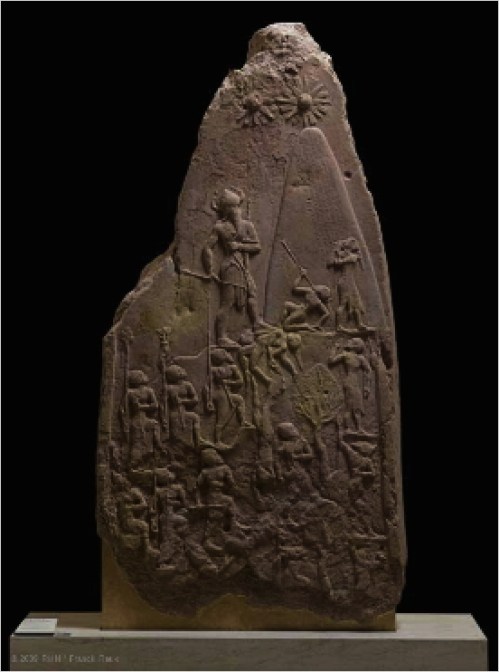
The brilliance of Naram-Sin's reign is reflected in the execution of this stele, which commemorated his victory over Satuni, king of the Lullubi.  The Akkadian army is climbing the steep slopes of the Zagros Mountains, home to the Lullubi. This upward march sweeps aside all resistance. To the right of a line of trees clinging to the mountainside, defeated enemies are depicted in a posture of submission. Those who have been killed are trampled underfoot by the Akkadian soldiers or drop over the precipice. These mountain people are clad in a tunic of hide and wear their long hair tied back. The composition is dominated by the lofty figure of the king, to whom all eyes - those of the Akkadian soldiers and of their Lullubi enemies - are turned. The triumphant sovereign, shown taller than the other men in the traditional manner, leads his army in the attack on the mountain.  He is followed by standard bearers who march before helmeted soldiers carrying bows and axes. Naram-Sin tramples the bodies of his enemies, while a kneeling Lullubi tries to tear out the arrow piercing his throat. Another raises his hands to his mouth, begging the Akkadian king for mercy.  But the conqueror's gaze is directed toward the top of the mountain. Above Naram-Sin, solar disks seem to radiate their divine protection toward him, while he rises to meet them. The Akkadian sovereign wears a conical helmet with horns - a symbol traditionally the privilege of the gods - and is armed with a large bow and an axe. This victorious ascension chiseled in stone thus celebrates a sovereign who considers himself on an equal footing with the gods. In official inscriptions, Naram-Sin's name was therefore preceded with a divine determinative.  He pushed back the frontiers of the empire farther than they had ever been, from Ebla in Syria to Susa in Elam, and led his army

The brilliance of Naram-Sin’s reign is reflected in the execution of this stele, which commemorated his victory over Satuni, king of the Lullubi.
The Akkadian army is climbing the steep slopes of the Zagros Mountains, home to the Lullubi. This upward march sweeps aside all resistance. To the right of a line of trees clinging to the mountainside, defeated enemies are depicted in a posture of submission. Those who have been killed are trampled underfoot by the Akkadian soldiers or drop over the precipice. These mountain people are clad in a tunic of hide and wear their long hair tied back.
The composition is dominated by the lofty figure of the king, to whom all eyes – those of the Akkadian soldiers and of their Lullubi enemies – are turned. The triumphant sovereign, shown taller than the other men in the traditional manner, leads his army in the attack on the mountain.
He is followed by standard bearers who march before helmeted soldiers carrying bows and axes. Naram-Sin tramples the bodies of his enemies, while a kneeling Lullubi tries to tear out the arrow piercing his throat. Another raises his hands to his mouth, begging the Akkadian king for mercy.
But the conqueror’s gaze is directed toward the top of the mountain. Above Naram-Sin, solar disks seem to radiate their divine protection toward him, while he rises to meet them. The Akkadian sovereign wears a conical helmet with horns – a symbol traditionally the privilege of the gods – and is armed with a large bow and an axe.
This victorious ascension chiseled in stone thus celebrates a sovereign who considers himself on an equal footing with the gods. In official inscriptions, Naram-Sin’s name was therefore preceded with a divine determinative.
He pushed back the frontiers of the empire farther than they had ever been, from Ebla in Syria to Susa in Elam, and led his army “where no other king had gone before him.”
He now appears as a universal monarch, as proclaimed by his official title “King of the Four Regions” – namely, of the whole world.
http://www.louvre.fr/en/oeuvre-notices/victory-stele-naram-sin

Even at this comparatively early time (c . 3800 b.c.) the resources of the country had been well exploited by its Semitic conquerors, and their absorption of the Sumerian civilization had permitted them to make very considerable progress in the enlightened arts. Some of their work in bas-relief, and even in the lesser if equally difficult craft of gem-cutting, is among the finest efforts of Babylonian art.

Nor were they deficient in more utilitarian fields. They constructed roads through the most important portions of the empire, along which a service of posts carried messages at stated intervals, the letters conveyed by these being stamped or franked by clay seals, bearing the name of Sargon.

Sargon is also famous as the first founder of a Babylonian library. This library appears to have contained works of a most surprising nature, having regard to the period at which it was instituted.

One of these was entitled The Observations of Bel, and consisted of no less than seventy-two books dealing with astronomical matters of considerable complexity; it registered and described the appearances of comets, conjunctions of the sun and moon, and the phases of the planet Venus, besides recording many eclipses. This wonderful book was long afterward translated into Greek by the Babylonian historian Berossus, and it demonstrates the great antiquity of Babylonian astronomical science even at this very early epoch.

Another famous work contained in the library of Sargon dealt with omens, the manner of casting them, and their interpretation—a very important side-issue of Babylonian magico-religious practice.

Among the conquests of this great monarch, whose splendour shines through the shadows of antiquity like the distant flash of arms on a misty day, was the fair island of Cyprus. Even imagination reels at the well-authenticated assertion that five thousand seven hundred years ago the keels of a Babylonian conqueror cut the waves of the Mediterranean and landed upon the shores of flowery Cyprus stern Semitic warriors, who, loading themselves with loot, erected statues of their royal leader and returned with their booty.
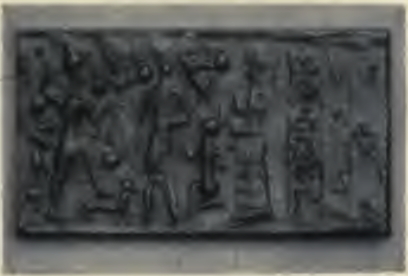
A god in horned cap brandishes a mace and the forked lightening of Iva-Vul, Thunder God, and sets foot on a recumbent bull.  Behind him is a leaping ibex. In front, a man, perhaps the king, in a short coat, standing full face. Behind him a man on bended knee, possibly the owner of the cylinder. Above him, a small deer is recumbent and inverted.  Then a figure in a long garment, and 3 rows of cuneiform writing:

A god in horned cap brandishes a mace and the forked lightening of Iva-Vul, Thunder God, and sets foot on a recumbent bull.
Behind him is a leaping ibex. In front, a man, perhaps the king, in a short coat, standing full face. Behind him a man on bended knee, possibly the owner of the cylinder. Above him, a small deer is recumbent and inverted.
Then a figure in a long garment, and 3 rows of cuneiform writing:
“Arba Istar: son of Ibu Beled: servant of the god Naram-Sin.”
The king Naram-Sin, to whom a divine determinative prefix is given here, reigned in Babylonia no later than 2600 BCE.
Cyprus, plate 4300.
John L. Myres, Handbook of the Cesnola Collection of Antiquities from Cyprus, 1914.

In a Cyprian temple De Cesnola discovered, down in the lowest vaults, a haematite cylinder which described its owner as a servant of Naram-Sin, the son of Sargon, so that a certain degree of communication must have been kept up between Babylonia and the distant island, just as early Egypt and Crete were bound to each other by ties of culture and commerce.

Lewis Spence, Myths and Legends of Babylonia and Assyria, 1917, pp. 16-9.

Mesopotamian Religion is Undefinable

“Mesopotamian religion includes certain beliefs and practices of the Sumerians, Akkadians, Assyrians, Babylonians and other peoples who lived at various times in different parts of ancient Mesopotamia, the region corresponding roughly to modern Iraq, from the fourth through the first millennia BCE.

The history and cultures of these peoples were mostly forgotten during the early Christian era, save for brief historical narratives of famous kings and cities in the Hebrew Bible, in classical authors such as Herodotus, Diodorus and Josephus, and in scattered excerpts from a lost book by Berossus, a Babylonian writing in Greek in the third century BCE.

Beginning in the nineteenth century CE, with the discovery and excavation of ancient Mesopotamian sites and decipherment of Mesopotamian languages such as Sumerian and Akkadian, European and American scholars identified texts, objects and architecture as religious in nature. They used these to reconstruct ancient Mesopotamian religious beliefs and practices in the absence of any continuous or living tradition from ancient times to the present.

Inevitably the intellectual concerns of successive generations of scholars, their personal religious commitments and their individual stances, such as piety, scepticism or anticlericalism, had their effect on agendas of research and modes of presentation of Mesopotamian religion in modern studies. Many scholars of an earlier generation took for granted, for example, a higher degree of religious preoccupation and expression among ‘ancient Oriental’ or ‘Semitic peoples’ than among other ancient peoples such as the Greeks and Romans, but generalizations on this order are no longer the basis for serious research.

Some scholars imagined, for example, that the priesthood was primarily responsible for preserving culture, while others claimed that priests resisted change and development, suppressed writings unacceptable to them, and generally stood in the way of progress.

Pioneering studies of Mesopotamian religion tended to be comprehensive, such as that by M. Jastrow (1898, partially revised German edition 1912, with a volume of illustrations, 1912). Its fundamental thesis was that ancient Mesopotamian religion derived from local animistic cults that grew and merged into a larger, more complex interlocking set of religious practices and beliefs.

Similar views were set forth by R. W. Rogers (1908) in a volume that treated Mesopotamian religion as a sort of prelude to Judaism, itself a prelude to Christianity. E. Dhorme (1945, not available in English) wrote a concise and well-documented descriptive study.

The most influential writer in English on Mesopotamian religion was Thorkild Jacobsen. He developed a view that ancient Mesopotamian religion derived from a person’s sense of the ‘other’ in the natural world around him, leading to feelings of fear and awe. People perceived active will in natural events, processes and phenomena. This sense of the other was expressed, using metaphorical terms, in myth and theology and was acted upon in cult and ritual.

We have a comprehensive presentation of his views (Jacobsen 1976) and a later summary statement of his work (Jacobsen 1987). Bottéro (2001) stressed spiritual values and a phenomenological rather than a schematic, theoretical approach; for a summary of its main theses see Bottéro (1992: 201–31).

Economic and ritual aspects of Mesopotamian religion are presented by Oppenheim (1977), professing disdain for a historical approach to the subject. He contributed a brief but suggestive essay to a collection edited by Ferm (1950: 65–79). A more detailed, primarily bibliographical survey was offered by Römer (1969). There are numerous technical studies of aspects of Mesopotamian religion in the scientific literature of Assyriology, but few of them are in English.

Many presentations of Mesopotamian religion rely on retellings of ancient literary works that modern scholars classify as mythology. Authoritative presentations of Mesopotamian and other ancient Near Eastern mythologies were made in Kramer (1961 and 1969), as well as in a major treatment of Mesopotamian mythological texts jointly with Bottéro (1989, not available in English). Recent English translations of Akkadian mythology are found in Dalley (1989) and Foster (1996). Important Sumerian myths and other religious texts are translated in Jacobsen (1987).

No ancient Mesopotamian term corresponds to the modern concept of ‘religion,’ nor is there any ancient scripture, systematic treatise or general description of religious belief or activity from any period of Mesopotamian history. This means that definition of Mesopotamian religion can at best be only a modern mode of selecting and interpreting ancient writings and material culture using modern humanistic categories for which there may not have been ancient counterparts. Although the Mesopotamians recognized certain matters as ‘pertaining to the gods’, a distinction between religious and secular matters may not have been always fully comprehensible in the context of Mesopotamian culture.”

Benjamin R. Foster, “Sources,” John R. Hinnells, ed., A Handbook of Ancient Religions, 2007, pp. 161-5.

Transcendant Radiance of the Gods

“Although the gods were visualized in anthropomorphic form, with human emotions and physical needs and desires, important distinctions set the gods apart from humanity.

First, they had transcendent divine powers in the universe, over other gods, and over human lives and institutions. Second was the gods’ sublime position in an ordered universe, in which divinity could be expressed in terms of rank and precedence. Sublime power and position inspired fear, trembling and speechlessness in the presence of a god (Jacobsen 1976: 3–5; Bottéro 1992: 210).

Divinity was furthermore revealed by a radiant brightness, not as of heat but as of a gem-like sheen, blinding, pure and holy. This was sometimes seen as separate from the divine being, worn like a brilliant garment or headgear, or set about the features as glories. In art, this property could be represented by brightly coloured inlays on the surface of figures, or rosettes or stars sewn on textiles. In poetry, this concept was expressed by words meaning awe-inspiring radiance and sublime purity.

A distinctive aspect of Sumerian religious thought was the concept called ‘me’, literally ‘is’. This was an individual, differentiated, abstract power that defined and controlled both divine attributes and attributes of human civilization (van Dijk 1971: 440–2).

Thus there was a ‘me’ of individual gods, temples and lands, and of human institutions, states and accomplishments such as kingship, wisdom, music, old age or carpentry. According to the Sumerian myth of Inanna and Enki, Enki controlled these but Inanna got them away from him by getting him drunk then taking them as gifts proffered in his intoxicated state, which he regretted when sober (Farber, in Hallo 1997: 522–6).

The concept of ‘me’ did not carry over into post-Sumerian times, though there was an Akkadian concept called ‘parsu’ which referred to the dynamic existence of gods and temples.”

Benjamin R. Foster, “Properties of Divinity,” John R. Hinnells, ed., A Handbook of Ancient Religions, 2007, pp. 179-80.

Immortality and Mortality of Mesopotamian Gods

“A further property of divinity was immortality. In narratives about divine deeds, gods were understood to be born of the intercourse of male and female parents. There is reference to their being nursed as infants but no further indication of a sense of their education, training or personal development.

Rather, as in the case of Marduk in the Babylonian Epic of Creation, the gods were born with full powers, knowing how to use weapons, understand magic words and so forth. As with Ninurta, a hero god, younger gods were expected to honour, obey and avenge slights to their parents. Having achieved a certain maturity, the gods stayed that way and did not age, though one and the same god could be portrayed as a youthful hero or as a sublime sage with magical, in preference to physical, prowess.

Gods could die, but only at the hands of other gods. Some died in battle or were executed for offences against higher gods. For example, the rebel god, Aw-ila, in the Story of the Flood (Foster 1996: 160–203 and below, pp. 184–5, 187) was executed to punish the uprising of the lesser gods against the great gods, but his spirit lingered on in the newly created human race, palpable as the human pulse. His flesh and blood were used to make the first human and his will may have given the human race its rebellious or wayward spirit.

The execution of Kingu, leader of the attacking army of gods and monsters in the Babylonian Epic of Creation, was modelled on this episode, but Kingu was there (falsely) accused of suborning Tiamat, mother of the gods, to kill her children (Foster 1996: 350–401).”

Benjamin R. Foster, “Birth and Death,” John R. Hinnells, ed., A Handbook of Ancient Religions, 2007, pp. 180-1.

Worship of Idols and Graven Images

“Just as a great king might exercise wide dominion in the world but needed to sleep and eat, so too the Mesopotamian gods were ascribed universal dominion but had physical, social and aesthetic needs that their human subjects were created to serve (Oppenheim 1977: 183–98).

Thus temples of the gods were at first houses then palatial structures where the god ruled as a householder and dignitary (Oppenheim 1961: 158–69). The god’s house was provided with sleeping quarters, audience chambers, storerooms and dining halls in which choice foods were served and music performed. There were gardens for the god’s enjoyment and dalliance. Their homes were appointed in luxurious style with works of art, commemorative inscriptions and treasuries of offerings, gifts and valuables.

The gods travelled to visit other gods and entertained each other with feasts accompanied by speeches and heavy drinking. Like any good householder, the gods were concerned with the stewardship of their domains. The Sumerian goddess Nanshe, for example, is described in a hymn as searching out fraud and embezzlement in her household accounts ( Jacobsen 1987a: 131; Heimpel in Hallo 1997: 526–31).

The gods were understood to be physically present at will in an image (Hallo 1983) that was dressed and adorned with special clothing, jewelry and headdresses. Destruction of the image or its removal by an enemy was a disaster for the community, demanding a theological explanation: the deity was angry with his city or her people, even if no cause for this anger could be established, and had forsaken both the image and the community.

Return of an abducted image was a moment of jubilation and renewal of patriotic feeling, as when the lost statue of Marduk was returned from its captivity in Elam by the Babylonian king Nebuchadnezzar I (twelfth century BCE).

Some Mesopotamian authors speculated on the relationship between an object produced by human craftsmanship and a universal cosmic power, asserting, as in the Epic of Erra, that the image was primeval and the craftsmen uncanny, with later human counterparts permitted by the gods to make repairs (Foster 1996: 765). However, reports of theft of divine apparel or jewelry suggest that not all Mesopotamians were awed by images of the gods.”

Benjamin R. Foster, “Gods in Their Dwellings,” John R. Hinnells, ed., A Handbook of Ancient Religions, 2007, pp. 181-2.

Mesopotamian Cosmology

“In literature and magic spells, Mesopotamians referred to the beginnings of the world. The various accounts were quite different, so there was no one story that should be considered standard or universally accepted.

The most comprehensive and ambitious of the accounts of creation, contained in the Babylonian Epic of Creation, refers to a time before the present generation of gods in which there were two waters, male and female, commingling with no distinct separation. Rather than the ‘chaos’ which it is often considered, this combination was dynamic and productive, yielding several pairs of older gods, male and female, and ultimately a much larger number of younger gods, on whom the narrative focuses.

The successive generations of gods were progressively stronger and greater than the preceding ones, suggesting that the Mesopotamians visualized a dynamic past development of their universe, culminating in a present order that was stable and unchanging (Foster 1996: 350):

When on high no name was given to heaven,

Nor below was the netherworld called by name,

Primeval Apsu was their progenitor,

And matrix-Tiamat was she who bore them all,

They were mingling their waters together,

No canebrake was intertwined nor thicket matted close.

When no gods at all had been brought forth,

None called by names, none destinies ordained,

Then were the gods formed within these two.

The Babylonian Epic of Creation ascribed to Marduk, god of Babylon, the reorganization of the cosmos into the form the Babylonians knew it, including the motions of the stars, a firmament above the earth, rivers and mountains of the earth, the phases of the moon, and so forth. Since this account dates only to the second half of the second millennium BCE and presupposes a cosmos centred on Babylon, there is no reason to assign it universal validity in Mesopotamia. The poem appears to contain a variety of earlier materials worked into a coherent narrative.

The universe was visualized as circular, with a firmament below heaven and a corresponding surface above the netherworld. Some speculative texts proposed several layers in the cosmos (Lambert 1975). In any case, heaven was so remote from earth that the land was not visible to a human observer who had risen so high, such as the mythologized king Etana, who flew up to heaven on an eagle, or the sage Adapa, who was summoned to heaven after interfering with the wind.

In later periods, heaven and netherworld were thought to be organized like urban earth, with gates, defences, and large residences for the gods containing reception areas, sleeping quarters, baths and other amenities.”

Benjamin R. Foster, “Cosmology,” John R. Hinnells, ed., A Handbook of Ancient Religions, 2007, pp. 183-4.

Mesopotamian End Times

“Mesopotamia offers little evidence for a belief in a future end of the world. The only clear reference to this occurs in a third-century BCE work in Greek by Berossus, reputedly a Babylonian priest. He stated that the earth was in danger of ending in fire or flood when the planets were gathered in a straight line in the constellations Cancer or Capricorn.

No earlier Mesopotamian reference to this belief has been identified, so its authenticity as a native Mesopotamian tradition is disputed. Although there are references to good and bad times and to the impermanence of political power in any one city or dynasty, these changes were described not as cyclical but as the result of divine favour or disfavour to individual rulers or their cities.

The Mesopotamians viewed the world in which they lived as different from that of very ancient times, which were separated from the more recent past by the flood. The Mesopotamians believed that the flood would not recur; therefore, in effect the end of the world had already taken place.

They expected the world to endure in the form they knew it, despite individual triumphs and destructions of cities and states. Since the flood had shown that the human race was essential to maintain the living standards of the gods, the gods might reduce the human population through plague or famine, but would never again attempt to eliminate it entirely.”

Benjamin R. Foster, “End of the World,” John R. Hinnells, ed., A Handbook of Ancient Religions, 2007, pp. 184-5.

Creation of Man

“According to the Babylonian Flood Story, the gods created the human race in order for it to maintain them in a comfortable and luxurious living standard. In this account, the first human was made in collaboration by the birth-goddess, Mami or Nintu, and Enki, god of wisdom. They took a piece of clay, kneaded it with divine spittle, then mixed in the spirit, flesh and blood of a slain rebellious god (Foster 1996: 168):

“They slaughtered Aw-ilu, who had the inspiration [for the revolt against the gods], in their assembly.

The [birth-goddess] Nintu mixed clay with his flesh and blood.

That same god and man were thoroughly mixed in the clay.

For the rest of time they would hear the drum,

From the flesh of the god the spirit remained.

It would make the living know its sign,

Lest he be allowed to be forgotten, the spirit remained.”

To sustain the human race, birth, maturity, marriage and procreation were instituted. Later, when the population had grown too great, celibacy, infertility, still birth and social restrictions against childbirth for certain groups of people were imposed on the human race.

This was not the only Mesopotamian story of how human beings were created. In a Sumerian account, the god of wisdom produced various experimental but defective human beings until a satisfactory human was brought forth (Kramer 1961: 68–70). In another Sumerian creation story, human beings grew from the earth after Enlil struck it with a pickaxe. Then he handed them the pickaxe and they set to work (Farber in Hallo 1997: 511–13). In the Babylonian Epic of Creation, Enki/Ea’s role in creating the human race is subordinated to Marduk, who is said to have had the original idea for it (Foster 1996: 383):

“I shall compact blood, I shall cause bones to be.

I shall make stand a human being, let ‘Man’ be its name.

I shall create human kind.

They shall bear the gods’ burden that those may rest.”

Humans in Mesopotamian thought were differentiated from animals in that they ate prepared foods, such as bread and beer, in preference to uncooked wild plants and water. Humans, unlike animals, wore clothes and treated and adorned their bodies with alien substances, such as oils and cosmetics, and cut their hair, rather than letting it grow to a natural length.

Humans were different from gods in that they had inferior mental and physical powers and had limited lifespans. What some later peoples deemed human characteristics, such as an immortal soul, language, social organization and use of implements, seemed to the Mesopotamians to be developments of human potential rather than distinguishing features of the race.”

Benjamin R. Foster, “Gods and the Human Race,” John R. Hinnells, ed., A Handbook of Ancient Religions, 2007, pp. 185-6.