
Samizdat

Publishing the Forbidden. All Rights Reserved. © Samizdat 2014-2026.

Desecration of the Dead, Depredations of the Dead

” … Sometimes the bodies of the Sumerians were placed in sarcophagi of clay. The earlier type was of “bath-tub” shape, round and flat-bottomed, with a rounded lid, while the later was the “slipper-shaped coffin,” which was ornamented with charms. There is a close resemblance between the “bath-tub” coffins of Sumeria and the Egyptian pottery coffins of oval shape found in Third and Fourth Dynasty tombs in rock chambers near Nuerat. Certain designs on wooden coffins, and tombs as early as the First Dynasty, have direct analogies in Babylonia.

No great tombs were erected in Sumeria. The coffins were usually laid in brick vaults below dwellings, or below temples, or in trenches outside the city walls. On the “stele of victory,” which belongs to the period of Eannatum, patesi of Lagash, the dead bodies on the battlefield are piled up in pairs quite naked, and earth is being heaped over them; this is a specimen of mound burial.

According to Herodotus the Babylonians “buried their dead in honey, and had funeral lamentations like the Egyptians.” The custom of preserving the body in this manner does not appear to have been an ancient one, and may have resulted from cultural contact with the Nile valley during the late Assyrian period. So long as the bones were undisturbed, the spirit was supposed to be assured of rest in the Underworld. This archaic belief was widespread …

… In Babylonia the return of the spirits of the dead was greatly dreaded. Ishtar once uttered the terrible threat: “I will cause the dead to rise; they will then eat and live. The dead will be more numerous than the living.”

When a foreign country was invaded, it was a common custom to break open the tombs and scatter the bones they contained. Probably it was believed, when such acts of vandalism were committed, that the offended spirits would plague their kinsfolk.

Ghosts always haunted the homes they once lived in, and were as malignant as demons. It is significant to find in this connection that the bodies of enemies who were slain in battle were not given decent burial, but mutilated and left for birds and beasts of prey to devour.

The demons that plagued the dead might also attack the living. A fragmentary narrative, which used to be referred to as the Cuthean Legend of Creation, and has been shown by Mr. L.W. King to have no connection with the struggle between Merodach and the dragon, deals with a war waged by an ancient king against a horde of evil spirits, led by “the lord of heights, lord of the Anunaki (earth spirits).” Some of the supernatural warriors had bodies like birds; others had “raven faces,” and all had been “suckled by Tiamat.”

For three years the king sent out great armies to attack the demons, but “none returned alive.” Then he decided to go forth himself to save his country from destruction. So he prepared for the conflict, and took the precaution of performing elaborate and therefore costly religious rites so as to secure the cooperation of the gods.

His expedition was successful, for he routed the supernatural army. On his return home, he recorded his great victory on tablets which were placed in the shrine of Nergal at Cuthah.

This myth may be an echo of Nergal’s raid against Eresh-ki-gal. Or, being associated with Cuthah, it may have been composed to encourage burial in that city’s sacred cemetery, which had been cleared by the famous old king of the evil demons which tormented the dead and made seasonal attacks against the living.”

Donald A. Mackenzie, Myths of Babylonia and Assyria, 1915.
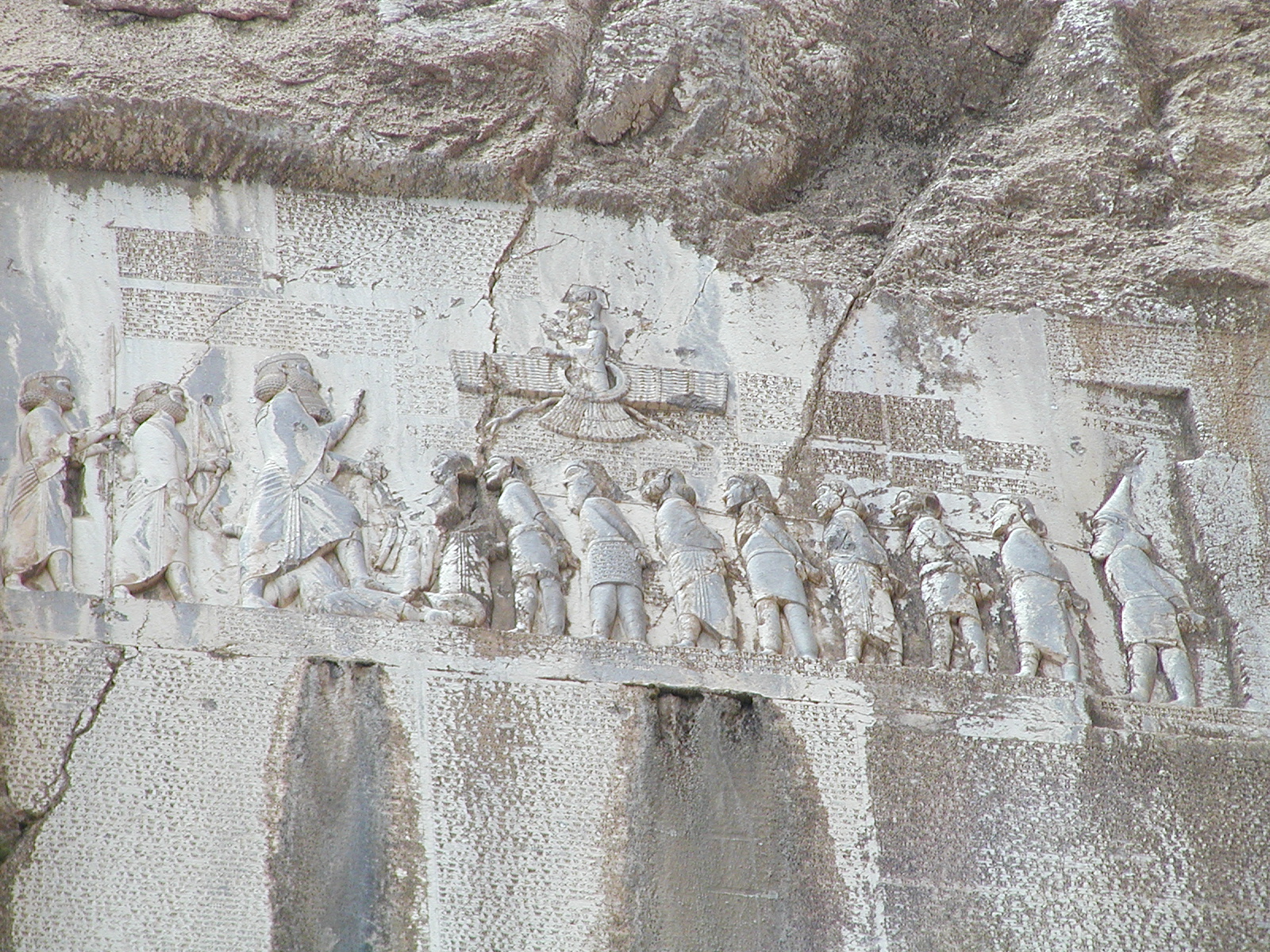
Magical Raiment

” … Some bodies which were laid in Sumerian graves were wrapped up in reed matting, a custom which suggests that the reeds afforded protection or imparted magical powers. Magical ceremonies were performed in Babylonian reed huts.

As we have seen, Ea revealed the “purpose” of the gods, when they resolved to send a flood, by addressing the reed hut in which Pir-napishtim lay asleep. Possibly it was believed that the dead might also have visions in their dreams which would reveal the “purpose” of demons who were preparing to attack them.

In Syria it was customary to wrap the dead in a sheep skin. As priests and gods were clad in the skins of animals from which their powers were derived, it is probable that the dead were similarly supposed to receive inspiration in their skin coverings.

The Highland seer was wrapped in a bull’s skin and left all night beside a stream so as to obtain knowledge of the future. This was a form of the Taghairm ceremony, which is referred to by Scott in his Lady of the Lake.

The belief in the magical influence of sacred clothing gave origin to the priestly robes. When David desired to ascertain what Saul intended to do he said, “Bring hither the ephod.” Then he came to know that his enemy had resolved to attack Keilah.

Elisha became a prophet when he received Elijah’s mantle.”

Donald A. Mackenzie, Myths of Babylonia and Assyria, 1915.

Prehistoric Sumerian Burial Customs, Magical Talismans and Amulets

” … The conservative element in Babylonian religion is reflected by the burial customs. These did not change greatly after the Neolithic period. Prehistoric Sumerian graves resemble closely those of pre-Dynastic Egypt.

The bodies of the dead were laid on their sides in crouching posture, with a “beaker,” or “drinking cup” urn, beside the right hand. Other vessels were placed near the head. In this connection it may be noted that the magic food prepared for Gilgamesh by Pir-napishtim’s wife, when he lay asleep, was also placed near his head.

The corpse was always decked with various ornaments, including rings, necklaces, and armlets. As has been indicated, these were worn by the living as charms, and, no doubt, they served the same purpose for the dead.

This charm-wearing custom was condemned by the Hebrew teachers. On one occasion Jacob commanded his household to “put away the strange gods which were in their hand, and all the ear-rings which were in their ears; and Jacob buried them under the oak which was by Shechem.”

To Jacob, personal ornaments had quite evidently an idolatrous significance.”

Donald A. Mackenzie, Myths of Babylonia and Assyria, 1915.

The Extortionate Costs of Funerary Rites in Ancient Babylonia

” … It seems remarkable that the doctrine of Eternal Bliss, which obtained in Egypt on the one hand and in India on the other, should never have been developed among the Babylonians. Of course, our knowledge in this connection is derived from the orthodox religious texts.

Perhaps the great thinkers, whose influence can be traced in the tendencies towards monotheism which became marked at various periods, believed in a Heaven for the just and good. If they did, their teachings must have been suppressed by the mercenary priests.

It was extremely profitable for these priests to perpetuate the belief that the spirits of the dead were consigned to a gloomy Hades, where the degree of suffering which they endured depended on the manner in which their bodies were disposed of upon earth.

An orthodox funeral ceremony was costly at all times. This is made evident by the inscriptions which record the social reforms of Urukagina, the ill-fated patesi of Lagash. When he came to the throne he cut down the burial fees by more than a half.

“In the case of an ordinary burial,” writes Mr. King, “when a corpse was laid in a grave, it had been the custom for the presiding priest to demand as a fee for himself seven urns of wine or strong drink, four hundred and twenty loaves of bread, one hundred and twenty measures of corn, a garment, a kid, a bed, and a seat.”

The reformer reduced the perquisites to “three urns of wine, eighty loaves of bread, a bed, and a kid, while the fee of his (the priest’s) assistant was cut down from sixty to thirty measures of corn.”

Donald A. Mackenzie, Myths of Babylonia and Assyria, 1915.

Different Categories of Paradise

” … In the sacred books of India a number of Paradises are referred to. No human beings, however, entered the Paradise of Varuna, who resembles the Sumerian Ea-Oannes.

The souls of the dead found rest and enjoyment in the Paradise of Yama, while “those kings that yield up their lives, without turning their backs on the field of battle, attain,” as the sage told a hero, “to the mansion of Indra,” which recalls the Valhal of Odin. It will thus be seen that belief in immortality was a tenet of the Indian cults of Indra and Yama.

It is possible that the Gilgamesh epic in one of its forms concluded when the hero reached the island of Pir-napishtim, like the Indian Yama who “searched and spied the path for many.” The Indian “Land of the Pitris” (Ancestors), over which Yama presided, may be compared to the Egyptian heaven of Osiris. It contains, we are told, “all kinds of enjoyable articles,” and also “sweet, juicy, agreeable and delicious edibles … floral wreaths of the most delicious fragrance, and trees that yield fruits that are desired of them.”

Thither go “all sinners among human beings, as also (those) that have died during the winter solstice”–a suggestion that this Paradise was not unconnected with the Tammuz-like deity who took up his abode in the spirit land during the barren season.

The view may be urged that in the Gilgamesh epic we have a development of the Tammuz legend in its heroic form. Like Ishtar, when she descended to Hades, the King of Erech could not return to earth until he had been sprinkled by the water of life. No doubt, an incident of this character occurred also in the original Tammuz legend. The life of the god had to be renewed before he could return.

Did he slumber, like one of the Seven Sleepers, in Ea’s house, and not awake again until he arrived as a child in his crescent moon boat–“the sunken boat” of the hymns–like Scef, who came over the waves to the land of the Scyldings?”

Donald A. Mackenzie, Myths of Babylonia and Assyria, 1915.

On the Burial Rites

” … The primitive house-burial rite is referred to in the Ethiopic version of the life of Alexander the Great.

The “Two-horned,” as the hero was called, conversed with Brahmans when he reached India. He spoke to one of them, “saying: ‘Have ye no tombs wherein to bury any man among ye who may die?’

And an interpreter made answer to him, saying:

‘Man and woman and child grow up, and arrive at maturity, and become old, and when any one of them dieth we bury him in the place wherein he lived; thus our graves are our houses. And our God knoweth that we desire this more than the lust for food and meat which all men have: this is our life and manner of living in the darkness of our tombs.'”

When Alexander desired to make a gift to these Brahmans, and asked them what they desired most, their answer was, “Give us immortality.”

In the Gilgamesh epic the only ray of hope which relieves the gloomy closing passages is Ea-bani’s suggestion that the sufferings endured by the dead may be alleviated by the performance of strict burial rites. Commenting on this point Professor Jastrow says: “A proper burial with an affectionate care of the corpse ensures at least a quiet repose.

Such a one rests on a couch and drinks pure water;

But he whose shade has no rest in the earth, as I have seen and you will see,

His shade has no rest in the earth

Whose shade no one cares for …

What is left over in the pot, remains of food

That are thrown in the street, he eats.”

Gilgamesh Epic.

By disseminating the belief that the dead must be buried with much ceremony, the priests secured great power over the people, and extracted large fees.

In Egypt, on the other hand, the teachers of the sun cult sold charms and received rewards to perform ceremonies so that chosen worshippers might enter the sun-barque of Ra; while the Osirian priests promised the just and righteous that they would reach an agricultural Paradise where they could live and work as on earth, but receive a greater return for their labour, the harvests of the Otherworld being of unequalled abundance.”

Donald A. Mackenzie, Myths of Babylonia and Assyria, 1915.

Nether Cuthah

” … In the Descent of Ishtar the Babylonian Underworld is called Cuthah.

This city had a famous cemetery, like Abydos in Egypt, where many pious and orthodox worshippers sought sepulture. The local god was Nergal, who symbolized the destructive power of the sun and the sand storm; he was a gloomy, vengeful deity, attended by the spirits of tempest, weariness, pestilence, and disease, and was propitiated because he was dreaded.

In Nether Cuthah, as Ea-bani informed Gilgamesh, the worm devoured the dead amidst the dust and thick darkness.

It is evident that this Underworld was modelled on the grave. In early times men believed that the spirits of the dead hovered in or about the place of sepulture. They were therefore provided with “houses” to protect them, in the same manner as the living were protected in their houses above the ground.

The enemies of the human ghosts were the earth spirits. Weapons were laid beside the dead in their graves so that they might wage war against demons when necessary.

The corpse was also charmed, against attack, by the magical and protecting ornaments which were worn by the living–necklaces, armlets, ear-rings, &c.

Even face paint was provided, probably as a charm against the evil eye and other subtle influences.

So long as corpses were left in their graves, the spirits of the dead were, it would appear, believed to be safe. But they required food and refreshment. Food vessels and drinking urns were therefore included in the funerary furniture, and the dead were given food offerings at regular intervals.

Once a year the living held feasts in the burial ground, and invited the ghosts to share in the repast. This custom was observed in Babylonia, and is not yet obsolete in Egypt; Moslems and Coptic Christians alike hold annual all-night feasts in their cemeteries.

[ … ]

According to Babylonian belief, the dead who were not properly buried roamed through the streets searching for food, eating refuse and drinking impure water.”

Donald A. Mackenzie, Myths of Babylonia and Assyria, 1915.

An Underworld Love Story

“The Persephone of the Babylonian Underworld was Eresh-ki-gal, who was also called Allatu. A myth, which was found among the Egyptian Tel-el-Amarna Letters, sets forth that on one occasion the Babylonian gods held a feast.

All the deities attended it, except Eresh-ki-gal. She was unable to leave her gloomy Underworld, and sent her messenger, the plague demon Namtar, to obtain her share.

The various deities honoured Namtar, except Nergal, by standing up to receive him. When Eresh-ki-gal was informed of this slight she became very angry, and demanded that Nergal should be delivered up to her so that he might be put to death.

The storm god at once hastened to the Underworld, accompanied by his own group of fierce demons, whom he placed as guardians at the various doors so as to prevent the escape of Eresh-ki-gal.

Then he went boldly towards the goddess, clutched her by the hair, and dragged her from her throne.

After a brief struggle, she found herself overpowered. Nergal made ready to cut off her head, but she cried for mercy and said: “Do not kill me, my brother! Let me speak to thee.”

This appeal indicated that she desired to ransom her life–like the hags in the European folk tales–so Nergal unloosed his hold.

Then Eresh-ki-gal continued: “Be thou my husband and I will be thy wife. On thee I confer sovereignty over the wide earth, giving thee the tablet of wisdom. Thou shalt be my lord and I will be thy lady.”

Nergal accepted these terms by kissing the goddess. Affectionately drying her tears, he spoke, saying: “Thou shalt now have from me what thou hast demanded during these past months.”

In other words, Nergal promises to honour her as she desired, after becoming her husband and equal.”

Donald A. Mackenzie, Myths of Babylonia and Assyria, 1915.

Hades, Nifelhel, Put, Underworld.

“There was no Heaven for the Babylonian dead.

All mankind were doomed to enter the gloomy Hades of the Underworld, “the land of darkness and the shadow of death; a land of darkness, as darkness itself; and of the shadow of death, without any order, and where the light is darkness,” as Job exclaimed in the hour of despair, lamenting his fate.

This gloomy habitation of the dead resembles the Greek Hades, the Teutonic Nifelhel, and the Indian Put. No detailed description of it has been found.

The references, however, in the Descent of Ishtar and the Gilgamesh epic suggest that it resembled the hidden regions of the Egyptians, in which souls were tortured by demons who stabbed them, plunged them in pools of fire, and thrust them into cold outer darkness where they gnashed their teeth, or into places of horror swarming with poisonous reptiles.

Ishtar was similarly tortured by the plague demon, Namtar, when she boldly entered the Babylonian Underworld to search for Tammuz. Other sufferings were, no doubt, in store for her, resembling those, perhaps, with which the giant maid in the Eddic poem Skirnismal was threatened when she refused to marry Frey, the god of fertility and harvest:

Trolls shall torment thee from morn till eve

In the realms of the Jotun race,

Each day to the dwellings of Frost giants must thou

Creep helpless, creep hopeless of love;

Thou shalt weeping have in the stead of joy,

And sore burden bear with tears….

May madness and shrieking, bondage and yearning

Burden thee with bondage and tears.

In like manner, too, the inhabitants of the Indian Hell suffered endless and complicated tortures.”

Donald A. Mackenzie, Myths of Babylonia and Assyria, 1915.

Only Two Residents of the Babylonian Paradise

“Leaving, meantime, the many problems which arise from consideration of the Deluge legends and their connection with primitive agricultural myths, the attention of readers may be directed to the Babylonian conception of the Otherworld.

Pir-napishtim, who escaped destruction at the Flood, resides in an Island Paradise, which resembles the Greek “Islands of the Blessed”, and the Irish “Tir nan og” or “Land of the Young,” situated in the western ocean, and identical with the British …

… island-valley of Avilion,

Where falls not hail, or rain, or any snow,

Nor ever wind blows loudly, but it lies

Deep meadow’d, happy, fair with orchard lawns

And bowery hollows crowned with summer sea.

Only two human beings were permitted to reside on the Babylonian island paradise, however. These were Pir-napishtim and his wife.

Apparently Gilgamesh could not join them there. His gods did not transport heroes and other favoured individuals to a happy isle or isles like those of the Greeks and Celts and Aryo-Indians.”

Donald A. Mackenzie, Myths of Babylonia and Assyria, 1915.

Questing for Immortality

” … Pir-napishtim, the Babylonian Noah, and the semi-divine Gilgamesh appear to be represented in Vedic mythology by Yama, god of the dead. Yama was “the first man,” and, like Gilgamesh, he set out on a journey over mountains and across water to discover Paradise.

He is lauded in the Vedic hymns as the explorer of “the path” or “way” to the “Land of the Pitris” (Fathers), the Paradise to which the Indian un-cremated dead walked on foot. Yama never lost his original character. He is a traveller in the Epics as in the Vedas.

Him who along the mighty heights departed,

Him who searched and spied the path for many,

Son of Vivasvat, gatherer of the people,

Yama, the King, with sacrifices worship.

Rigveda, x, 14, 1.

To Yama, mighty King, be gifts and homage paid,

He was the first of men that died,

the first to brave Death’s rapid rushing stream,

the first to point the road

To heaven, and welcome others to that bright abode.

Sir M. Monier Williams’ Translation.

Yama and his sister Yami were the first human pair. They are identical with the Persian Celestial twins, Yima and Yimeh. Yima resembles Mitra (Mithra); Varuna, the twin brother of Mitra, in fact, carries the noose associated with the god of death.

The Indian Yama, who was also called Pitripati, “lord of the fathers,” takes Mitra’s place in the Paradise of Ancestors beside Varuna, god of the sky and the deep. He sits below a tree, playing on a flute and drinking the Soma drink which gives immortality. When the descendants of Yama reached Paradise they assumed shining forms “refined and from all taint set free.”

In Persian mythology “Yima,” says Professor Moulton, “reigns over a community which may well have been composed of his own descendants, for he lived yet longer than Adam. To render them immortal, he gives them to eat forbidden food, being deceived by the Daevas (demons). What was this forbidden food? May we connect it with another legend whereby, at the Regeneration, Mithra is to make men immortal by giving them to eat the fat of the Ur-Kuh, the primeval cow from whose slain body, according to the Aryan legends adopted by Mithraism, mankind was first created?”

Yima is punished for “presumptuously grasping at immortality for himself and mankind, on the suggestion of an evil power, instead of waiting Ahura’s good time.” Professor Moulton wonders if this story, which he endeavours to reconstruct, “owed anything to Babylon?”

Donald A. Mackenzie, Myths of Babylonia and Assyria, 1915.

Comparative Deluge Myths

Flood myths are found in many mythologies both in the Old World and the New.

The violent and deceitful men of the mythical Bronze Age of Greece were destroyed by a flood. It is related that Zeus said on one occasion to Hermes:

“I will send a great rain, such as hath not been since the making of the world, and the whole race of men shall perish.

I am weary of their iniquity.”

For receiving with hospitable warmth these two gods in human guise, Deucalion, an old man, and his wife Pyrrha were spared, however. Zeus instructed his host to build an ark of oak, and store it well with food. When this was done, the couple entered the vessel and shut the door. Then Zeus “broke up all the fountains of the deep, and opened the well springs of heaven, and it rained for forty days and forty nights continually.”

The Bronze folk perished: not even those who fled to the hilltops could escape. The ark rested on Parnassus, and when the waters ebbed the old couple descended the mountain and took up their abode in a cave.

In Indian mythology the world is destroyed by a flood at the end of each Age of the Universe. There are four ages: the Krita or Perfect Age, the Treta Age, the Dwapara Age, and the Kali or Wicked Age. These correspond closely to the Greek and Celtic ages.

There are also references in Sanskrit literature to the destruction of the world because too many human beings lived upon it.

“When the increase of population had been so frightful,” a sage related, “the Earth, oppressed with the excessive burden, sank down for a hundred Yojanas. Suffering pain in all her limbs, and being deprived of her senses by excessive pressure, the Earth in distress sought the protection of Narayana, the foremost of the gods.”

Manu’s account of the flood has been already referred to (Chapter II). The god in fish shape informed him:

“The time is ripe for purging the world…. Build a strong and massive ark, and furnish it with a long rope….”

When the waters rose the horned fish towed the ark over the roaring sea, until it grounded on the highest peak of the Himavat, which is still called Naubandha (the harbour). Manu was accompanied by seven rishis.

In the Celtic (Irish) account of the flood, Cessair, granddaughter of Noah, was refused a chamber for herself in the ark, and fled to the western borders of the world as advised by her idol. Her fleet consisted of three ships, but two foundered before Ireland was reached. The survivors in addition to Cessair were, her father Bith, two other men, Fintan and Ladru, and fifty women.

All of these perished on the hills except Fintan, who slept on the crest of a great billow, and lived to see Partholon, the giant, arriving from Greece.

There is a deluge also in Egyptian mythology. When Ra, the sun god, grew old as an earthly king, men began to mutter words against him. He called the gods together and said: “I will not slay them (his subjects) until I have heard what ye say concerning them.”

Nu, his father, who was the god of primeval waters, advised the wholesale destruction of mankind.

Said Ra: “Behold men flee unto the hills; their heart is full of fear because of that which they said.”

The goddess Hathor-Sekhet, the Eye of Ra, then went forth and slew mankind on the hills. Thereafter Ra, desiring to protect the remnant of humanity, caused a great offering to be made to the goddess, consisting of corn beer mixed with herbs and human blood. This drink was poured out during the night.

“And the goddess came in the morning; she found the fields inundated, she rejoiced thereat, she drank thereof, her heart was rejoiced, she went about drunken and took no more cognizance of men.”

Donald A. Mackenzie, Myths of Babylonia and Assyria, 1915.

The Babylonian Account of the Deluge

The story of the Deluge which was related to Gilgamesh by Pir-napishtim runs as follows:–

“Hear me, O Gilgamesh, and I will make revelation regarding the hidden doings of the high gods. As thou knowest, the city of Shurippak is situated upon the bank of the Euphrates. The gods were within it: there they assembled together in council.

Anu, the father, was there, and Bel the counsellor and warrior, Ninip the messenger, and Ennugi the governor. Ea, the wise lord, sat also with them. In their hearts the gods agreed together to send a great deluge.

“Thereafter Ea made known the purpose of the divine rulers in the hut of reeds, saying: ‘O hut of reeds, hear; O wall, understand … O man of Shurippak, son of Umbara Tutu, tear down thy house and build a ship; leave all thou dost possess and save thy life, and preserve in the ship the living seed of every kind. The ship that thou wilt build must be of goodly proportions in length and height. It must be floated on the great deep.’

“I heard the command of Ea and understood, and I made answer, saying, ‘O wise lord, as thou hast said so will I do, for thy counsel is most excellent. But how shall I give reason for my doings to the young men and the elders?’

“Ea opened his mouth and said unto me, his servant: ‘What thou shalt say unto them is this…. It hath been revealed unto me that Bel doth hate me, therefore I cannot remain any longer in his domain, this city of Shurippak, so I must depart unto the domain of Ea and dwell with him…. Unto you will Bel send abundance of rain, so that you may obtain birds and fishes in plenty and have a rich harvest. But Shamash hath appointed a time for Ramman to pour down destruction from the heavens.‘”

Ea then gave instructions to Pir-napishtim how to build the ship in which he should find refuge. So far as can be gathered from the fragmentary text, it appears that this vessel was to have a deck house six stories high, with nine apartments in each story. According to another account, Ea drew a plan of the great ship upon the sand.

Pir-napishtim set to work and made a flat-bottomed vessel, which was 120 cubits wide and 120 cubits in height. He smeared it with bitumen inside and pitch outside; and on the seventh day it was ready. Then he carried out Ea’s further instructions. Continuing his narrative to Gilgamesh, he said:

“I gathered together all that I possessed, my silver and gold and seeds of every kind, and my goods also. These I placed in the ship. Then I caused to go aboard all my family and house servants, the animals of the field and the beasts of the field and the workers–every one of them I sent up.

“The god Shamash appointed the time, saying: ‘I will cause the Night Lord to send much rain and bring destruction. Then enter thou the ship and shut thy door.’

“At the appointed time the Night Lord sent at even-time much rain. I saw the beginning of the deluge and I was afraid to look up. I entered the ship and shut the door. I appointed Buzur-Kurgala, the sailor, to be captain, and put under his command the great vessel and all that it contained.

“At the dawn of day I saw rising athwart the heavens a dark cloud, and in the midst of it Ramman thundered. Nebo and Merodach went in front, speeding like emissaries over hills and plains. The cables of the ship were let loose.

“Then Ninip, the tempest god, came nigh, and the storm broke in fury before him. All the earth spirits leapt up with flaming torches and the whole land was aflare. The thunder god swept over the heavens, blotting out the sunlight and bringing thick darkness.

Rain poured down the whole day long, and the earth was covered with water; the rivers were swollen; the land was in confusion; men stumbled about in the darkness, battling with the elements.

Brothers were unable to see brothers; no man could recognize his friends…. The spirits above looked down and beheld the rising flood and were afraid: they fled away, and in the heaven of Anu they crouched like to hounds in the protecting enclosures.

“In time Ishtar, the lady of the gods, cried out distressfully, saying: ‘The elder race hath perished and turned to clay because that I have consented to evil counsel in the assembly of the gods. Alas! I have allowed my people to be destroyed. I gave being to man, but where is he? Like the offspring of fish he cumbers the deep.’

“The earth spirits were weeping with Ishtar: they sat down cowering with tightened lips and spake not; they mourned in silence.

“Six days and six nights went past, and the tempest raged over the waters which gradually covered the land. But when the seventh day came, the wind fell, the whirling waters grew peaceful, and the sea retreated. The storm was over and the rain of destruction had ceased. I looked forth. I called aloud over the waters. But all mankind had perished and turned to clay. Where fields had been I saw marshes only.

“Then I opened wide the window of the ship, and the sunlight suffused my countenance. I was dazzled and sank down weeping and the tears streamed over my face. Everywhere I looked I saw water.

“At length, land began to appear. The ship drifted towards the country of Nitsir, and then it was held fast by the mountain of Nitsir. Six days went past and the ship remained stedfast. On the seventh day I sent forth a dove, and she flew away and searched this way and that, but found no resting place, so she returned.

I then sent forth a swallow, and she returned likewise. Next I sent forth a raven, and she flew away. She saw that the waters were shrinking, and gorged and croaked and waded, but did not come back. Then I brought forth all the animals into the air of heaven.

“An offering I made on the mountain. I poured out a libation. I set up incense vessels seven by seven on heaped-up reeds and used cedar wood with incense. The gods smelt the sweet savour, and they clustered like flies about the sacrificer.

“Thereafter Ishtar (Sirtu) drew nigh. Lifting up the jewels, which the god Anu had fashioned for her according to her desire, she spake, saying: ‘Oh! these gods! I vow by the lapis lazuli gems upon my neck that I will never forget! I will remember these days for ever and ever. Let all the gods come hither to the offering, save Bel (Enlil) alone, because that he ignored my counsel, and sent a great deluge which destroyed my people.’

“But Bel Enlil came also, and when he beheld the ship he paused. His heart was filled with wrath against the gods and the spirits of heaven. Angrily he spake and said: ‘Hath one escaped? It was decreed that no human being should survive the deluge.’

“Ninip, son of Bel, spoke, saying: ‘Who hath done this save Ea alone? He knoweth all things.’

“Ea, god of the deep, opened his mouth and said unto the warrior Bel: ‘Thou art the lord of the gods, O warrior. But thou wouldst not hearken to my counsel and caused the deluge to be. Now punish the sinner for his sins and the evil doer for his evil deed, but be merciful and do not destroy all mankind. May there never again be a flood.

Let the lion come and men will decrease. May there never again be a flood. Let the leopard come and men will decrease. May there never again be a flood. Let famine come upon the land; let Ura, god of pestilence, come and snatch off mankind…. I did not reveal the secret purpose of the mighty gods, but I caused Atra-chasis (Pir-napishtim) to dream a dream in which he had knowledge of what the gods had decreed.’

“Having pondered a time over these words, Bel entered the ship alone. He grasped my hand and led me forth, even me, and he led forth my wife also, and caused her to kneel down beside me. Then he stood between us and gave his blessing.

He spoke, saying: ‘In time past Pir-napishtim was a man. Henceforth Pir-napishtim and his wife will be like unto deities, even us. Let them dwell apart beyond the river mouths.’

“Thereafter Bel carried me hither beyond the mouths of rivers.”

Donald A. Mackenzie, Myths of Babylonia and Assyria, 1915.

The Unearthly Lotuses of Life

” … The quest of the plant, flower, or fruit of life is referred to in many folk tales.

In the Mahabharata, Bhima, the Indian Gilgamesh or Hercules, journeys to north-eastern Celestial regions to find the lake of the god Kuvera (Kubera), on which grow the “most beautiful and unearthly lotuses,” which restore health and give strength to the weary.

As Gilgamesh meets with Pir-napishtim, who relates the story of the Deluge which destroyed the “elder race,” Bhima meets with Hanuman, who informs him regarding the Ages of the Universe and the races which were periodically destroyed by deluges.

When Bhima reaches the lotus lake he fights with demons. To heal his wounds and recover strength he plunges into the lake. “As he drank of the waters, like unto nectar, his energy and strength were again fully restored.”

Hercules similarly sets out to search for the golden apples which grow in

” … those Hesperian gardens famed of old,

Fortunate fields, and groves and flowery vales.”

As Bhima slew Yakshas which guarded the lotuses, Hercules slew Ladon, the guardian of the apples. Other heroes kill treasure-protecting dragons of various kinds.

There is a remarkable resemblance between the Babylonian account of Gilgamesh’s journey through the mountain tunnel to the garden and seashore, and the Indian story of the demigod Hanuman passing through the long cavern to the shoreland palace of the female ascetic, when he was engaged searching for Sita, the wife of Rama, who had been carried away by Ravana, the demon king of Ceylon.

In the version of the latter narrative which is given in the Mahabharata, Hanuman says:

“I bring thee good news, O Rama; for Janaka’s daughter hath been seen by me. Having searched the southern region with all its hills, forests, and mines for some time, we became very weary. At length we beheld a great cavern. And having beheld it, we entered that cavern which extended over many yojanas. It was dark and deep, and overgrown with trees and infested by worms.

And having gone a great way through it, we came upon sunshine and beheld a beautiful palace. It was the abode of the Daitya (sea demon) Maya. And there we beheld a female ascetic named Parbhvati engaged in ascetic austerities. And she gave us food and drink of various kinds. And having refreshed ourselves therewith and regained our strength, we proceeded along the way shown by her. At last we came out of the cavern and beheld the briny sea, and on its shores, the Sahya, the Malaya, and the great Dardura mountains.

And ascending the mountains of Malaya, we beheld before us the vast ocean (or, “the abode of Varuna”). And beholding it, we felt sorely grieved in mind…. We despaired of returning with our lives…. We then sat together, resolved to die there of starvation.”

Hanuman and his friends, having had, so far, experiences similar to those of Gilgamesh, next discovered the eagle giant which had burned its wings when endeavouring to soar to the sun. This great bird, which resembles the Etana eagle, expressed the opinion that Sita was in Lanka (Ceylon), whither she must have been carried by Ravana. But no one dared to cross the dangerous ocean.

Hanuman at length, however, obtained the assistance of Vayu, the wind god, his divine father, and leapt over the sea, slaying monsters as he went. He discovered where the fair lady was concealed by the king of demons.”

Donald A. Mackenzie, Myths of Babylonia and Assyria, 1915.

The Water of Life

” … In the mythical histories of Alexander the Great, the hero searches for the Water of Life, and is confronted by a great mountain called Musas (Mashti). A demon stops him and says; “O king, thou art not able to march through this mountain, for in it dwelleth a mighty god who is like unto a monster serpent, and he preventeth everyone who would go unto him.”

In another part of the narrative Alexander and his army arrive at a place of darkness “where the blackness is not like the darkness of night, but is like unto the mists and clouds which descend at the break of day.”

A servant uses a shining jewel stone, which Adam had brought from Paradise, to guide him, and found the well. He drank of the “waters of life” and bathed in them, with the result that he was strengthened and felt neither hunger nor thirst. When he came out of the well “all the flesh of his body became bluish-green and his garments likewise bluish-green.” Apparently he assumed the colour of supernatural beings.

Rama of India was blue, and certain of his monkey allies were green, like the fairies of England and Scotland. This fortunate man kept his secret. His name was Matun, but he was afterwards nicknamed “‘El-Khidr,‘ that is to say, ‘Green.'” What explanation he offered for his sudden change of appearance has not been recorded.

It is related that when Matun reached the Well of Life a dried fish which he dipped in the water was restored to life and swam away. In the Koran a similar story is told regarding Moses and Joshua, who travelled “for a long space of time” to a place where two seas met.

“They forgot their fish which they had taken with them, and the fish took its way freely to the sea.” The Arabian commentators explain that Moses once agreed to the suggestion that he was the wisest of men. In a dream he was directed to visit Al Khedr, who was “more knowing than he,” and to take a fish with him in a basket.

On the seashore Moses fell asleep, and the fish, which had been roasted, leapt out of the basket into the sea. Another version sets forth that Joshua, “making the ablution at the fountain of life,” some of the water happened to be sprinkled on the fish, which immediately leapt up.”

Donald A. Mackenzie, Myths of Babylonia and Assyria, 1915.

Excerpts from the Epic of Gilgamesh

” … Pir-napishtim made answer, reminding the pilgrim that all men must die. Men built houses, sealed contracts, disputed one with another, and sowed seeds in the earth, but as long as they did so and the rivers rose in flood, so long would their fate endure. Nor could any man tell when his hour would come. The god of destiny measured out the span of life: he fixed the day of death, but never revealed his secrets.

Gilgamesh then asked Pir-napishtim how it chanced that he was still alive. “Thou hast suffered no change,” he said, “thou art even as I am. Harden not thy heart against me, but reveal how thou hast obtained divine life in the company of the gods.”

Pir-napishtim thereupon related to his descendant the story of the deluge … The gods had resolved to destroy the world, and Ea in a dream revealed unto Pir-napishtim how he could escape. He built a ship which was tossed about on the waters, and when the world had been destroyed, Bel discovered him and transported him to that island in the midst of the Sea of Death.

Gilgamesh sat in the boat listening to the words of his ancestor. When the narrative was ended, Pir-napishtim spoke sympathetically and said: “Who among the gods will restore thee to health, O Gilgamesh? Thou hast knowledge of my life, and thou shalt be given the life thou dost strive after. Take heed, therefore, to what I say unto thee. For six days and seven nights thou shalt not lie down, but remain sitting like one in the midst of grief.”

Gilgamesh sat in the ship, and sleep enveloped him like to a black storm cloud.

Pir-napishtim spoke to his wife and said: “Behold the hero who desireth to have life. Sleep envelops him like to a black storm cloud.”

To that lone man his wife made answer: “Lay thine hand upon him so that he may have perfect health and be enabled to return to his own land. Give him power to pass through the mighty door by which he entered.”

Then Pir-napishtim addressed his wife, saying: “His sufferings make me sad. Prepare thou for him the magic food, and place it near his head.”

On the day when Gilgamesh lay down, the food was prepared by seven magic processes, and the woman administered it while yet he slept. Then Pir-napishtim touched him, and he awoke full of life.

Gilgamesh spake unto Pir-napishtim and said: “I was suddenly overcome by sleep…. But thou didst awaken me by touching me, even thou…. Lo! I am bewitched. What hast thou done unto thy servant?”

Then Pir-napishtim told Gilgamesh that he had been given to eat of the magic food. Afterwards he caused Arad Ea to carry Gilgamesh to a fountain of healing, where his disease-stricken body was cleansed. The blemished skin fell from him, and he was made whole.

Thereafter Gilgamesh prepared to return to his own land. Ere he bade farewell, however, Pir-napishtim revealed unto him the secret of a magic plant which had power to renew life and give youth and strength unto those who were old.

Arad Ea conducted the hero to the island where the plant grew, and when Gilgamesh found it he rejoiced, and said that he would carry it to Erech, his own city, where he would partake of it and restore his youth.

So Gilgamesh and Arad Ea went on their way together, nor paused until they came to a well of pure water. The hero stooped down to draw water. But while he was thus engaged that demon, the Earth Lion, crept forth as a serpent, and, seizing the magic plant of life, carried it away. Stricken with terror, Gilgamesh uttered a curse. Then he sat down and wept bitterly, and the tears streamed over his face. To Arad Ea he spake, saying: “Why has my health been restored to me? Why should I rejoice because that I live? The benefit which I should have derived for myself has now fallen to the Earth Lion.”

The two travellers then resumed their journey, performing religious acts from time to time; chanting dirges and holding feasts for the dead, and at length Gilgamesh returned to Erech. He found that the city walls were crumbling, and he spake regarding the ceremonies which had been performed while yet he was in a far-distant country.

During the days which followed Gilgamesh sorrowed for his lost friend Ea-bani, whose spirit was in the Underworld, the captive of the spirits of death. “Thou canst not draw thy bow now,” he cried, “nor raise the battle shout. Thou canst not kiss the woman thou hast loved; thou canst not kiss the child thou hast loved, nor canst thou smite those whom thou hast hated.”

In vain Gilgamesh appealed to his mother goddess to restore Ea-bani to him. Then he turned to the gods, and Ea heard him. Thereafter Nergal, god of death, caused the grave to yawn, and the spirit of Ea-bani arose like a wind gust.

Gilgamesh, still dreading death, spoke to the ghost of his friend, saying: “Tell me, my friend, O tell me regarding the land in which thou dost dwell.”

Ea-bani made answer sorrowfully: “Alas! I cannot tell thee, my friend. If I were to tell thee all, thou wouldst sit down and weep.”

Said Gilgamesh: “Let me sit down and weep, but tell me regarding the land of spirits.”

The text is mutilated here, but it can be gathered that Ea-bani described the land where ill-doers were punished, where the young were like the old, where the worm devoured, and dust covered all. But the state of the warrior who had been given burial was better than that of the man who had not been buried, and had no one to lament or care for him.

“He who hath been slain in battle,” the ghost said, “reposeth on a couch drinking pure water–one slain in battle as thou hast seen and I have seen. His head is supported by his parents: beside him sits his wife. His spirit doth not haunt the earth.

But the spirit of that man whose corpse has been left unburied and uncared for, rests not, but prowls through the streets eating scraps of food, the leavings of the feast, and drinking the dregs of vessels.”

So ends the story of Gilgamesh in the form which survives to us.”

Donald A. Mackenzie, Myths of Babylonia and Assyria, 1915.

The Immemorial Practices of Folk Religion

“Reference has been made to the introduction of Tammuz worship into Jerusalem. Ishtar, as Queen of Heaven, was also adored by the backsliding Israelites as a deity of battle and harvest. When Jeremiah censured the people for burning incense and serving gods “whom they knew not,” he said, “neither they, ye, nor your fathers,” they made answer: “Since we left off to burn incense to the queen of heaven, and to pour out drink offerings unto her, we have wanted all things, and have been consumed by the sword and the famine.”

The women took a leading part in these practices, but refused to accept all the blame, saying, “When we burned incense to the queen of heaven, and poured out drink offerings unto her, did we make our cakes and pour out drink offerings unto her without our men?” That the husbands, and the children even, assisted at the ceremony is made evident in another reference to goddess worship: “The children gather wood, and the fathers kindle the fire, and the women knead the dough, to make cakes to the queen of heaven.”

Jastrow suggests that the women of Israel wept for Tammuz, offered cakes to the mother goddess, &c., because “in all religious bodies … women represent the conservative element; among them religious customs continue in practice after they have been abandoned by men.”

The evidence of Jeremiah, however, shows that the men certainly co-operated at the archaic ceremonials. In lighting the fires with the “vital spark,” they apparently acted in imitation of the god of fertility. The women, on the other hand, represented the reproductive harvest goddess in providing the food supply. In recognition of her gift, they rewarded the goddess by offering her the cakes prepared from the newly ground wheat and barley–the “first fruits of the harvest.”

As the corn god came as a child, the children began the ceremony by gathering the wood for the sacred fire. When the women mourned for Tammuz, they did so evidently because the death of the god was lamented by the goddess Ishtar. It would appear, therefore, that the suggestion regarding the “conservative element” should really apply to the immemorial practices of folk religion.

These differed from the refined ceremonies of the official cult in Babylonia, where there were suitable temples and organized bands of priests and priestesses. But the official cult received no recognition in Palestine; the cakes intended for a goddess were not offered up in the temple of Abraham’s God, but “in the streets of Jerusalem” and those of other cities.

The obvious deduction seems to be that in ancient times women everywhere played a prominent part in the ceremonial folk worship of the Great Mother goddess, while the men took the lesser part of the god whom she had brought into being and afterwards received as “husband of his mother.”

This may account for the high social status of women among goddess worshippers, like the representatives of the Mediterranean race, whose early religion was not confined to temples, but closely associated with the acts of everyday life.”

Donald A. Mackenzie, Myths of Babylonia and Assyria, 1915.

Human Sacrifice

“The goddesses of classic mythology had similar reputations. Aphrodite (Venus) had many divine and mortal lovers. She links closely with Astarte and Ashtoreth (Ishtar), and reference has already been made to her relations with Adonis (Tammuz). These love deities were all as cruel as they were wayward. When Ishtar wooed the Babylonian hero, Gilgamesh, he spurned her advances, as has been indicated, saying:

On Tammuz, the spouse of thy youth,

Thou didst lay affliction every year.

Thou didst love the brilliant Allalu bird

But thou didst smite him and break his wing;

He stands in the woods and cries “O my wing.”

He likewise charged her with deceiving the lion and the horse, making reference to obscure myths:

Thou didst also love a shepherd of the flock,

Who continually poured out for thee the libation,

And daily slaughtered kids for thee;

But thou didst smite him and didst change him into a leopard,

So that his own sheep boy hunted him,

And his own hounds tore him to pieces.

These goddesses were ever prone to afflict human beings who might offend them or of whom they wearied. Demeter (Ceres) changed Ascalaphus into an owl and Stellio into a lizard. Rhea (Ops) resembled

The tow’red Cybele,

Mother of a hundred gods,

the wanton who loved Attis (Adonis). Artemis (Diana) slew her lover Orion, changed Actaeon into a stag, which was torn to pieces by his own dogs, and caused numerous deaths by sending a boar to ravage the fields of Oeneus, king of Calydon.

Human sacrifices were frequently offered to the bloodthirsty “mothers.” The most famous victim of Artemis was the daughter of Agamemnon, “divinely tall and most divinely fair.” Agamemnon had slain a sacred stag, and the goddess punished him by sending a calm when the war fleet was about to sail for Troy, with the result that his daughter had to be sacrificed.

Artemis thus sold breezes like the northern wind hags and witches.”

Donald A. Mackenzie, Myths of Babylonia and Assyria, 1915.

Revolting Unmoral Rites

“There is another phase, however, to the character of the mother goddess which explains the references to the desertion and slaying of Tammuz by Ishtar. “She is,” says Jastrow, “the goddess of the human instinct, or passion which accompanies human love. Gilgamesh … reproaches her with abandoning the objects of her passion after a brief period of union.” At Ishtar’s temple “public maidens accepted temporary partners, assigned to them by Ishtar.”

The worship of all mother goddesses in ancient times was accompanied by revolting unmoral rites which are referred to in condemnatory terms in various passages in the Old Testament, especially in connection with the worship of Ashtoreth, who was identical with Ishtar and the Egyptian Hathor.

Ishtar in the process of time overshadowed all the other female deities of Babylonia, as did Isis in Egypt. Her name, indeed, which is Semitic, became in the plural, Ishtar·te, a designation for goddesses in general. But although she was referred to as the daughter of the sky, Anu, or the daughter of the moon, Sin or Nannar, she still retained traces of her ancient character.

Originally she was a great mother goddess, who was worshipped by those who believed that life and the universe had a female origin in contrast to those who believed in the theory of male origin. Ishtar is identical with Nina, the fish goddess, a creature who gave her name to the Sumerian city of Nina and the Assyrian city of Nineveh.

Other forms of the Creatrix included Mama, or Mami, or Ama, “mother,” Aruru, Bau, Gula, and Zerpanitum. These were all “Preservers” and healers. At the same time they were “Destroyers,” like Nin-sun and the Queen of Hades, Eresh-ki-gal or Allatu.

They were accompanied by shadowy male forms ere they became wives of strongly individualized gods, or by child gods, their sons, who might be regarded as “brothers” or “husbands of their mothers,” to use the paradoxical Egyptian term.

Similarly Great Father deities had vaguely defined wives. The “Semitic” Baal, “the lord,” was accompanied by a female reflection of himself–Beltu, “the lady.” Shamash, the sun god, had for wife the shadowy Aa.

As has been shown, Ishtar is referred to in a Tammuz hymn as the mother of the child god of fertility. In an Egyptian hymn the sky goddess Nut, “the mother” of Osiris, is stated to have “built up life from her own body.” Sri or Lakshmi, the Indian goddess, who became the wife of Vishnu, as the mother goddess Saraswati, a tribal deity, became the wife of Brahma, was, according to a Purana commentator, “the mother of the world … eternal and undecaying.”

The gods, on the other hand, might die annually: the goddesses alone were immortal. Indra was supposed to perish of old age, but his wife, Indrani, remained ever young. There were fourteen Indras in every “day of Brahma”, a reference apparently to the ancient conception of Indra among the Great Mother-worshipping sections of the Aryo-Indians.

In the Mahabharata the god Shiva, as Mahadeva, commands Indra on “one of the peaks of Himavat,” where they met, to lift up a stone and join the Indras who had been before him. “And Indra on removing that stone beheld a cave on the breast of that king of mountains in which were four others resembling himself.”

Indra exclaimed in his grief, “Shall I be even like these?” These five Indras, like the “Seven Sleepers,” awaited the time when they would be called forth. They were ultimately reborn as the five Pandava warriors.”

Donald A. Mackenzie, Myths of Babylonia and Assyria, 1915.

The Amorous Queen of Heaven Sat as One in Darkness

“It is evident that there were various versions of the Tammuz myth in Ancient Babylonia. In one the goddess Ishtar visited Hades to search for the lover of her youth. A part of this form of the legend survives in the famous Assyrian hymn known as The Descent of Ishtar. It was first translated by the late Mr. George Smith, of the British Museum.

A box containing inscribed tablets had been sent from Assyria to London, and Mr. Smith, with characteristic patience and skill, arranged and deciphered them, giving to the world a fragment of ancient literature infused with much sublimity and imaginative power.

Ishtar is depicted descending to dismal Hades, where the souls of the dead exist in bird forms:

I spread like a bird my hands.

I descend, I descend to the house of darkness, the dwelling of the god Irkalla:

To the house out of which there is no exit,

To the road from which there is no return:

To the house from whose entrance the light is taken,

The place where dust is their nourishment and their food mud.

Its chiefs also are like birds covered with feathers;

The light is never seen, in darkness they dwell….

Over the door and bolts is scattered dust.

When the goddess reaches the gate of Hades she cries to the porter:

Keeper of the waters, open thy gate,

Open thy gate that I may enter.

If thou openest not the gate that I may enter

I will strike the door, the bolts I will shatter,

I will strike the threshold and will pass through the doors;

I will raise up the dead to devour the living,

Above the living the dead shall exceed in numbers.

The porter answers that he must first consult the Queen of Hades, here called Allatu, to whom he accordingly announces the arrival of the Queen of Heaven. Allatu’s heart is filled with anger, and makes reference to those whom Ishtar caused to perish:

Let me weep over the strong who have left their wives,

Let me weep over the handmaidens who have lost the embraces of their husbands,

Over the only son let me mourn, who ere his days are come is taken away.

Then she issues abruptly the stern decree:

Go, keeper, open the gate to her,

Bewitch her according to the ancient rules;

that is, “Deal with her as you deal with others who come here.”

As Ishtar enters through the various gates she is stripped of her ornaments and clothing. At the first gate her crown was taken off, at the second her ear-rings, at the third her necklace of precious stones, at the fourth the ornaments of her breast, at the fifth her gemmed waist-girdle, at the sixth the bracelets of her hands and feet, and at the seventh the covering robe of her body.

Ishtar asks at each gate why she is thus dealt with, and the porter answers, “Such is the command of Allatu.”

After descending for a prolonged period the Queen of Heaven at length stands naked before the Queen of Hades. Ishtar is proud and arrogant, and Allatu, desiring to punish her rival whom she cannot humble commands the plague demon, Namtar, to strike her with disease in all parts of her body. The effect of Ishtar’s fate was disastrous upon earth: growth and fertility came to an end.

Meanwhile Pap-sukal, messenger of the gods, hastened to Shamash, the sun deity, to relate what had occurred. The sun god immediately consulted his lunar father, Sin, and Ea, god of the deep. Ea then created a man lion, named Nadushu-namir, to rescue Ishtar, giving him power to pass through the seven gates of Hades. When this being delivered his message …

Allatu … struck her breast; she bit her thumb,

She turned again: a request she asked not.

In her anger she cursed the rescuer of the Queen of Heaven.

May I imprison thee in the great prison,

May the garbage of the foundations of the city be thy food,

May the drains of the city be thy drink,

May the darkness of the dungeon be thy dwelling,

May the stake be thy seat,

May hunger and thirst strike thy offspring.

She was compelled, however, to obey the high gods, and addressed Namtar, saying:

Unto Ishtar give the waters of life and bring her before me.

Thereafter the Queen of Heaven was conducted through the various gates, and at each she received her robe and the ornaments which were taken from her on entering. Namtar says:

Since thou hast not paid a ransom for thy deliverance to her (Allatu), so to her again turn back,

For Tammuz the husband of thy youth.

The glistening waters (of life) pour over him…

In splendid clothing dress him, with a ring of crystal adorn him.

Ishtar mourns for “the wound of Tammuz,” smiting her breast, and she did not ask for “the precious eye-stones, her amulets,” which were apparently to ransom Tammuz. The poem concludes with Ishtar’s wail:

O my only brother (Tammuz) thou dost not lament for me.

In the day that Tammuz adorned me, with a ring of crystal,

With a bracelet of emeralds, together with himself, he adorned me,

With himself he adorned me; may men mourners and women mourners

On a bier place him, and assemble the wake.

A Sumerian hymn to Tammuz throws light on this narrative. It sets forth that Ishtar descended to Hades to entreat him to be glad and to resume care of his flocks, but Tammuz refused or was unable to return.

His spouse unto her abode he sent back.

She then instituted the wailing ceremony:

The amorous Queen of Heaven sits as one in darkness.”

Donald A. Mackenzie, Myths of Babylonia and Assyria, 1915.

The Legend of the Usurper King Sargon of Akkad

“That there existed in Babylonia at an extremely remote period an agricultural myth regarding a Patriarch of divine origin who was rescued from a boat in his childhood, is suggested by the legend which was attached to the memory of the usurper King Sargon of Akkad. It runs as follows:

“I am Sargon, the mighty King of Akkad. My mother was a vestal (priestess), my father an alien, whose brother inhabited the mountain…. When my mother had conceived me, she bare me in a hidden place. She laid me in a vessel of rushes, stopped the door thereof with pitch, and cast me adrift on the river…. The river floated me to Akki, the water drawer, who, in drawing water, drew me forth. Akki, the water drawer, educated me as his son, and made me his gardener. As a gardener, I was beloved by the goddess Ishtar.”

It is unlikely that this story was invented by Sargon. Like the many variants of it found in other countries, it was probably founded on a form of the Tammuz-Adonis myth. Indeed, a new myth would not have suited Sargon’s purpose so well as the adaptation of an old one, which was more likely to make popular appeal when connected with his name.

The references to the goddess Ishtar, and Sargon’s early life as a gardener, suggest that the king desired to be remembered as an agricultural Patriarch, if not of divine, at any rate of semi-divine origin.”

Donald A. Mackenzie, Myths of Babylonia and Assyria, 1915.

The Attis Cult and the Baptism of Blood

“Tammuz died with the dying vegetation, and Diarmid expired when the hills apparently were assuming their purple tints. The month of Tammuz wailings was from 20th June till 20th July, when the heat and dryness brought forth the demons of pestilence. The mourners chanted:

He has gone, he has gone to the bosom of the earth,

And the dead are numerous in the land….

Men are filled with sorrow: they stagger by day in gloom …

In the month of thy year which brings not peace hast thou gone.

Thou hast gone on a journey that makes an end of thy people.

The following extract contains a reference to the slaying of the god:

The holy one of Ishtar, in the middle of the year the fields languish…

The shepherd, the wise one, the man of sorrows, why have they slain?…

In his temple, in his inhabited domain,

The child, lord of knowledge, abides no more…

In the meadows, verily, verily, the soul of life perishes.

There is wailing for Tammuz “at the sacred cedar, where the mother bore thee,” a reference which connects the god, like Adonis and Osiris, with tree worship:

The wailing is for the herbs: the first lament is, “they are not produced.”

The wailing is for the grain, ears are not produced.

The wailing is for the habitations, for the flocks which bring forth no more.

The wailing is for the perishing wedded ones; for the perishing children; the dark-headed people create no more.

The wailing is also for the shrunken river, the parched meadows, the fish pools, the cane brakes, the forests, the plains, the gardens, and the palace, which all suffer because the god of fertility has departed. The mourner cries:

How long shall the springing of verdure be restrained?

How long shall the putting forth of leaves be held back?

Whither went Tammuz? His destination has already been referred to as “the bosom of the earth,” and in the Assyrian version of the “Descent of Ishtar” he dwells in “the house of darkness” among the dead, “where dust is their nourishment and their food mud,” and “the light is never seen”–the gloomy Babylonian Hades.

In one of the Sumerian hymns, however, it is stated that Tammuz “upon the flood was cast out.” The reference may be to the submarine “house of Ea,” or the Blessed Island to which the Babylonian Noah was carried. In this Hades bloomed the nether “garden of Adonis.”

The following extract refers to the garden of Damu (Tammuz):–

Damu his youth therein slumbers …

Among the garden flowers he slumbers; among the garden flowers he is cast away …

Among the tamarisks he slumbers, with woe he causes us to be satiated.

Although Tammuz of the hymns was slain, he returned again from Hades. Apparently he came back as a child. He is wailed for as “child, Lord Gishzida,” as well as “my hero Damu.”

In his lunar character the Egyptian Osiris appeared each month as “the child surpassingly beautiful;” the Osiris bull was also a child of the moon; “it was begotten”, says Plutarch, “by a ray of generative light falling from the moon.”

When the bull of Attis was sacrificed his worshippers were drenched with its blood, and were afterwards ceremonially fed with milk, as they were supposed to have “renewed their youth” and become children.

The ancient Greek god Eros (Cupid) was represented as a wanton boy or handsome youth. Another god of fertility, the Irish Angus, who resembles Eros, is called “the ever young;” he slumbers like Tammuz and awakes in the Spring.

Apparently it was believed that the child god, Tammuz, returned from the earlier Sumerian Paradise of the Deep, and grew into full manhood in a comparatively brief period, like Vyasa and other super-men of Indian mythology. A couplet from a Tammuz hymn says tersely:

In his infancy in a sunken boat he lay.

In his manhood in the submerged grain he lay.

The “boat” may be the “chest” in which Adonis was concealed by Aphrodite when she confided him to the care of Persephone, queen of Hades, who desired to retain the young god, but was compelled by Zeus to send him back to the goddess of love and vegetation.

The fact that Ishtar descended to Hades in quest of Tammuz may perhaps explain the symbolic references in hymns to mother goddesses being in sunken boats also when their powers were in abeyance, as were those of the god for part of each year.

It is possible, too, that the boat had a lunar and a solar significance. Khonsu, the Egyptian moon god, for instance, was associated with the Spring sun, being a deity of fertility and therefore a corn spirit; he was a form of Osiris, the Patriarch, who sojourned on earth to teach mankind how to grow corn and cultivate fruit trees.

In the Egyptian legend Osiris received the corn seeds from Isis, which suggests that among Great-Mother-worshipping peoples, it was believed that agricultural civilization had a female origin.

The same myths may have been attached to corn gods and corn goddesses, associated with water, sun, moon, and stars.”

Donald A. Mackenzie, Myths of Babylonia and Assyria, 1915.

Tammuz, Attis, Osiris, Adonis, Diarmid Derive from a More Ancient God of Fertility

“The Babylonian myth of Tammuz, the dying god, bears a close resemblance to the Greek myth of Adonis. It also links with the myth of Osiris. According to Professor Sayce, Tammuz is identical with “Daonus or Daos, the shepherd of Pantibibla,” referred to by Berosus as the ruler of one of the mythical ages of Babylonia. We have therefore to deal with Tammuz in his twofold character as a patriarch and a god of fertility.

The Adonis version of the myth may be summarized briefly. Ere the god was born, his mother, who was pursued by her angry sire, as the river goddesses of the folk tales are pursued by the well demons, transformed herself into a tree.

Adonis sprang from the trunk of this tree, and Aphrodite, having placed the child in a chest, committed him to the care of Persephone, queen of Hades, who resembles the Babylonian Eresh-ki-gal. Persephone desired to retain the young god, and Aphrodite (Ishtar) appealed to Zeus (Anu), who decreed that Adonis should spend part of the year with one goddess and part of the year with the other.

It is suggested that the myth of Adonis was derived in post-Homeric times by the Greeks indirectly from Babylonia through the Western Semites, the Semitic title “Adon,” meaning “lord,” having been mistaken for a proper name. This theory, however, cannot be accepted without qualifications.

It does not explain the existence of either the Phrygian myth of Attis, which was developed differently from the Tammuz myth, or the Celtic story of “Diarmid and the boar,” which belongs to the archaeological “Hunting Period.”

There are traces in Greek mythology of pre-Hellenic myths about dying harvest deities, like Hyakinthos and Erigone, for instance, who appear to have been mourned for. There is every possibility, therefore, that the Tammuz ritual may have been attached to a harvest god of the pre-Hellenic Greeks, who received at the same time the new name of Adonis.

Osiris of Egypt resembles Tammuz, but his Mesopotamian origin has not been proved. It would appear probable that Tammuz, Attis, Osiris, and the deities represented by Adonis and Diarmid were all developed from an archaic god of fertility and vegetation, the central figure of a myth which was not only as ancient as the knowledge and practice of agriculture, but had existence even in the “Hunting Period.”

Traces of the Tammuz-Osiris story in various forms are found all over the area occupied by the Mediterranean or Brown race from Sumeria to the British Isles. Apparently the original myth was connected with tree and water worship and the worship of animals.

Adonis sprang from a tree; the body of Osiris was concealed in a tree which grew round the sea-drifted chest in which he was concealed. Diarmid concealed himself in a tree when pursued by Finn.

The blood of Tammuz, Osiris, and Adonis reddened the swollen rivers which fertilized the soil. Various animals were associated with the harvest god, who appears to have been manifested from time to time in different forms, for his spirit pervaded all nature. In Egypt the soul of Osiris entered the Apis bull or the ram of Mendes.

Tammuz in the hymns is called “the pre-eminent steer of heaven,” and a popular sacrifice was “a white kid of the god Tammuz,” which, however, might be substituted by a sucking pig. Osiris had also associations with swine, and the Egyptians, according to Herodotus, sacrificed a pig to him annually.

When Set at full moon hunted the boar in the Delta marshes, he probably hunted the boar form of Osiris, whose human body had been recovered from the sacred tree by Isis.

As the soul of Bata, the hero of the Egyptian folk tale, migrated from the blossom to the bull, and the bull to the tree, so apparently did the soul of Osiris pass from incarnation to incarnation. Set, the demon slayer of the harvest god, had also a boar form; he was the black pig who devoured the waning moon and blinded the Eye of Ra.

In his character as a long-lived patriarch, Tammuz, the King Daonus or Daos of Berosus, reigned in Babylonia for 36,000 years. When he died, he departed to Hades or the Abyss. Osiris, after reigning over the Egyptians, became Judge of the Dead.”

Donald A. Mackenzie, Myths of Babylonia and Assyria, 1915.

Tammuz

“Among the gods of Babylonia none achieved wider and more enduring fame than Tammuz, who was loved by Ishtar, the amorous Queen of Heaven–the beautiful youth who died and was mourned for and came to life again. He does not figure by his popular name in any of the city pantheons, but from the earliest times of which we have knowledge until the passing of Babylonian civilization, he played a prominent part in the religious life of the people.

Tammuz, like Osiris of Egypt, was an agricultural deity, and as the Babylonian harvest was the gift of the rivers, it is probable that one of his several forms was Dumu-zi-abzu, “Tammuz of the Abyss.” He was also “the child,” “the heroic lord,” “the sentinel,” “the healer,” and the patriarch who reigned over the early Babylonians for a considerable period.

“Tammuz of the Abyss” was one of the members of the family of Ea, god of the Deep, whose other sons, in addition to Merodach, were Nira, an obscure deity; Ki-gulla, “world destroyer,” Burnunta-sa, “broad ear,” and Bara and Baragulla, probably “revealers” or “oracles.” In addition there was a daughter, Khi-dimme-azaga, “child of the renowned spirit”. She may have been identical with Belit-sheri, who is referred to in the Sumerian hymns as the sister of Tammuz.

This family group was probably formed by symbolizing the attributes of Ea and his spouse Damkina. Tammuz, in his character as a patriarch, may have been regarded as a hostage from the gods: the human form of Ea, who instructed mankind, like King Osiris, how to grow corn and cultivate fruit trees. As the youth who perished annually, he was the corn spirit. He is referred to in the Bible by his Babylonian name.

When Ezekiel detailed the various idolatrous practices of the Israelites, which included the worship of the sun and “every form of creeping things and abominable beasts”–a suggestion of the composite monsters of Babylonia–he was brought “to the door of the gate of the Lord’s house, which was towards the north; and, behold, there sat women weeping for Tammuz.”

The weeping ceremony was connected with agricultural rites. Corn deities were weeping deities, they shed fertilizing tears; and the sowers simulated the sorrow of divine mourners when they cast seed in the soil “to die,” so that it might spring up as corn. This ancient custom, like many others, contributed to the poetic imagery of the Bible. “They that sow in tears,” David sang, “shall reap in joy. He that goeth forth and weepeth, bearing precious seed, shall doubtless come again with rejoicing, bringing his sheaves with him.”

In Egypt the priestesses who acted the parts of Isis and Nepthys, mourned for the slain corn god Osiris.

Gods and men before the face of the gods are weeping for

thee at the same time, when they behold me!…

All thy sister goddesses are at thy side and behind thy couch,

Calling upon thee with weeping–yet thou are prostrate upon thy bed!…

Live before us, desiring to behold thee.

It was believed to be essential that human beings should share the universal sorrow caused by the death of a god. If they remained unsympathetic, the deities would punish them as enemies. Worshippers of nature gods, therefore, based their ceremonial practices on natural phenomena.

“The dread of the worshippers that the neglect of the usual ritual would be followed by disaster, is particularly intelligible,” writes Professor Robertson Smith, “if they regarded the necessary operations of agriculture as involving the violent extinction of a particle of divine life.”

By observing their ritual, the worshippers won the sympathy and co-operation of deities, or exercised a magical control over nature.”

Donald A. Mackenzie, Myths of Babylonia and Assyria, 1915.

Lilith

“Some of the supernatural beings resemble our elves and fairies and the Indian Rakshasas. Occasionally they appear in comely human guise; at other times they are vaguely monstrous. The best known of this class is Lilith, who, according to Hebrew tradition, preserved in the Talmud, was the demon lover of Adam. She has been immortalized by Dante Gabriel Rossetti:

Of Adam’s first wife Lilith, it is told

(The witch he loved before the gift of Eve)

That, ere the snake’s, her sweet tongue could deceive,

And her enchanted hair was the first gold.

And still she sits, young while the earth is old,

And, subtly of herself contemplative,

Draws men to watch the bright web she can weave,

heart and body and life are in its hold.

The rose and poppy are her flowers; for where

Is he not found, O Lilith, whom shed scent

And soft shed kisses and soft sleep shall snare?

Lo! as that youth’s eyes burned at thine, so went

Thy spell through him, and left his straight neck bent

And round his heart one strangling golden hair.

Lilith is the Babylonian Lilithu, a feminine form of Lilu, the Sumerian Lila. She resembles Surpanakha of the Ramayana, who made love to Rama and Lakshmana, and the sister of the demon Hidimva, who became enamoured of Bhima, one of the heroes of the Mahabharata, and the various fairy lovers of Europe who lured men to eternal imprisonment inside mountains, or vanished for ever when they were completely under their influence, leaving them demented.

The elfin Lilu similarly wooed young women, like the Germanic Laurin of the “Wonderful Rose Garden,” who carried away the fair lady Kunhild to his underground dwelling amidst the Tyrolese mountains, or left them haunting the place of their meetings, searching for him in vain:

A savage place! as holy and enchanted

As ere beneath the waning moon was haunted

By woman wailing for her demon lover…

His flashing eyes, his floating hair!

Weave a circle round him thrice,

And close your eyes with holy dread,

For he on honey dew hath fed

And drunk the milk of Paradise.

Coleridge’s Kubla Khan.

Another materializing spirit of this class was Ardat Lili, who appears to have wedded human beings like the swan maidens, the mermaids, and Nereids of the European folk tales, and the goddess Ganga, who for a time was the wife of King Shantanu of the Mahabharata.

The Labartu, to whom we have referred, was a female who haunted mountains and marshes; like the fairies and hags of Europe, she stole or afflicted children, who accordingly had to wear charms round their necks for protection. Seven of these supernatural beings were reputed to be daughters of Anu, the sky god.

The Alu, a storm deity, was also a spirit which caused nightmare. It endeavoured to smother sleepers like the Scandinavian hag Mara, and similarly deprived them of power to move. In Babylonia this evil spirit might also cause sleeplessness or death by hovering near a bed. In shape it might be as horrible and repulsive as the Egyptian ghosts which caused children to die from fright or by sucking out the breath of life.”

Donald A. Mackenzie, Myths of Babylonia and Assyria, 1915.

Gods, Goddesses, Demons

” … In the early stages of Sumerian culture, the gods and goddesses who formed groups were indistinguishable from demons. They were vaguely defined, and had changing shapes. When attempts were made to depict them they were represented in many varying forms. Some were winged bulls or lions with human heads; others had even more remarkable composite forms. The “dragon of Babylon”, for instance, which was portrayed on walls of temples, had a serpent’s head, a body covered with scales, the fore legs of a lion, hind legs of an eagle, and a long wriggling serpentine tail. Ea had several monster forms. The following description of one of these is repulsive enough:–

The head is the head of a serpent,

From his nostrils mucus trickles,

His mouth is beslavered with water;

The ears are like those of a basilisk,

His horns are twisted into three curls,

He wears a veil in his head band,

The body is a suh-fish full of stars,

The base of his feet are claws,

The sole of his foot has no heel,

His name is Sassu-wunnu,

A sea monster, a form of Ea.

R.C. Thompson’s Translation.

Even after the gods were given beneficent attributes to reflect the growth of culture, and were humanized, they still retained many of their savage characteristics. Bel Enlil and his fierce son, Nergal, were destroyers of mankind; the storm god desolated the land; the sky god deluged it with rain; the sea raged furiously, ever hungering for human victims; the burning sun struck down its victims; and the floods played havoc with the dykes and houses of human beings.

In Egypt the sun god Ra was similarly a “producer of calamity,” the composite monster god Sokar was “the lord of fear”. Osiris in prehistoric times had been “a dangerous god,” and some of the Pharaohs sought protection against him in the charms inscribed in their tombs.

The Indian Shiva, “the Destroyer”, in the old religious poems has also primitive attributes of like character.

The Sumerian gods never lost their connection with the early spirit groups. These continued to be represented by their attendants, who executed a deity’s stern and vengeful decrees. In one of the Babylonian charms the demons are referred to as “the spleen of the gods”–the symbols of their wrathful emotions and vengeful desires.

Bel Enlil, the air and earth god, was served by the demons of disease, “the beloved sons of Bel,” which issued from the Underworld to attack mankind. Nergal, the sulky and ill-tempered lord of death and destruction, who never lost his demoniac character, swept over the land, followed by the spirits of pestilence, sunstroke, weariness, and destruction.

Anu, the sky god, had “spawned” at creation the demons of cold and rain and darkness. Even Ea and his consort, Damkina, were served by groups of devils and giants, which preyed upon mankind in bleak and desolate places when night fell. In the ocean home of Ea were bred the “seven evil spirits” of tempest–the gaping dragon, the leopard which preyed upon children, the great Beast, the terrible serpent, &c.

In Indian mythology Indra was similarly followed by the stormy Maruts, and fierce Rudra by the tempestuous Rudras.

In Teutonic mythology Odin is the “Wild Huntsman in the Raging Host.”

In Greek mythology the ocean furies attend upon fickle Poseidon.

Other examples of this kind could be multiplied.”

Donald A. Mackenzie, Myths of Babylonia and Assyria, 1915.

Ancient Animism

” … The memorable sermon preached by Paul to the Athenians when he stood “in the midst of Mars’ hill,” could have been addressed with equal appropriateness to the ancient Sumerians and Akkadians.

“I perceive,” he declared, “that in all things ye are too superstitious…. God that made the world and all things therein, seeing that he is Lord of heaven and earth, dwelleth not in temples made with hands; neither is worshipped with men’s hands as though he needed any thing, seeing he giveth to all life, and breath, and all things … for in him we live, and move, and have our being; as certain also of your own poets have said, For we are also his offspring. Forasmuch then as we are the offspring of God, we ought not to think that the Godhead is like unto gold, or silver, or stone, graven by art and man’s device.”

Babylonian temples were houses of the gods in the literal sense; the gods were supposed to dwell in them, their spirits having entered into the graven images or blocks of stone.

It is probable that like the Ancient Egyptians they believed a god had as many spirits as he had attributes. The gods, as we have said, appear to have evolved from early spirit groups. All the world swarmed with spirits, which inhabited stones and trees, mountains and deserts, rivers and ocean, the air, the sky, the stars, and the sun and moon.

The spirits controlled Nature: they brought light and darkness, sunshine and storm, summer and winter; they were manifested in the thunderstorm, the sandstorm, the glare of sunset, and the wraiths of mist rising from the steaming marshes.

They controlled also the lives of men and women. The good spirits were the source of luck. The bad spirits caused misfortunes, and were ever seeking to work evil against the Babylonian. Darkness was peopled by demons and ghosts of the dead. The spirits of disease were ever lying in wait to clutch him with cruel invisible hands.”

Donald A. Mackenzie, Myths of Babylonia and Assyria, 1915.

Comparative Mythology

” … Of special interest in this connection are the resemblances between some of the Indian and Babylonian myths. The writer has drawn upon that “great storehouse” of ancient legends, the voluminous Indian epic, the Mahabharata, and it is shown that there are undoubted links between the Garuda eagle myths and those of the Sumerian Zu bird and the Etana eagle, while similar stories remain attached to the memories of “Sargon of Akkad” and the Indian hero Karna, and of Semiramis (who was Queen Sammu-ramat of Assyria) and Shakuntala.

The Indian god Varuna and the Sumerian Ea are also found to have much in common, and it seems undoubted that the Manu fish and flood myth is a direct Babylonian inheritance, like the Yuga (Ages of the Universe) doctrine and the system of calculation associated with it. It is of interest to note, too, that a portion of the Gilgamesh epic survives in the Ramayana story of the monkey god Hanuman’s search for the lost princess Sita; other relics of similar character suggest that both the Gilgamesh and Hanuman narratives are derived in part from a very ancient myth.

Gilgamesh also figures in Indian mythology as Yama, the first man, who explored the way to the Paradise called “The Land of Ancestors”, and over which he subsequently presided as a god. Other Babylonian myths link with those found in Egypt, Greece, Scandinavia, Iceland, and the British Isles and Ireland. The Sargon myth, for instance, resembles closely the myth of Scyld (Sceaf), the patriarch, in the Beowulf epic, and both appear to be variations of the Tammuz-Adonis story. Tammuz also resembles in one of his phases the Celtic hero Diarmid, who was slain by the “green boar” of the Earth Mother, as was Adonis by the boar form of Ares, the Greek war god.”

Donald A. Mackenzie, Myths of Babylonia and Assyria, 1915.

The Behistun Inscription

“In 1854 Sir Henry Rawlinson superintended diggings at Birs Nimrud (Borsippa, near Babylon), and excavated relics of the Biblical Nebuchadrezzar. This notable archaeologist began his career in the East as an officer in the Bombay army. He distinguished himself as a political agent and diplomatist. While resident at Baghdad, he devoted his leisure time to cuneiform studies.

One of his remarkable feats was the copying of the famous trilingual rock inscription of Darius the Great on a mountain cliff at Behistun, in Persian Kurdistan (the Behistun Inscription). This work was carried out at great personal risk, for the cliff is 1700 feet high and the sculptures and inscriptions are situated about 300 feet from the ground.

The Behistun Inscription

Bisotun Iran Relief Achamenid Period” by Hara1603 – Own work. Licensed under Public Domain via Wikimedia Commons.

Darius was the first monarch of his line to make use of the Persian cuneiform script, which in this case he utilized in conjunction with the older and more complicated Assyro-Babylonian alphabetic and syllabic characters to record a portion of the history of his reign.

Rawlinson’s translation of the famous inscription was an important contribution towards the decipherment of the cuneiform writings of Assyria and Babylonia.”

Donald A. Mackenzie, Myths of Babylonia and Assyria, 1915.

Babylon

“Ancient Babylonia has made stronger appeal to the imagination of Christendom than even Ancient Egypt, because of its association with the captivity of the Hebrews, whose sorrows are enshrined in the familiar psalm:

By the rivers of Babylon, there we sat down;

Yea, we wept, when we remembered Zion.

We hanged our harps upon the willows….

In sacred literature proud Babylon became the city of the anti-Christ, the symbol of wickedness and cruelty and human vanity. Early Christians who suffered persecution compared their worldly state to that of the oppressed and disconsolate Hebrews, and, like them, they sighed for Jerusalem–the new Jerusalem. When St. John the Divine had visions of the ultimate triumph of Christianity, he referred to its enemies–the unbelievers and persecutors–as the citizens of the earthly Babylon, the doom of which he pronounced in stately and memorable phrases:

Babylon the great is fallen, is fallen,

And is become the habitation of devils,

And the hold of every foul spirit,

And a cage of every unclean and hateful bird….

For her sins have reached unto heaven

And God hath remembered her iniquities….

The merchants of the earth shall weep and mourn over her,

For no man buyeth their merchandise any more.

“At the noise of the taking of Babylon,” cried Jeremiah, referring to the original Babylon, “the earth is moved, and the cry is heard among the nations…. It shall be no more inhabited forever; neither shall it be dwelt in from generation to generation.” The Christian Saint rendered more profound the brooding silence of the desolated city of his vision by voicing memories of its beauty and gaiety and bustling trade:

The voice of harpers, and musicians, and of pipers and trumpeters

shall be heard no more at all in thee;

And no craftsman, of whatsoever craft he be, shall be found any more in thee;

And the light of a candle shall shine no more at all in thee;

And the voice of the bridegroom and of the bride shall be heard no more at all in thee:

For thy merchants were the great men of the earth;

For by thy sorceries were all nations deceived.

And in her was found the blood of prophets, and of saints,

And of all that were slain upon the earth.

So for nearly two thousand years has the haunting memory of the once-powerful city pervaded Christian literature, while its broken walls and ruined temples and palaces lay buried deep in desert sand. The history of the ancient land of which it was the capital survived in but meagre and fragmentary form, mingled with accumulated myths and legends. A slim volume contained all that could be derived from references in the Old Testament and the compilations of classical writers.”

Donald A. Mackenzie, Myths of Babylonia and Assyria, 1915.

Learning the Language of the Birds

” … In other dragon stories the heroes devise their plans after eating the dragon’s heart. According to Philostratus, Apollonius of Tyana was worthy of being remembered for two things–his bravery in traveling among fierce robber tribes, not then subject to Rome, and his wisdom in learning the language of birds and other animals as the Arabs do.

This accomplishment the Arabs acquired, Philostratus explains, by eating the hearts of dragons. The “animals” who utter magic words are, of course, the Fates. Siegfried of the Nibelungenlied, after slaying the Regin dragon, makes himself invulnerable by bathing in its blood.

He obtains wisdom by eating the heart: as soon as he tastes it he can understand the language of birds, and the birds reveal to him that Mimer is waiting to slay him.

Sigurd similarly makes his plans after eating the heart of the Fafner dragon. In Scottish legend Finn-mac-Coul obtains the power to divine secrets by partaking of a small portion of the seventh salmon associated with the “well dragon,” and Michael Scott and other folk heroes become great physicians after tasting the juices of the middle part of the body of the white snake.

The hero of an Egyptian folk tale slays a “deathless snake” by cutting it in two parts and putting sand between the parts. He then obtains from the box, of which it is the guardian, the book of spells; when he reads a page of the spells he knows what the birds of the sky, the fish of the deep, and the beasts of the hill say; the book gives him power to enchant “the heaven and the earth, the abyss, the mountains and the sea.”

Donald A. Mackenzie, Myths of Babylonia and Assyria, 1915.

Sacred Harlotry

” … They worshipped Baal of the Lebanon, who may well have been Adonis, and at Amathus on the south coast they instituted the rites of Adonis and Aphrodite, or rather Astarte. Here, as at Byblus, these rites resembled the Egyptian worship of Osiris so closely that some people even identified the Adonis of Amathus with Osiris.

[ … ]

” … it is possible that a native goddess of fertility was worshipped on the spot before the arrival of the Phoenicians, and that the newcomers identified her with their own Baalath or Astarte, whom she may have closely resembled.

If two deities were thus fused in one, we may suppose that they were both varieties of that great goddess of motherhood and fertility whose worship appears to have been spread all over Western Asia from a very early time. The supposition is confirmed as well by the archaic shape of her image as by the licentious character of her rites; for both that shape and those rites were shared by her with other Asiatic deities.

Her image was simply a white cone or pyramid. In like manner, a cone was the emblem of Astarte at Byblus, of the native goddess whom the Greeks called Artemis at Perga in Pamphylia, and of the sun-god Heliogabalus at Emesa in Syria. Conical stones, which apparently served as idols, have also been found at Golgi in Cyprus, and in the Phoenician temples of Malta; and cones of sandstone came to light at the shrine of the “Mistress of Torquoise” among the barren hills and frowning precipices of Sinai.

In Cyprus it appears that before marriage all women were formerly obliged by custom to prostitute themselves to strangers at the sanctuary of the goddess, whether she went by the name of Aphrodite, Astarte, or what not. Similar customs prevailed in many parts of Western Asia. Whatever its motive, the practice was clearly regarded, not as an orgy of lust, but as a solemn religious duty performed in the service of that great Mother Goddess of Western Asia whose name varied, while her type remained constant, from place to place.

Thus at Babylon every woman, whether rich or poor, had once in her life to submit to the embraces of a stranger at the temple of Mylitta, that is, of Ishtar or Astarte, and to dedicate to the goddess the wages earned by this sanctified harlotry. The sacred precinct was crowded with women waiting to observe the custom. Some of them had to wait there for years.

At Heliopolis or Baalbec in Syria, famous for the imposing grandeur of its ruined temples, the custom of the country required that every maiden should prostitute herself to a stranger at the temple of Astarte, and matrons as well as maids testified their devotion to the goddess in the same manner.

The emperor Constantine abolished the custom, destroyed the temple, and built a church in its stead.

In Phoenician temples women prostituted themselves for hire in the service of religion, believing that by this conduct they propitiated the goddess and won her favour. “It was a law of the Amorites, that she who was about to marry should sit in fornication seven days by the gate.” At Byblus the people shaved their heads in the annual mourning for Adonis. Women who refused to sacrifice their hair had to give themselves up to strangers on a certain day of the festival, and the money which they thus earned was devoted to the goddess.

A Greek inscription found at Tralles in Lydia proves that the practice of religious prostitution survived in that country as late as the second century of our era. It records of a certain woman, Aurelia Aemilia by name, not only that she herself served the god in the capacity of a harlot at his express command, but that her mother and other female ancestors had done the same before her; and the publicity of the record, engraved on a marble column which supported a votive offering, shows that no stain attached to such a life and such a parentage.

In Armenia the noblest families dedicated their daughters to the service of the goddess Anaitis in her temple of Acilisena, where the damsels acted as prostitutes for a long time before they were given in marriage. Nobody scrupled to take one of these girls to wife when her period of service was over. Again, the goddess Ma was served by a multitude of sacred harlots at Comana in Pontus, and crowds of men and women flocked to her sanctuary from the neighbouring cities and country to attend the biennial festivals or to pay their vows to the goddess.

If we survey the whole of the evidence on this subject, some of which has still to be laid before the reader, we may conclude that a great Mother Goddess, the personification of all the reproductive energies of nature, was worshipped under different names but with a substantial similarity of myth and ritual by many peoples of Western Asia; that associated with her was a lover, or rather series of lovers, divine yet mortal, with whom she mated year by year, their commerce being deemed essential to the propagation of animals and plants, each in their several kind; and further, that the fabulous union of the divine pair was simulated and, as it were, multiplied on earth by the real, though temporary, union of the human sexes at the sanctuary of the goddess for the sake of thereby ensuring the fruitfulness of the ground and the increase of man and beast.

At Paphos the custom of religious prostitution is said to have been instituted by King Cinyras, and to have been practised by his daughters, the sisters of Adonis, who, having incurred the wrath of Aphrodite, mated with strangers and ended their days in Egypt. In this form of the tradition the wrath of Aphrodite is probably a feature added by a later authority, who could only regard conduct which shocked his own moral sense as a punishment inflicted by the goddess instead of as a sacrifice regularly enjoined by her on all her devotees. At all events the story indicates that the princesses of Paphos had to conform to the custom as well as women of humble birth.”

James George Frazer, The Golden Bough: A Study in Magic and Religion, 1922, Adonis in Cyprus, np.

Osiris, Tammuz, Adonis, Attis

“Under the names of Osiris, Tammuz, Adonis, and Attis, the peoples of Egypt and Western Asia represented the yearly decay and revival of life, especially of vegetable life, which they personified as a god who annually died and rose again from the dead. In name and detail the rites varied from place to place: in substance they were the same. The supposed death and resurrection of this oriental deity, a god of many names but of essentially one nature, is now to be examined. We begin with Tammuz or Adonis.

The worship of Adonis was practised by the Semitic peoples of Babylonia and Syria, and the Greeks borrowed it from them as early as the seventh century before Christ. The true name of the deity was Tammuz: the appellation of Adonis is merely the Semitic Adon, “lord,” a title of honour by which his worshippers addressed him. But the Greeks through a misunderstanding converted the title of honour into a proper name.

In the religious literature of Babylonia Tammuz appears as the youthful spouse or lover of Ishtar, the great mother goddess, the embodiment of the reproductive energies of nature. The references to their connexion with each other in myth and ritual are both fragmentary and obscure, but we gather from them that every year Tammuz was believed to die, passing away from the cheerful earth to the gloomy subterranean world, and that every year his divine mistress journeyed in quest of him “to the land from which there is no returning, to the house of darkness, where dust lies on door and bolt.”

During her absence the passion of love ceased to operate: men and beasts alike forgot to reproduce their kinds: all life was threatened with extinction. So intimately bound up with the goddess were the sexual functions of the whole animal kingdom that without her presence they could not be discharged.

A messenger of the great god Ea was accordingly despatched to rescue the goddess on whom so much depended. The stern queen of the infernal regions, Allatu or Eresh-Kigal by name, reluctantly allowed Ishtar to be sprinkled with the Water of Life and to depart, in company probably with her lover Tammuz, that the two might return together to the upper world, and that with their return all nature might revive.

[ … ]

The tragical story and the melancholy rites of Adonis are better known to us from the descriptions of Greek writers than from the fragments of Babylonian literature or the brief reference of the prophet Ezekiel, who saw the women of Jerusalem weeping for Tammuz at the north gate of the temple.

Mirrored in the glass of Greek mythology, the oriental deity appears as a comely youth beloved by Aphrodite. In his infancy the goddess hid him in a chest, which she gave in charge to Persephone, queen of the nether world. But when Persephone opened the chest and beheld the beauty of the babe, she refused to give him back to Aphrodite, though the goddess of love went down herself to hell to ransom her dear one from the power of the grave.

The dispute between the two goddesses of love and death was settled by Zeus, who decreed that Adonis should abide with Persephone in the under world for one part of the year, and with Aphrodite in the upper world for another part.

At last the fair youth was killed in hunting by a wild boar, or by the jealous Ares, who turned himself into the likeness of a boar in order to compass the death of his rival. Bitterly did Aphrodite lament her loved and lost Adonis.

In this form of the myth, the contest between Aphrodite and Persephone for the possession of Adonis clearly reflects the struggle between Ishtar and Allatu in the land of the dead, while the decision of Zeus that Adonis is to spend one part of the year under ground and another part above ground is merely a Greek version of the annual disappearance and reappearance of Tammuz.”

James George Frazer, The Golden Bough: A Study in Magic and Religion, 1922, The Myth of Adonis, np.

Killing the Divine King

“At Babylon, within historical times, the tenure of the kingly office was in practice lifelong, yet in theory it would seem to have been merely annual. For every year at the festival of Zagmuk the king had to renew his power by seizing the hands of the image of Marduk in his great temple of Esagil at Babylon.

Even when Babylon passed under the power of Assyria, the monarchs of that country were expected to legalise their claim to the throne every year by coming to Babylon and performing the ancient ceremony at the New Year festival, and some of them found the obligation so burdensome that rather than discharge it they renounced the title of king altogether and contented themselves with the humbler one of Governor.

Further, it would appear that in remote times, though not within the historical period, the kings of Babylon or their barbarous predecessors forfeited not merely their crown but their life at the end of a year’s tenure of office. At least this is the conclusion to which the following evidence seems to point.

According to the historian Berosus, who as a Babylonian priest spoke with ample knowledge, there was annually celebrated in Babylon a festival called the Sacaea. It began on the sixteenth day of the month Lous, and lasted for five days, during which masters and servants changed places, the servants giving orders and the masters obeying them.

A prisoner condemned to death was dressed in the king’s robes, seated on the king’s throne, allowed to issue whatever commands he pleased, to eat, drink, and enjoy himself, and to lie with the king’s concubines. But at the end of the five days he was stripped of his royal robes, scourged, and hanged or impaled. During his brief term of office he bore the title of Zoganes.

This custom might perhaps have been explained as merely a grim jest perpetrated in a season of jollity at the expense of an unhappy criminal. But one circumstance–the leave given to the mock king to enjoy the king’s concubines–is decisive against this interpretation. Considering the jealous seclusion of an oriental despot’s harem we may be quite certain that permission to invade it would never have been granted by the despot, least of all to a condemned criminal, except for the very gravest cause.

This cause could hardly be other than that the condemned man was about to die in the king’s stead, and that to make the substitution perfect it was necessary he should enjoy the full rights of royalty during his brief reign. There is nothing surprising in this substitution. The rule that the king must be put to death either on the appearance of any symptom of bodily decay or at the end of a fixed period is certainly one which, sooner or later, the kings would seek to abolish or modify.

We have seen that in Ethiopia, Sofala, and Eyeo the rule was boldly set aside by enlightened monarchs; and that in Calicut the old custom of killing the king at the end of twelve years was changed into a permission granted to any one at the end of the twelve years’ period to attack the king, and, in the event of killing him, to reign in his stead; though, as the king took care at these times to be surrounded by his guards, the permission was little more than a form.

Another way of modifying the stern old rule is seen in the Babylonian custom just described. When the time drew near for the king to be put to death (in Babylon this appears to have been at the end of a single year’s reign) he abdicated for a few days, during which a temporary king reigned and suffered in his stead. At first the temporary king may have been an innocent person, possibly a member of the king’s own family; but with the growth of civilisation the sacrifice of an innocent person would be revolting to the public sentiment, and accordingly a condemned criminal would be invested with the brief and fatal sovereignty.

In the sequel we shall find other examples of a dying criminal representing a dying god. For we must not forget that, as the case of the Shilluk kings clearly shows, the king is slain in his character of a god or a demigod, his death and resurrection, as the only means of perpetuating the divine life unimpaired, being deemed necessary for the salvation of his people and the world.”

James George Frazer, The Golden Bough: A Study in Magic and Religion, 1922, The Killing of the Divine King, np.

Rituals of Human Sacrifice and Moloch

” … Without being unduly rash we may surmise that the tribute of seven youths and seven maidens whom the Athenians were bound to send to Minos every eight years had some connexion with the renewal of the king’s power for another octennial cycle.

Traditions varied as to the fate which awaited the lads and damsels on their arrival in Crete; but the common view appears to have been that they were shut up in the labyrinth, there to be devoured by the Minotaur, or at least to be imprisoned for life.

Perhaps they were sacrificed by being roasted alive in a bronze image of a bull, or of a bull-headed man, in order to renew the strength of the king and of the sun, whom he personated. This at all events is suggested by the legend of Talos, a bronze man who clutched people to his breast and leaped with them into the fire, so that they were roasted alive. He is said to have been given by Zeus to Europa, or by Hephaestus to Minos, to guard the island of Crete, which he patrolled thrice daily. According to one account he was a bull, according to another he was the sun.

Probably he was identical with the Minotaur, and stripped of his mythical features was nothing but a bronze image of the sun represented as a man with a bull’s head. In order to renew the solar fires, human victims may have been sacrificed to the idol by being roasted in its hollow body or placed on its sloping hands and allowed to roll into a pit of fire. It was in the latter fashion that the Carthaginians sacrificed their offspring to Moloch.

The children were laid on the hands of a calf-headed image of bronze, from which they slid into a fiery oven, while the people danced to the music of flutes and timbrels to drown the shrieks of the burning victims. The resemblance which the Cretan traditions bear to the Carthaginian practice suggests that the worship associated with the names of Minos and the Minotaur may have been powerfully influenced by that of a Semitic Baal.

In the tradition of Phalaris, tyrant of Agrigentum, and his brazen bull we may have an echo of similar rites in Sicily, where the Carthaginian power struck deep roots.”

James George Frazer, The Golden Bough: A Study in Magic and Religion, 1922, The Killing of the Divine King, np.

Mortality of the Gods

“The grave of Zeus, the great god of Greece, was shown to visitors in Crete as late as about the beginning of our era. The body of Dionysus was buried at Delphi beside the golden statue of Apollo, and his tomb bore the inscription, “Here lies Dionysus dead, the son of Semele.”

According to one account, Apollo himself was buried at Delphi; for Pythagoras is said to have carved an inscription on his tomb, setting forth how the god had been killed by the python and buried under the tripod.

The great gods of Egypt themselves were not exempt from the common lot. They too grew old and died. But when at a later time the discovery of the art of embalming gave a new lease of life to the souls of the dead by preserving their bodies for an indefinite time from corruption, the deities were permitted to share the benefit of an invention which held out to gods as well as to men a reasonable hope of immortality.

Every province then had the tomb and mummy of its dead god. The mummy of Osiris was to be seen at Mendes; Thinis boasted of the mummy of Anhouri; and Heliopolis rejoiced in the possession of that of Toumou.

The high gods of Babylon also, though they appeared to their worshippers only in dreams and visions, were conceived to be human in their bodily shape, human in their passions, and human in their fate; for like men they were born into the world, and like men they loved and fought and died.”

James George Frazer, The Golden Bough: A Study in Magic and Religion, 1922, The Mortality of the Gods, np.

Name Magic

” … In Egypt attempts like that of Isis to appropriate the power of a high god by possessing herself of his name were not mere legends told of the mythical beings of a remote past; every Egyptian magician aspired to wield like powers by similar means.

For it was believed that he who possessed the true name possessed the very being of god or man, and could force even a deity to obey him as a slave obeys his master. Thus the art of the magician consisted in obtaining from the gods a revelation of their sacred names, and he left no stone unturned to accomplish his end. When once a god in a moment of weakness or forgetfulness had imparted to the wizard the wondrous lore, the deity had no choice but to submit humbly to the man or pay the penalty of his contumacy.

The belief in the magic virtue of divine names was shared by the Romans. When they sat down before a city, the priests addressed the guardian deity of the place in a set form of prayer or incantation, inviting him to abandon the beleaguered city and come over to the Romans, who would treat him as well as or better than he had ever been treated in his old home.

Hence the name of the guardian deity of Rome was kept a profound secret, lest the enemies of the republic might lure him away, even as the Romans themselves had induced many gods to desert, like rats, the falling fortunes of cities that had sheltered them in happier days.

Nay, the real name, not merely of its guardian deity, but of the city itself, was wrapt in mystery and might never be uttered, not even in the sacred rites. A certain Valerius Soranus, who dared to divulge the priceless secret, was put to death or came to a bad end.

In like manner, it seems, the ancient Assyrians were forbidden to mention the mystic names of their cities; and down to modern times the Cheremiss of the Caucasus keep the names of their communal villages secret from motives of superstition.”

James George Frazer, The Golden Bough: A Study in Magic and Religion, 1922, Tabooed Words, np.

The Castration of the Galli, Priests of the Goddess

” … On certain days a multitude flocks into the temple, and the Galli in great numbers, sacred as they are, perform the ceremonies of the men and gash their arms and turn their backs to be lashed. 61 Many bystanders play on the pipes the while many beat drums; others sing divine and sacred songs. All this performance takes place outside the temple, and those engaged in the ceremony enter not into the temple.

During these days they are made Galli. As the Galli sing and celebrate their orgies, frenzy falls on many of them and many who had come as mere spectators afterwards are found to have committed the great act. I will narrate what they do.

Any young man who has resolved on this action, strips off his clothes, and with a loud shout bursts into the midst of the crowd, and picks up a sword from a number of swords which I suppose have been kept ready for many years for this purpose. He takes it and castrates himself 62 and then runs wild through the city, bearing in his hands what he has cut off. He casts it into any house at will, and from this house he receives women’s raiment and ornaments. 63 Thus they act during their ceremonies of castration.”

Herbert A. Strong and John Garstang, trans., The Syrian Goddess, by Lucian, 1913, pp. 84-5.

What was the Third Image?

” … In this shrine are placed the statues, one of which is Hera, the other Zeus, though they call him by another name. Both of these are golden, both are sitting; Hera is supported by lions, Zeus is sitting on bulls. The effigy of Zeus recalls Zeus in all its details—his head, his robes, his throne; nor even if you wished it could you take him for another deity. 43

Hera, however, as you look at her will recall to you a variety of forms. Speaking generally she is undoubtedly Hera, but she has something of the attributes of Athene, and of Aphrodite, and of Selene, and of Rhea, and of Artemis, and of Nemesis, and of The Fates.

In one of her hands she holds a sceptre, in the other a distaff; on her head she bears rays and a tower and she has a girdle wherewith they adorn none but Aphrodite of the sky. 44 And without she is gilt with gold, and gems of great price adorn her, some white, some sea-green, others wine-dark, others flashing like fire. Besides these there are many onyxes from Sardinia and the jacinth and emeralds, the offerings of the Egyptians and of the Indians, Ethiopians, Medes, Armenians, and Babylonians.

But the greatest wonder of all I will proceed to tell: she bears a gem on her head called a Lychnis; it takes its name from its attribute. From this stone flashes a great light in the night-time, so that the whole temple gleams brightly as by the light of myriads of candles, but in the day-time the brightness grows faint; the gem has the likeness of a bright fire. There is also another marvel in this image: if you stand over against it, it looks you in the face, and as you pass it the gaze still follows you, and if another approaching from a different quarter looks at it, he is similarly affected.

Between the two there stands another image of gold, no part of it resembling the others. This possesses no special form of its own, but recalls the characteristics of other gods. The Assyrians themselves speak of it as a symbol, but they have assigned to it no definite name. They have nothing to tell us about its origin, nor its form: some refer it to Dionysus; others to Deukalion; others to Semiramis; for its summit is crowned by a golden pigeon, 45 and this is why they allege that it is the effigy of Semiramis. It is taken down to the sea twice in every year to bring up the water of which I have spoken. 46

In the body of the temple, as you enter, there stands on the left hand side, a throne for the Sun god; but there is no image upon it, for the effigies of the Sun and Moon are not exhibited. I have learnt, however, the reasons of this practice. They say that religion does not forbid making effigies of the other deities, for the outward form of these deities is known to all; but the Sun and Moon are plain for all to see, and all men behold them. What boots it, therefore, to make effigies of those deities who offer themselves for all to gaze on?”

Herbert A. Strong and John Garstang, trans., The Syrian Goddess, by Lucian, 1913, pp. 70-4.

Sacred Castration

” … And even to the present day this brazen statue is seen standing in the temple, the work of Hermocles of Rhodes. Its form is that of a woman, but the garments are those of a man. 36 It is said, too, that his most intimate friends, as a proof of their sympathy, castrated themselves like him, and chose the same manner of life. Others there are who bring gods into the story and affirm that Combabus was beloved by Hera; and that it was she who inspired many with the idea of castrating themselves, so that her lover should not be the only one to lament the loss of his virility.

Meantime the custom once adopted remains even to-day, and many persons every year castrate themselves and lose their virile powers: whether it be out of sympathy with Combabus, or to find favour with Hera. They certainly castrate themselves, and then cease to wear man’s garb; they don women’s raiment and perform women’s tasks. 37

I have heard the origin of this ascribed to Combabus as well, for the following event occurred to him. A certain foreign woman who had joined a sacred assembly, beholding a human form of extreme beauty and dressed in man’s attire, became violently enamoured of him: after discovering that he was unsexed, she took away her life.

Combabus accordingly in despair at his incapacity for love, donned woman’s attire, that no woman in future might be deceived in the same way. This is the reason of the female attire of the Galli.”

Herbert A. Strong and John Garstang, trans., The Syrian Goddess, by Lucian, 1913, pp. 65-6.

Phallic Features of the Dionysus Cult

” … There is, however, another sacred story which I had from the lips of a wise man—that the goddess was Rhea, and the shrine the work of Attes. Now this Attes was by nation a Lydian, and he first taught the sacred mysteries of Rhea. 30 The ritual of the Phrygians and the Lydians and the Samothracians was entirely learnt from Attes.

For when Rhea deprived him of his powers, he put off his manly garb and assumed the appearance of a woman and her dress, 31 and roaming over the whole earth he performed his mysterious rites, narrating his sufferings and chanting the praises of Rhea.

In the course of his wanderings he passed also into Syria. Now, when the men from beyond Euphrates would neither receive him nor his mysteries, 32 he reared a temple to himself on this very spot. The tokens of this fact are as follows: She is drawn by lions, she holds a drum in her hand and carries a tower on her head, just as the Lydians make Rhea to do. 33 He also affirmed that the Galli who are in the temple in no case castrate themselves in honour of Juno, but of Rhea, and this in imitation of Attes. All this seems to me more specious than true, for I have heard a different and more credible reason given for their castration.

I approve of the remarks about the temple made by those who in the main accept the theories of the Greeks: according to these the goddess is Hera, but the work was carried out by Dionysus, 34 the son of Semele: Dionysus visited Syria on his journey to Aethiopia.

There are in the temple many tokens that Dionysus was its actual founder: for instance, barbaric raiment, Indian precious stones, and elephants’ tusks brought by Dionysus from the Aethiopians. Further, a pair of phalli of great size are seen standing in the vestibule, bearing the inscription, “I, Dionysus, dedicated these phalli to Hera my stepmother.” This proof satisfies me.

And I will describe another curiosity to be found in this temple, a sacred symbol of Dionysus. The Greeks erect phalli in honour of Dionysus, and on these they carry, singular to say, mannikins made of wood, with enormous pudenda; they call these puppets. There is this further curiosity in the temple: as you enter, on the right hand, a small brazen statue meets your eye of a man in a sitting posture, with parts of monstrous size.

These are the legends concerning the founders of the temple.”

Herbert A. Strong and John Garstang, trans., The Syrian Goddess, by Lucian, 1913, pp. 55-8.

Deukalion and the Deluge

” … The people, then, allege that it was Deukalion or Sisythus who founded the temple; I mean the Deukalion in whose time the great flood occurred.

I have heard the story about Deukalion as the Greeks narrate it from the Greeks themselves. The story runs as follows: The present race of men was not the first to be created. The first generation perished to a man; the present is a second creation.

This generation became a vast multitude, owing to Deukalion. Of the men of the original creation they tell this tale: they were rebellious, and wilful, and performed unholy deeds, disregarding the sanctity of oaths and hospitality, and behaving cruelly to suppliants; and it was for these misdeeds that the great destruction fell upon them.

Straightway the earth discharged a vast volume of water, and the rivers of heaven came down in streams and the sea mounted high. Thus everything became water, and all men perished; Deukalion alone was saved for another generation, on the score of his wisdom and piety.

The manner of his salvation was as follows: He placed his children and his wives in an ark of vast size, and he himself also entered in. Now, when he had embarked, there came to him wild boars and horses, and generations of lions and serpents, and all the other beasts which roam the earth, all in couples. He welcomed them all. Nor did they harm him; and friendship remained amongst them as Zeus himself ordained. These, one and all, floated in this ark as long as the flood remained. This is the legend of Deukalion as told by the Greeks.” 22

Herbert A. Strong and John Garstang, trans., The Syrian Goddess, by Lucian, 1913, pp. 50-1.

Dead Men, Hollow Ghosts

” … But profoundly as I also feel the value of the religious impulse, so keenly do I feel the danger and almost necessary disaster of each and every creed and dogma.

For the material of religion is essentially the uncharted, the ungrasped, as Herbert Spencer would say, though with a somewhat different connotation, the ‘unknowable.’

Further, every religious dogma errs in two ways. First, it is a confident statement about something unknown and therefore practically always untrustworthy; secondly, if it were right and based on real knowledge, then its subject-matter would no longer belong to the realm of religion; it would belong to science or philosophy.

To win new realms for knowledge out of the unknown is part of the normal current of human effort; but to force intellectual dogma upon material which belongs only to the realm of dim aspiration is to steer for a backwater of death.

In that backwater lies stranded many an ancient galley, haunted by fair figures of serene Olympians, and even, it must be said, by the phantom of Him—the Desire of all nations—who is the same yesterday, to-day and for ever.

The stream of life flows on, a saecular mystery; but these, the eidola of man’s market-place, are dead men, hollow ghosts.”

Jane Ellen Harrison, Themis–A Study of the Social Origins of Greek Religion, 1912, p. xix.

Attis = Christ

” … The Grail story is not du fond en comble the product of imagination, literary or popular.

At its root lies the record, more or less distorted, of an ancient Ritual, having for its ultimate object the initiation into the secret of the sources of Life, physical and spiritual.

This ritual, in its lower, exoteric, form, as affecting the processes of Nature, and physical life, survives to-day, and can be traced all over the world, in Folk ceremonies, which, however widely separated the countries in which they are found, show a surprising identity of detail and intention.

In its esoteric ‘Mystery’ form it was freely utilized for the imparting of high spiritual teaching concerning the relation of Man to the Divine Source of his being, and the possibility of a sensible union between Man, and God.

The recognition of the cosmic activities of the Logos appears to have been a characteristic feature of this teaching, and when Christianity came upon the scene it did not hesitate to utilize the already existing medium of instruction, but boldly identified the Deity of Vegetation, regarded as Life Principle, with the God of the Christian Faith.

Thus, to certain of the early Christians, Attis was but an earlier manifestation of the Logos, Whom they held identical with Christ.

The evidence of the Naassene document places this beyond any shadow of doubt, and is of inestimable value as establishing a link between pre-Christian, and Christian, Mystery tradition.

This curious synthetic belief, united as it was with the highly popular cult of Mithra, travelled with the foreign legionaries, adherents of that cult, to the furthest bounds of the Roman Empire, and when the struggle between Mithraism and Christianity ended in the definite triumph of the latter, by virtue of that dual synthetic nature, the higher ritual still survived, and was celebrated in sites removed from the centres of population–in caves, and mountain fastnesses; in islands, and on desolate sea-coasts.”

Jessie L. Weston, From Ritual to Romance, 1920, pp. 191-2.

The Mystery of the Third Gate

” … But what is of special interest to us is the treatment meted out to the Christian Mystics, whom Hippolytus stigmatizes as heretics, and whose teaching he deliberately asserts to be simply that of the Pagan Mysteries.

He had come into possession of a secret document belonging to one of these sects, whom he calls the Naassenes; this document he gives in full, and it certainly throws a most extraordinary light upon the relation which this early Christian sect held to exist between the New, and the Old, Faith.

Mr G. R. S. Mead, in his translation of the Hermetic writings entitled Thrice-Greatest Hermes, has given a careful translation and detailed analysis of this most important text … [ … ]  edited by Hippolytus, in the Refutation, about 222 A. D. Thus the ground covered is roughly from 50 B. C. to 220 A. D. 1 [ … ] Mr Mead, in his introductory remarks, summarizes the evidence as follows:

“The claim of these Gnostics was practically that Christianity, or rather the Good News of The Christ, was precisely the consummation of the inner doctrine of the Mystery-institutions of all the nations: the end of them all was the revelation of the Mystery of Man.” 1

[ … ]

In other words the teaching of these Naassenes was practically a synthesis of all the Mystery-religions, and although Hippolytus regards them as nothing more than devotees of the cult of the Magna Mater, we shall see that, while their doctrine and teaching were undoubtedly based mainly upon the doctrine and practices of the Phrygian Mysteries, they practically identified the deity therein worshipped, i.e., Attis, with the presiding deity of all the other Mysteries.

Mr Mead draws attention to the fact that Hippolytus places these Naassenes in the fore-front of his Refutation; they are the first group of Heretics with whom he deals, and we may therefore conclude that he considered them, if not the most important, at least the oldest, of such sectaries. 2

[ … ]

At the outset it will be well to understand that the central doctrine of all these Mysteries is what Reitzenstein sums up as “the doctrine of the Man, the Heavenly Man, the Son of God, who descends and becomes a slave of the Fate Sphere: the Man who, though originally endowed with all power, descends into weakness and bondage, and has to win his own freedom, and regain his original state.

This doctrine is not Egyptian, but seems to have been in its origin part and parcel of the Chaldean Mystery-tradition and was widely spread in Hellenistic circles. 1

Thus, in the introductory remarks prefixed by Hippolytus to the document he is quoting he asserts that the Naassenes honour as the Logos of all universals Man, and Son of Man–“and they divide him into three, for they say he has a mental, psychic, and choïc aspect; and they think that the Gnosis of this Man is the beginning of the possibility of knowing God, saying, ‘The beginning of Perfection is the Gnosis of Man, but the Gnosis of God is perfected Perfection.’

All these, mental, psychic, and earthy, descended together into one Man, Jesus, the Son of Mary.” 2

Thus the Myth of Man, the Mystery of Generation, is the subject matter of the document in question, and this myth is set forth with reference to all the Mysteries, beginning with the Assyrian.

Paragraph 5 runs: “Now the Assyrians call this Mystery Adonis, and whenever it is called Adonis it is Aphrodite who is in love with and desires Soul so-called, and Aphrodite is Genesis according to them.” 3

But in the next section the writer jumps from the Assyrian to the Phrygian Mysteries, saying, “But if the Mother of the Gods emasculates Attis, she too regarding him as the object of her love, it is the Blessed Nature above of the super-Cosmic, and Aeonian spaces which calls back the masculine power of Soul to herself.” 4

In a note to this Mr Mead quotes from The Life of Isidorus: “I fell asleep and in a vision Attis seemed to appear to me, and on behalf of the Mother of gods to initiate me into the feast called Hilario, a mystery which discloses the way of our salvation from Hades.”

Throughout the document reference is continually made to the Phrygians and their doctrine of Man. The Eleusinian Mysteries are then treated of as subsequent to the Phrygian, “after the Phrygians, the Athenians,” but the teaching is represented as being essentially identical.

We have then a passage of great interest for our investigation, in which the Mysteries are sharply divided into two classes, and their separate content clearly defined.

There are–“the little Mysteries, those of the Fleshly Generation, and after men have been initiated into them they should cease for a while and become initiated in the Great, Heavenly, Mysteries–for this is the Gate of Heaven, and this is the House of God, where the Good God dwells alone, into which House no impure man shall come.” 1

Hippolytus remarks that “these Naassenes say that the performers in theatres, they too, neither say nor do anything without design–for example, when the people assemble in the theatre, and a man comes on the stage clad in a robe different from all others, with lute in hand on which he plays, and thus chants the Great Mysteries, not knowing what he says:

‘Whether blest Child of Kronos, or of Zeus, or of Great Rhea,

Hail Attis, thou mournful song of Rhea!

Assyrians call thee thrice-longed-for Adonis;

All Egypt calls thee Osiris;

The Wisdom of Hellas names thee Men’s Heavenly Horn;

The Samothracians call thee august Adama;

The Haemonians, Korybas;

The Phrygians name thee Papa sometimes;

At times again Dead, or God, or Unfruitful, or Aipolos;

Or Green Reaped Wheat-ear;

Or the Fruitful that Amygdalas brought forth,

Man, Piper–Attis!’

This is the Attis of many forms, of whom they sing as follows:

‘Of Attis will I sing, of Rhea’s Beloved,

Not with the booming of bells,

Nor with the deep-toned pipe of Idaean Kuretes;

But I will blend my song with Phoebus’ music of the lyre;

Evoi, Evan,

–for thou art Pan, thou Bacchus art, and Shepherd of bright stars!'” 1

On this Hippolytus comments:

“For these and suchlike reasons these Naassenes frequent what are called the Mysteries of the Great Mother, believing that they obtain the clearest view of the universal Mystery from the things done in them.”

And after all this evidence of elaborate syncretism, this practical identification of all the Mystery-gods with the Vegetation deity Adonis-Attis, we are confronted in the concluding paragraph, after stating that “the True Gate is Jesus the Blessed,” with this astounding claim, from the pen of the latest redactor, “And of all men we alone are Christians, accomplishing the Mystery at the Third Gate.” 2

Jessie L. Weston, From Ritual to Romance, 1920, pp. 144-8.

Mirrors Reflect the Soul

” … We can now understand why it was a maxim both in ancient India and ancient Greece not to look at one’s reflection in water, and why the Greeks regarded it as an omen of death if a man dreamed of seeing himself so reflected. They feared that the water-spirits would drag the person’s reflection or soul under water, leaving him soulless to perish. This was probably the origin of the classical story of the beautiful Narcissus, who languished and died through seeing his reflection in the water.

Further, we can now explain the widespread custom of covering up mirrors or turning them to the wall after a death has taken place in the house. It is feared that the soul, projected out of the person in the shape of his reflection in the mirror, may be carried off by the ghost of the departed, which is commonly supposed to linger about the house till the burial. The custom is thus exactly parallel to the Aru custom of not sleeping in a house after a death for fear that the soul, projected out of the body in a dream, may meet the ghost and be carried off by it.

The reason why sick people should not see themselves in a mirror, and why the mirror in a sick-room is therefore covered up, is also plain; in time of sickness, when the soul might take flight so easily, it is particularly dangerous to project it out of the body by means of the reflection in a mirror. The rule is therefore precisely parallel to the rule observed by some peoples of not allowing sick people to sleep; for in sleep the soul is projected out of the body, and there is always a risk that it may not return.”

James George Frazer, The Golden Bough: A Study in Magic and Religion, 1922, The Soul as a Shadow and Reflection, np.

The Missing Books of Hippolytus’s The Refutation of All Heresies

” … In the previous chapter we have seen that there is evidence, and abundant evidence, not merely of the existence of Mysteries connected with the worship of Adonis-Attis, but of the high importance assigned to such Mysteries; at the time of the birth of Christianity they were undoubtedly the most popular and the most influential of the foreign cults adopted by Imperial Rome.

In support of this statement I quoted certain passages from Cumont’s Religions Orientales, in which he touches on the subject: here are two other quotations which may well serve as introduction to the evidence we are about to examine.

“Researches on the doctrines and practices common to Christianity and the Oriental Mysteries almost invariably go back, beyond the limits of the Roman Empire, to the Hellenized East. It is there we must seek the key of enigmas still unsolved–The essential fact to remember is that the Eastern religions had diffused, first anterior to, then parallel with, Christianity, doctrines which acquired with this latter a universal authority in the decline of the ancient world. The preaching of Asiatic priests prepared in their own despite the triumph of the Church 1.”

But the triumph of the new Faith once assured the organizing, dominating, influence of Imperial Rome speedily came into play. Christianity, originally an Eastern, became a Western, religion, the ‘Mystery’ elements were frowned upon, kinship with pre-Christian faiths ignored, or denied; where the resemblances between the cults proved too striking for either of these methods such resemblances were boldly attributed to the invention of the Father of Lies himself, a cunning snare whereby to deceive unwary souls.

Christianity was carefully trimmed, shaped, and forced into an Orthodox mould, and anything that refused to adapt itself to this drastic process became by that very refusal anathema to the righteous.

Small wonder that, under such conditions, the early ages of the Church were marked by a fruitful crop of Heresies, and heresy-hunting became an intellectual pastime in high favour among the strictly orthodox.

Among the writers of this period whose works have been preserved Hippolytus, Bishop of Portus in the early years of the third century, was one of the most industrious. He compiled a voluminous treatise, entitled Philosophumena, or The Refutation of all Heresies, of which only one MS. and that of the fourteenth century, has descended to us.

The work was already partially known by quotations, the first Book had been attributed to Origen, and published in the editio princeps of his works. The text originally consisted of ten Books, but of these the first three, and part of the fourth, are missing from the MS. The Origen text supplies part of the lacuna, but two entire Books, and part of a third are missing.

Now these special Books, we learn from the Introduction, dealt with the doctrines and Mysteries of the Egyptians and Chaldaeans, whose most sacred secrets Hippolytus boasts that he has divulged.

Curiously enough, not only are these Books lacking but in the Epitome at the beginning of Book X the summary of their contents is also missing, a significant detail, which, as has been suggested by critics, looks like a deliberate attempt on the part of some copyist to suppress the information contained in the Books in question.”

Incidentally this would seem to suggest that the worthy bishop was not making an empty boast when he claimed to be a revealer of secrets.”

Jessie L. Weston, From Ritual to Romance, 1920, pp. 142-4.

No New Thing

“We have now seen that the Ritual which, as we have postulated, lies, in a fragmentary and distorted condition, at the root of our existing Grail romances, possessed elements capable of assimilation with a religious system which the great bulk of its modern adherents would unhesitatingly declare to be its very antithesis.

That Christianity might have borrowed from previously existing cults certain outward signs and symbols, might have accommodated itself to already existing Fasts and Feasts, may be, perforce has had to be, more or less grudgingly admitted; that such a rapprochement should have gone further, that it should even have been inherent in the very nature of the Faith, that, to some of the deepest thinkers of old, Christianity should have been held for no new thing but a fulfilment of the promise enshrined in the Mysteries from the beginning of the world, will to many be a strange and startling thought.

Yet so it was, and I firmly believe that it is only in the recognition of this one-time claim of essential kinship between Christianity and the Pagan Mysteries that we shall find the key to the Secret of the Grail.

And here at the outset I would ask those readers who are inclined to turn with feelings of contemptuous impatience from what they deem an unprofitable discussion of idle speculations which have little or nothing to do with a problem they hold to be one of purely literary interest, to be solved by literary comparison and criticism, and by no other method, to withhold their verdict till they have carefully examined the evidence I am about to bring forward, evidence which has never so far been examined in this connection, but which if I am not greatly mistaken provides us with clear and unmistakable proof of the actual existence of a ritual in all points analogous to that indicated by the Grail romances.”

Jessie L. Weston, From Ritual to Romance, 1920, pp. 141-2.

A Human Head Carried on a River of Blood

” … The first men on earth to receive knowledge of the gods, and to build temples and shrines and to summon meetings for religious observances are said to have been the Egyptians. 5 They were the first, too, to take cognizance of holy names, and to repeat sacred traditions. Not long after them the Assyrians heard from the Egyptians their doctrines as to the gods, and they reared temples and shrines: in these they placed statues and images.

Originally the temples of the Egyptians possessed no images. And there exist in Syria temples of a date not much later than those of Egypt, many of which I have seen myself, for instance, the temple of Hercules in Tyre. 6 This is not the Hercules of Greek legend; but a Tyrian hero of much greater antiquity than he.

There is likewise in Phœnicia a temple of great size owned by the Sidonians. They call it the temple of Astarte. 7 I hold this Astarte to be no other than the moon-goddess. But according to the story of one of the priests this temple is sacred to Europa, the sister of Cadmus. She was the daughter of Agenor, and on her disappearance from Earth the Phœnicians honoured her with a temple and told a sacred legend about her; how that Zeus was enamoured of her for her beauty, and changing his form into that of a bull carried her off into Crete. 8 This legend I heard from other Phœnicians as well; and the coinage current among the Sidonians bears upon it the effigy of Europa sitting upon a bull, none other than Zeus. 9 Thus they do not agree that the temple in question is sacred to Europa.

The Phœnicians have also another sacred custom, derived from Egypt, not from Assyria: it came, they say, from Heliopolis into Phœnicia. I never witnessed this myself, but it is important, and of great antiquity.

I saw too at Byblos a large temple, 10 sacred to the Byblian Aphrodite 11: this is the scene of the secret rites of Adonis: I mastered these. They assert that the legend about Adonis and the wild boar is true, 12 and that the facts occurred in their country, and in memory of this calamity they beat their breasts and wail every year, and perform their secret ritual amid signs of mourning through the whole countryside.

When they have finished their mourning and wailing, they sacrifice in the first place to Adonis, as to one who has departed this life: after this they allege that he is alive again, and exhibit his effigy to the sky. They proceed to shave their heads, 13 too, like the Egyptians on the loss of their Apis. The women who refuse to be shaved have to submit to the following penalty, viz., to stand for the space of an entire day in readiness to expose their persons for hire. The place of hire is open to none but foreigners, and out of the proceeds of the traffic of these women a sacrifice to Aphrodite is paid. 14

Some of the inhabitants of Byblos maintain that the Egyptian Osiris is buried in their town, and that the public mourning and secret rites are performed in memory not of Adonis, but of Osiris. 15 I will tell you why this story seems worthy of credence. A human head comes every year from Egypt to Byblos, 16 floating on its seven days’ journey thence: the winds, by some divine instinct, waft it on its way: it never varies from its course but goes straight to Byblos. The whole occurrence is miraculous. It occurs every year, and it came to pass while I was myself in Byblos, and I saw the head in that city.

There is, too, another marvellous portent in the region of the Byblians. A river, flowing from Mount Libanus, discharges itself into the sea: this river bears the name of Adonis. 17 Every year regularly it is tinged with blood, and loses its proper colour before it falls into the sea: it dyes the sea, to a large space, red: 18 and thus announces their time of mourning to the Byblians.

Their story is that during these days Adonis is wounded, and that the river’s nature is changed by the blood which flows into its waters; and that it takes its name from this blood. Such is the legend vulgarly accepted: but a man of Byblos, who seemed to me to be telling the truth, told me another reason for this marvellous change.

He spoke as follows: “This river, my friend and guest, passes through the Libanus: now this Libanus abounds in red earth. The violent winds which blow regularly on those days bring down into the river a quantity of earth resembling vermilion. It is this earth that turns the river to red. And thus the change in the river’s colour is due, not to blood as they affirm, but to the nature of the soil.” 19

This was the story of the Byblian. But even assuming that he spoke the truth, yet there certainly seems to me something supernatural in the regular coincidence of the wind and the colouring of the river.”

Herbert A. Strong and John Garstang, trans., The Syrian Goddess, by Lucian, 1913, pp. 42-8.

The New Mystery

” … Lucian has heard of Christianity, but seems to have regarded it as an ordinary Oriental cult. He refers to it twice; the first passage is in the memoirs of Alexander, in which the false prophet is alleged to have proclaimed: “If any atheist, Christian, or Epicurean has come to spy out the sacred rites, let him flee”; and in the same tract (§ 25) he couples Christians and atheists.

The second passage is in the treatise on the death of Peregrinus the impostor, who, according to Lucian, was a renegade from Christianity and indeed had occupied an important post among that community. The translation is Sir Richard Jebb’s.

“He had thoroughly learnt,” says Lucian, “the wondrous philosophy of the Christians, having consorted in Palestine with their priests and scribes. What would you expect? He speedily showed that they were mere children in his hands: he was their prophet, the chief of their religious fraternity (θιασιάρχης), the convener of their meetings (συναγωγεύς) —in short, everything to them. Some of their books he interpreted and elucidated; many of them he wrote himself. They regarded him as a god, made him their law-giver, and adopted him as their champion (προστάτην ἐπεγράφοντο).”

Concerning their tenets he says, “They still reverence that great one (τὸν μέγαν ἐκεῖνον), the man who was crucified in Palestine because he brought this new mystery into the world. The poor creatures have persuaded themselves that they will be altogether immortal and live for ever; wherefore they despise death and in many cases give themselves to it voluntarily.

Then their first Law-giver (i.e., Christ) persuaded them that they were all brethren, when they should have taken the step of renouncing all the Hellenic gods, and worshipping that crucified one, their sophist, and living after his laws.

So they despise all things alike (i.e., all dangers and sufferings) and hold their goods in common: though they have received such traditions without any certain warrant. If then an artful impostor comes among them, an adroit man of the world, he very soon enriches himself by making these simple folk his dupes.”

Herbert A. Strong and John Garstang, trans., The Syrian Goddess, by Lucian, 1913, pp. 35-7.