Samizdat

Publishing the Forbidden. All Rights Reserved. © Samizdat 2014-2025.

Kvanvig: Dates the apkallu to the Beginning of the 1st Millennium BCE

“Most of the sources we have to these imaginations developed around the apkallus are Assyrian. This does not, however, mean that the imaginations only belonged to Assyrian mythology. Of the three lists of the apkallus known, two are Babylonian, and Bīt Mēseri was known in Babylonia. The most extensive description of their role we find in Berossos and the most systematic transition from apkallus to ummanus exists on the Uruk tablet.

This photograph of Tablet IV of the Poem of Erra is dated to 629-539 BCE.  https://tourguidegirl.files.wordpress.com/2014/11/img_0744.jpg

This photograph of Tablet IV of the Poem of Erra is dated to 629-539 BCE.
https://tourguidegirl.files.wordpress.com/2014/11/img_0744.jpg

The apkallus play an important role in the Poem of Erra, which according to most scholars is Babylonian. The tendency to ascribe compositions to apkallus is also attested in Babylonian sources. Berossos knows the reliefs of fish-apkallus existed. This motif is generally well attested in Late Babylonian representations.

(Cf. Green, “Mischwesen,” p. 252.)
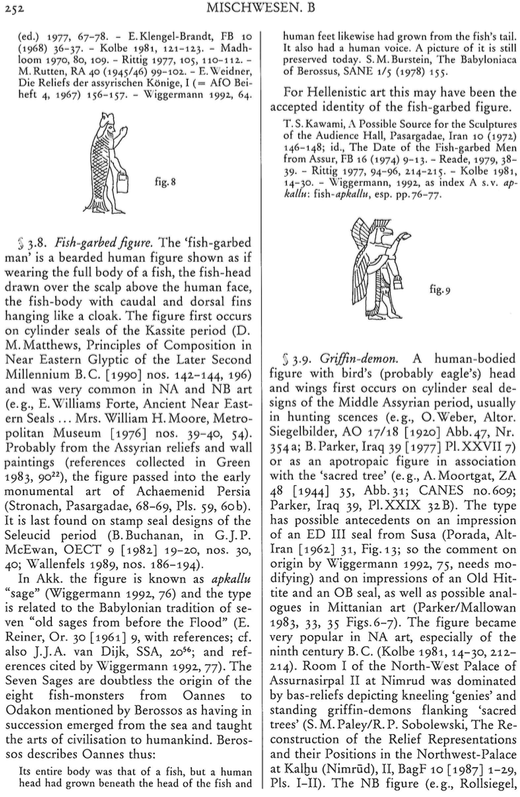
Excerpt from Anthony Green, "Mischwesen. B." (Fish-garbed figure). Reallexikon der Assyriologie, 1994, p. 252.

Excerpt from Anthony Green, “Mischwesen. B.” (Fish-garbed figure). Reallexikon der Assyriologie, 1994, p. 252.

Clay figurines of the apkallus are found at Ur. There is also no reason to think that these imaginations were esoteric, belonging to a limited class of scholars. Imaginations of the apkallus are not limited to a certain genre of literature, but appear in all sorts of written compositions and in a variety of practices and depictions.

(Cf. Rittig, Assyrisch-babylonische Kleinplastik, pp. 72, 83.)

When I first gathered and analyzed the sources to the apkallus preparing for my dissertation in 1984, later published in Roots of Apocalyptic in 1989, I concluded:

“The distinction between the group of seven sages and the group of four in Bīt Mēseri, and between apkallus and ummanus in W 20 030, 7, demonstrates a special way of interpreting history: the primeval history is “the history of revelation,” and the history which follows is the time when this revelation is transmitted and unfolded.”

(Kvanvig, Roots of Apocalyptic, p. 201.)

Parpola explicitly supported this argument in his edition of the Assyrian and Babylonian letters.

(Parpola, Letters from Assyrian and Babylonian Scholars, XVIII.)

The textual and iconographic basis for understanding this part of Assyrian and Babylonian mythology is now considerably widened. But this extension of the source material has not undermined the assumption in the quotation above, but has provided the opportunity to give a much more refined and comprehensive presentation of a fairly late development in Mesopotamian religion.

At the present it is difficult to draw a diachronic picture of the origin and development of the apkallu tradition. We find the oldest reference to the seven apkallus in Eridu in a Sumerian temple hymn, where the tablet is dated to the Old Babylonian period.

(Cf. A.W. Sjöberg and E. Bergmann, The Collection of the Sumerian Temple Hymns, New York, 1969, p. 25.)

The text is hard to interpret, but the context of the apkallus is both the apsû, the me, and Enki’s son Asarluhi. The time is about the same as the date of the Sumerian tablet with the Adapa Myth, Adapa also coming from Eridu. The fact that these two sources are Sumerian does not necessarily indicate that the concept of the apkallus in Eridu is older than the Old Babylonian period.

All the other sources come from the first millennium. The archeological evidence also points in the same direction; the depictions of apkallus in figurines, on cylinder seals and on reliefs start in the beginning of the first millennium.

Bird Apkallū and Fish Apkallū, the so-called purādu-fish, side by side. Apkallū statuettes of this design were buried in appropriate places in the home of a Babylonian exorcist. They were believed to have prophylactic qualities, guarding the home from evil.

Bird Apkallū and Fish Apkallū, the so-called purādu-fish, side by side. Apkallū statuettes of this design were buried in appropriate places in the home of a Babylonian exorcist. They were believed to have prophylactic qualities, guarding the home from evil.

The first textual witness from the first millennium might be the Poem of Erra. Here the apkallus are placed in the framework of primeval history. They were responsible for Marduk’s attire before the flood; they survived the flood and were sent back to the apsû after the flood.

This composition is held to be Babylonian. Thus it is not likely to regard the development of the apkallu tradition as simply an Assyrian matter. The pairing of kings and apkallus as found in the two Babylonian lists, Berossos and the Uruk tablet, seems to reflect the position of the ummanus at the royal courts also in Babylonia.

As shown, there existed a chronography pairing Assyrian kings and ummanus, which demonstrated their position in the first millennium. Thus the expansion of the apkallu tradition seems intimately connected to the increasing importance of the scholarly guilds, in their attempt to systemize and legitimize the lore of their professions from the beginning of the first millennium.”

Helge Kvanvig, Primeval History: Babylonian, Biblical, and Enochic: An Intertextual Reading, Brill, 2011, pp. 156-8.
Kvanvig: Earthly Counterparts of the Divine Watchers

“It is important to notice that the connection between the ummanus and the apkallus was not only imagined as a line of transmission, running from antediluvian time through history. The connection was not only horizontal, but also vertical.

When the ummanus participated in the “mouth washing” ritual of the divine statue, they acted on behalf of the apkallus, as we have seen it in the Poem of Erra. This implies that the apkallus were not only great figures of wisdom in the past; they were powerful transcendent forces in the present.

The maintenance of the divine statue was a necessary prerequisite for the upholding of the power of the king and the survival of the empire. In this role the earthly ummanus are called “the images” of the apkallus belonging to the divine realm; they are the representatives of these transcendent forces on earth.

We find the same imagination of the apkallus as acting transcendent forces in rituals directed against demons. This is evident both in the ritual texts themselves and in the practice accompanying them. In the rituals the apkallus were invoked to expel the demons.

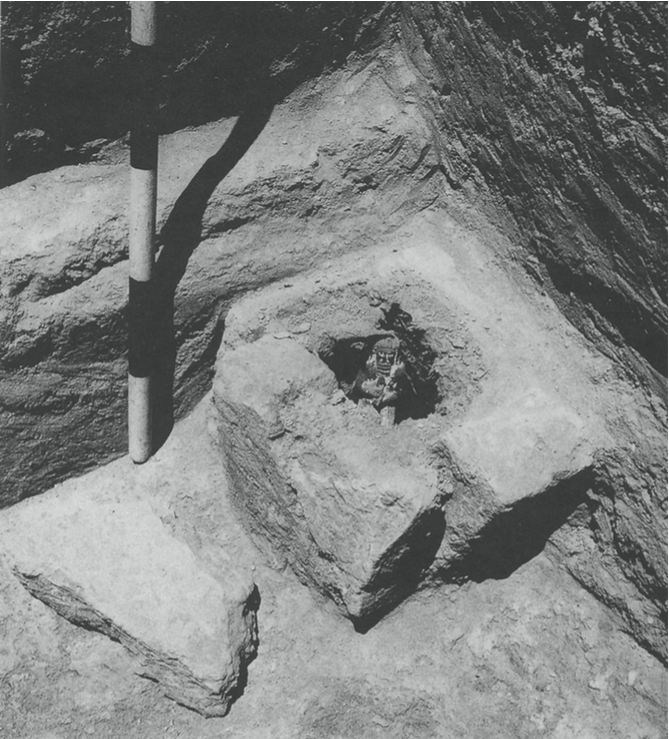
Apotropaic figurine deposit found in room S57 of Fort Shalmaneser at Nimrud. Adapted from Curtis and Read (1995:112).

Apotropaic figurine deposit found in room S57 of Fort Shalmaneser at Nimrud. Adapted from Curtis and Read (1995:112).

In the dedication of palaces and houses figurines of the apkallus were deposited in the foundation to protect the house against demonic attack. When a person became ill, representations of the apkallus were placed in the room to signify their active presence in the ritual to dispel the evil.

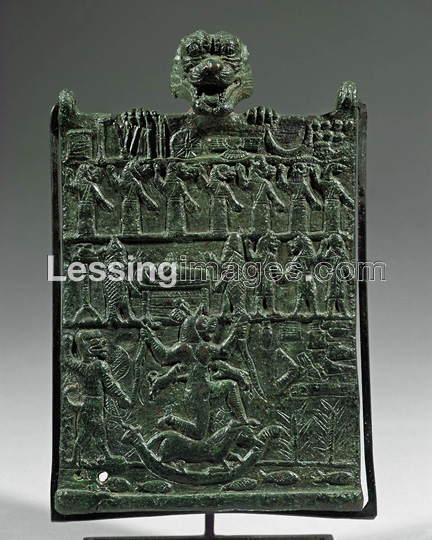
Their presence is even carved into an Assyrian bronze tablet, which shows the sick man lying on his bed with his hand raised toward heaven and the demon Lamaštu lurking just under his bed, the bed is surrounded not by āšipū; what these in reality represented were the apkallus.

This is the actual bronze frieze of the illustration above, held in the collection of the Louvre as AO 22205.

This is the actual bronze frieze of the illustration held in the collection of the Louvre as AO 22205. The Lessing imprint covers much of the middle register where the sick man is portrayed with his arm raised to heaven. In the left corner is the lamp of Nusku, illuminating the proceedings. Puradu-fish apkallu are at both ends of the bed conducting the ritual. The creatures of the Mesopotamian pandemonium on the right half of the register have apotropaic functions, banishing the demons of evil, which were considered the cause of illness. 

Also, this side of the belief in apkallus had political consequences. When the king had protected his palaces through proper rituals and deposed the figurines of the apkallus, he could make large images of them at the entrances and in the halls to tell both demons and enemies, that his kingdom was protected from any evil.

This combination of the apkallus as messengers from the gods, revealing the insight of heaven and earth to humans in antediluvian time, and guardians of the cosmic order, the political order, and the life and health of individuals, may seem difficult to combine.

But as we have underscored many times, there is a clear interconnection. For the ummanus, insight into the divine secrets was necessary in order to fulfill their role as watchers, both communicating with the gods and using magic to fight demons. In both cases the wisdom was revealed from the gods and written down in compositions.

Those who revealed this knowledge once in antediluvian time were the apkallus; those who were ultimately, invisibly present when this knowledge was practiced were the apkallus. But of course, those who visibly and actually had this role on the earth were the ummanus. In relation to the king they should watch his life and empire as the earthly counterparts of the watchers in the divine realm.”

Helge Kvanvig, Primeval History: Babylonian, Biblical, and Enochic: An Intertextual Reading, Brill, 2011, pp. 155-6.

Kvanvig: At the Brink of Legendary Time and Historical Time

“In Bīt Mēseri and Berossos, where there are narratives connected to the names, it is clear that the apkallus were those who brought humankind the basic wisdom needed to establish civilization. This is written out in a full story in Berossos; the same is referred to in Bīt Mēseri in the phrase “plans of heaven and earth.”

In both places the first apkallu Uan/Oannes is most prominent in this matter. They both concur with the D fragment of the Adapa Myth, where Adapa is given insight into the secrets of both heaven and earth, the whole of Anu’s domain.

We observe in the lists, however, that there is not only a division between the first group of seven apkallus and the subsequent sages / scholars; there is also continuity. This seems to be the whole idea of extending the list of seven with subsequent scholars. The subsequent scholars belong to a tradition going back to the antediluvian apkallus.

There are variations in how this is expressed. The system is most clear in the Uruk tablet, which changes the designation from apkallu, mostly reserved for sages before the flood, to ummanu, the self-designation of the scholars preserving their wisdom after the flood.

But there is a very interesting hint in Bīt Mēseri as well. Lu-Nanna, the last apkallu in the list after the flood, is two-thirds apkallu. Here there is clearly a second point of transition–we must presume this time from apkallus to scholars.

A stone bust of the King Šulgi (2094 BCE - 2047 BCE), possibly recovered from the ruins of Tello, ancient Girsu.  Third dynasty of Ur 2120 BCE.  Colecciones Burzaco © Jose Latova.  http://press.lacaixa.es/socialprojects/photo.html?noticia=17853&imagen=14

A stone bust of the King Šulgi (2094 BCE – 2047 BCE), possibly recovered from the ruins of Tello, ancient Girsu.
Third dynasty of Ur 2120 BCE.
Colecciones Burzaco © Jose Latova.
http://press.lacaixa.es/socialprojects/photo.html?noticia=17853&imagen=14

This is confirmed in another short notice about Lu-Nanna in Bīt Mēseri: he lived during the time of Šulgi. Here, when the power of the apkallus fades, we are for the first and only time in Bīt Mēseri placed in real history. Šulgi is attested as a historical king; he reigned during the third dynasty of Ur (2094-2047 BCE).

Thus, at the brink between legendary time and historical time comes the transition from the mythical and legendary apkallus to the historical ummanus.

This clear tendency in the lists is confirmed by several witnesses from Late Assyrian kings stretching down to the last Babylonian king Nabonidus. The witnesses both attest that there was a special quality connected to wisdom from before the flood, and that this was the wisdom brought to humankind through the apkallus.

The king needed access to this kind of “higher” wisdom, which included insight into the divine secrets, in order to reign. Those responsible for providing the king with this kind of wisdom were the ummanus attached to the royal court. The wisdom one brought to humankind by the apkallus accordingly had a political dimension.

The ummanus provided the king with the wisdom necessary to rule the empire. The myth about the transmission of divine wisdom became part of an imperial ideology.

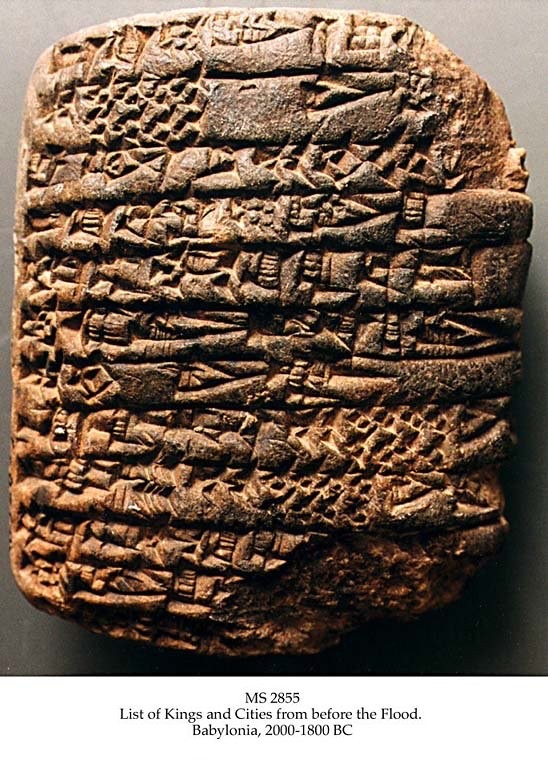
Text:  "IN ERIDU: ALULIM RULED AS KING 28,800 YEARS. ELALGAR RULED 43,200 YEARS. ERIDU WAS ABANDONED. KINGSHIP WAS TAKEN TO BAD-TIBIRA. AMMILU'ANNA THE KING RULED 36,000 YEARS. ENMEGALANNA RULED 28,800 YEARS. DUMUZI RULED 28,800 YEARS. BAD-TIBIRA WAS ABANDONED. KINGSHIP WAS TAKEN TO LARAK. EN-SIPA-ZI-ANNA RULED 13,800 YEARS. LARAK WAS ABANDONED. KINGSHIP WAS TAKEN TO SIPPAR. MEDURANKI RULED 7,200 YEARS. SIPPAR WAS ABANDONED. KINGSHIP WAS TAKEN TO SHURUPPAK. UBUR-TUTU RULED 36,000 YEARS. TOTAL: 8 KINGS, THEIR YEARS: 222,600" MS in Sumerian on clay, probably Larsa Babylonia, 2000-1800 BC, 1 tablet, 8,1x6,5x2,7 cm, single column, 26 lines in cuneiform script. 5 other copies of the Antediluvian king list are known only: MS 3175, 2 in Oxford: Ashmolean Museum, one is similar to this list, containing 10 kings and 6 cities, the other is a big clay cylinder of the Sumerian King List, on which the kings before the flood form the first section, and has the same 8 kings in the same 5 cities as the present.  A 4th copy is in Berkeley: Museum of the University of California, and is a school tablet. A 5th tablet, a small fragment, is in Istanbul. The list provides the beginnings of Sumerian and the world’s history as the Sumerians knew it. The cities listed were all very old sites, and the names of the kings are names of old types within Sumerian name-giving. Thus it is possible that correct traditions are contained, though the sequence given need not be correct. The city dynasties may have overlapped. It is generally held that the Antediluvian king list is reflected in Genesis 5, which lists the 10 patriarchs from Adam to Noah, all living from 365 years (Enoch) to 969 years (Methuselah), altogether 8,575 years.  It is possible that the 222,600 years of the king list reflects a more realistic understanding of the huge span of time from Creation to the Flood, and the lengths of the dynasties involved.  The first of the 5 cities mentioned , Eridu, is Uruk, in the area where the myths place the Garden of Eden, while the last city, Shuruppak, is the city of Ziusudra, the Sumerian Noah. Jöran Friberg: A remarkable Collection of Babylonian Mathematical Texts. Springer 2007.  Sources and Studies in the History of Mathematics and Physical Sciences.  Manuscripts in the Schøyen Collection, vol. 6, Cuneiform Texts I. pp. 237-241. Andrew George, ed.: Cuneiform Royal Inscriptions and Related Texts in the Schøyen Collection, Cornell University Studies in Assyriology and Sumerology, vol. 17,  Manuscripts in the Schøyen Collection, Cuneiform texts VI. CDL Press, Bethesda, MD, 2011, text 96, pp. 199-200, pls. LXXVIII-LXXIX. Andrew E. Hill & John H. Walton: A survey of the Old Testament, 3rd ed., Grand Rapids, Mi., Zondervan Publ. House, 2009, p. 206.  Zondervan Illustrated Bible, Backgrounds, Commentary. John H. Walton, gen. ed. Grand Rapids, Mich., Zondervan, 2009, vol 1, p. 482, vol. 5, p. 398. Babylonia 2000 - 1800 BC

Text:
“IN ERIDU: ALULIM RULED AS KING 28,800 YEARS. ELALGAR RULED 43,200 YEARS. ERIDU WAS ABANDONED. KINGSHIP WAS TAKEN TO BAD-TIBIRA. AMMILU’ANNA THE KING RULED 36,000 YEARS. ENMEGALANNA RULED 28,800 YEARS. DUMUZI RULED 28,800 YEARS. BAD-TIBIRA WAS ABANDONED. KINGSHIP WAS TAKEN TO LARAK. EN-SIPA-ZI-ANNA RULED 13,800 YEARS. LARAK WAS ABANDONED. KINGSHIP WAS TAKEN TO SIPPAR. MEDURANKI RULED 7,200 YEARS. SIPPAR WAS ABANDONED. KINGSHIP WAS TAKEN TO SHURUPPAK. UBUR-TUTU RULED 36,000 YEARS. TOTAL: 8 KINGS, THEIR YEARS: 222,600”
MS in Sumerian on clay, probably Larsa Babylonia, 2000-1800 BC, 1 tablet, 8,1×6,5×2,7 cm, single column, 26 lines in cuneiform script.
5 other copies of the Antediluvian king list are known only: MS 3175, 2 in Oxford: Ashmolean Museum, one is similar to this list, containing 10 kings and 6 cities, the other is a big clay cylinder of the Sumerian King List, on which the kings before the flood form the first section, and has the same 8 kings in the same 5 cities as the present.
A 4th copy is in Berkeley: Museum of the University of California, and is a school tablet. A 5th tablet, a small fragment, is in Istanbul.
The list provides the beginnings of Sumerian and the world’s history as the Sumerians knew it. The cities listed were all very old sites, and the names of the kings are names of old types within Sumerian name-giving. Thus it is possible that correct traditions are contained, though the sequence given need not be correct. The city dynasties may have overlapped.
It is generally held that the Antediluvian king list is reflected in Genesis 5, which lists the 10 patriarchs from Adam to Noah, all living from 365 years (Enoch) to 969 years (Methuselah), altogether 8,575 years.
It is possible that the 222,600 years of the king list reflects a more realistic understanding of the huge span of time from Creation to the Flood, and the lengths of the dynasties involved.
The first of the 5 cities mentioned, Eridu, is Uruk, in the area where the myths place the Garden of Eden, while the last city, Shuruppak, is the city of Ziusudra, the Sumerian Noah.
Jöran Friberg: A Remarkable Collection of Babylonian Mathematical Texts. Springer 2007.
Sources and Studies in the History of Mathematics and Physical Sciences.
Manuscripts in the Schøyen Collection, vol. 6, Cuneiform Texts I. pp. 237-241. Andrew George, ed.: Cuneiform Royal Inscriptions and Related Texts in the Schøyen Collection, Cornell University Studies in Assyriology and Sumerology, vol. 17,
Manuscripts in the Schøyen Collection, Cuneiform texts VI. CDL Press, Bethesda, MD, 2011, text 96, pp. 199-200, pls. LXXVIII-LXXIX.
Andrew E. Hill & John H. Walton: A Survey of the Old Testament, 3rd ed., Grand Rapids, MI., Zondervan Publishing House, 2009, p. 206.
Zondervan Illustrated Bible, Backgrounds, Commentary. John H. Walton, gen. ed. Grand Rapids, MI, Zondervan, 2009, vol 1, p. 482, vol. 5, p. 398.

This wisdom became in the course of the first millennium not only oral, but written. There are numerous examples of how especially compositions belonging to the secret lore of the ummanus were ascribed to the apkallus, above all to the first of them, Uanadapa.

Here we can observe the same chain of transmission as in the lists. There is a general tendency to ascribe compositions of high authority to Ea and to Adapa, or other apkallus, as the second link in the chain.

Moreover, there is a tendency to use a language of revelation in the transmission from Ea to Adapa. In a manner like Kabti-ilāni-Marduk the god “showed” the heavenly wisdom to Adapa, who wrote it down on tablets. Or, as in the case of Nabonidus, he was even wiser than Adapa, because the god had revealed to him the divine secrets.

This notion is in line with a broader tendency from the end of the second millennium, to date compositions back to the mythical primeval time, the time before the flood.”

Helge Kvanvig, Primeval History: Babylonian, Biblical, and Enochic: An Intertextual Reading, Brill, 2011, pp. 154-5.

Kvanvig: On the Correspondences Between Antediluvian Myths

“Here he works along two lines: on the one hand, he demonstrates how the succession in the chain of written composition in the first millennium is dominated by Eaapkallusummanus; on the other hand, he shows how the written lore of the ummanus was collected and systematized as a secret revelation belonging to this alleged chain of transmission.

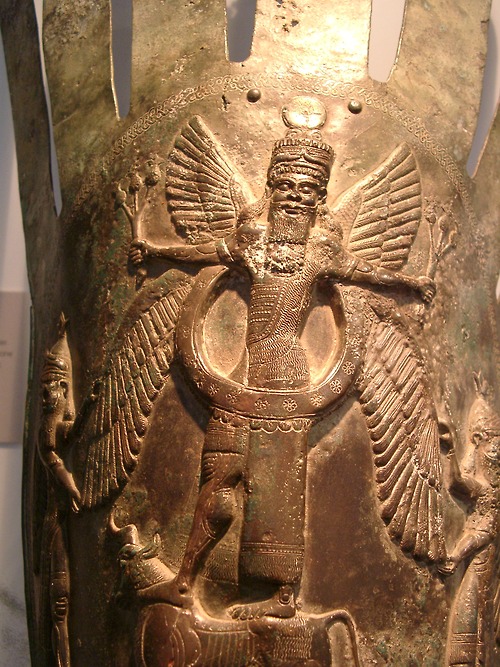
Apkallu type 3, illustration 36, Stephanie Dalley, IDD. Professor Dalley cites this illustration, number 36, for the apkallu standing at the flanks of a deity. In the first case, it is far from certain that the figure on the left of the central deity is an apkallu at all, as it lacks all indicators of divinity and most crucially, wings. This figure does raise what appears to be a mullilu cone in its right hand, and it does hold the usual banduddu bucket in his left hand, though it must be admitted that depictions of cones with leaves still attached are irregular. Unfortunately Professor Dalley does not identify the deity in the center of the illustration, though I am encouraged that she does consider it to be a deity, rather than an apkallu of high rank, which I will provisionally attempt to do. I have discussed elsewhere in captions to these illustrations the possibility that the deity at the center of this composition, which appears to adorn a necklace or breastplate, is the god Anu, who is allegedly never depicted in Mesopotamian iconography. The circular device at the apex of his crown, which is appropriately horned, is apparent in only one other example, a bronze face protector or frontal helmet. In that example, the circular device or disc is so worn that the lower portion of its mount mimics the inverted crescent of the Moon god Sin. The context is inappropriate for Sin, however, and it is more likely that the disc mount is simply worn from great age, with the circular portion along the top gone. In any case, a bird-headed type 3 Nisroc apkallu is on the right, with banduddu bucket in the left hand and an indistinct item in his raised right hand. It appears to be a mullilu cone, but with leaves or sprouting, as noted. As mentioned, the figure on the left side of the deity lacks wings, though it mimics the blessing gesture, cone and banduddu bucket of the right-side apkallu. The left side figure may not be an apkallu at all. Perhaps it is a priest. Or a human umu-apkallu. It lacks all symbols of divinity or semi-divinity. The central figure remains problematic for me, wearing a crown which reminds me of a depiction of the god Anu. The problem is that Assyriologists aver that no representations of Anu exist. Also significant for me, this figure, whether it is a deity or an apkallu, wears a large ring around the torso. My suspicion is that this ring would be decorated with rosettes, were sufficient detail available. This figure also holds a ring in his left hand, an item typically reserved for deities, while raising his right hand in the classical gesture of greeting.

Click to zoom. Apkallu type 3, illustration 36, Stephanie Dalley, IDD.
Professor Dalley cites this illustration, number 36, for the apkallu standing at the flanks of a deity. In the first case, it is far from certain that the figure on the left of the central deity is an apkallu at all, as it lacks all indicators of divinity and most crucially, wings. This figure does raise what appears to be a mullilu cone in its right hand, and it does hold the usual banduddu bucket in his left hand, though it must be admitted that depictions of cones with leaves still attached are irregular.
Unfortunately Professor Dalley does not identify the deity in the center of the illustration, though I am encouraged that she does consider it to be a deity, rather than an apkallu of high rank, which I will provisionally attempt to support.
I have discussed elsewhere in captions to these illustrations the possibility that the deity at the center of this composition, which appears to adorn a necklace or breastplate, is the god Anu, who is allegedly never depicted in Mesopotamian iconography.
The circular device at the apex of his crown, which is appropriately horned, is apparent in only one other example, a bronze face protector or frontal helmet, which is posted lower on this page.
In that example, the circular device or disc is so worn that the lower portion of its mount mimics the inverted crescent of the Moon god Sin.
The context is inappropriate for Sin, however, and it is more likely that the disc mount is simply worn from great age, with the circular portion along the top gone.
In any case, a bird-headed type 3 Nisroc apkallu is on the right, with banduddu bucket in the left hand and an indistinct item in his raised right hand. It appears to be a mullilu cone, but with leaves or sprouting, as noted.
As mentioned, the figure on the left side of the deity lacks wings, though it mimics the blessing gesture, cone and banduddu bucket of the right-side apkallu. The left side figure may not be an apkallu at all. Perhaps it is a priest. Or a human umu-apkallu. It lacks all symbols of divinity or semi-divinity.
The central figure remains problematic for me, wearing a crown which reminds me of a depiction of the god Anu. The problem is that Assyriologists aver that no representations of Anu exist.
Also significant for me, this figure, whether it is a deity or an apkallu, wears a large ring around the torso. My suspicion is that this ring would be decorated with rosettes, were sufficient detail available.
This figure also holds a ring in his left hand, an item typically reserved for deities, called a chaplet by Anthony Green and Jeremy Black, while raising his right hand in the classical gesture of greeting.

He admits that there are other voices, even in the first millennium, but this is the dominant tendency. One may object to Lenzi’s work, that he goes too far in his effort to systemize the material.

If influential ummanus first in Assyria and then in Late Babylonia saw it as a priority both to bring together their lore under specific rubrics, and to establish a theology of revelation and transmission, going back to one god, Ea, they had quite a task, given the vast variety in the material they inherited from the millennium before.

We think the most important aspect of Lenzi’s impressive detailed examination of the sources is that he manages to show that there was a strong tendency toward systematization. There was an attempt to bring together the lore of the different scholarly professions into series given distinctive labels: these compositions belong to the lore of this profession–bārûtu, āšipūtu, kalûtu, asûtu, tupšarrūtu.

There was also the clear tendency to claim compositions belonging to the lore of these professions as secrets revealed by the gods in antediluvian time and restricted to the ummanus in present time.

(Cf. also Francesca Rochberg, The Heavenly Writing: Divination, Horoscopy and Astronomy in Mesopotamian Culture, Cambridge, 2004, pp. 181-5.)

This design is perplexing. I am uncertain whether it depicts a human apkallū, an ummanu, or, as earlier analysts determined, the god Anu. The problem is that Assyriologists assert that Anu is never represented in illustrations or bas reliefs. The iconography is correct for an apkallū. The horned headdress is indicative of divinity, the plants held in both hands are not unprecedented, though they are not common. I believe that they are poppy bulbs. The rosette design in the large ring appears elsewhere in Neo-Assyrian symbolism, though its significance is undetermined. The large ring around the torso appears in the illustration above, as well. The wings on the figure are typical of an apkallu. The fact that the figure stands on a bull, however, suggests that this is a depiction of a deity, rather than a human apkallū. Further, the disc atop the headdress is problematic. In no other example does a human apkallū appear with a disc surmounting a horned headdress. The device at the top of the figure in the illustration above resembles this ring. Indeed, it is unclear whether the disc is just worn, or whether the lower part of the disc portrays the inverted horns of the Moon, indicative of the Moon god Sin. Or, it could just be a damaged ring, similar to the device above. This is one of the most dramatic examples of Neo-Assyrian art, but my scholarship is too meager to explicate it. http://transfixussednonmortuus.tumblr.com/image/32382020729

This design is perplexing. I am uncertain whether it depicts a human apkallū, an ummanu, or, as earlier analysts determined, the god Anu. The problem is that Assyriologists assert that Anu is never represented in illustrations or bas reliefs.
The iconography is correct for an apkallū. The horned headdress is indicative of divinity, the plants held in both hands are not unprecedented, though they are not common. I believe that they are poppy bulbs.
The rosette design in the large ring appears elsewhere in Neo-Assyrian symbolism, though its significance is undetermined. The large ring around the torso appears in the illustration above, as well.
The wings on the figure are typical of an apkallu, and indicative of divinity or semi-divinity.
The fact that the figure stands on a bull, however, suggests that this is a depiction of a deity, rather than a human apkallū. I would like to say that the bull is sacred to Anu, but Assyriologists insist that Anu is never depicted in Mesopotamian art. 
Further, the disc atop the headdress is problematic. In no other example does a human apkallū appear with a disc surmounting a horned headdress. The device at the top of the figure in the illustration above resembles this ring.
Indeed, it is unclear whether the disc is just worn, or whether the lower part of the disc portrays the inverted horns of the Moon, the “recumbent crescent,” as Black and Green describe it, indicative of the Moon god Sin. Or, it could just be a damaged ring, similar to the device above.
This is one of the most dramatic examples of Neo-Assyrian art, but my scholarship is too meager to explicate it.
http://transfixussednonmortuus.tumblr.com/image/32382020729

At the crucial point in this chain, we find the apkallus, above all Uanadapa, who were those who brought the divine knowledge to the humans.

The analyses carried out by van der Toorn and Lenzi are fully in accord with our own observations. There is a clear division between the first group of seven apkallus and subsequent sages and scholars in all three lists: Bīt Mēseri, Berossos, and the Uruk tablet.

They express this differently, but the tendency is clear. Bīt Mēseri lists seven apkallus “born in the river” and then four apkallus “of human descent.” Berossos lists seven apkallus before the flood and then one great scholar in the tenth generation after. The Uruk tablet lists seven apkallus before the flood, one afterwards, and continues with ummanus.

The antediluvian apkallus are closely connected to the divine realm, above all to the god Ea. “To be born in the river” means to be engendered in the abode of Ea. Oannes in Berosses (sic) goes to and fro the sea, the abode of Ea. But not only Ea is involved.

In our reading of the relationship between the Adapa Myth and Bīt Mēseri we found that the first apkallu, U-an, “the light of heaven” (An), was an echo of the fate of Adapa in the myth, fragment D, where Adapa is adopted sage by Anu.

This name of the first sage is reflected both in the Catalogue, in Berossos and on the Uruk tablet.”

Helge Kvanvig, Primeval History: Babylonian, Biblical, and Enochic: An Intertextual Reading, Brill, 2011, pp. 153-4.